10 B2B SaaS Ideas Worth Validating in 2026
Explore 10 B2B SaaS ideas with target buyers, monetization angles, and validation tips for 2026. Test each one with real buyers before you write code.
The most popular advice about B2B SaaS ideas is to find a huge market, add AI, and build something better than the incumbents. That's a reliable way to spend months developing software without knowing who can authorize the purchase. Most ideas fail before the first line of code because the founder hasn't identified a painful workflow, a budget owner, and a reason to switch.
Market size won't solve that problem. Grand View Research projects the B2B SaaS market will reach $434.4 billion in 2026, but a large category doesn't prove demand for your particular product. A finance manager trying to enforce spending controls for growing software companies buys control over actual purchases, not exposure to a growing market.
The categories below address established business workflows. Your opportunity is narrower: a particular buyer, an expensive exception, or an integration that existing tools handle poorly.
Start with the purchase: A credible prospect can explain what happens today, why it's unacceptable, and whose budget would fund the replacement.
Each idea includes a practical validation test and a monetization approach. Don't treat familiar competitors as evidence that your version will sell. Treat them as alternatives your buyer already has, then test why that buyer would choose you.
1. Revenue Intelligence and Conversation Analytics
A sales manager doesn't need another dashboard saying the pipeline looks healthy. They need to know whether a buyer has agreed to a next step, whether procurement has appeared, and whether the account has an internal champion.
Revenue intelligence products connect calls, emails, and CRM records to make those signals inspectable. Gong and Clari are useful reference points, but competing across their entire scope would require substantial integration and distribution work. Start with a decision a manager makes repeatedly, such as which deals need intervention before a forecast review.
Validate a Decision, Not a Transcript
With permission, analyze a prospect's existing call recordings alongside the associated CRM opportunities. Produce a deal-review brief containing buyer commitments, unresolved objections, and supporting excerpts, then ask the manager to use it during an actual pipeline meeting.
- Buyer and budget: Target a sales leader with sales-operations or enablement spending authority. Confirm whether revenue operations must approve integrations.
- Validation signal: Ask for a paid continuation after the manager uses the brief. Praise for transcript quality isn't evidence that they'll change their workflow.
- Monetization: Charge by participating sales team or analyzed account, with higher tiers for CRM writeback and manager reporting.
For example, an agency selling retainers could use the product to flag proposals where nobody discussed approval authority. Put the finding inside the CRM rather than requiring representatives to maintain another workspace.
Recording notices, access restrictions, and retention controls belong in the initial product. The trade-off is straightforward: deeper visibility can improve coaching, but employees and customers need clear boundaries around recording and analysis.
2. AI-Powered Customer Support Automation
Say a software customer asks why their invoice changed after adding colleagues. A useful support assistant retrieves the account's billing context, explains the change from approved documentation, and hands the conversation to an agent when the facts don't line up.
That's a stronger starting point than a chatbot trained on every document the company owns. In the 2025 NFIB technology survey, 24% of U.S. small-business owners reported currently using AI for business activities. Don't assume your buyer already knows how to configure or supervise it.

Sell Reliable Resolution
Intercom's Fin, Zendesk, Ada, and Forethought give buyers existing alternatives. A new entrant needs a narrower advantage, such as support for specialized equipment distributors or account-aware answers for a particular billing system.
Validate in shadow mode. Generate draft replies for historical and incoming tickets without sending them automatically. Have the support lead mark factual errors, missing context, and cases that require escalation.
The buyer is usually the head of support or an owner managing support payroll. Ask them to fund a supervised pilot from that budget, and compare agent effort, reopened cases, and customer feedback rather than counting deflected conversations alone.
A platform fee plus charges for confirmed resolutions can align pricing with value. Define resolution carefully, including a reopen policy, and keep an obvious human handoff. If customers must fight the bot to reach an agent, you've shifted work rather than removed it.
3. Usage-Based Billing and Monetization Infrastructure
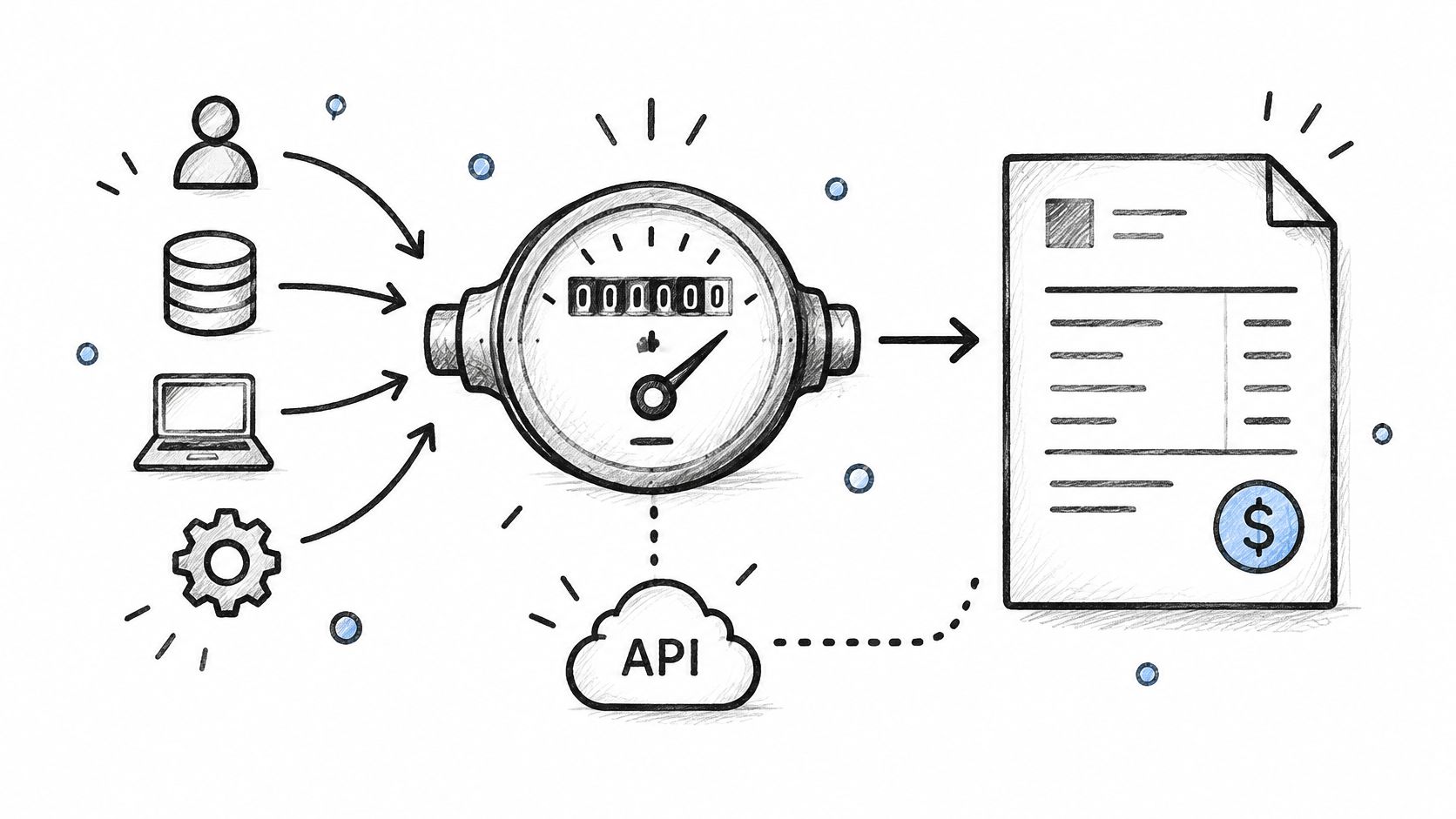
Billing software becomes valuable when customers dispute charges and engineers can't reconstruct the calculation. For an API company, the hard part isn't displaying an invoice. It's explaining which events produced each charge under the correct contract.
Stripe Billing, Chargebee, Orb, and Lago offer useful reference points. A focused entrant could handle contract-specific allowances, usage reconciliation, or billing explanations for a particular class of API product rather than replace the payment stack.
Prove the Numbers Before Moving Money
Run a parallel billing test. Take historical usage events and contract terms, reproduce the customer's invoices, and investigate discrepancies with finance and engineering. Don't request control of production invoicing before you can explain the existing bills.
- Buyer and budget: The finance lead owns invoicing accuracy, while engineering controls implementation. Identify which department funds the purchase.
- Worked use case: An AI document-processing vendor needs to distinguish failed requests, billable pages, and contract allowances without maintaining custom invoice scripts.
- Monetization: Combine a platform subscription with metered event processing, but offer predictable limits so customers can budget.
Your business model strategy should account for the cost of processing and retaining usage records. Charging a share of customer revenue may create friction when buyers see the product as infrastructure.
Build idempotent ingestion, event replay, versioned pricing, and visible audit trails early. Open-source metering can help buyers inspect the mechanism, but it also creates maintenance obligations. Integrating with the existing payment processor is usually an easier initial sale than demanding a migration.
4. Automated Compliance and Security Certification
The most useful compliance product helps someone finish the work. Collecting cloud configuration evidence matters, but a small software company also needs to assign remediation, review access, and answer a customer's security questionnaire.
The 2025 Verizon small-business survey found that 47% of SMBs invested in cybersecurity technology during the prior year. That establishes spending activity, not an invitation to build another alert-heavy dashboard.

Validate Against a Live Customer Requirement
Ask a founder, security lead, or operations manager to bring a real customer questionnaire or audit-preparation backlog. Manually gather evidence, identify missing owners, and create an approval-ready response pack before building integrations.
Vanta, Drata, and Secureframe are established alternatives. Your wedge might be access-review execution for agencies or evidence collection for software vendors using a particular infrastructure stack.
Sell completed security work and usable evidence, not a promise that installing software makes a company compliant.
The paid test is whether the buyer funds continued evidence maintenance after the immediate questionnaire is complete. If they only want temporary help, you may have found a service business rather than recurring software demand.
Charge a subscription for ongoing monitoring and evidence workflows, with implementation separately scoped. Keep independent audit fees distinct, and avoid conflating an assurance report, a certification, and obligations under privacy or healthcare rules.
For example, a SaaS vendor could use the product to assign access-review exceptions to managers and publish approved evidence in a trust center. The budget may sit with security, operations, or the founder, especially when a customer deal is blocked.
5. Corporate Spend Management and Corporate Cards
Don't start by issuing cards. Start with the finance task that remains painful even when employees already have them: assigning owners, enforcing purchase policies, collecting receipts, or checking renewals against approved budgets.
Ramp and Brex illustrate the breadth of the category. A new founder can avoid competing across that breadth by serving agencies that allocate spending to clients or software businesses that need project-level ownership.
Organizations' actual cloud spending exceeded budgets by 17%, according to Flexera's 2025 State of the Cloud Report. That's evidence for investigating infrastructure-spend control, not a claim about every company's card expenses.
Test Control Before Building Financial Infrastructure
For an agency, import transaction exports and map purchases to clients, owners, and approval policies. Return an exception queue that the finance manager can use during reconciliation.
- Buyer and budget: Sell to a controller or finance lead through the finance-software budget. Employees who submit expenses aren't usually the economic buyer.
- Validation test: Charge for a reconciliation pilot and ask whether the buyer will provide ongoing feeds and assign policy owners.
- Monetization: Begin with a software subscription for approvals, allocations, and accounting sync. Card revenue requires issuing relationships and economics you shouldn't assume.
The trade-off is control versus interruption. Automatically blocking an unauthorized purchase can help, but blocking an urgent production expense can create a larger problem.
Make policy exceptions explicit, time-bound, and auditable. Integrate with the customer's accounting system early, and preserve their chart of accounts rather than forcing finance to repair your categorizations at month-end.
6. Incident Management and Developer Observability
An engineering team can already have monitoring and still struggle during an outage. Alerts arrive without ownership, responders duplicate investigation, and nobody records why a rollback was chosen.
PagerDuty and incident.io are useful reference products. A focused startup could coordinate incidents for teams using a particular deployment stack or reduce duplicate alerts before they reach an on-call engineer.

Start Beside the Existing Pager
Don't ask a team to trust an unproven product with its only emergency notification path. Validate in parallel by ingesting historical alerts and running a supervised incident drill with current responders.
For example, correlate deployment events with related application alerts, suggest the service owner, and draft an incident timeline in Slack. Ask engineers whether the grouping preserved important distinctions or hid separate failures.
The buyer is typically an engineering manager, platform lead, or reliability leader with developer-tooling budget. A paid pilot should require them to configure real ownership rules and review incident output, not merely connect a sandbox.
As you compare business opportunity ideas, distinguish urgent operational work from reporting that people can postpone. Incident routing has urgency, but it also carries demanding reliability expectations.
Charge by responding team, service coverage, or responder seats. Avoid a model that makes customers worry that receiving more alerts will unexpectedly increase their bill.
The product itself needs fallback delivery, escalation testing, and clear failure states. A polished post-incident summary won't compensate for a missed page.
7. Product Onboarding and Adoption Platform
A user finishing a tour hasn't necessarily received value. For an analytics product, activation might mean connecting a data source and sharing a useful report, not clicking through tooltips.
Userpilot's analysis of SaaS product metrics reports an average activation rate of 37.5% across an analysis of 547 SaaS companies. Treat that as a reason to investigate activation, not as a universal target for unrelated products.
The practical work starts with a defined user outcome and event instrumentation.
Sell Progress Through a Workflow
Appcues, Userpilot, and WalkMe provide reference points. A narrower product could guide account administrators through integrations and permissions, rather than add generic tours to every screen.
- Buyer and budget: Target product growth or customer success, then establish who owns activation and can authorize software spending.
- Validation test: Manually implement contextual guidance for a blocked workflow. Compare eligible users who receive it with a suitable control group.
- Monetization: Charge by active users or customer accounts, with advanced segmentation and experimentation in higher tiers.
Say a project-management tool loses new workspace owners before they invite colleagues. Test an invitation prompt triggered after creating a project, rather than showing the same introductory tour to everyone.
Measure the business event, not checklist completion. Also check whether guidance creates support requests or slows experienced users.
The implementation trade-off matters: a visual editor is convenient, but fragile selectors can break when the application changes. Stable event hooks and a developer-friendly integration may win more trust than promising that engineering will never be needed.
8. Accounts Payable Automation
An invoice reaches a shared inbox, but nobody knows which manager requested the purchase. Extracting the invoice total won't fix the approval problem.
Accounts payable automation should connect document capture, ownership, approval, accounting entries, and payment status. Bill.com, Tipalti, and Stampli offer different reference points; AP automation picks from Loopfour can help buyers frame a comparison, but your validation should use their actual invoices.
Find the Exception Finance Keeps Chasing
A useful entry point is a company whose invoices require project codes or approvals from distributed department heads. Integrate with its accounting system and handle that workflow well before expanding payment coverage.
Use concrete pain points examples to distinguish extraction work from approval delays, missing purchase orders, and vendor-detail changes. Those problems need different product features.
Validate with a supervised invoice batch. Process documents alongside the existing workflow, record corrections, and show the controller exactly where a human must intervene.
Keep payment authority separate: Extracting an invoice is not permission to change vendor bank details or release funds.
The buyer is the controller, AP manager, or finance director, using finance-operations budget. Ask for a paid pilot tied to a live close or approval cycle, then assess whether the team wants ongoing access.
Monetize through a subscription with invoice-volume bands and separately scoped implementation. Avoid relying on payment revenue until the underlying payment relationships are established.
For example, a property-services business might need invoices allocated to locations before approval. The value is a traceable accounting entry and a resolved exception, not merely a confident-looking extraction result.
9. AI-Assisted Recruiting and Applicant Tracking
Recruiting software can save coordination work without pretending to determine who deserves a job. Scheduling, interview preparation, candidate communication, and evidence-linked summaries are more defensible starting points than automatic rejection.
Greenhouse, Lever, and Ashby give buyers established options. Replacing an entire applicant tracking system is a difficult initial sale, so consider an add-on for recruiting teams coordinating interviews across busy hiring managers.
A discussion of AI recruitment software risks and adoption belongs in buyer evaluation, but the product also needs concrete controls: restricted access, reviewable outputs, and a record of human decisions.
Test Administrative Value Without Ranking Candidates
Use a supervised workflow to draft interview briefs from approved materials and coordinate calendars. For example, a recruiting operations manager could review a candidate summary with links to the underlying application before sharing it with interviewers.
- Buyer and budget: Recruiting operations or the head of talent may own the recruiting-software budget. Involve HR and security before handling live candidate records.
- Validation signal: Seek payment for continued scheduling or briefing support, along with permission to integrate into the existing workflow.
- Monetization: Charge by recruiter seat or active hiring workload rather than rewarding automatic rejection volume.
Keep humans responsible for selection decisions. A generated summary should distinguish documented experience from an inference, and reviewers should be able to correct it.
The trade-off is speed versus review burden. If recruiters must reconstruct every summary to trust it, you haven't removed work. Start with tasks whose accuracy they can inspect quickly, and avoid collecting candidate information the workflow doesn't require.
10. Reverse ETL and Data Activation
A customer success manager needs to know which accounts stopped using a critical feature. The warehouse may contain that information, but it's useless to the manager until it appears in the CRM with a clear action.
Reverse ETL moves modeled warehouse data into operational systems. Hightouch and Census are useful category reference points, while Segment is relevant to the broader customer-data ecosystem.
Don't sell data movement alone. Sell a maintained operational workflow, such as routing accounts with stalled adoption to the correct customer success owner.
Validate the Action at the Destination
Start with a company that already has a warehouse and someone responsible for its data models. Manually export an approved account segment into a CRM sandbox, then have the business team use it to prioritize work.
Ask whether the fields changed an actual decision. If the team only admires the dashboard, you haven't validated activation.
- Buyer and budget: The data lead may control infrastructure spending, but revenue operations or marketing operations must own the destination workflow.
- Validation test: Secure a paid pilot that includes field ownership, sync rules, and an operational user responsible for acting on the output.
- Monetization: Charge for maintained destinations, active workflows, or sync capacity, with clear treatment of retries and backfills.
A narrow CRM integration still needs identity matching, field mapping, permissions, and failure alerts. Show when a record last synced and why a write failed.
The difficult trade-off is flexibility versus support cost. Every destination's schema and API behavior can create maintenance work. Start with a constrained use case and reusable templates rather than promising to connect every warehouse to every business application.
How the 10 B2B SaaS ideas compare by buyer, pricing, and established players
| Item | Target Market | Pricing Model | Notable Players |
|---|---|---|---|
| Revenue Intelligence and Conversation Analytics | Mid-market and enterprise sales organizations with 20 or more reps | Per-seat annual subscription, often with enterprise platform fees | Gong, ZoomInfo (Chorus), Clari |
| AI-Powered Customer Support Automation | SaaS companies, e-commerce brands, and service businesses with high ticket volume | Per resolution or per seat, plus platform fees | Intercom, Zendesk, Ada, Forethought |
| Usage-Based Billing and Monetization Infrastructure | API companies, AI product teams, and SaaS businesses with consumption pricing | Percentage of billed revenue or platform subscription tiers | Stripe, Chargebee, Orb, Lago |
| Automated Compliance and Security Certification | Early and growth-stage B2B SaaS companies selling to enterprises | Annual subscription based on company size or number of integrations | Vanta, Drata, Secureframe |
| Corporate Spend Management and Corporate Cards | Startups, growth-stage companies, and mid-market finance teams | Free or low-cost software tiers with interchange revenue and premium subscriptions | Ramp, Brex, Divvy |
| Incident Management and Developer Observability | Engineering, DevOps, and SRE teams at software companies | Per-user monthly subscription with tiered feature sets | PagerDuty, Atlassian (Opsgenie), incident.io |
| Product Onboarding and Adoption Platform | SaaS product, growth, and customer success teams | Subscription based on monthly active users or tracked profiles | WalkMe, SAP, Appcues, Userpilot |
| Accounts Payable Automation | Small and midsize businesses and finance teams in growing companies | Per-user subscription plus transaction or payment fees | Bill.com, Tipalti, Stampli |
| AI-Assisted Recruiting and Applicant Tracking | Recruiting teams at growing companies and staffing firms | Per-seat annual subscription with tiered enterprise plans | Greenhouse, Lever, Ashby |
| Reverse ETL and Data Activation | Data teams and revenue operations teams at growth-stage and enterprise companies | Usage-based pricing tied to synced rows or monthly active records, plus platform tiers | Hightouch, Census, Segment (Twilio) |
Pick One Idea and Prove Demand Before You Build
The strongest B2B SaaS idea is usually the one where you understand the buyer's work well enough to challenge your own assumptions. Familiarity with a category helps, but access to a budget owner and a live workflow matters more than enthusiasm for the technology.
Write the problem in a sentence with a real buyer in mind. A controller can't close the books because department heads haven't assigned invoice codes is sharper than finance teams need automation. The sharper version tells you whom to contact, what documents to request, and what a useful prototype must accomplish.
Ask for a Commitment That Costs Something
Interview strangers who currently perform or manage the work. Ask them to walk through the most recent occurrence, show the workaround, and explain who approved spending on the current solution.
A prospect sharing operational records, introducing the budget owner, or paying for a supervised pilot is giving you stronger evidence than someone joining a free waitlist. Keep the pilot scope explicit, particularly when handling recordings, candidate records, financial information, or production alerts.
A paid manual pilot proves interest in an outcome. It doesn't automatically prove demand for a repeatable software subscription.
Confirm that the buyer wants software rather than outsourced labor or a one-time cleanup. Ask what must keep happening after the initial problem is resolved, who will operate the product, and whether they'll tolerate recurring billing.
Test the Commercial Model Alongside the Product
Choose a charging unit the buyer can understand and forecast. Support resolution, active hiring workload, monitored services, and processed invoices each create different incentives, so test the unit before building pricing infrastructure around it.
Our SaaS validation process uses a landing page with Stripe checkout for a paid waitlist and $50–$150 in paid ads, with 10 strangers paying anything inside 14 days as a validation signal. That's a useful early commercial test, not a substitute for security review, integration feasibility, or a budget owner's commitment in a complex enterprise sale.
If buyers refuse payment, determine whether the problem lacks urgency, the offer lacks credibility, or the proposed delivery doesn't fit their workflow. Don't answer every objection by adding features.
Choose a category, name the buyer, and offer a narrowly scoped result before committing to a full build. Your next milestone should be a credible purchase decision and a workable delivery path, not a larger backlog.
We curate startup ideas from real Hacker News and Reddit pain points, including B2B SaaS, AI, and developer tools. Visit Find Startup Idea to browse candidates, save the ideas you'd put your name on, and generate a launch prompt for the opportunity you want to validate.