Business Model Strategy: The Startup Survival Blueprint
Learn how business model strategy connects to startup survival. Discover the models, trade-offs, and frameworks that turn ideas into viable ventures.
51% of the startups examined in a 2021 peer-reviewed analysis failed because their business model didn't work. That's why a good idea alone doesn't survive, the venture has to create value, deliver it repeatably, and capture revenue in a way the business can sustain.
Table of Contents
- Why Business Model Strategy Matters for Survival
- The Three Core Components of a Business Model
- Novelty Versus Efficiency in Strategic Design
- Common Business Model Patterns and Trade-offs
- The Hidden Implementation Gap
- A Decision Framework for Model Selection
- Testing Your Business Model Before Scaling
Why Business Model Strategy Matters for Survival
A founder can have a sharp product concept, a clear customer pain point, and still build a business that collapses under its own economics. The idea is rarely what kills the venture. The operating logic behind it is. In startup terms, business model strategy is the bridge between “people want this” and “we can keep selling this without bleeding cash.”

A 2021 peer-reviewed analysis of startup business models found that approximately 51% of the examined startups failed because of a non-functional business model (MDPI). That number changes how you should think about early-stage risk. Founders coming out of accelerator demo days often assume the main challenge is proving demand. In practice, the harder test is whether the company can deliver that value repeatedly, at a cost structure that leaves room to survive.
The part founders underestimate
A concept can win praise in a pitch meeting and still be strategically weak if acquisition is too expensive or delivery cannot be reproduced profitably. I have seen teams get excited by early interest, then discover that each new customer adds more operational drag than the last. The venture looks alive, but the economics are already working against it.
Practical rule: If you can't explain how the venture earns money, how it delivers value, and why that delivery is sustainable, you don't yet have a business model, you have a hypothesis.
That is why a business model should not be treated like a deck written after product development. It should be treated as an operating hypothesis tested alongside demand. The best founders do not stop at “Will people like this?” They also ask whether the unit economics still make sense after the first wave of enthusiasm fades.
A useful way to pressure-test that question is to model the work before it gets heavy. If service, sales, onboarding, or fulfillment depend on capabilities the team does not yet have, the venture may be too fragile to scale. What looks like product-market fit can still fail if the delivery system and the pricing model do not support each other.
If you want a shorthand for survival, use this: product demand gets attention, but business model strategy decides whether that attention turns into a company. That difference separates a promising hobby from a venture that can endure.
The Three Core Components of a Business Model
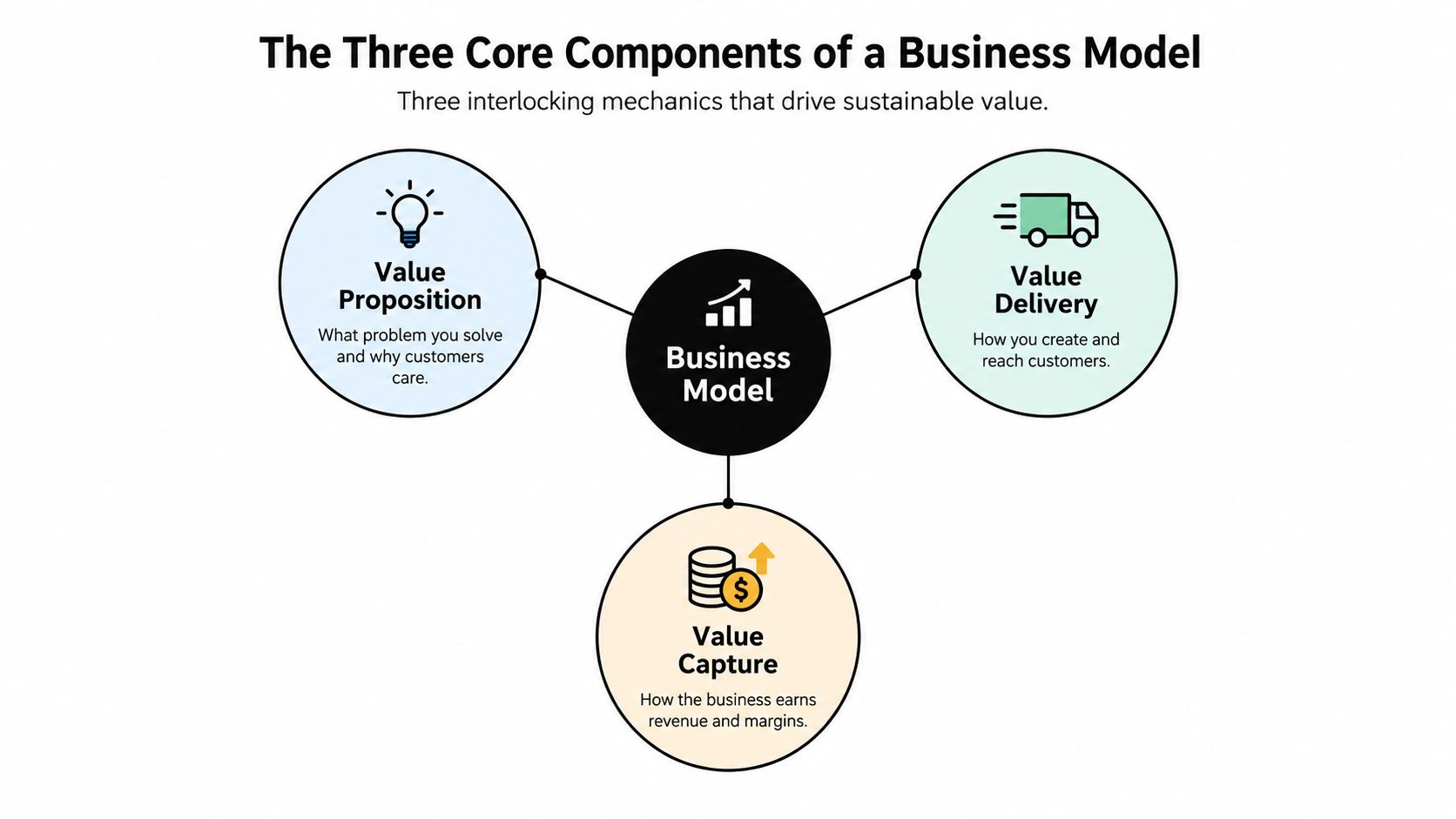
A business model only works when three mechanics hold together, value creation, value delivery, and value capture. If one slips, the venture becomes fragile. A team can solve a real problem and still lose money if it cannot deliver the solution consistently or charge in a way that supports the rest of the business.
Value creation
Value creation starts with the problem you solve and why a customer cares. Many teams stop here too early. A strong value proposition clearly defines the customer, the pain being removed, and why your answer is better than the default alternative.
Value delivery
Delivery is where strategy meets operations. It depends on channels, people, partners, systems, and service processes that let customers receive the value you promised. I have seen ideas look attractive on paper and then break in execution because the delivery path required capabilities the team did not yet have.
Value capture
Capture is how the business earns revenue and protects margin. Pricing, billing, packaging, and contract structure all shape that outcome. If value capture is misaligned, the business can grow in usage while weakening financially.
Customer discovery tests the first component before too much money goes into the other two, and customer discovery interviews are one practical way to do that well. The mistake is treating customer discovery as enough on its own. It is not.
A model is coherent only when customers want the outcome, the company can deliver it repeatedly, and the money left over makes the effort worth continuing.
The fastest way to assess your own model is to find the weak link. If creation is strong but delivery is messy, fix operations. If delivery works but margins are thin, redesign pricing. If capture is healthy but the customer problem is vague, return to the market. Business model strategy is the alignment of those three mechanics.
Novelty Versus Efficiency in Strategic Design
Some business models win by being novel, others by being efficient. The distinction matters because each one creates performance through a different mechanism. Research on 282 Chinese high-tech firms found that novelty-centered business-model design was positively associated with innovation performance, while efficiency-centered design worked indirectly through incremental innovation capability (RePEc).
When novelty is the better bet
Novelty fits markets that are shifting quickly and where buyers are still open to new ways of solving the same problem. A startup might bundle services into a subscription while competitors still sell each item separately, or it might change who pays, when they pay, or what is included in the offer. Aim for meaningful difference rather than novelty for its own sake.
When efficiency wins
Efficiency is the stronger choice in stable, predictable markets where buyers already understand the category. The edge comes from lower delivery cost, smoother operations, and easier repeatability. In those settings, being the cheapest to run or the easiest to scale can matter more than introducing a new transaction pattern.
A practical example is a logistics-heavy service in a mature category. If the market already understands the offer, the better model may be the one that reduces fulfillment cost, simplifies billing, and keeps margins intact under pressure. By contrast, a subscription bundle in a turbulent market may need more experimentation with packaging and timing to stay relevant as buyer needs change.
Strategic match matters: novelty fits turbulent markets, efficiency fits stable ones.
Founders get caught between these two logics. They spend months perfecting unit economics before they know whether the market even values the new structure. Or they chase novelty in a market that mainly rewards dependable execution. Both mistakes are expensive.
Choose the axis that matches the environment. If the market is unsettled, prioritize differentiation, new channels, or unconventional packaging. If the category is mature, prioritize repeatability, lower cost to serve, and process discipline. Business model strategy works best when the model fits the market instead of fighting it.
Common Business Model Patterns and Trade-offs
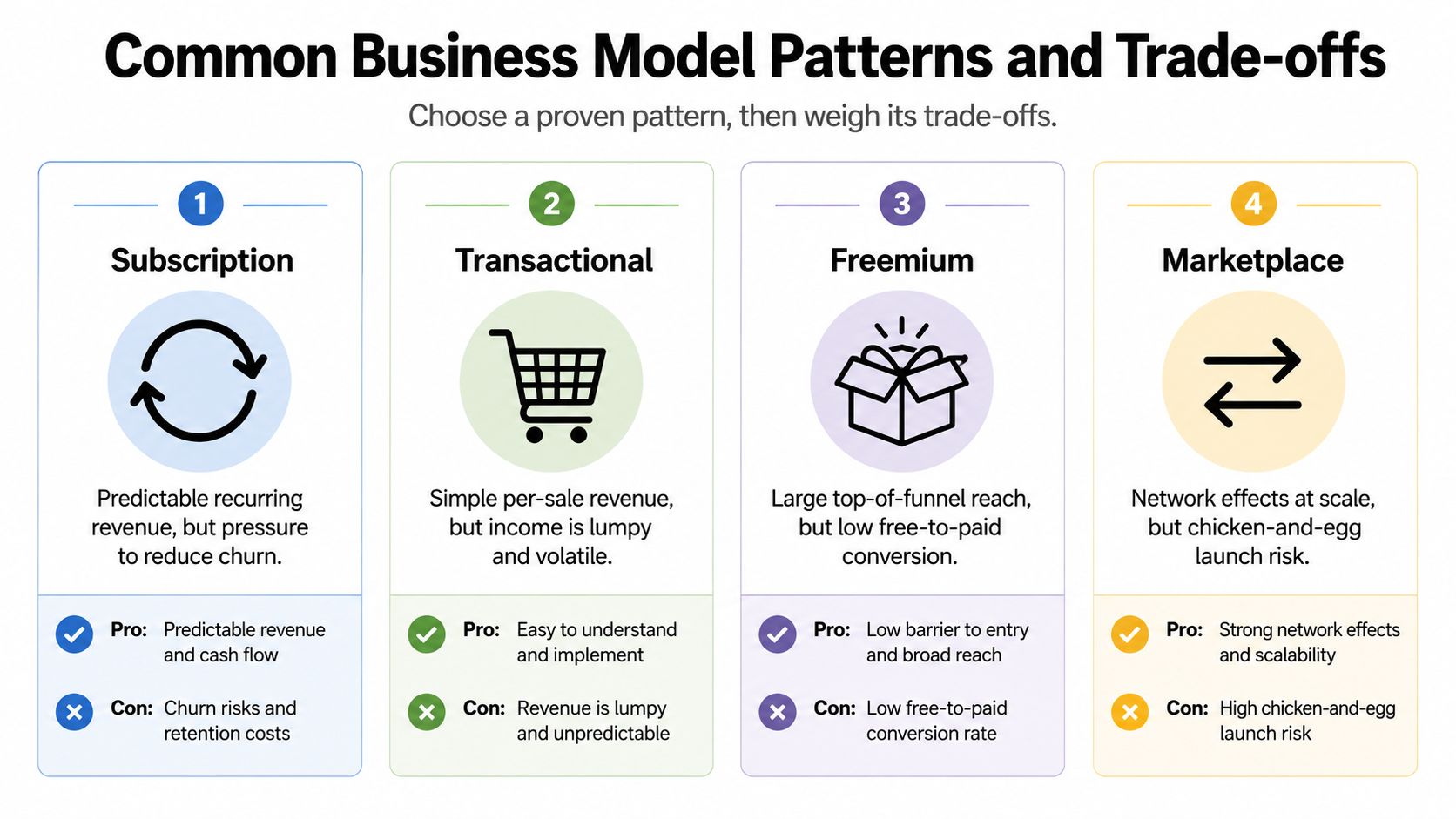
A business model is not a single idea. It is a set of economic choices, and founders usually work from patterns that already exist, then adapt them to their market. Subscription, transactional, freemium, marketplace, and platform models each solve a different problem, and each one creates a different operational burden. The fit between pattern and market matters more than the label.
Subscription and transactional models
Subscription models work when the product keeps earning its place after the first sale. Recurring revenue looks attractive, but only if onboarding is strong and retention work is built into the operating rhythm. If customers drift away, the model turns fragile fast.
Transactional models are easier to explain and often easier to launch. Revenue can be lumpier, forecasting is harder, and every sale has to carry more of the business on its back. That can be fine in a market with clear buying intent and short decision cycles.
Freemium and marketplace models
Freemium can widen awareness quickly, but the conversion path becomes the pressure point. Free users create reach, yet they also create cost, so the paid offer has to be specific enough to justify the switch.
Marketplace models can scale well once liquidity is there. Before that, they are hard to launch because both sides need a clear reason to participate at the same time. Many founders underestimate how much coordination that requires.
The trade-off is simple. Wider access usually raises complexity.
What the evidence says
Peer-reviewed research on 264 manufacturing SMEs found that changes in value creation, value proposition, or value capture had a positive and statistically significant relationship with firm performance (MDPI). That supports a practical point founders often learn the hard way: the model itself changes outcomes, not just the product wrapped inside it.
Pricing decisions also have to match the delivery burden. The AdManage.ai partnership program ties partner payouts to service economics, which is a direct example of pricing distribution into the model instead of treating it as an afterthought. In service-heavy businesses, that kind of structure shapes margin, support load, and partner behavior at the same time.
SignalZen's AI customer support pricing is another reminder that recurring service layers need a pricing logic that fits the workload, not just the pitch.
Simple models are easier to execute, but they can blur into the crowd. More ambitious patterns can create sharper differentiation, but they also raise the operational load on the team. There is no universal winner. The right choice is the model that fits your product, your channel, and the economics your team can actually deliver.
The Hidden Implementation Gap
A business model can look sound on paper and still fail in practice. The gap usually appears after the concept is defined, when the company discovers that delivery, coordination, and control all have to change for the model to work.
Research on 26 business model innovations found 10 failures and 16 successes, with outcomes tied to organizational fit, implementation complexity, and management commitment (MIT Sloan Review). Founders should read that as a direct warning. A more novel model is only valuable if the organization can carry it through real operating conditions.
Where execution breaks
The break usually comes from hidden costs. Teams underestimate delivery effort, overlook capability gaps, or assume people will absorb a new workflow without friction. Other times the model depends on partner coordination, service consistency, or risk controls the company does not yet have.
The difference between a business model and an operating model matters here, and the business model vs operating model guide explains that split clearly. The business model defines how value and money move. The operating model defines who does the work, with what tools, and under what controls. Mixing them creates confidence without readiness.
What readiness looks like
Before scaling, ask what must be true inside the company for the model to work. Identify the first dependency likely to fail. Set a clear point where the experiment should stop rather than keep spending cash. Those questions are uncomfortable, but they are cheaper than learning the answer after launch.
Teams that price the idea before understanding delivery cost end up with margins that cannot fund the service layer. A model can sound attractive and still be too complex for the organization behind it.
Kill-or-continue thresholds matter because they stop enthusiasm from masquerading as evidence.
Radical ideas can be valuable, but complexity and weak risk management can make them less viable than a simpler path. Founders should prefer the model the team can run well. Treat execution quality as a component of strategy from day one.
A Decision Framework for Model Selection
The cleanest way to choose a business model strategy is to compare the market, the economics, and the team's ability to execute. Start with the market. If the category is turbulent, a novelty-oriented model usually has more room to create advantage. If the category is stable, efficiency tends to matter more because customers already know what “good enough” looks like.
Then look at the economics. Ask whether the model needs high retention, low service cost, or strong network effects to work. If the answer is yes, those requirements must show up early in the design, not after launch. A model that depends on complex operations should not be priced or staffed like a simple product.
A quick decision lens
- Choose novelty when the customer problem is not well served, the market is changing, and you can defend a new way of buying or using the solution.
- Choose efficiency when the category is established, buyers are price aware, and repeatability is the main source of advantage.
- Choose simplicity when the team is small, cash is tight, and the model needs to prove itself fast.
- Choose complexity only when the added economics are clear enough to justify the implementation burden.
The last filter is organizational readiness. If the team lacks the systems, people, or discipline to support the model, the strategy isn't ready yet. A good business model strategy respects both ambition and constraint. That balance is what keeps a startup from confusing momentum with viability.
Testing Your Business Model Before Scaling

A business model should be tested like a hypothesis, not announced like a finished truth. In an empirical study of 250 German organizations, business model innovation had a positive and statistically significant effect on firm performance, but the relationship weakened as firms progressed through their life cycle (Springer). That makes early testing more valuable, not less.
A practical testing sequence
Start with one customer segment and one problem. Define the value exchange in plain language, then state how the business will make money from that exchange. After that, test the metrics that show whether the model is viable, conversion, retention, gross margin, and acquisition cost.
A minimum viable product is useful because it forces a small test that can disprove a weak assumption. If the smallest version fails, scaling only magnifies the error.
Use short, time-boxed experiments with clear pass or fail criteria. That keeps the team from mistaking activity for validation. It also makes the issue easier to isolate, whether it is product demand, pricing, delivery, or channel mismatch. A 5% free-to-paid conversion after 30 days is a fail signal, not a tuning problem.
For founders building partner-led or service-heavy offers, the AdManage.ai partnership program shows why distribution and monetization often have to be designed together. Strong demand on paper still falls apart if customer acquisition is too expensive or too fragile to repeat.
Test the money path before you celebrate the demand signal.
Treat business model strategy as a cycle of choosing, testing, learning, and revising until the economics support survival. That is how a startup moves from a promising concept to a durable company.