Business Model vs Operating Model: Key Differences
Learn the key differences between business model vs operating model in this clear startup guide. Discover how each drives strategy and execution.
The business model defines the economic promise, while the operating model defines the organizational machinery required to deliver it at scale. When a pivot changes one without the other, fewer than one-third of organizational transformations have historically improved performance and sustained the gains, according to McKinsey's transformation research.
You've probably seen the pattern. A startup moves from one-time sales to subscriptions, updates the pricing page, raises money, and expects recurring revenue to solve the growth problem. Instead, onboarding stays slow, support remains reactive, incentives still reward new bookings, and nobody owns retention. Revenue stalls while the team works harder to deliver a promise the company hasn't operationalized.
That's the dangerous gap in the business model vs operating model debate. The first tells customers, investors, and employees why the company can create economic value. The second determines whether people, processes, technology, governance, and decision rights can deliver that value repeatedly. Treating the two as interchangeable is how founders scale confusion.
Table of Contents
- Why Startups Fail at Both Models
- What Is a Business Model
- What Is an Operating Model
- Business Model Metrics vs Operating Model Metrics
- When to Change the Business Model First
- How to Align Both Models for Execution
- AI, Data, and the New Alignment Challenge
- Practical Checklist and Common Pitfalls
Why Startups Fail at Both Models
A founder launches a product for small businesses with one-time implementation fees. Customers like the result, but revenue arrives in irregular bursts and the sales pipeline is difficult to forecast. The team pivots to a subscription, hires account executives, and announces recurring growth before it has built customer-success workflows, usage instrumentation, renewal ownership, or a reliable support process.
The new business model may be sensible. The operating model is still built for projects.
That distinction matters because a business model describes how a company creates, delivers, and captures value, while an operating model describes how the organization is configured to execute the strategy. The business model contains the customer, offering, revenue mechanism, and cost logic. The operating model contains structure, governance, processes, technology, talent, rewards, and decision rights.
Practical rule: Never approve a pivot by changing the revenue slide alone. Write down the capabilities the new promise requires, then identify who owns each one.
McKinsey found that more than 80% of surveyed organizations undertook digital transformations during the five years covered by its global survey, yet fewer than one-third of organizational transformations historically succeeded in improving performance and sustaining the gains. The same pattern appears in startups because both settings confuse strategic intent with execution capacity.
A useful starting point is customer pain. If you're still unsure whether the problem is urgent enough to support a business, use pain point examples for startup research to sharpen the problem before committing to a monetization or delivery design.
The practical question isn't “Which model is more important?” Both are necessary. The question that matters is which model contains the current risk. If customers don't want the offer or won't pay through the proposed channel, change the business model. If customers want it but delivery is slow, expensive, inconsistent, or impossible to scale, change the operating model.
What Is a Business Model
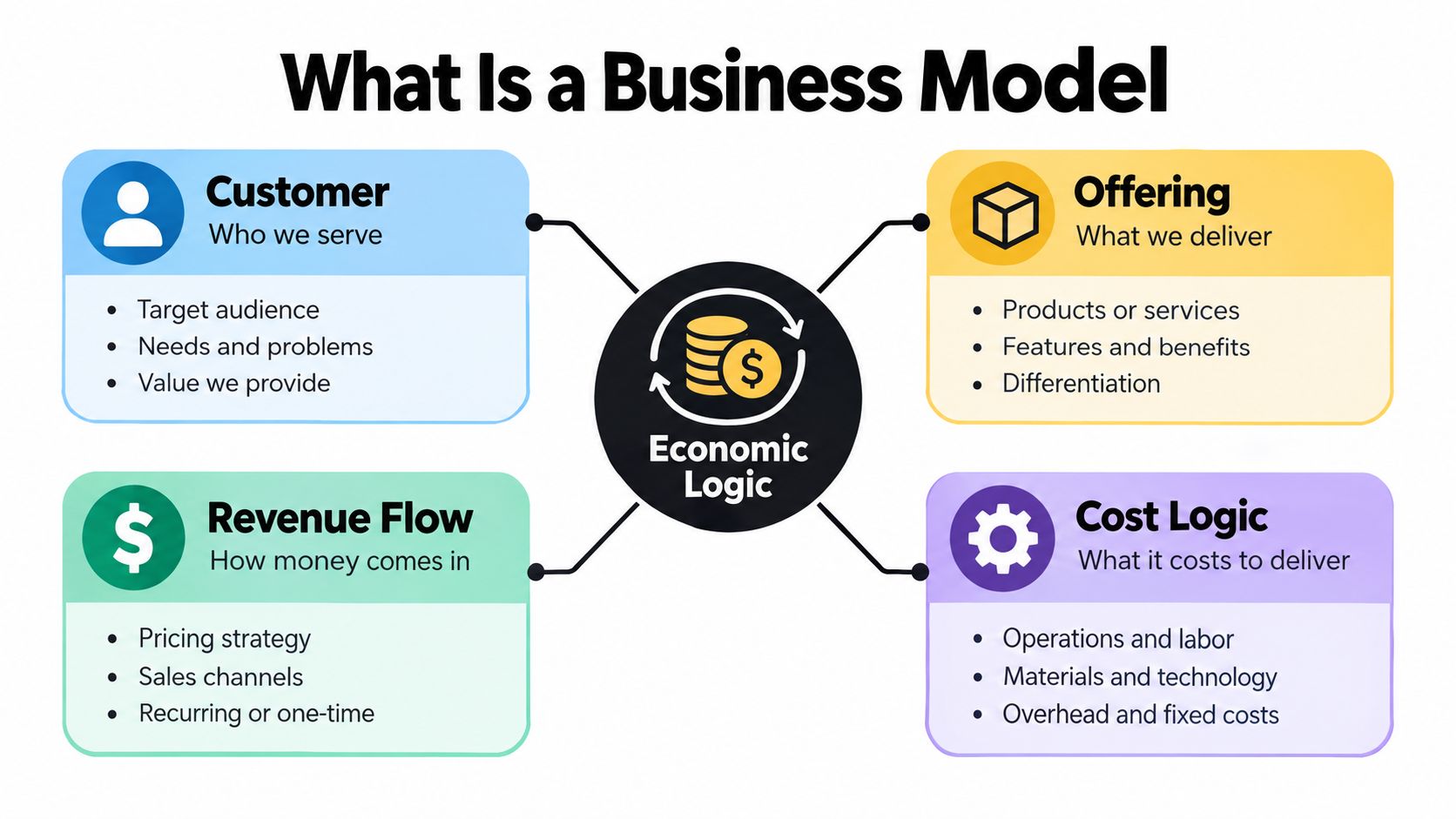
A business model is the economic logic of a company. It explains who the company serves, what it offers, how money comes in, and what it costs to create and deliver the offer.
Those four components should fit together:
- Customer: Identify the person or organization with the problem, the authority to buy, and a reason to act.
- Offering: Define the outcome, product, or service the customer receives. Features matter only when they support that outcome.
- Revenue flow: Explain how payment moves through the business. A marketplace may collect a transaction fee, while a subscription company charges for continuing access.
- Cost logic: Show what consumes resources, including production, service delivery, acquisition, infrastructure, partners, and support.
A marketplace illustrates the interdependence. Buyers need a useful selection, sellers need access to demand, and the company needs a monetization mechanism that doesn't destroy participation. A subscription service has a different promise. It must earn recurring payment by delivering enough continuing value to justify renewal. A platform may open an ecosystem and capture value through fees, data, or advertising, but each choice creates different commercial assumptions.
The model is a hypothesis, not proof. You can state it clearly and still be wrong.
Validate the economic hypothesis
Founders often jump to product development because a feature is easier to discuss than a payment decision. Start with the uncomfortable questions:
- Who will pay, and what outcome are they buying?
- What evidence supports willingness to pay?
- Which channel can reach that customer at an acceptable acquisition cost?
- Does the revenue mechanism support healthy gross margin?
- Can customer lifetime value justify acquisition and payback?
Startup evaluation should use explicit demand and unit-economics metrics, including willingness to pay, conversion rate, recurring revenue, gross margin, customer lifetime value, acquisition cost, and payback period, as documented in research on business-model performance indicators. These measures test whether the value proposition and monetization architecture are viable. They don't prove that the company can deliver repeatedly at scale.
A strong one-sentence model might read: “We help independent clinics reduce appointment administration through a subscription software product, sold directly to practice owners, with support and infrastructure costs that remain manageable as usage grows.” The sentence isn't a strategy by itself, but it exposes assumptions that can be tested.
For a concise way to communicate those assumptions to a team or investor, a business model slide can force useful decisions about customers, value, revenue, and costs.
What Is an Operating Model
An operating model specifies how the business runs. It turns strategic intent into repeatable work by defining the organization's structure, governance, processes, technology, workforce roles, performance measures, rewards, and decision rights.
A subscription company, for example, needs more than recurring billing. It needs a clear owner for onboarding, a way to detect declining usage, a support path for unresolved problems, incentives that don't end at the initial sale, and data that connects product activity to renewal risk. Without those mechanisms, the company has changed its commercial promise but not its capacity to keep that promise.
IBM describes business-model transformation as a fundamental change in how an organization delivers products, services, and value to customers, investors, or other stakeholders. Its explanation also highlights the practical failure mode: a company can move from one-time sales to subscriptions while leaving pricing systems, customer support, incentives, data architecture, and recurring-revenue processes designed for the old model. See IBM's overview of digital transformation and business-model change for that distinction.
The six execution elements
You can audit an operating model by asking six direct questions:
- Structure: Which teams exist, and how do they work together?
- Governance: Which forums make trade-offs, allocate resources, and resolve conflicts?
- Processes: How does work move from customer need to delivered outcome?
- Technology: Which systems, data flows, and integrations make the promise possible?
- Talent: Which skills and roles are required, and where are the gaps?
- Decision rights: Who can decide without waiting for executive escalation?
Operating-model thinking has roots in organization-design frameworks such as the McKinsey 7-S framework, introduced in the late 1970s as a major milestone in organizational-effectiveness thinking. The startup version is less formal, but the principle holds. Strategy fails when people don't know who decides, how work moves, or what behavior the company rewards.
A practical operating model design guide can help founders turn this abstract diagnosis into an explicit view of roles, accountabilities, workflows, and measures.
The right operating model is not the one with the most process. Early-stage companies need enough structure to prevent recurring failure, not a miniature bureaucracy. Document ownership for critical customer and product flows, establish a small number of reliable operating rhythms, and leave room for direct communication while the model is still changing.
Business Model Metrics vs Operating Model Metrics
A founder can report strong revenue while the operating model deteriorates. New sales may hide rising service costs, slow implementation, weak quality, or decisions that depend on one exhausted executive. The reverse also happens. A team can improve throughput and internal productivity while customers still don't value the offer.
Separate the metrics before diagnosing the problem.
| Metric Category | Business Model Metrics | Operating Model Metrics |
|---|---|---|
| Customer economics | Acquisition, retention, willingness to pay, customer lifetime value | Onboarding time, service-level attainment, support quality |
| Revenue logic | Revenue generated, recurring revenue, conversion rate, gross margin | Cost-to-serve, billing accuracy, delivery productivity |
| Growth potential | Future growth potential, channel economics, payback period | Throughput, employee capacity, decision-making speed |
| Market execution | Time to market, demand, customer retention | Cycle time, quality, reliability, process adherence |
| Resource use | Acquisition cost, resources spent, commercial margin | Automation rate, operational capacity, unit cost |
Business-model metrics answer, “Does this economic promise work?” Operating-model metrics answer, “Can this organization deliver it repeatedly at the required cost and quality?”
For a recurring-service company, map revenue to onboarding time, product adoption, support resolution, and retention ownership. For a marketplace, connect liquidity to match rate, response time, and the work required to keep both sides active. For a cost-leadership proposition, track automation, unit cost, quality, and exception handling instead of celebrating volume alone.
The evidence supports this separation. Bain found that organizations in the top quartile of operating-model indicators achieved five-year average revenue growth 120 basis points faster and operating margins 260 basis points higher than bottom-quartile organizations. Accenture reports that technology- and data-enabled operating models can produce up to an 11% top-line productivity premium, and that such companies were 1.6 times more likely to outperform on growth-related measures. These findings appear in Accenture's analysis of the tech-powered operating model.
Diagnostic test: If the business metric is healthy but the operating metric is failing, don't redesign the offer yet. Fix the machinery first.
This separation also protects founders from a common error: treating every problem as a product-market-fit problem. A company may have a viable model and an incapable delivery system. It may also have an efficient team working hard to deliver an offer customers won't buy. The remedy depends on which side of the table is failing.
When to Change the Business Model First
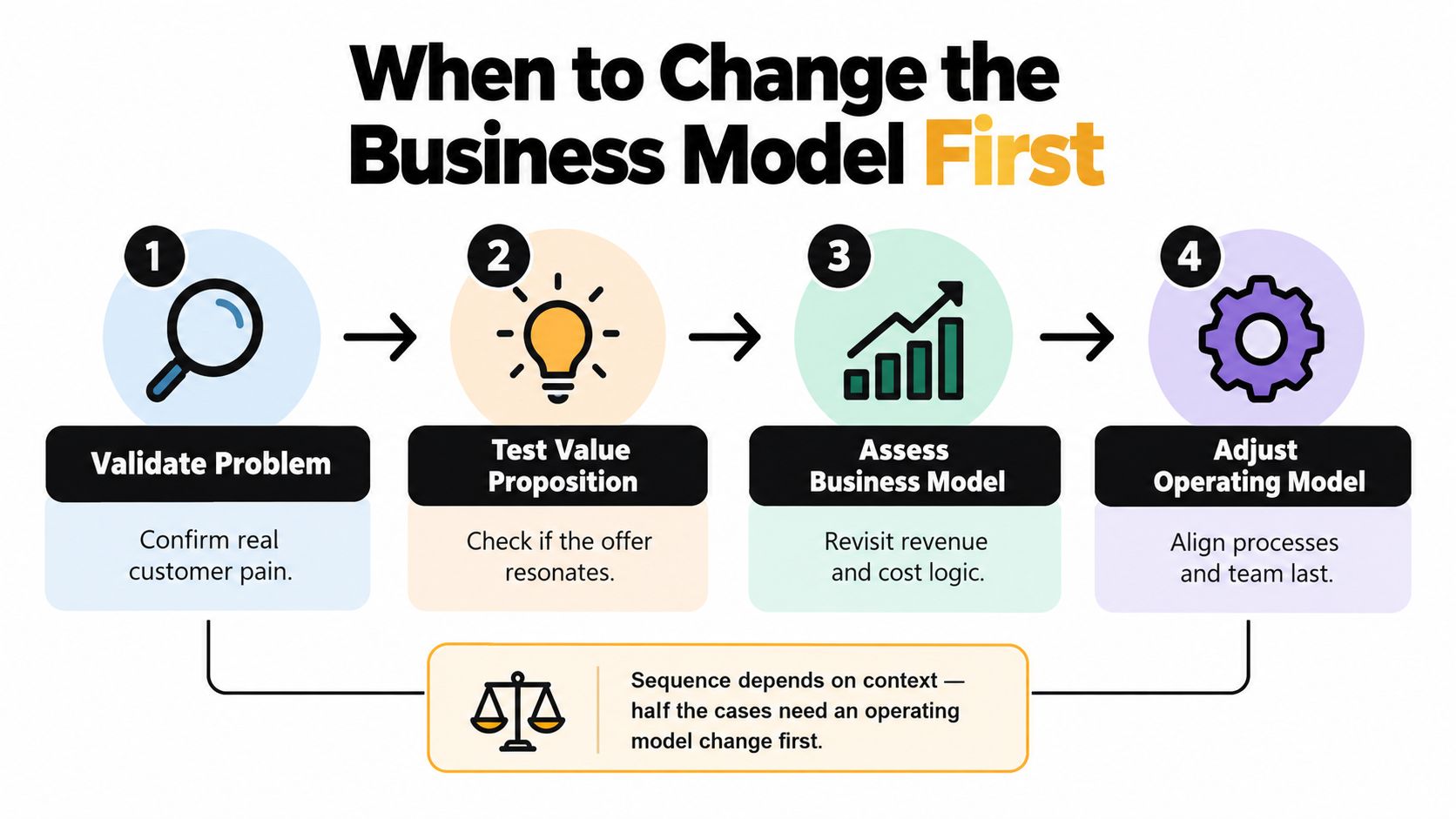
Change the business model first when the company's economic logic is wrong. The warning signs usually appear in customer behavior and commercial evidence: buyers resist payment, the channel costs too much, the price doesn't match perceived value, or the revenue mechanism creates friction that prevents adoption.
Consider a marketplace that assumes buyers will pay a transaction fee. Interviews and live tests show that buyers value the service but won't accept that fee. Hiring customer-success staff won't repair the problem. The founder needs to test another monetization path, such as seller-side payment or a different packaged offer, before expanding the operating system around a rejected assumption.
Customer discovery should happen before organizational redesign. Structured customer discovery interviews can reveal whether the issue is the problem, the offer, the price, the buying process, or the delivery experience.
Change the operating model first when demand is real
The sequence reverses when customers want the product and the economics are promising, but delivery breaks under pressure. A SaaS company may have strong willingness to pay and acceptable retention among activated accounts, yet onboarding takes too long because implementation depends on a founder, product data is incomplete, and support tickets have no clear routing.
In that case, adding enterprise sales roles can make the situation worse. The company should redesign onboarding, assign ownership, instrument activation, clarify escalation, and simplify the handoffs before increasing demand.
A useful decision rule is:
- Change the business model: Customers reject the price, channel, value exchange, or revenue mechanism.
- Change the operating model: Customers accept the proposition, but delivery is slow, costly, unreliable, or hard to scale.
- Change both deliberately: The pivot changes the customer promise and requires a materially different delivery system.
The minimum viable operating model depends on stage. Before product-market fit, keep roles broad, decision paths short, and processes lightweight. Once a repeated failure threatens customer value, assign an owner and create a simple operating rhythm. Don't introduce approval layers merely because larger companies use them.
Recent research found that roughly two-thirds of surveyed organizations redesigned their operating models during the previous two years, while half expected another redesign in the following two years, as reported in McKinsey's operating-model research. Redesign is common, but it isn't automatically the cure. A company can repeatedly reorganize while avoiding the commercial assumption that actually needs testing.
How to Align Both Models for Execution
Alignment isn't a diagram you draw once for a strategy workshop. It is a recurring management practice that connects every economic promise to the capability responsible for delivering it.
Start with the promise. Write the customer outcome, the payment mechanism, and the cost assumption in plain language. Then ask what must happen operationally for that promise to remain true after the founder stops touching every transaction.
Use a promise-to-capability map
Build a simple working sheet with four columns:
- Business promise: What value does the customer expect?
- Required capability: What must the organization do consistently?
- Named owner: Who decides, operates, and improves the capability?
- Proof metric: Which measure shows whether delivery works?
Examples make the mapping concrete:
- Recurring service: Promise ongoing value. Capability requires onboarding, usage visibility, support, and renewal ownership. Track onboarding time, retention, and service quality.
- Marketplace liquidity: Promise a useful match. Capability requires participant acquisition, matching logic, response workflows, and trust controls. Track match rate and response time.
- Cost leadership: Promise an attractive price supported by efficient delivery. Capability requires automation, standardization, exception handling, and cost visibility. Track automation rate, unit cost, and quality.
The metric should expose a failure early enough to act. A retention decline may reflect weak value, poor onboarding, or inadequate support. The founder should investigate the operating path before deciding that the entire business model is invalid.
Keep the early system deliberately small
A minimum viable operating model usually includes clear ownership for sales, product decisions, customer delivery, financial control, and the most important risk. It doesn't require a department for each responsibility. One person can hold several roles, but the decision rights and expected outcomes must be explicit.
Review alignment on a regular operating cadence. Ask:
- Has the customer promise changed?
- Did the revenue or cost assumption change?
- Which workflow now carries more volume or risk?
- Where did customers experience delay, inconsistency, or confusion?
- Which owner lacks authority, data, or capacity?
- Which metric moved because of demand, and which moved because of execution?
Founders trying to protect speed should focus on how to keep your business lean without removing the controls that protect customer value. Lean doesn't mean undocumented. It means every process earns its place by reducing a real failure, delay, or cost.
Alignment improves when teams connect commercial reviews with operating reviews. Don't hold a revenue meeting that ignores delivery capacity, or an efficiency meeting that ignores customer value. Put the relevant owners in the same conversation and make trade-offs visible.
AI, Data, and the New Alignment Challenge
AI changes the alignment problem because the value proposition often depends on capabilities customers cannot see. An AI-enabled business may promise faster decisions, better recommendations, automated analysis, or a new workflow. The operating model must then manage data quality, model behavior, security, human oversight, ownership, and continuous improvement.
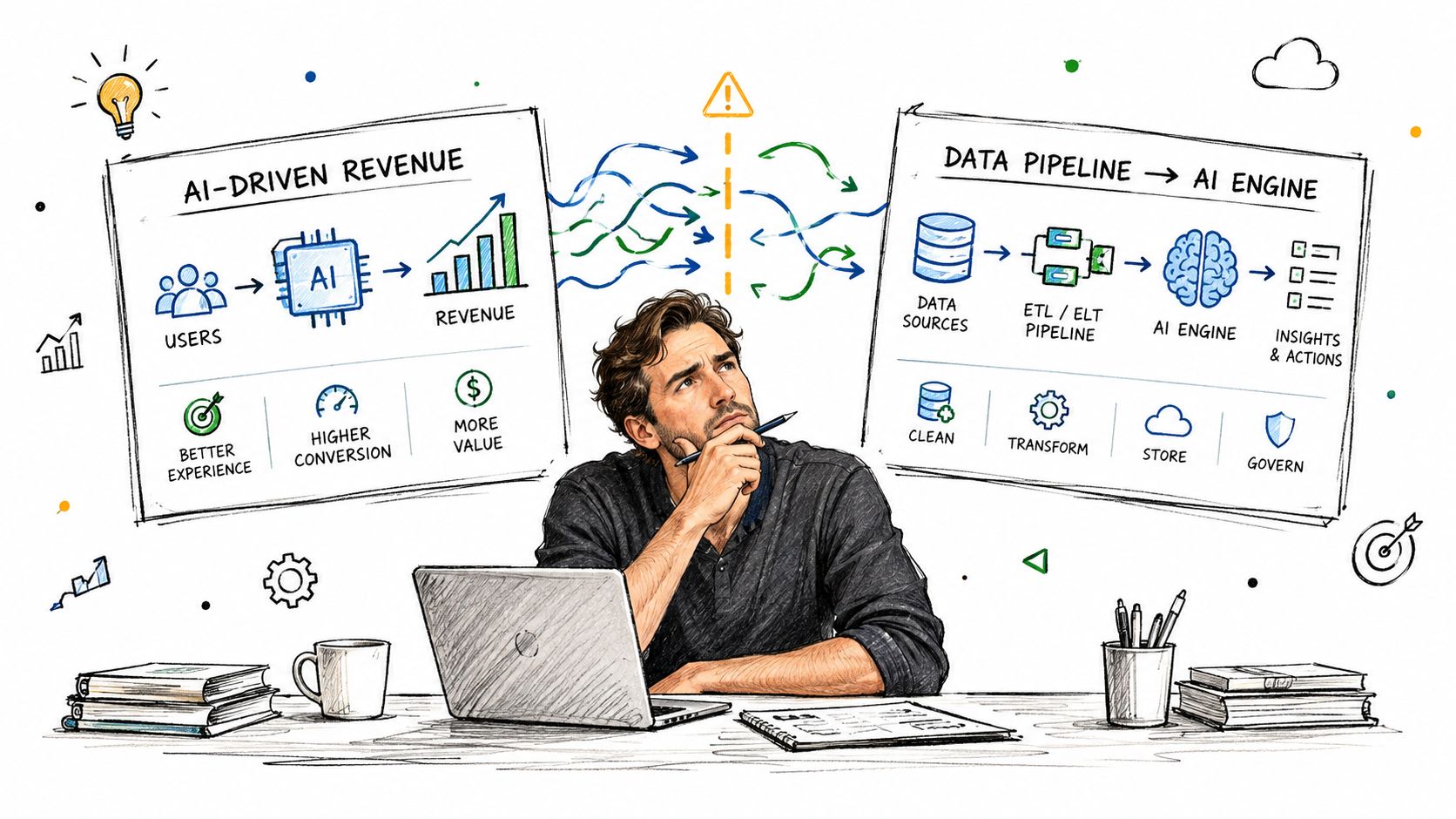
Hiring more technical staff doesn't solve the whole problem. A data-intensive model may require reusable data and AI platforms, data engineering, self-service analytics, security controls, DataOps-style delivery, model-risk governance, and clear accountability between business and technology teams.
MIT CISR's AI-era operating-model research frames the challenge around accountabilities, processes, platforms, metrics, behaviors, innovation velocity, and decision-making speed. That list is useful because it shifts the question from “Do we have an AI team?” to “Can the company operate this value engine responsibly and repeatedly?”
Assign ownership where value is created
Ownership should follow the business outcome, not just the technology stack. A product leader may own the customer problem and adoption target. A technical leader may own platform reliability. A risk or security owner may govern model controls. The company needs explicit decision rights when speed, cost, accuracy, safety, and customer experience conflict.
Deloitte's survey of about 400 US business leaders found that digital programs achieved expected value for 88% of respondents when a chief digital officer held primary ownership, compared with 69% under a chief technology officer and 59% under a chief information officer, as reported in the referenced data-driven enterprise research.
The lesson isn't that every startup needs a chief digital officer. Early-stage companies rarely need another executive title. They do need one accountable person who can connect the AI promise to data availability, product outcomes, operational controls, and financial results.
A useful AI capability check asks:
- Can the team explain which customer outcome the model improves?
- Does someone own data quality and access?
- Can the company detect harmful, inaccurate, or degraded outputs?
- Are human review and escalation rules explicit?
- Can product, engineering, operations, and risk make decisions together?
- Does the measurement system include business value and operational reliability?
A model can be technically impressive and commercially weak. It can also create demand that the organization can't safely support. Alignment means treating data and governance as operating capabilities, not as infrastructure tasks left until launch.
Practical Checklist and Common Pitfalls
Before scaling, founders should be able to answer four questions without reaching for a slide deck:
- Economic proof: Have real customers demonstrated willingness to pay, or are the revenue assumptions still untested?
- Execution ownership: Are the capabilities behind the promise documented, assigned, and supported with decision rights?
- Drift detection: What signals show that customer demand, delivery quality, or cost-to-serve is moving away from the original model?
- Metric separation: Can the team distinguish model risk from execution risk using commercial and operational measures?
Three failure patterns deserve particular attention.
Confusing revenue growth with operating health
Revenue can rise while delivery quality falls. Warning signs include longer onboarding, overloaded support, rising exceptions, and decisions that require founder intervention. Corrective action is to pair every commercial milestone with the operating capacity needed to fulfill it.
Scaling machinery before validating demand
A polished sales organization, complex platform, or specialized team won't rescue an unproven revenue mechanism. If customers don't accept the offer, stop adding execution capacity and return to problem, value, channel, and pricing tests.
Treating alignment as a one-time exercise
Pivots, new channels, enterprise customers, partners, and AI capabilities all change the operating requirements. Review the promise-to-capability map whenever the company changes its customer, offer, payment mechanism, or cost structure.
Keep this short summary visible:
Business model: Who buys, what they receive, how money comes in, and what the economics require.
Operating model: Who does the work, how decisions happen, which systems support it, and how delivery stays reliable.
Sequencing rule: Change the business model when the economic logic fails. Change the operating model when delivery fails. Change both when the promise and the machinery change together.
The best founders don't ask whether the business model or operating model matters more. They ask which assumption is currently limiting the company, test that assumption with the right evidence, and redesign only the machinery the next stage requires.
Find Startup Idea helps founders discover startup opportunities grounded in real pain points from HN and Reddit, then turn promising problems into clearer business-model hypotheses. Visit Find Startup Idea to find problems worth validating before you invest in the operating model.