Customer Discovery Interviews: A Founder's Playbook
Plan, run, and analyze customer discovery interviews that actually change decisions. Includes recruiting tactics, question templates, and bias traps to avoid.
You're sitting on a call where the other person sounds helpful, nods at every pain point, and says some version of “yeah, I'd probably use that.” It feels like traction. It feels like early validation. Then you hang up and realize you still don't know whether the problem is real, recurring, painful enough to matter, or just polite conversation.
That's the trap. Customer discovery interviews aren't a friendly way to collect feedback, they're a decision-making instrument for testing assumptions before you spend real time and money. Steve Blank's Customer Development framework made that explicit by separating Customer Discovery from Customer Validation, along with Customer Creation and Company Building. Discovery asks whether a meaningful problem and customer segment exist, while validation asks whether a repeatable sales motion can be built. The order matters because evidence should come before build effort, not after it.
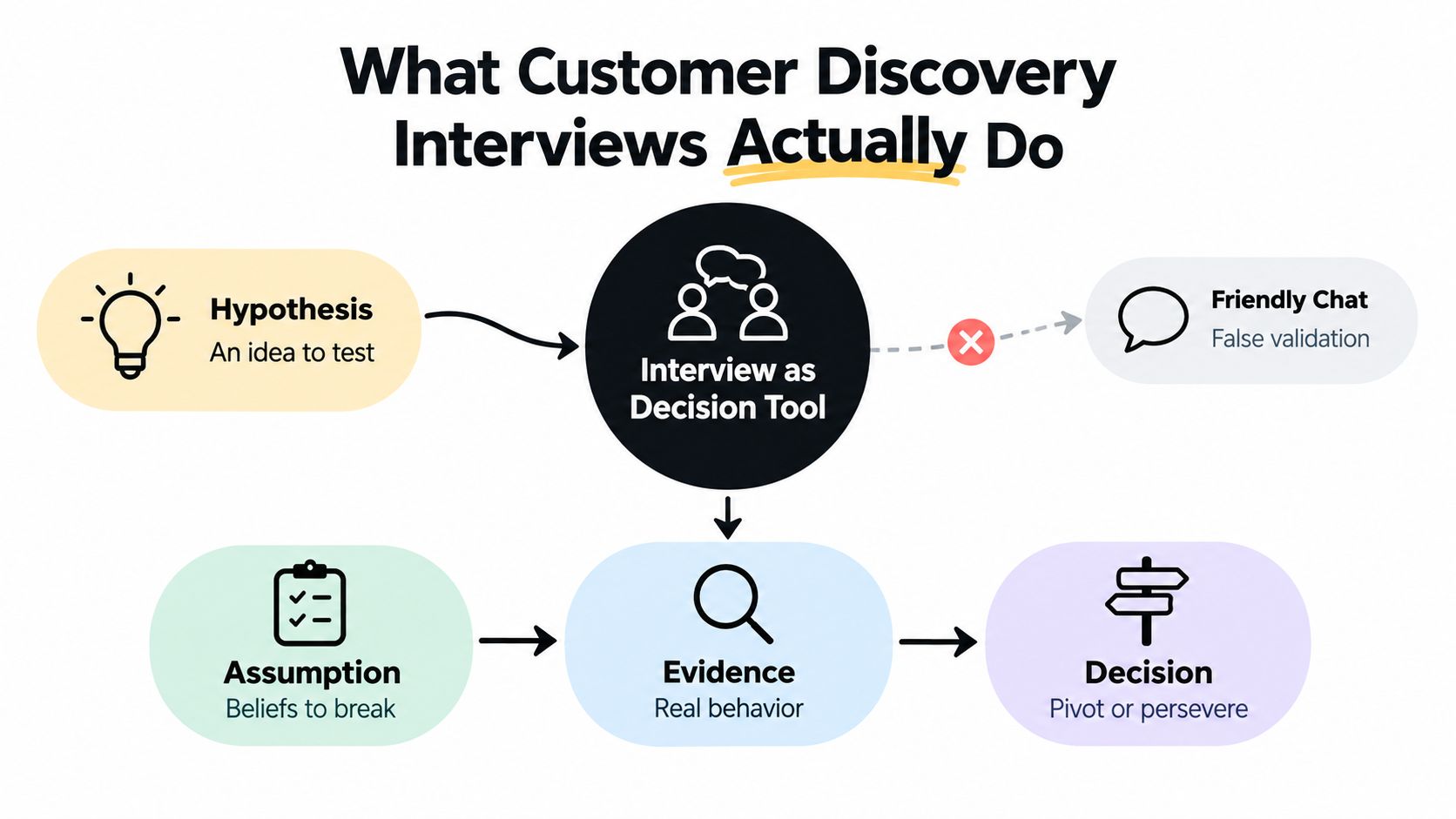
A practical way to think about the method is simple. The founder writes one sentence that names the assumption to test, then uses interviews to decide whether to pivot, persevere, or kill the idea. The guide from Chicago Brandstarters is useful as a companion if you want a concise outside reference, and the underlying logic matches what Blank argues on his customer development materials. If you're also mapping pain points before you interview, the internal pain points examples guide helps translate vague frustration into something testable.
Table of Contents
- What Customer Discovery Interviews Actually Do
- Planning Your First Discovery Round
- Recruiting Participants Outside Your Network
- Conducting the Interview Without Leading the Witness
- Reading the Evidence After Each Interview
- When to Stop and What Comes Next
- Your First Week of Discovery Interviews
What Customer Discovery Interviews Actually Do
A founder can leave an interview with polite enthusiasm and still learn nothing. That is the trap. Customer discovery interviews are a decision tool, not a feedback session, and the difference changes how you listen.
Start with a hypothesis, not a chat
The goal is to test whether a real, recurring problem exists for a specific segment. Steve Blank's Customer Development framework makes that separation clear. Customer Discovery tests the problem and the customer. Customer Validation comes later, when you need proof that a repeatable sales motion is possible. If you blur those stages, you end up collecting reactions to a solution before you have evidence that the problem matters.
A useful starting sentence sounds like this: “I believe [segment] has [specific problem] often enough that they already use [workaround] and would consider a better option.” That line forces the work to be concrete. It also gives you a cleaner filter for recruiting, questioning, and note-taking.
Before a call, decide what would count as bad news. If the person cannot describe the problem as frequent, costly, or disruptive, that is evidence against the idea. If they describe pain but do not control the budget, do not own the workflow, or never change tools, that is also evidence against it. The point is to find the condition that kills the idea fastest, not to collect every objection.
The method works because founders are bad at reading weak signals when they are attached to the idea. In a randomized controlled study of 116 early-stage startups, founders trained in Lean Startup practices, including explicit hypotheses and behavioral customer interviews, were more likely to recognize weak ideas and pivot or exit before committing more capital, according to INSEAD's summary of the study. That is what discovery should do. It should protect time, cash, and attention from assumptions that sound reasonable but do not survive contact with customers.
If you are still turning vague complaints into testable problems, the internal pain points examples guide helps translate frustration into interviewable claims. For a concise outside reference, the guide from Chicago Brandstarters stays close to the same logic.
| Discovery plan essentials vs. optional polish | |
|---|---|
| Must-have for round 1 | Can wait |
| Hypothesis to test | Fancy interview deck |
| Defined segment | CRM workflow |
| Disconfirming evidence | Brand language refinement |
| Note-taking system | Perfect transcript tooling |
| Stop rule | Interview branding |
Planning Your First Discovery Round
A first discovery round works best when it is small, organized, and a little uncomfortable. You are not collecting opinions for later. You are testing whether a problem is real enough to deserve more time, more interviews, or a different direction entirely. A solo founder can set that up in a week if the work stays tight.
Turn a vague idea into a testable claim
Start by narrowing the problem. “Small business owners need better invoicing” is too soft to guide research. “Plumbers lose time chasing unpaid invoices and already juggle workarounds in spreadsheets or texts” is much closer to something you can test. The point is not to write the perfect hypothesis. The point is to make the assumption specific enough that a customer can break it.
Then define what would count as disconfirming evidence. If people do not describe the problem as frequent, costly, or disruptive, that is a warning sign. If they describe pain but do not control the budget, do not own the workflow, or never change tools, that is another warning sign. A useful discovery round looks for the condition that kills the idea fastest, because polite agreement can sound like signal even when it is noise.
Use a concrete failure statement before you schedule interviews. For the plumber invoicing example, a simple rule might be: if five of six plumbers describe chasing invoices as routine but none have paid for a fix, the hypothesis fails on willingness to change. That keeps the round tied to a decision, not a pile of encouraging notes.
Build only the minimum useful setup
Keep the logistics light. A one-page brief is enough for round one, and a short screening form is better than a long survey. Remote calls are usually easier to schedule, and they work well when the problem is conversational. In-person makes more sense only when observing the workflow matters.
A simple tracking sheet should capture who the person is, what segment they belong to, what problem they described, what workaround they use, and what would make the problem urgent enough to act on. Do not over-design the sheet. You are trying to make patterns visible, not produce a dashboard.
A few things can wait:
- Messaging polish can wait until you know the segment responds.
- Brand assets can wait until you know the problem is real.
- Automation can wait until you know the interviews are worth scaling.
Keep one bias check in the plan. If a question seems to produce agreement from everyone, ask whether it invites a socially safe answer instead of a revealing one. Polite confidence is often the least useful data in the room. The goal in week one is a working interview plan you can show a co-founder, mentor, or advisor without defending every assumption. If they cannot tell what would prove the idea wrong, neither can the market.
Recruiting Participants Outside Your Network
Convenience sampling is where discovery falls apart. Friends are eager. Ex-colleagues are polite. Your closest contacts are also the people most likely to make your idea sound reasonable, even when they'd never buy it. You need people who genuinely live inside the problem.

Source the people who live the problem
The fastest way to find them is through places where the problem is already being discussed. Niche subreddit threads, trade-association directories, and LinkedIn outreach all work when the ask is narrow and specific. If your segment is narrow enough, a cold message can be effective because the relevance is obvious.
The message should sound like research, not outreach theater. Say what behavior or role you're studying, mention that there's no product pitch, and ask whether they'd be open to a short conversation about how they currently handle the problem. People who have the issue often respond because the topic is familiar. People who don't have it usually ignore the message, which is fine.
Micro-influencer referrals can also work well. In practice, that often means someone respected in a niche community knows who struggles with the problem and is willing to introduce you. The same is true for professional groups and associations. The key is that the participant is selected for relevance, not convenience.
Use a screener that filters for reality
A screening form should separate lived pain from curiosity. Ask about the person's role, the last time the problem came up, and whether they personally deal with it or only observe it. That helps exclude freebie-seekers and enthusiasts who just like talking about tools.
Strong screening answer: “I dealt with this last week, and I already use two workarounds.”
Weak screening answer: “I'm always interested in new productivity tools.”
If the same demographic keeps filling your calendar, that's useful, but only if it matches the segment you're testing. Otherwise, you're collecting one narrow slice of the market and mistaking it for the whole thing. Keep the recruiting list honest, and don't be afraid to throw out a source channel that keeps attracting the wrong crowd.
If you want a useful outside reference for choosing collection methods, the Captapi guide on qualitative research data collection methods is a practical companion. The main point, though, is simple. Participants should resemble the people who would feel the problem, not the people most likely to answer your email.
Conducting the Interview Without Leading the Witness
A discovery call can feel productive and still tell you nothing. The founder asks for confirmation, the participant gives a polite answer, and both walk away thinking they reached alignment. That warmth is usually noise.
Use the interview as a decision tool. Ask what happened last time, what they did step by step, what workaround they used, and what it cost them in time, money, or frustration. Keep the script tight and the tone neutral. Record two exact participant phrases on every call and paste them into the tracking sheet verbatim. Those phrases often expose the actual problem faster than your summary does.
Here's the wrong exchange:
Founder: “Would you use a tool that automates invoice reminders?”
Participant: “Yes, absolutely. That sounds useful.”
Founder: “Great, so this would solve it?”
Participant: “Sure, I think so.”
That answer is polite, not proof.
The stronger version sounds different:
Founder: “Tell me about the last time an invoice got delayed.”
Participant: “I had to text the client twice, then follow up by email, then ask my bookkeeper to check the schedule.”
Founder: “What happened after that?”
Participant: “We still waited another week, and I wrote it off as part of doing business.”
That is evidence. It shows behavior, workaround, and consequence.
Open questions do the work. Leave room for silence. Do not rescue the participant from pauses. If you need a wider qualitative frame for choosing research data collection methods, the choosing research data collection methods guide is a useful reference. The core habit stays the same, though. Ask about memory, not preference.
“Would you use this?” is a weak question because it asks for imagination, not memory.
A one-page outline is enough. Include opening context, one or two behavioral prompts, a few probes for workaround and cost, and a closing question about whether anything important was missed. If you feel tempted to add product slides, stop. Once the pitch enters the room, the interview stops being discovery.
Reading the Evidence After Each Interview
A good interview can still mislead you if you score it casually. A participant saying the problem is annoying is weaker evidence than someone who already spends time or money working around it. In discovery, behavior outranks enthusiasm.
Rank what you heard before you decide what it means
Start with what people have already done. Recent behavior matters more than general statements. Incurred cost matters more than hypothetical interest. Decision authority matters because the person may care strongly about the problem and still lack the power to act on it. Enthusiasm is the weakest signal, since it often reflects politeness, optimism, or curiosity rather than urgency.
A review of qualitative interviewing pitfalls recommends behavioral evidence such as recent problem occurrence, existing workarounds, and the cost of the current solution, because enthusiastic opinions can look like validation when they are only goodwill. The useful question is simple: what have they already paid, fixed, hacked around, or repeated?
Separate observation from interpretation
Keep three layers in your notes. First, write the observed fact, such as, “They sent three reminders by email before escalating.” Second, record the participant's interpretation, such as, “They said the client was disorganized.” Third, add your inference, such as, “The workflow depends on manual follow-up.”
That separation keeps you honest. It also makes it easier to compare interviews across the week without rewriting the same story in three different ways. A small codebook helps. Use the same labels for recurring issues, and watch for disconfirming cases that break your first impression.
Practical rule: if the participant's behavior and your story do not match, trust the behavior first.
A quick scoring habit helps here. After each call, ask whether you saw real behavior, a real workaround, and a real consequence. If all three are present, that is strong evidence. If only enthusiasm is present, treat it as noise. If the story is mixed, mark it mixed and move on without forcing a conclusion. That discipline turns discovery into a decision-making instrument instead of a collection of encouraging conversations.
When to Stop and What Comes Next
The old “do 10 interviews” rule sounds tidy because it avoids a decision. In practice, it is too blunt. The stopping point depends on whether new calls are still changing what you know, or only repeating the same themes in slightly different words.
Use saturation, not superstition
Qualitative research often shows topic categories settling after about 9 interviews, but 16 to 24 are usually needed to capture nuance, variation, and causal meaning, and 20 to 40 across sites or segments, as described in the journal article on saturation logic. That is a planning range, not a command. The right number depends on how mixed your audience is and how much explanation you need.
What matters is whether each interview adds a new category, a sharper boundary, or a real contradiction. If the same pattern keeps showing up in the same language, you may have enough for this round. If every call changes who seems to have the problem, or why it matters, keep going.
Decide the next move before you want to keep going
Set a stop rule before the next round starts. Define, in advance, what evidence would justify a pivot, what would justify continuing, and what would justify a second round with a tighter segment. That keeps discovery from stretching on because the answer feels uncomfortable.
A recurring split between one segment with clear pain and another with vague interest usually points to a segmentation problem, not a product problem. If you need help keeping a research process focused, the Find Startup Idea team writes about exactly this discipline.
The test is simple. Stop when the evidence has earned the stop. If the interviews are still producing new information, keep listening. If they are only producing polite agreement, move on.
Your First Week of Discovery Interviews
The first week is not about collecting opinions. It is about making a decision with enough evidence to keep going, pivot, or stop. A practical setup helps: write the segment, the pain, the current workaround, and the strongest reason the idea may be wrong in one short paragraph.
Use the first week to build the decision system around the interviews. Day two is for the screener and tracking sheet. Day three and four are for recruiting. Day five is for running three to five interviews. Day six is for synthesis, and day seven is for the call on what the round means.
The only artifact worth keeping from that first batch is a one-page memo. It should cover what you believed, what you heard, what repeated, what contradicted you, and what you will do next. If the result takes more than a page to explain, the signal is probably still muddy.
Keep two bias checks in place from the start. Separate observations from interpretations. Write down what would count as disconfirming evidence before the interviews begin. That matters when polite answers start to sound like proof.
If you are still choosing which problem to point this playbook at, the Find Startup Idea blog collects pain points worth testing first.
Start with the smallest serious round possible, then let the evidence tell you whether the segment deserves a second pass. If the interviews expose a real, repeated pain, move fast. If they do not, stop early and protect your runway.