Business Model Generation That Actually Ships
Learn business model generation with frameworks that turn ideas into testable models. Discover the canvas, revenue experiments, and validation methods that
Most founders are told to fill out the Canvas and then start building. That advice sounds disciplined, but it often produces a neat document and a weak company. Business model generation only matters when the model survives contact with customers, channels, and pricing, because a polished diagram by itself doesn't prove anything.
A better standard is simple, if uncomfortable, generation means falsifying assumptions before you spend real money. A team that skips discovery can still end up with a clean nine-block grid, but it's just a confident guess until the evidence says otherwise. That's why the work is not drawing the model, it's ranking the riskiest assumptions and testing them in order.
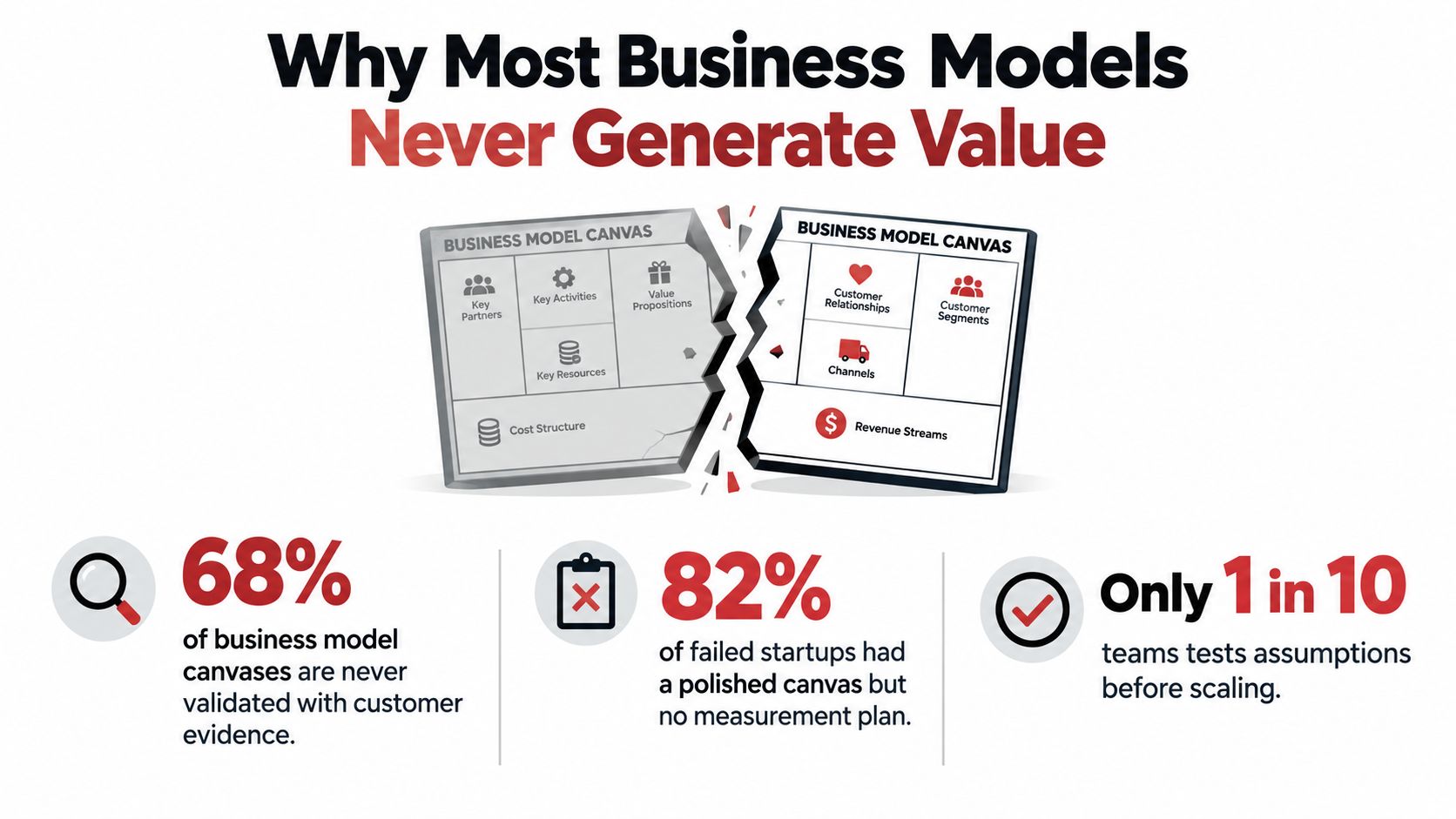
Table of Contents
- Why Most Business Models Never Generate Value
- The Business Model Canvas as a Shared Language
- Choosing the Right Revenue Model to Generate
- Running the Four-Step Evidence Loop
- Using Digital Experiments as Evidence, Not Opinions
- Designing Distribution and Monetization Together
- Testing Business Models in the Age of AI
- Your Operating Rules for Generating a Real Business Model
Why Most Business Models Never Generate Value
The most common mistake is treating the Canvas as the finish line. Founders sketch customer segments, value propositions, and revenue streams, then assume the hard part is done. In reality, the model only starts to matter when those blocks are tied to evidence, and the gap between confidence and proof is where many startups waste runway.
A recent synthesis reports that only 22% of early-stage startups ran structured customer interviews before development, while 78% relied mainly on intuition. That doesn't mean intuition is useless. It means a convincing idea can still be badly under-tested, especially when the founder is surrounded by positive feedback from friends, early users, or investors.
Practical rule: if you can't name the assumption that would kill the idea, you're not generating a business model yet, you're decorating one.
Three failure patterns show up again and again. First, teams leave assumptions untested. Second, they move to scale before they know the model works. Third, they bolt AI onto the offer and mistake novelty for durability. If you want a broader menu of early discovery tactics, the guide to 10 product discovery methods is a useful companion.
A simple scenario makes the problem obvious. A founder designs a service-business tool, writes “subscription revenue” in the corner of the Canvas, and launches ads before proving that the target segment feels enough pain to pay monthly. The model looks complete, but the business doesn't yet exist. For a deeper planning lens, the related discussion of business model strategy helps distinguish a good idea from a coherent operating choice.
The Business Model Canvas as a Shared Language
The Business Model Canvas became influential because it turned business-model thinking into a one-page visual system. Alexander Osterwalder's doctoral work on business-model innovation began in 2004, and the widely shared version arrived with Business Model Generation in 2010 (academic review of the frameworkA55.pdf)). That mattered because teams could finally compare options without hiding behind long prose.
For a B2B tool serving service businesses, the nine blocks work as a connected story. Customer Segments might be independent contractors and small agencies. Value Propositions might be automated scheduling and invoicing. Channels could be the website and sales demos, while Customer Relationships may require dedicated account managers. On the operating side, Key Resources might be the engineering team and cloud infrastructure, Key Activities software development and support, Key Partners payment processors and CRM vendors, Cost Structure salaries and hosting fees, and Revenue Streams monthly subscription plus per-seat fees.
The point is interlock. If the revenue stream depends on per-seat pricing, the channel has to reach businesses that understand seat-based software. If the relationship model depends on dedicated account managers, the cost structure cannot be treated as if it were self-serve. The Canvas works best as a shared language for tradeoffs, not a glossary of startup words.
A Canvas that does not reveal friction between blocks is usually too vague to be useful.
Its spread also says something useful about the framework itself. HEC Montréal reports that Business Model Generation began with a 5,000-copy print run in 2010, later sold over 1 million copies, and was translated into about 30 languages (HEC Montréal). The point is not popularity for its own sake. The Canvas gave teams a common vocabulary for arguing about the same model, which is why it travelled so widely.
Choosing the Right Revenue Model to Generate
Revenue model choice is a bet about behavior, not a formatting exercise. A subscription model assumes recurring value and enough switching friction to prevent churn from eating the business. Freemium assumes a wide top of funnel and a small paid conversion layer, which means the free tier can't become a margin sink. Marketplace models depend on solving supply and demand at the same time, while open-business models often rely on a narrow set of monetizable services around a broader free layer.
A good way to think about this is to ask which block is under the most pressure. Subscription stresses customer retention and value continuity. Freemium stresses cost structure and conversion. Marketplace stresses customer segments, channels, and key partnerships because supply and demand have to arrive together. Open-business models stress value proposition clarity, because the core offer must stay compelling even when some components are free.
If you need a practical pricing reference while comparing these options, find the right SaaS pricing can help you frame the tradeoffs without pretending pricing is separate from the model itself.
The wrong revenue model often sounds attractive because it lowers friction in the short term. Freemium can feel like the easiest way to get users. Marketplaces can look elegant on a slide. Open models can create buzz. But each of those choices only works if the underlying assumptions about customer behavior, willingness to pay, and unit economics hold up in the market.
Useful test: pick the revenue model that makes your weakest assumption easiest to disprove.
A founder should treat monetization as a hypothesis, not a default. If monthly billing fits the pain frequency and usage pattern, subscription may be right. If users need to experience value before paying, a limited free tier can be a bridge. If you're matching two sides of a market, the biggest risk may be liquidity, not pricing.
Running the Four-Step Evidence Loop
A business model gets stronger when evidence replaces optimism. The most workable sequence is simple, measure first, then hypothesize, then discover, then validate. This sequencing turns the Canvas into a control loop, because each new result changes what you do next instead of leaving you with a prettier slide deck.
Start with measurement. Pick the few metrics that reveal uncertainty, not the ones that merely look busy. Then write hypotheses in falsifiable form. A weak version says, “Small agencies will like this.” A stronger version says, “Small agencies that currently use spreadsheets will book a demo if we promise automated invoicing and time savings.”
The third step is discovery. Use interviews, lightweight landing pages, or small ads to test desirability before building. The fourth step is validation, which needs stronger proof. Research on business experiments notes that discovery is cheaper and faster, while validation requires more time, people, or money, and commercial viability is best tested with actual sales and transaction data (TIM Review article). If you are comparing this with a lean MVP process, the guide to what is MVP is a useful mental bridge.
A concrete example helps. Suppose the assumption is willingness to pay. Discovery might be a landing page with a waitlist and a message about saving admin time. Validation might be a paid pilot with a clear price, a clear offer, and a simple yes-or-no threshold before launch. If no one pays, that's not a bad marketing day, it's disconfirming evidence about the model.
Kill criteria belong on paper before launch, not after the data feels inconvenient.
The logic is controlled uncertainty. Measurement tells you which assumption matters most. Discovery tells you whether the problem is real enough to deserve building. Validation tells you whether the model repeats under money, not just conversation. That's the difference between a startup idea and a startup-ready business model.
Using Digital Experiments as Evidence, Not Opinions
Digital experiments are useful only when they measure a behavior tied to the model. If the Canvas says the value proposition is stronger onboarding, test activation, not admiration. If the model depends on pricing, test conversion or paid upgrade, not click curiosity. Vanity metrics can make a team feel busy while leaving the core question unanswered.
Research on high-technology startups found that firms adopting A/B-testing technology showed better performance on critical dimensions such as page views and new product features, and the effects extended to tail outcomes as well (NBER working paper). The useful lesson isn't “add testing software.” It's that disciplined experimentation helps only when teams can design clean comparisons and translate results into product or monetization changes.
The setup matters more than the tool. Before launch, define one success metric, decide how users will be segmented, and write the hypothesis in advance. Then choose the outcome that maps back to a Canvas block. If the assumption concerns Channels, compare cohorts by traffic source. If it concerns Value Propositions, compare groups by behavior and willingness to continue. If it concerns Revenue Streams, track actual purchase behavior rather than survey intent.
The other error is treating all users as interchangeable. Different traffic sources, acquisition intent, and user mix can hide or fake a result. That's why clean cohort design matters more than a clever headline. Teams that skip this discipline end up with results they can't trust, and they still have to make the same decision later, only with worse data.
For a practical resource on structuring tests, find winning conversion experiments is useful because it keeps the focus on decisions, not dashboards.
Designing Distribution and Monetization Together
Channels and revenue streams can't be chosen independently. A high-trust, low-volume channel, like direct sales or partnerships, can support higher contract value because a human relationship carries part of the sale. A low-trust, high-volume channel, like SEO, paid ads, or communities, usually requires a tighter offer, simpler conversion path, and lower friction in the purchase process.
That coupling affects economics. If acquisition depends on sales calls, then payback can be slower, but the average customer may justify the effort through higher value. If acquisition depends on content or ads, the model often needs faster conversion and cleaner self-serve onboarding. In other words, the channel doesn't just bring traffic, it shapes who can buy, how quickly they decide, and what they'll tolerate in pricing and packaging.
Many founders get trapped by optimism. They choose a channel they personally like, then force the monetization layer to adapt. The better move is to ask which combination makes the whole system coherent. A subscription product sold through a sales-led motion looks different from one sold through organic search. A marketplace with community-driven acquisition has different economics from one that depends on partner referrals.
A useful rule is to work backward from the cheapest believable path to a paid customer. If the channel can't support the price, or the price can't support the channel, the model needs revision. Sometimes that means narrowing the segment. Sometimes it means changing the offer. Sometimes it means admitting the channel is wrong for the first version of the business.
Testing Business Models in the Age of AI
AI makes business model thinking harder, not easier. A product can look impressive on the Canvas and still be fragile if the underlying model depends on a provider's pricing, a model that changes quickly, or a workflow that customers don't value enough to pay for. AI can strengthen a model, but it can also make it easier to copy.
Recent global evidence shows the shift is already happening. Deloitte surveyed 3,235 business and IT leaders across 24 countries, and 34% said their organizations were beginning to use AI to transform operations by creating products and services or reinventing business models (Deloitte). That doesn't prove AI ventures are attractive. It does mean founders need better filters than "add AI and see what happens."
The right validation questions are specific. Can a competitor substitute the model easily? Do you control the data rights you need? Does the workflow create switching costs, or does it just wrap a public capability? What happens to gross margin if usage rises faster than price? Does AI reduce the customer's total cost, or just move cost somewhere less visible? If the answer is vague, the model is probably still weak.
AI also changes accountability. If a customer expects human oversight, then automated output can't be the only promise. If regulation matters, then the company may need auditability and traceability before scale. If the product is mostly a thin interface on someone else's model, then defensibility lives in workflow, distribution, or data, not in the AI label itself.
A founder should be ready to walk away if the offer is easy to copy, margin-sensitive to provider costs, or valuable only as a novelty. Those are not edge cases, they're common failure modes.
Your Operating Rules for Generating a Real Business Model
Generating a real business model comes down to seven operating rules. Start with the Canvas, but treat it as a working hypothesis, not a finished answer. The gap between a model on paper and a model that survives contact with customers is the gap that kills most startups, and the difference between a business model and an operating model matters here.
First, rank assumptions by risk, not by tidiness. A neat Canvas can hide the one block that will break the business if it is wrong. Second, test customer pain before product detail. Third, tie each experiment to one block on the Canvas so learning stays specific.
Fourth, connect distribution and pricing early. A model that cannot be acquired at a price that fits the buyer is usually fragile. Fifth, set decision thresholds before launch, so you know what would make you stop, narrow, or continue. Sixth, require evidence before scale, because early confidence is not the same as proof. Seventh, kill, narrow, or reposition fast when the evidence turns against the model.
A short checklist keeps the rules practical:
- Name the riskiest assumption: Identify the block that would break the business if it is wrong.
- Define one measurable behavior: Choose activation, conversion, retention, referral, or paid upgrade.
- Choose the lightest credible test: Use the cheapest experiment that can disprove the idea.
- Set a stop rule: Decide what result means stop, narrow, or continue.
- Check channel fit: Make sure the acquisition path supports the price and the buyer.
- Stress-test AI claims: Ask whether the model still works without the AI label.
- Revisit weekly: Update the model from evidence, not enthusiasm.
That is the discipline. It keeps founders from polishing a canvas while the business underneath stays unproven. A model that survives these rules is much more likely to earn attention, revenue, and time.