What Is MVP: The Startup Validation Framework
Discover what is MVP in startups, how it tests core business assumptions, and the evidence ladder to validate your idea before writing a single line of code.
Most founders still treat an MVP like a cheap first draft of a product. That's how they end up shipping a half-finished app, collecting polite praise, and mistaking interest for demand. A real Minimum Viable Product is not a smaller product, it's a bounded experiment built to prove or kill one risky assumption with the least irreversible effort.
Table of Contents
- Redefining the Minimum Viable Product
- The Origins and Core Mechanics of MVP Testing
- Designing Your First Validation Experiment
- Lessons from IMVU and What Building Actually Requires
- The Evidence Ladder for Startup Validation
- Making the Decision to Pivot or Persevere
Redefining the Minimum Viable Product
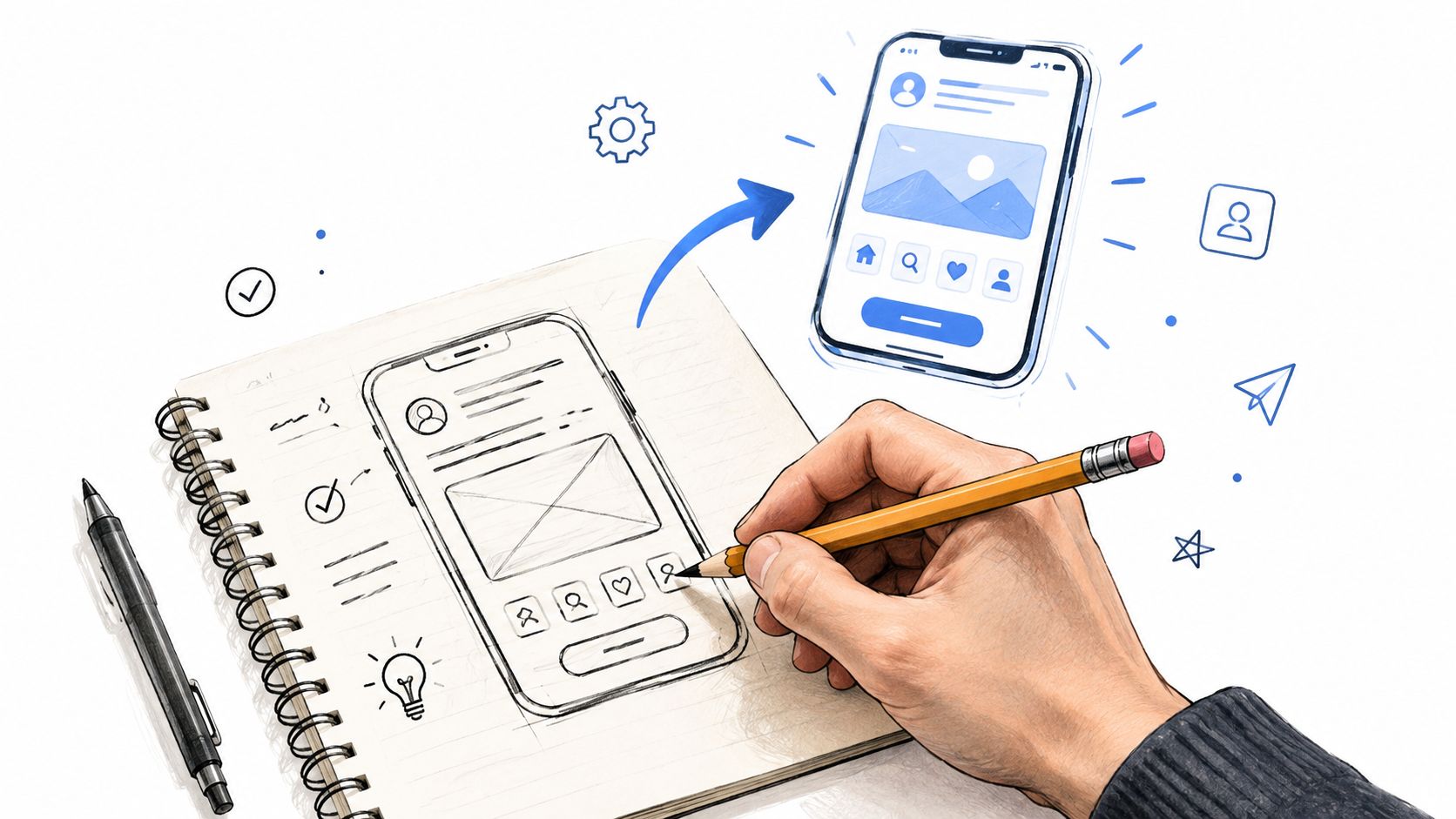
The most common mistake is to define an MVP as “the smallest thing we can launch.” That framing pushes teams toward feature trimming, not learning. The better definition is closer to a research instrument, a deliberately limited test that produces behavior, not just opinions.
The original idea was coined in 2001 by Frank Robinson of SyncDev, then folded into customer development by Steve Blank, and later made globally familiar by Eric Ries through the Lean Startup movement and The Lean Startup in 2011. That history matters because it shows the point was never “ship less,” it was “learn faster” through evidence about customer demand, usability, and value before you spend heavily on scaling (London Business School on the minimum viable product).
What the word viable really means
Viable does not mean polished. It means the first experience has enough value to trigger meaningful feedback, like a payment, a repeat visit, a completed task, or a clear refusal. If people can't use it, the signal is weak.
Practical rule: If the first release can't produce observable customer behavior, it isn't an MVP, it's a prototype dressed up as a launch.
For founders exploring problem areas, that shift changes the starting point. Instead of asking how many features fit into version one, ask which assumption is most dangerous if it's wrong. A concise resource on testing ideas with a minimum viable product makes that distinction well, and pain points examples can help identify the customer problems worth testing first.
The Origins and Core Mechanics of MVP Testing
An MVP is only useful when it tests a hypothesis. Teams that talk about “launching quickly” without naming the belief under test usually end up collecting noise, not evidence. The mechanics are simple, but they have to be explicit before any build begins.
Eric Ries's IMVU example shows the learning model in practice, and the full story is covered below. That case became influential because the team replaced assumptions with observed customer behavior, not because it shipped a polished first version (Eric Ries and IMVU MVP example).
The four parts of a real MVP experiment
A useful MVP experiment needs four things.
- The assumption being tested. State the risky belief in plain language.
- The observable confirming event. Decide what counts as evidence, such as a signup, activation, payment, or repeat use.
- The target cohort. Define exactly who you are testing with, not “everyone.”
- The decision threshold. Set in advance what result means continue, revise, or stop.
That structure fits research that treats an MVP as a minimal, sufficient representation of a business hypothesis, not just a reduced product (MVP and experimentation in software startups). In practice, the format can be a landing page, clickable prototype, concierge workflow, or a single-feature tool if it produces reliable evidence.
The point is decision quality. If the experiment cannot change a go or no-go decision this week, it is instrumentation, not validation.
Designing Your First Validation Experiment
The cleanest MVPs start with a painful, narrow problem and end with a decision. That's why the build comes after the hypothesis, not before it. If the team doesn't know what result would count as success, the experiment will keep expanding until it becomes a product no one has proven they want.
One useful way to start is by mapping the journey you expect a real buyer to take, from first exposure to the first moment of value. That journey should include acquisition source, activation event, and the behavior that proves the user cared enough to continue. If you're validating a business idea, a plain landing page or simple pre-order flow can be more valuable than weeks of software work.
The best validation tests feel almost uncomfortable because they force a yes or no.
The design question isn't “what can we build fast?” It's “what can we test with the least irreversible effort?” If the risky assumption is price sensitivity, a pre-order or paid pilot may reveal more than ten interviews. If the risky assumption is usability, a clickable prototype or concierge workflow may be enough.
An article on Receiver conversion tactics is useful here because conversion thinking forces you to care about the actual path a visitor takes, not the internal logic of your feature list. For early discovery conversations, customer discovery interviews are a strong companion method, but they should feed the experiment, not replace it.
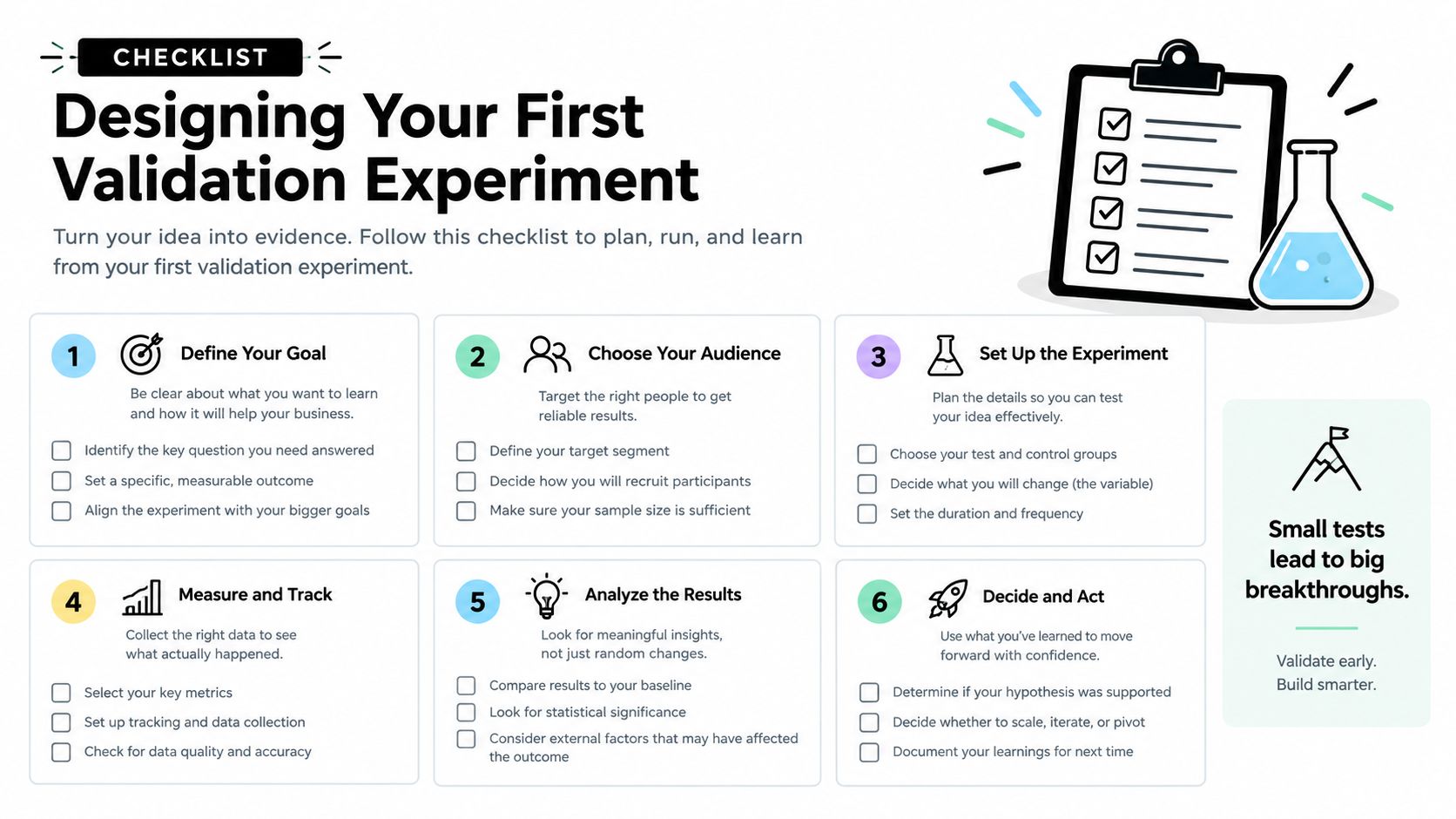
Before any code goes live, define three things in writing:
- The testable belief. State the assumption in one sentence.
- The evidence you want. Pick one event that counts as confirmation or rejection.
- The action you'll take. Decide whether you'll continue, change the offer, or stop.
When founders skip this setup, they usually end up tuning copy, button colors, or features forever. That's not validation. That's avoidance with a roadmap.
Lessons from IMVU and What Building Actually Requires
IMVU is a clear reminder that an MVP can be substantial and still be valid. A team may spend months building the specific experience needed to test a hard assumption, and that work still counts when it produces believable evidence about customer behavior. The build is only the vehicle. The learning is the deliverable.
A founder I would flag is the one who strips onboarding to meet a deadline, then treats a low activation rate as proof that the idea failed. Sometimes the product is weak. Sometimes the test is. If the experience is too thin to earn honest behavior, the market cannot answer the question you are asking.
IMVU also shows why early teams should stop defending their first theory so quickly. Build against the assumption, watch how people respond, and accept that the answer may be uncomfortable. That kind of feedback is cheaper than months spent polishing the wrong feature set.
MVPs replace opinion with observed behavior. They do not prove scale. They prove whether the team can learn from the market, set a decision threshold, and change course without pretending certainty where none exists.
The Evidence Ladder for Startup Validation
Not all validation is equal. Friendly interviews and big signup counts can feel encouraging, but they don't sit near the top of the evidence ladder. The strongest signals show that someone gave up time, money, or both.
A peer-reviewed study on pre-MVP validation treats paying customers before the complete product exists as the highest evidence level because payment tests willingness to pay without leaning on investor opinion. That same approach recommends looking at acquisition source, activation, time to first value, task completion, repeat usage, conversion, and churn by cohort (CRV on the MVP approach).
The startup evidence ladder
| Validation Method | Signal Strength | What It Actually Proves |
|---|---|---|
| Compliments and positive comments | Weak | People like the idea in theory |
| Interviews and surveys | Low to moderate | The problem may exist |
| Observed workarounds | Moderate | The pain is real enough to trigger action |
| Waitlist signups | Moderate | Interest exists, but commitment is still unproven |
| Clickable prototype usage | Moderate to strong | People can understand the proposed solution |
| Pre-orders, deposits, paid pilots | Strong | Buyers will exchange money or scarce resources |
| Repeat usage and cohort retention | Stronger | The product keeps delivering value after novelty fades |
The key is to distinguish interest from commercial demand. A high signup count can hide weak intent if nobody returns, pays, or finishes the intended job. A smaller group that repeats, converts, and stays is more trustworthy than a large audience that only applauds.
A useful operating rule is to instrument the core journey from the first click to the moment of value. If you can't see acquisition, activation, and repeat behavior, you can't tell whether you've built a useful product or just generated curiosity. For some founders, Find Startup Idea is one way to surface problem ideas from real pain points before that validation work begins.
Making the Decision to Pivot or Persevere
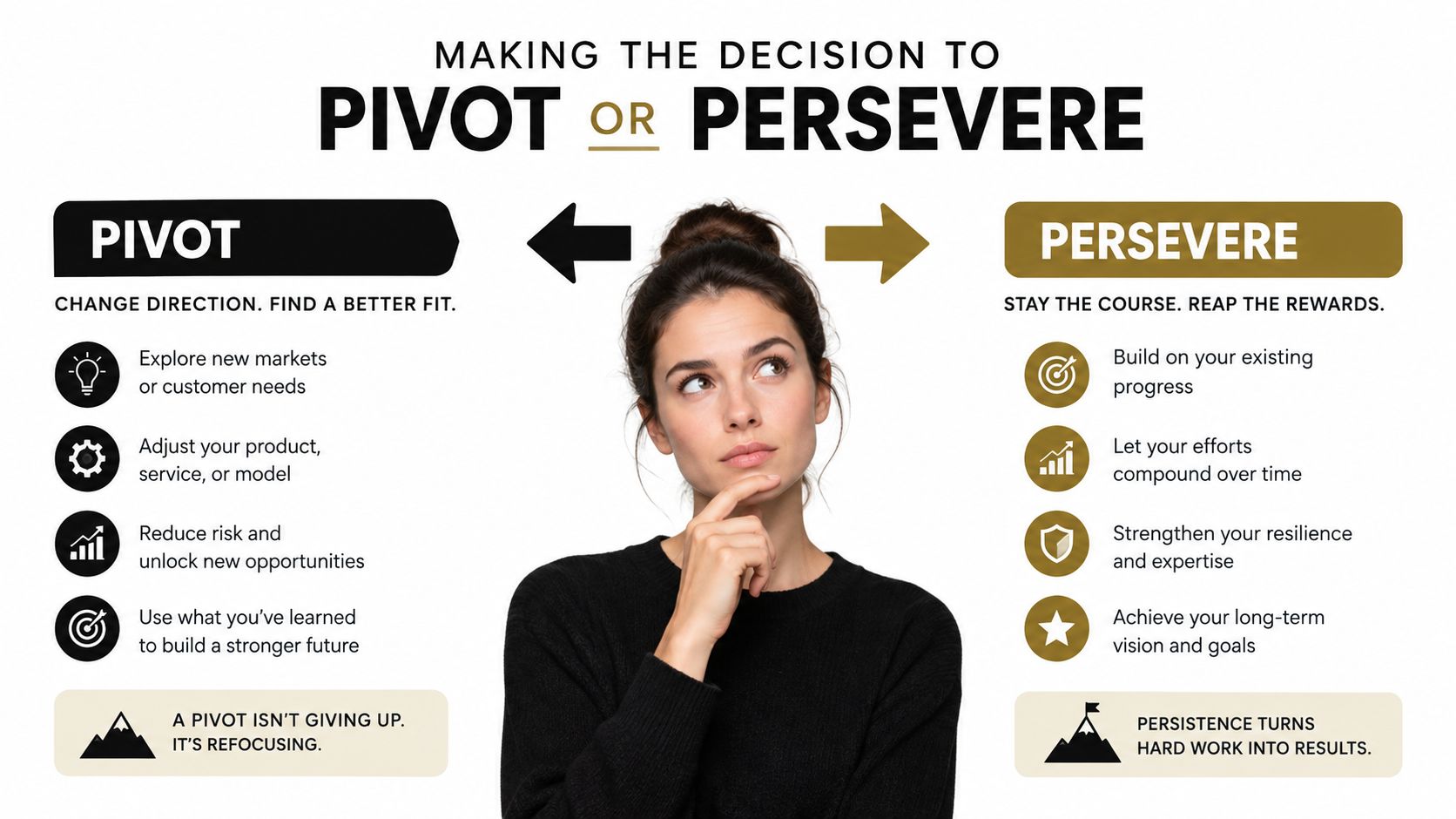
An MVP earns its keep when it helps you decide. If the experiment doesn't force a choice, it's just more activity. The point is to use evidence to move toward one of three outcomes, persevere, pivot, or stop.
The reason this discipline matters is brutal but familiar. “No market need” keeps showing up among the leading reasons startups fail, appearing in roughly 35%–42% of cited analyses of startup post-mortems (Why startups fail). That doesn't mean every idea should die early. It means founders need a way to disconfirm quickly when the demand isn't there.
Decide by sacrifice, not applause
Rank the evidence by what the customer had to give up. Money beats compliments. A deposit beats a waitlist. Repeat usage beats a one-time trial. If your threshold was a paid pilot and you only got friendly calls, the answer is already in the data.
The right decision is often the least emotionally satisfying one. Sometimes you keep going because the signal is strong enough. Sometimes you change the customer segment or the problem. Sometimes you stop and save capital. The mistake is pretending that weak evidence is strong just because building was hard.
If the business model and operating model are getting tangled, this comparison guide can help separate what you're selling from how you deliver it. That distinction matters because an MVP should test the business assumption first, not the entire machine.
Find Startup Idea helps founders spot real pain points, shape them into testable startup ideas, and validate the smallest version worth building. If you're working through what is MVP in practice, visit Find Startup Idea and use it to pressure-test your next idea before you spend real capital on the wrong version.