10 AI SaaS Ideas to Validate in 2026
Discover 10 AI SaaS ideas built from real Reddit and HN pain points, with target customers, validation steps, and ways to test demand before building.
Most AI SaaS ideas don't die because the model wasn't good enough. They die because nobody with a budget cared. A founder spends six weeks wiring up retrieval, ships a demo, and discovers that the people who praised it were never going to open a wallet.
The adoption numbers make this trap easier to fall into. Stanford's 2025 AI Index reports that 78% of organizations said they used AI in at least one business function in 2024, up from 55% in 2023. That tells you AI is normal now. It doesn't tell you which specific workflow a specific buyer will pay to fix, and it doesn't tell you whether they'll tolerate a monthly invoice for it.
So treat the ten AI SaaS ideas below as starting points, not predictions. Each one names the buyer who signs, the complaint people already type into Reddit and Hacker News, the cheapest signal you can collect in a fortnight, and the reason it might collapse. I've ranked them by how fast a stranger can prove value to themselves, not by market size.
Likes, retweets and "this is genius" comments are encouragement, not validation.
Run the tests before you write code. Two weeks is enough to learn whether you have a buyer or an audience.
1. AI Customer Support Triage and Auto-Resolution
This is an AI layer that sits on top of the helpdesk a team already uses. It reads incoming tickets, answers the repeat questions from the company's own knowledge base, routes messy cases to a human, and drafts replies for review. Intercom Fin, Zendesk's AI features and Gorgias's e-commerce agent are the reference points buyers will compare you against.
The buyer is a support lead or founder at a Shopify brand or a small B2B SaaS company, the person who writes "we're drowning in the same 20 support emails every day" in a founder forum.

Where the margin actually lives
Stanford's AI Index found that 49% of organizations using AI in service operations reported cost savings, though most of those savings came in below 10%. Price accordingly. A tool that trims handling time on repetitive tickets is a real business. A pitch that promises to delete the support team isn't.
- Cheapest demand signal: ask for a CSV export of last month's tickets, cluster them by hand, and send back the top ten intents with a drafted answer for each. If they reply asking to switch it on, you have demand.
- Main failure mode: the knowledge base is stale, so confident answers are wrong and agents stop trusting the tool. Show cited sources and confidence scores, and route anything uncertain to a person. Our guide to agent email escalation covers the handoff patterns worth copying.
Price per resolved conversation so cost tracks value, and get onboarding under fifteen minutes with a one-click help center connect. If you're still choosing a niche, our roundup of startup ideas worth testing is a useful cross-check.
2. AI Meeting Notes and Action Item Tracker
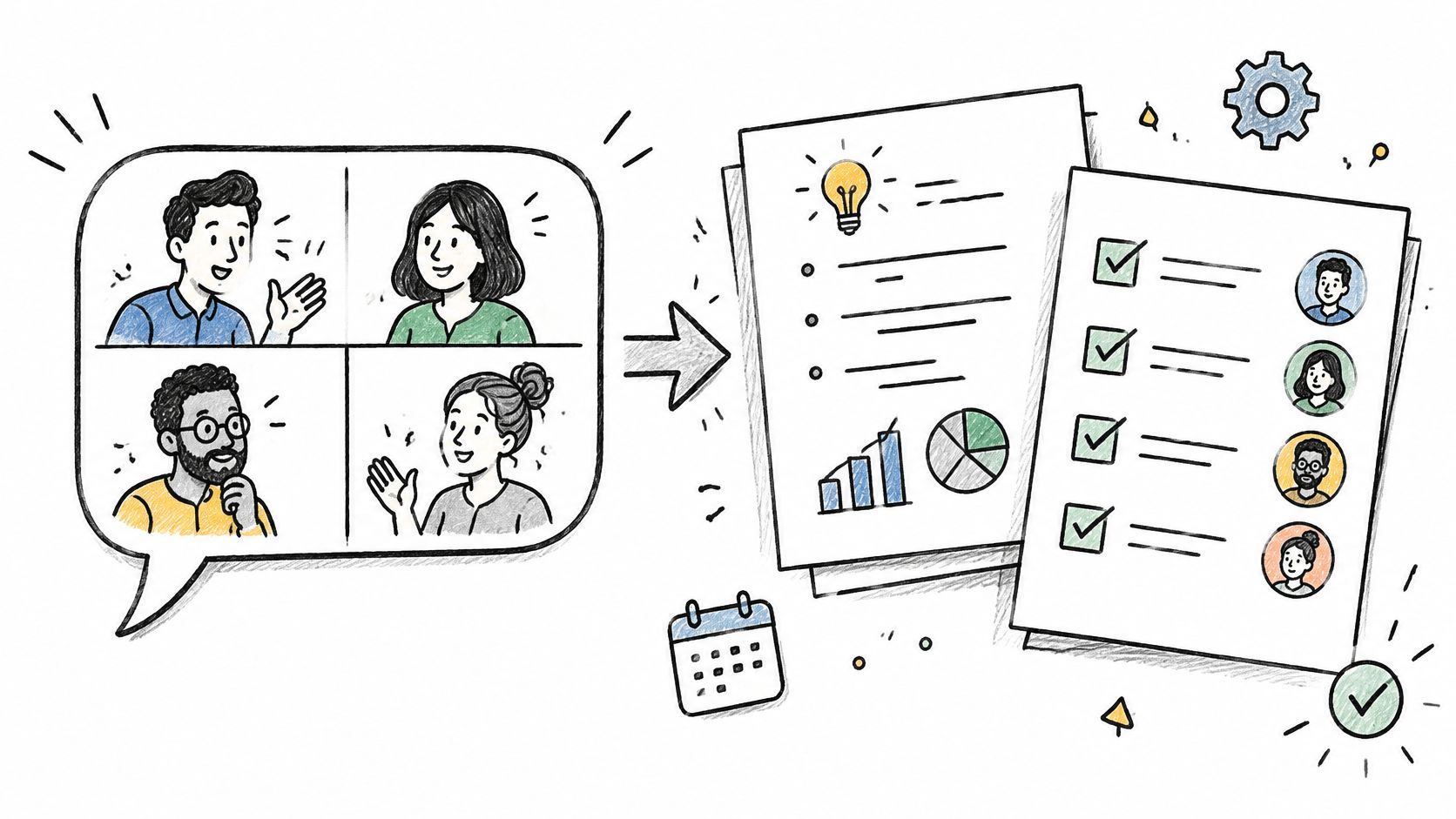
Say an agency runs a Monday client call. Three decisions get made, two people promise deliverables, and by Thursday nobody can say who owned what. That gap, not transcription, is the product.
Otter, Fireflies and Fathom already handle recording and summaries, and Fathom gives notes away. You won't win on transcription accuracy. You win by closing the loop: extract decisions and action items with named owners and dates, push them into Slack, Notion or Asana, then chase them.
The test that separates note-takers from trackers
Offer a sales team a free weekly open action item digest built from recordings they already have. Run it manually for two weeks. If a manager starts forwarding your digest to their reps without being asked, you've found the wedge. If they read it once and forget it, the pain isn't acute enough to bill for.
The buyer is a sales manager or head of customer success, and the phrase to listen for is "we had a meeting about this and nothing happened."
Two things break this idea. Consent is the first: build automatic participant notification and a clear opt-out, or you'll be banned by IT before the pilot ends. Trust is the second: let users edit any summary line in one click, because a single wrong attribution makes people re-read every transcript, which erases the time you saved.
Practical rule: if your product's output needs to be checked line by line, you haven't automated anything. You've added a reading task.
3. AI Lead Research and Enrichment Workflow
Manual prospect research is the most common time sink founders describe: two hours to build a list of thirty companies, another hour to find something specific enough to say in the first line. Clay, Apollo and Unify sell into that pain, which means the category is validated and crowded at the same time.
Your product takes natural-language criteria, builds the list, enriches each account from live web sources, and writes an outreach hook tied to a real signal such as a funding round, a job posting or a product launch.
Sell the workflow, not the rows
Users don't buy contacts. They buy a repeatable play. Ship a template library ("Series A SaaS hiring their first support lead") so a new user gets output on day one instead of facing an empty enrichment canvas.
- Buyer: founder-led sales teams and small agencies, who complain that "researching prospects eats my whole morning."
- Cheapest signal: sell a done-for-you batch. Take a target description, deliver an enriched list with hooks at a flat fee, and see whether they reorder the following week. Reordering is the subscription signal.
- Failure mode: data costs and staleness. Pass provider costs through transparently or bundle them into credits, and never hide a per-row charge inside a flat plan you'll lose money on.
Measure meetings booked, not contacts exported, and build unsubscribe handling and regional filters in from the start. Anyone comparing incumbents will read things like this Apollo alternative breakdown for AI agents, so know exactly which job you do better.
4. AI Content Repurposing Engine
One recorded webinar can become clips, captions, a newsletter section, three LinkedIn posts and a set of quote graphics. OpusClip, Descript and Riverside already prove people pay for pieces of this. The complaint you're solving is "I spend all week chopping up one podcast."
Here's the category in motion.
The buyer is a one-person marketing team at a B2B SaaS company or an agency producing shows for clients. Pick that niche and the messaging sharpens immediately, because B2B clips need different highlight logic than gaming streams.

What to test and what breaks
Let users define their own highlight criteria, such as "only moments with a number or a contrarian claim." That single control is the difference between a clip generator and an editor they trust.
Run a concierge test: charge a flat fee to repurpose one episode end to end, deliver it in 48 hours, and count how many clients ask for the next four episodes. Price the eventual product on source hours processed per month, since that's the cost driver you can't hide.
The failure mode is generic output. If every clip needs a human pass in Premiere anyway, you've sold a rough cut, not a distribution system. Export editable project files and captions so professionals can finish quickly rather than start over.
5. AI Cold Email Personalization and Deliverability Coach
Cold outreach threads repeat two complaints: nobody replies, and everything lands in spam. Lavender coaches reps inside Gmail and Outlook. Instantly and Smartlead handle sending and warm-up. A useful product here focuses on sender health and message quality rather than helping people send more.
The buyer is a founder doing their own outbound, or a sales manager watching reply rates slide. Score drafts before sending, explain which phrases triggered the spam warning, and monitor bounce rates and inbox placement per domain.
Defaults that keep customers alive
- Cap daily volume by default: make the user override a limit deliberately rather than discover it after their domain is burned.
- Check blacklists before campaigns: verify the sending domain against major lists such as Spamhaus and pause anything listed.
- Explain the score: a warning nobody understands gets ignored, so name the exact phrase and suggest a rewrite.
The cheapest demand signal is a paid inbox audit. Charge a small flat fee, review a prospect's domain setup and last sequence, and send a written fix list. If they ask you to keep monitoring it monthly, you have a subscription. Our startup email marketing guide covers the list-building side that has to work before any of this matters.
The reason this idea fails: you can't control the customer's list quality or offer. When replies don't come, they blame the coach. Position on reply rate and deliverability, never on volume, and partner with sending infrastructure providers instead of rebuilding it.
6. AI Review and Reputation Response Manager
A dental group with six locations gets reviews on Google, Yelp and Facebook, and the office manager answers them when she remembers. Your product collects them in one queue, flags urgent negatives, drafts replies in the brand's tone, and rolls recurring complaints into a theme report. Birdeye, Podium and ReviewTrackers are the incumbents, and multi-location pricing leaves room underneath them.
The buyer is an owner-operator or a marketing manager at a small chain, and the phrase is "I know I should reply to reviews, I just never get to it."
Sell the outcome, not the AI
Most small firms aren't shopping for AI at all. The Federal Reserve's analysis of Census Bureau business survey data put U.S. firm AI adoption at approximately 18% at the end of 2025. Pitch response time and review volume, and mention the model only if asked.
Never auto-publish a reply to a negative review at launch. One tone-deaf response to an angry customer costs more than a year of subscription revenue.
The cheapest test is a manual weekly digest: pull a prospect's reviews yourself, draft responses, and email them for approval. Charge for it. If they approve every draft without edits, automate the pipeline.
Where it breaks: platform API access. Review sites restrict scraping and change endpoints, so build on official APIs and budget for maintenance. Add a legitimate review-request workflow, because more reviews is the outcome owners want.
7. AI Contract Review for Small Businesses
Founders sign NDAs and vendor agreements without reading them properly because a lawyer's hourly rate makes routine documents feel not worth reviewing. Spellbook works inside Word for legal teams, Harvey serves large firms, and Ironclad manages lifecycle. The underserved buyer is the small company with no legal function at all.
Position as a first-pass risk screen, not legal advice. Read the document, flag unusual clauses in plain English, suggest standard alternatives, and make escalation to a real lawyer one click away.

Why human review is the feature
A 2025 Capgemini Research Institute survey of 1,020 organizations found 71% could not fully trust autonomous AI agents for enterprise use. In legal work that skepticism is correct. Build the product so a human always makes the call.
Start with one document type. NDAs have predictable structure, which means you can define red-flag rules that hold up and let users tune those rules to their own risk tolerance.
The adjacent pain is AI vendor paperwork itself. A 2025 WTO-ICC business survey found 12% of firms named regulatory or compliance issues as a key barrier to AI adoption, so tracking vendor terms and model changes is a natural extension.
Test it by charging a flat fee to screen a batch of real contracts and return a one-page risk summary. Failure mode: liability. Get jurisdiction-specific disclaimers reviewed by counsel before you launch, not after.
8. AI SEO Content Brief and Search Visibility Tool
Marketers rarely say they can't write. They say they don't know what to write next, or why the last twelve posts did nothing. Surfer, Frase and MarketMuse already sell optimization and briefs, so a new entrant needs a sharper job than "AI content tool."
That job is prioritization plus proof. Analyze the live results for a target keyword, identify what's missing, generate a brief with headings and questions, then track rankings and AI-answer visibility over time.
Build briefs that force originality
Thin content is the failure mode, and it's yours as much as the customer's. Every brief should demand something a competitor can't copy:
- Original data: name the internal number or survey the writer must include.
- First-hand detail: require a screenshot, a test result or a specific tool workflow.
- Expert quote: assign a named person to interview before drafting starts.
Pair each brief with an editing checklist so quality survives scale. A comparison of AI SEO tools shows how crowded the generation side is, which is exactly why the planning and verification side is the better wedge.
The buyer is an agency content lead or a SaaS head of marketing. Cheapest signal: sell three briefs as a paid package, then watch whether the client's published pieces rank and whether they reorder. AI-answer visibility tracking is the differentiator worth building early, because buyers are already asking why they've stopped getting traffic from search.
9. AI Competitor Intelligence Monitor
Founders find out about a competitor's pricing change from a lost deal, three weeks late. Crayon and Klue serve enterprise enablement teams, and Visualping sends raw change alerts. The gap is a short weekly brief that says what changed and why it matters.
Track pricing pages, changelogs, job postings, review sites and ad campaigns. Then filter hard. A CSS tweak isn't intelligence, and a new enterprise tier is.
The digest is the product
Let users choose which change categories they care about, and default everything else off. Build battlecards from detected changes so the insight reaches a sales rep in the middle of a deal, not in a folder nobody opens. If you're unclear on the discipline itself, read what competitor research actually involves before you scope the feature list.
The buyer is a product marketer or a founder at a company with two or three named rivals. The cheapest demand signal is a paid manual brief: pick their competitors, write the weekly summary yourself for a month, and charge for it. If they forward it to their team, automate it.
Two failure modes. Noise kills retention faster than anything, so tune signal thresholds aggressively. And legal exposure is real: respect robots.txt and terms of service, use public pages and official feeds, and never build a business on scraping behind a login.
10. No-Code AI Workflow Automation Builder
Operators want automation and can't maintain brittle Zapier chains. Zapier, Make and n8n all offer AI steps now, so a generic builder is a losing entry. One excellent workflow is a winning one.
Pick invoice intake or lead routing. Combine app triggers with AI steps that classify, extract and summarize, then add approval checkpoints before anything touches money or a customer.
Design for production, not demos
Menlo Ventures' 2025 enterprise AI report found 47% of enterprise AI evaluations reached production, compared with 25% for traditional SaaS, based on a survey of 495 U.S. enterprise AI decision-makers. Buyers are moving faster than you'd expect, which means reliability, retry logic and monitoring matter more than another node type.
Show cost per run and estimated time saved on the dashboard. That's the number the buyer defends internally.
The skills gap is your real market. Recent UK government AI adoption research found 78% of businesses planning to adopt AI reported limited AI skills, expertise or knowledge as a constraint. Those people need a finished workflow, not a canvas.
Test it by automating one process manually for a handful of companies at a fixed monthly fee. Failure mode: silent errors. An automation that misfiles invoices without telling anyone gets cancelled the week it's discovered.
How the 10 AI SaaS ideas compare at a glance
| Item | Target customers | Pricing model | Biggest risk |
|---|---|---|---|
| AI Customer Support Triage and Auto-Resolution | Small to mid-size SaaS and e-commerce companies with 1 to 5 support staff | Usage-based per resolution or tiered monthly seats | Hallucinations can undermine trust |
| AI Meeting Notes and Action Item Tracker | Sales teams, product managers, consultants, and remote teams | Freemium with per-user monthly subscription | Privacy and recording-consent requirements |
| AI Lead Research and Enrichment Workflow | B2B founders, SDR teams, and outbound agencies | Credit-based subscription plus data usage | Third-party data costs can erode margins |
| AI Content Repurposing Engine | Podcasters, YouTubers, B2B marketing teams, and agencies | Subscription tiers based on processed minutes | Crowded market and high video-processing costs |
| AI Cold Email Personalization and Deliverability Coach | Founders doing outbound, SDR teams, and lead-generation agencies | Monthly subscription by mailbox or seat | Changing email-provider requirements |
| AI Review and Reputation Response Manager | Local service businesses, restaurant groups, and mobile app developers | Per-location monthly subscription | Platforms may restrict API access or change policies |
| AI Contract Review for Small Businesses | Startup founders, freelancers, and small agencies | Per-document or flat monthly subscription | Review errors can create serious liability |
| AI SEO Content Brief and Search Visibility Tool | SEO agencies, content marketers, and SaaS growth teams | Monthly subscription by content credits or seats | Search algorithm changes can quickly shift value |
| AI Competitor Intelligence Monitor | Startup founders, product marketing managers, and sales enablement teams | Subscription by number of tracked competitors | Websites may block scraping |
| No-Code AI Workflow Automation Builder | Small business owners, operations managers, and non-technical founders | Tiered subscription based on task or run volume | Integration failures can disrupt business operations |
Validate Your AI SaaS Idea Before You Build It
Pick one idea from this list. Not three. Write its problem in a single sentence with a real buyer attached, the way "office managers at multi-location dental groups can't reply to reviews within a week" does. If you can't write that sentence, the idea isn't sharp enough to test yet, and no amount of building will fix it.
The reason to be strict is that buyers themselves are unsure. The same UK government AI adoption survey work on business attitudes found that most non-adopting businesses point to the absence of a clear business case, which means your first job is proving value, not shipping features.
The 14-day test
- Days 1 to 3: write the one-sentence problem, name the buyer, and build a landing page with a Stripe checkout for a paid waitlist. Charge something, even a small amount.
- Days 4 to 10: put $50 to $150 of paid ads behind it, plus direct outreach to people who've posted the exact complaint online.
- Days 11 to 14: count payments from strangers. The signal for a SaaS or digital product is 10 strangers paying anything inside 14 days.
Friends and coworkers don't count. Neither do upvotes. You're proving that someone who owes you nothing will hand over money before the product exists.
Then make the call inside the window: build, iterate on one variable, or move on. Change the buyer, the price or the promise, one at a time, and rerun. Don't change all three and pretend you learned something.
One more check specific to AI SaaS ideas: confirm the buyer wants software rather than a service or a one-time tool, and will tolerate recurring billing. Several ideas here, especially the concierge tests, can become consulting. That's a fine business, but it isn't the one you set out to build.
Our idea library holds 1000+ ideas sourced from real HN and Reddit pain points, browsable across AI/LLM, Dev Tools, Consumer, B2B SaaS and Crypto/Web3. Save the ones you'd put your name on, and we'll generate a launch prompt for each so your shortlist turns into tests instead of bookmarks.
Find Startup Idea collects startup ideas from real Hacker News and Reddit complaints, so you start with a buyer's problem rather than a model capability. Save the AI SaaS ideas you'd build, generate a launch prompt for each, and work through our 6-step, 14-day SaaS validation playbook drawn from real r/SaaS founders. Browse the library at Find Startup Idea and pick the one idea you'll test this fortnight.