What Is Idea Validation? a Practical Guide for Founders
Learn what is idea validation, why weak demand sinks startups, and how to test an idea with real buyers before you build anything.
Idea validation is testing whether strangers will pay, commit or give a clear yes before the product is built.
You've probably already pictured the product, chosen a name, or opened a blank landing-page template. The uncomfortable question is whether anyone outside your circle will change what they're doing to use it. Validation helps you answer that question before your enthusiasm turns into a costly building project.
What Idea Validation Means and Why It Comes First
Think of a chef offering tasting spoons before opening a restaurant. Watching potential diners choose a dish, ask about its price, or decline another taste is more useful than preparing a kitchen full of food nobody ordered.
For founders, the tasting spoon might be a prototype, a manual service, or a pre-sale page. The point isn't to impress people with how much you've made. It's to discover whether a specific customer values the result enough to act.
Strangers matter because they don't owe you encouragement. Friends and coworkers can help you spot confusing language, but their approval may reflect affection rather than purchasing intent. A clear yes should therefore mean agreement to a concrete next step, not general enthusiasm.
What you're actually testing
- The problem: Does a defined group experience an important difficulty?
- The solution: Would those people choose your approach over their current alternative?
- The commitment: Will they contribute money, time, access, or effort to obtain the result?
For another practical explanation of this early-stage work, Chicago Brandstarters on testing startup ideas is a useful companion.
When someone asks, what is idea validation, the most helpful distinction is that it's a decision process, not a feeling of confidence. You run it before substantial spending on code, design, or fundraising, and repeat it whenever a major assumption changes.
Market research describes customers and markets. A minimum viable product, or MVP, is a stripped-down offering used to learn through delivery. Product-market fit describes a stronger relationship between a product and its market, not permission to start building.
An idea is validated when a stranger behaves as if it matters.
That behavior supports a particular next investment. It doesn't prove that every part of the future business will work.
Why Weak Demand Sinks Most Startups
Demand deserves attention before technical polish. In CB Insights' analysis of 101 public startup post-mortems published in 2014, summarized in Fathy Shalaby's discussion of startup failure, the companies cited the following contributing reasons.
Reasons failed startups cited, from CB Insights post-mortems
| Reason cited | Share of companies citing it | Validation question it points to |
|---|---|---|
| No market need | 42% | Do enough people feel this problem often and pay to solve it? |
| Ran out of cash | 29% | Can the demand test run cheaply before substantial build spending? |
| Wrong team | 23% | Can the founder reach buyers directly to run the test? |
| Outcompeted | 19% | Do current alternatives leave the problem unsolved? |
These were self-selected, retrospective accounts, not a representative sample of all startups. Companies could cite several causes, so the percentages overlap and shouldn't be added together as separate groups.
The practical lesson isn't that funding or execution is unimportant. It's that neither can compensate for building something customers don't sufficiently need.
Investigate the problem before proposing the product
Say you want to build scheduling software for independent tutors. Asking whether tutors would like easier scheduling invites an agreeable answer, but tells you little about their priorities.
Ask about their most recent scheduling difficulty instead. Find out what happened, what they did about it, whether it affected paid work, and why their existing calendar or booking tool wasn't enough.
Useful questions include:
- Frequency: When did this last happen, and when did it happen before that?
- Existing effort: What do you currently do to prevent or fix it?
- Consequences: What work, income, or customer relationship suffered?
- Alternative shortcomings: Why haven't you switched to something already available?
A tutor who occasionally exchanges extra messages has a different problem from one who repeatedly loses bookings. Those situations may call for different products, prices, or no new product at all.
Start with evidence of an unresolved problem. Validation is cheapest when you can still change direction without discarding a substantial build.
Problem, Solution and Commitment Evidence Compared
Not all positive responses justify the same decision. Separate problem evidence, solution evidence, and commitment evidence so that enthusiasm doesn't become a substitute for action.
The hierarchy helps you identify what you've learned and what remains uncertain.
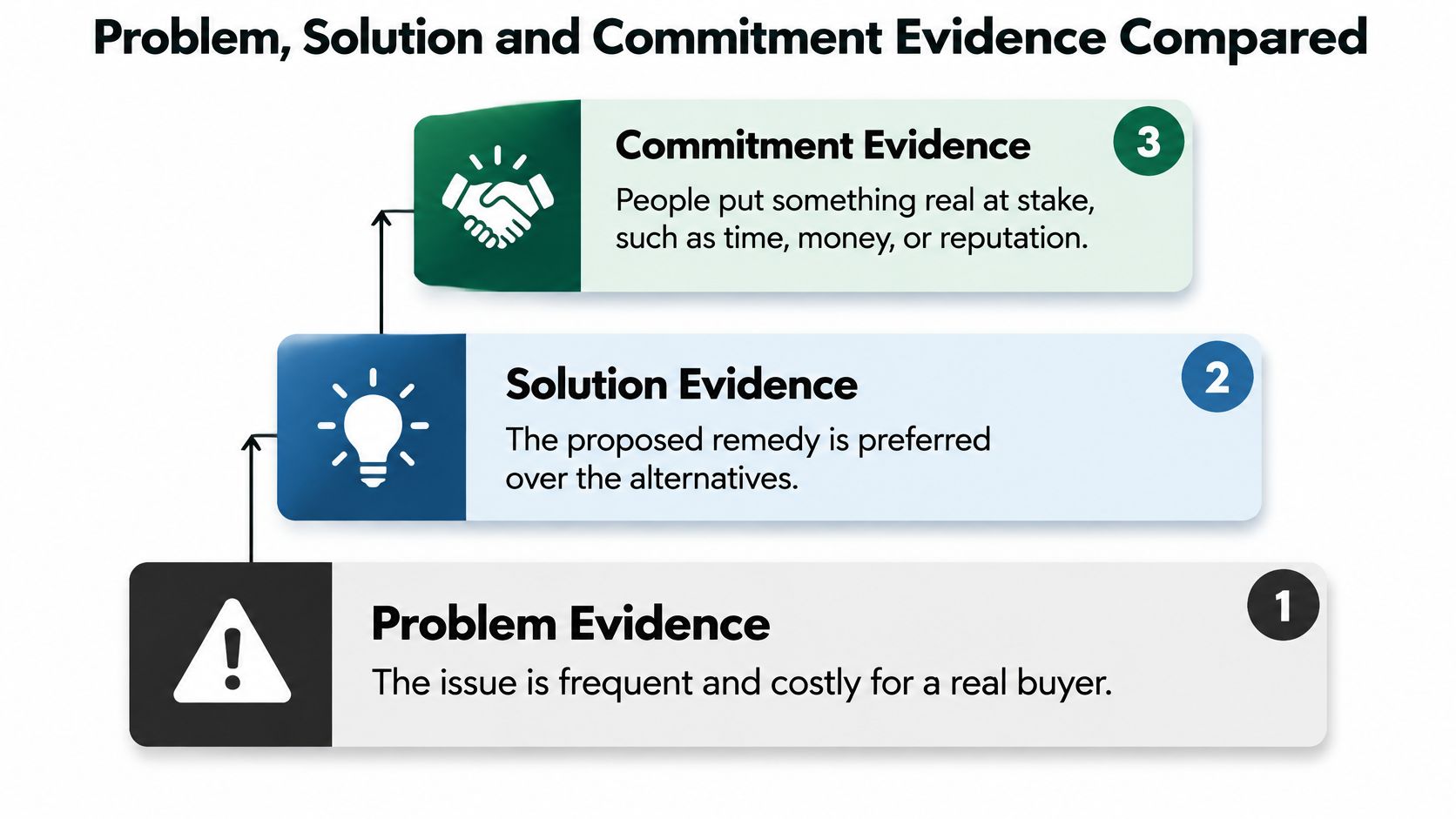
| Evidence level | What it establishes | What it doesn't establish |
|---|---|---|
| Problem evidence | The issue is frequent or costly for a real buyer | That your proposed remedy is desirable |
| Solution evidence | Someone prefers your approach to an alternative | That they'll adopt or purchase it |
| Commitment evidence | Someone puts money, time, access, or reputation at stake | That you can yet operate a sustainable business |
Interviews are particularly useful for understanding past incidents, workarounds, and purchasing context. Use a problem statement canvas to keep the customer and difficulty specific rather than drifting into a feature wishlist.
Match commitment to the buying decision
For business-to-business software, a signed pilot with an accountable buyer can tell you more than a large waitlist. For a consumer app, people returning voluntarily may be more informative than enthusiastic interviews.
The distinction matters because an unwanted offering remains a serious business risk, a concern discussed in the U.S. Chamber of Commerce guide to why small businesses fail. But a favorable conversation and a conversion aren't interchangeable measures of that risk.
Strangers giving money or a work email are stronger signals than likes, although a work email still doesn't prove willingness to pay. To distinguish casual attention from meaningful next steps, SignalVan on qualifying high intent prospects offers useful context.
Strong interviews followed by no sign-ups are contradictory evidence worth investigating. The problem may be real while your offer, trust level, or requested action is wrong.
Practical rule: Don't let strong problem evidence excuse missing commitment evidence.
A negative result is useful when it prevents you from funding an assumption that customers won't support.
Proof Signals for Each Business Type
Use these illustrative starting rules, not universal research benchmarks, to match the requested commitment to the business you're considering.
Proof signals and tests by business type
| Business type | Signal that counts | Test to run | Budget or window |
|---|---|---|---|
| SaaS or digital product | 10 strangers paying anything | Landing page with Stripe checkout for a paid waitlist, plus paid ads | $50–$150 of paid ads, within 14 days |
| Course or info product | 10–20 paid signups before the first lesson exists | Pre-sale page with checkout, plus paid ads | Set an affordable loss limit and a closing date before launch |
| Consumer app | Organic reach above 5x views per follower and 1%+ click-through to the waitlist | Short posts linking to a waitlist page | Organic posting during a predefined observation window |
| Crypto or on-chain product | 100+ self-attributed wallets engaging with the testnet | Public testnet | Within 30 days |
| Marketplace | 5 paid matched transactions brokered by hand | Manually match the first 10–20 buyers and sellers before writing code | Set a matching deadline before recruiting |
| Physical product | Strangers paying the actual price | Shopify or Kickstarter page with the actual price, plus a sample or 3D render | $100–$300 of paid traffic |
For SaaS, the initial question is whether strangers will make a financial commitment to the proposed outcome. A landing page and checkout can test that without requiring you to implement the application first.
Payment alone still leaves an important distinction unresolved: does the buyer want software, a done-for-you service, or a one-time tool? Confirm that the intended customer will tolerate recurring billing before treating a deposit as support for a subscription business.
Why the tests differ
A course can be sold around a clearly described learning outcome before lessons are recorded. A marketplace must demonstrate that buyers and sellers can complete an exchange, so manually brokering transactions tests more than collecting names.
Physical products introduce production and fulfillment obligations. Show the actual price, identify renders as renders, and explain delivery expectations before accepting money.
The consumer-app row is an audience and acquisition screen, not evidence of sustained use. Likewise, testnet engagement can demonstrate participation without proving future paid demand.
Each row reduces a different uncertainty. Choose the signal that would justify your next expenditure, and don't mistake completion of the test for validation of the whole business.
How to Run a Validation Test Step by Step
Treat validation as an experiment you could fail. A Springer chapter on startup validation describes the core method: formulate a falsifiable hypothesis, run a small experiment, and compare observed behavior with a predefined decision rule.
This visual summarizes the process from problem definition to decision.
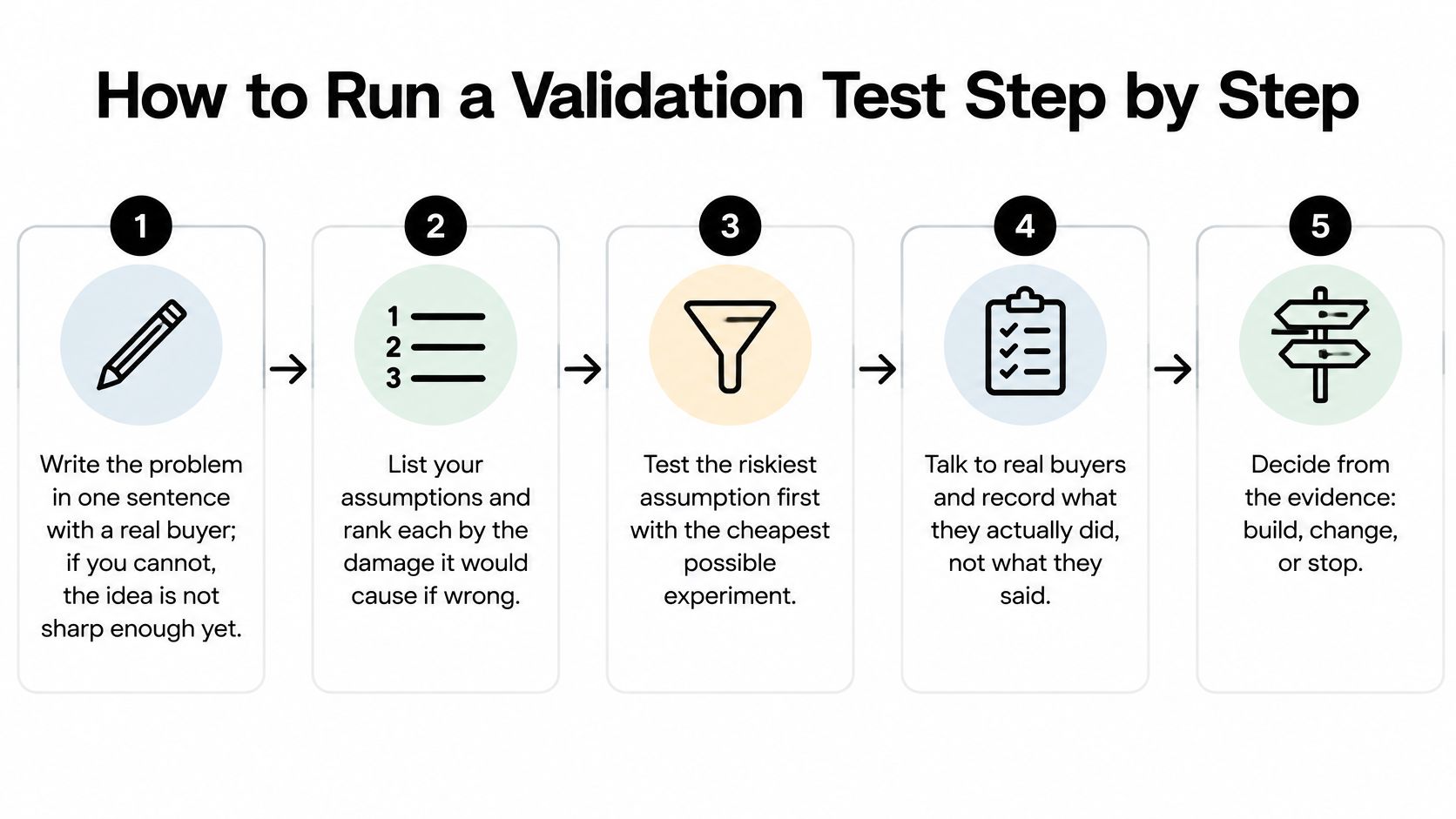
Write the problem with a real buyer. State who struggles, in what situation, and with what consequence. If you can't do that in a sentence, narrow the idea before designing a test.
Rank your assumptions. Consider both how uncertain each assumption is and how damaging it would be if wrong. Don't test an easy interface preference while leaving the buyer's willingness to switch unexamined.
Choose the smallest credible experiment. A riskiest assumption test should target the uncertainty that could invalidate the business. Use manual delivery or a simple checkout when a functioning application wouldn't add useful evidence.
Record the threshold and observation window. Write down the audience, requested action, primary measure, deadline, and pass/fail rule before launching. Changing the rule after seeing disappointing results defeats the purpose.
Recruit strangers through a named route. Our cold-traffic starting rule is 200–500 visits before drawing conclusions from a landing-page test, not a guarantee of statistical certainty. Record whether visitors came from search ads, targeted outreach, or another route, and separate responses by customer segment.
Compare behavior with the rule and record a decision. Proceed, revise a specific variable, or stop. A payment test doesn't pass because visitors spent time reading the page.
A passing result reaches the commitment threshold through a route you can plausibly use again. A failing result falls short, even if the surrounding comments sound encouraging.
For a video companion to the testing process:
Keep delivery planning separate from demand testing. A resource on creating digital products step by step can help you scope production after customers have given you a reason to proceed.
A Worked Example From Idea to Decision
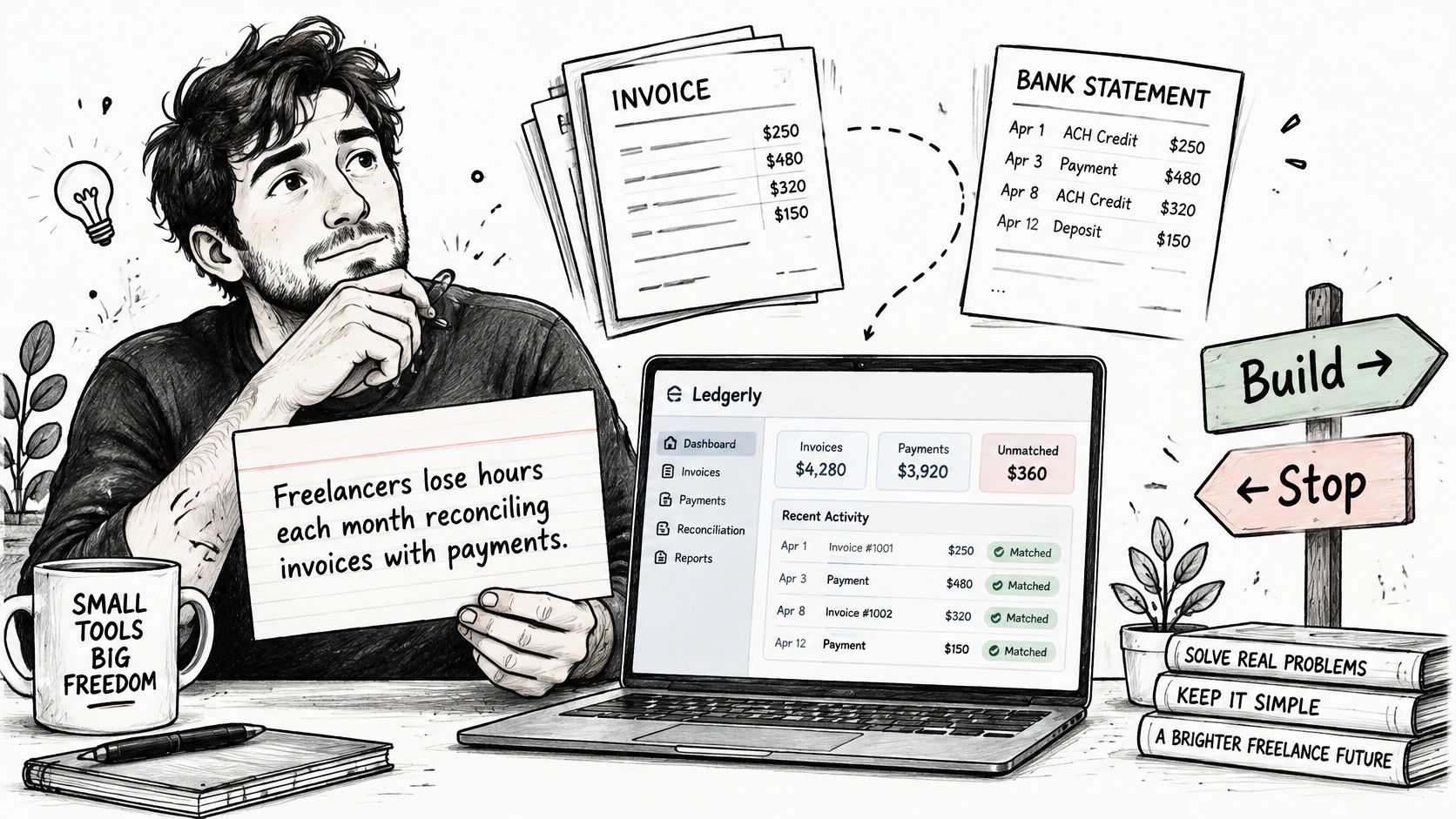
Consider a hypothetical solo founder exploring a bookkeeping tool. Her problem statement is simple: freelancers spend too much time matching client payments to outstanding invoices.
She hasn't established that this is common yet. She interviews freelancers about recent reconciliation work and recruits people who handle their own invoicing rather than mixing them with businesses that employ bookkeepers.
The image illustrates the workflow she wants to simplify, not evidence that her proposed tool works.
Set the rule before seeing the outcome
She creates a landing page describing the intended result and adds Stripe checkout for a paid pilot reservation. The page clearly explains that the software isn't ready, what the reservation covers, and how refunds work.
Her rule is to proceed only if the test meets the SaaS commitment threshold. She also records where visitors come from, so she can distinguish buyer interest from irrelevant traffic.
Suppose enough strangers pay to meet that rule. That justifies a narrow pilot focused on matching invoices and payments, not a complete accounting platform.
| Illustrative outcome | Decision |
|---|---|
| Paid reservations meet the prewritten rule | Deliver a narrowly scoped pilot |
| Many visitors subscribe, but nobody pays | Investigate the offer before building |
| Paying users expect a bookkeeping service | Reconsider whether software is the right business |
| Interest comes from an unintended segment | Test that segment deliberately |
Decide what remains unproven
The founder now needs to discover whether customers can connect their records, receive accurate matches, and continue using the workflow. She can compare minimum viable product examples to choose a limited delivery format rather than building every anticipated feature.
For the next experiment, she might change price while holding the buyer segment and promised outcome steady. Changing the price, audience, copy, and product together would make the result difficult to interpret.
If nobody pays, she shouldn't explain away the result with positive comments. She should investigate the obstacle, identify a credible revision, or leave the idea behind.
Misconceptions That Make Validation Fail
Popularity means demand. Likes, retweets, and enthusiastic comments show that people noticed something. They don't establish that those people will accept the trade-offs involved in buying or adopting it.
A bigger test budget produces a better answer. Our working warning is that spending more than $500 on validation usually means avoiding the harder part: talking to people. Treat that as a prompt to inspect your experiment, not a universal spending ceiling for every industry.
Replace reassuring signals with useful checks
- Friendly approval: Use friends' feedback to improve clarity, then test with people who resemble the intended buyer.
- A finished prototype: Observe whether someone uses it to solve a real task, rather than treating the artifact itself as evidence.
- Community complaints: Check who is complaining, what they've tried, and whether they represent your intended market.
- Cheap sign-ups: Follow the people through activation or purchase before concluding that acquisition works.
Demand automatically means distribution will work. A customer may want your product while remaining too expensive or difficult for you to reach. The idea validation framework highlights the need to examine customer access alongside the offer itself.
Hacker News and Reddit can reveal detailed frustrations, but vocal participants may be unusually technical or willing to assemble their own tools. Don't assume that an active thread represents every buyer you hope to serve.
Test whether you can reach the buyer
Record acquisition spending and founder time, then relate them to actual customers rather than clicks alone. Estimate whether realistic pricing and continued usage could support that effort without assuming everyone stays indefinitely.
The most useful test is one that could persuade you to abandon a weak assumption.
That's falsification in plain language: give the idea a fair chance to fail before giving it a large budget.
Decide to Build, Iterate or Move On
For an initial validation sprint, make a decision within 14 days: build, iterate on a variable, or move on. A longer test, such as testnet participation, needs an explicit continuation decision rather than being allowed to drift.
The objective isn't certainty. It's enough relevant evidence to justify a bounded next step.
Choose the next investment deliberately
| Decision | When it fits | What to do next |
|---|---|---|
| Build | Target customers meet the commitment rule | Deliver the smallest useful version and check whether the promised outcome occurs |
| Iterate | You can identify a plausible, testable obstacle | Change a variable such as price, segment, or purchase friction |
| Move on | The test fails and no focused revision has a credible rationale | Record what you learned and stop allocating resources |
Build doesn't mean launch a full roadmap. It means make the next investment proportionate to what customers have demonstrated.
Iteration also needs a reason. If you can't explain why a particular change should alter behavior, you're extending the test rather than learning from it.
Write your buyer's problem in a sentence today. Choose the matching experiment, define what would count as failure, and put a decision date on your calendar before you open another design tool.
Visit Find Startup Idea to browse 1000+ ideas sourced from real Hacker News and Reddit pain points across AI/LLM, Dev Tools, Consumer, B2B SaaS, and Crypto/Web3. Save the ideas you'd put your name on, generate a launch prompt, and choose a candidate to turn into a falsifiable validation test.