Online Communities Market Research Guide for 2026
Practical online communities market research guide covering Reddit, Hacker News, forums, scraping, and listening tactics to turn community insight into real

The most popular advice in online communities market research is also the most dangerous. Find where people complain loudly, copy their words, and build what they ask for. That's extraction, not research. A thread can be long, angry, and completely unrepresentative of anyone who would pay you. Your job isn't to listen harder. It's to prove, or kill, a signal before it turns into a product roadmap.
Why Loud Threads Are Not the Same as a Real Market
A passionate Reddit thread feels like market evidence because it has volume, specific language, and real emotion. It doesn't tell you who those people are, whether they'd switch tools, or whether the complaint survives outside that subreddit. Intensity often tracks identity and status inside the community, not willingness to pay. People perform expertise, defend norms, and pile onto fashionable complaints because the community rewards it.
Scale makes this trap easier to fall into. A 2026 Pew Research Center survey on online community participation found nearly 4 in 10 U.S. adults belong to at least one online community, rising to 48% among adults aged 18 to 29, and 85% of participants belong to more than one community. You're not sampling one audience in one place. You're watching overlapping populations who carry the same opinions across platforms, and who may not match your buyer at all.
The three discounts you must apply
Before you treat any thread as demand, discount it three ways.
- Selection bias: Members joined for a reason, often because they're more motivated, technical, or frustrated than the broader market.
- Vocal minority bias: A small group of highly active members can dominate visible discussion and set what looks like consensus.
- Platform bias: Rules, ranking, and culture shape which complaints get posted and amplified.
Academic work on this boundary warns that online communities have unclear organization and that turning community text into usable business insight is still early, as described in research on online communities and international business insight. It also flags a consent problem. Researchers can often access posts without meaningful permission, and contributions can remain visible after members leave.
The richest discussion may be the least reliable indicator of market size.
Treat community research as triangulation. Qualitative listening gives you language, context, and hypotheses. Quantitative checks, behavioral evidence, and direct conversations tell you whether a hypothesis describes a market. If you're testing an idea, pair this mindset with a structured approach to validating a startup idea before you build so enthusiasm doesn't substitute for proof. Loud is a starting point. It is not a decision.
Defining the Question and Mapping Your Community Landscape
Don't open Reddit with a vague goal like find a startup idea. Write a question community data can answer. Which workflow do freelance designers describe as broken often enough to seek workarounds? What triggers a small ecommerce owner to search for a replacement tool? A good question names a population, a situation, and a decision you'll make from the answer.
Then define eligibility before you collect anything. Who counts as a likely buyer, who is only an observer, and who should be excluded? Record baseline traits you can observe or verify, and plan how you'll remove duplicates and inactive accounts. This matters historically too. Online research communities account for 2.8% of total market research revenue and 26% of researchers use them regularly, according to market reporting on online community research adoption. The method is established, but it isn't universal, so your frame has to be defensible.
Map platforms to jobs, not hype
Communities aren't interchangeable. Use a short map, then invest hours only where fit is strong.
Community Types and Best Research Uses
| Community Type | Best Research Use | Watch Out For |
|---|---|---|
| Reddit subreddits | Pain language, workarounds, recurring complaints | Vocal minorities, subreddit norms |
| Hacker News | Technical buyers, tool switching, build versus buy debates | Developer skew, status signaling |
| Discord and Slack groups | Ongoing behavior, peer help, retention signals | Access limits, insider jargon |
| Niche forums | Deep domain problems, long buying cycles | Small samples, aging demographics |
| Review sites | Switching triggers, unmet expectations | Extreme reviews, incentivized posts |
Overlap is your next problem. The same person may post on Reddit, comment on Hacker News, and sit in two Slack groups, so don't count three mentions as three buyers. Note likely overlap in your brief and deduplicate by username, phrasing, and story details where you can.
For founders mapping where peers gather, this overview of online communities for entrepreneurs helps separate networking spaces from research worthy ones. If you want a broader method for moving from question to evidence online, AI-powered market research tips from Zemith covers practical ways to structure that early work. Finish with a one page brief. Question, target population, platform shortlist, exclusion rules, and what evidence would change your mind.
Turning Raw Threads into Structured Evidence
Teams fail at extraction. They paste comments into a spreadsheet, run sentiment scoring, and call the output insight. Sentiment tells you tone. It doesn't tell you intent, context, or whether money is involved. You need a coding schema before you tag anything.
The image below captures the shift from scattered comments to evidence you can sort and challenge.

A tagging taxonomy that fits on one page
Tag every useful post on four dimensions.
- Topic: The job or workflow being discussed, in the member's own terms where possible.
- Intent: Venting, seeking help, comparing tools, asking for recommendations, or reporting a purchase or switch.
- Intensity: Mild annoyance, repeated friction, or a blocking problem with a workaround cost.
- Buyer signal: Mentions budget, team impact, deadline, current paid tool, or a decision maker.
Here's how that plays out. Three Reddit complaints about client reporting look different at first. One hates formatting exports, one can't get data from two tools into one view, and one spends Friday afternoons rebuilding the same dashboard. Tagged properly, they collapse into one pain. Recurring manual assembly of client facing reports. Frequency alone would have split them. Intent and workaround cost unite them.
The reverse also happens. A popular Hacker News thread about note taking apps seems like one opportunity until you tag by segment. Students want free capture, researchers want citation handling, and team leads want permissions. That's not one market. It's three, with different willingness to pay.
Practical rule: Separate how often people mention a pain, how strongly they feel it, and whether they're already spending money or time to escape it.
Deduplicate aggressively. Identical complaints reposted across threads, quote chains, and cross posts inflate volume without adding evidence. Keep the strongest original example and note recurrence separately. For teams working through large volumes of customer language, customer signal analysis with Sift AI from Sift AI outlines ways to structure voice of customer material beyond raw sentiment. Your output shouldn't be a quote dump. It should be a ranked list of themes, each with segment, intent, intensity, and buyer signals attached.
Scraping, APIs, and Listening Tools Without Crossing the Line
Start with what you can run without engineering help. Saved searches, platform alerts, RSS where available, and no code listening tools cover most early research. Tools such as Reddit search operators, Hacker News Algolia search, and community specific archives let you pull historical threads fast. Find Startup Idea is one option in this layer, since it analyzes publicly available Hacker News discussions to surface pain points and quotes.
The visual below reflects the split between listening work and technical collection work in a small stack.

When you need scale, prefer official APIs over scraping. Reddit, Hacker News, and Discord all expose endpoints with documented limits. APIs give you stable fields, clearer terms, and fewer breakage surprises when a site changes its layout. If you do scrape public pages, keep it narrow, respect rate limits, and don't collect what you don't need.
Boundaries that aren't optional
- Terms of service: Check whether automated collection, storage, and commercial use are allowed before you build a pipeline.
- Data minimization: Store post text, date, community, and your tags. Skip emails, real names, and profile details you won't use.
- Private spaces: Don't join closed groups under false pretenses to harvest posts. If members expect privacy, treat the space as private.
- Quoting ethics: Paraphrase by default. Quote briefly only when wording itself is the evidence, and avoid identifying vulnerable posters.
Operational hygiene saves projects. Archive your own tagged extracts with source links and capture dates, because moderators delete threads and users edit posts. Keep a discard log too, noting why you excluded duplicates, spam, or off target segments. That log becomes your audit trail when someone challenges a finding.
This walkthrough shows how practitioners set up listening workflows in practice.
Build the smallest pipeline that answers your brief. A founder who checks three well chosen communities twice a week with consistent tagging will beat a team hoarding millions of untagged comments. Collection isn't insight. Discipline about what you keep, and why, is what makes the archive usable later.
Validating Community Insight Against Real Buyer Behavior
Validation is where online communities market research becomes a method instead of a hobby. A theme that looks huge in thread volume can collapse once you ask who is speaking and what they do outside the thread. A quieter theme can win because it maps cleanly to people who already spend money on imperfect fixes.
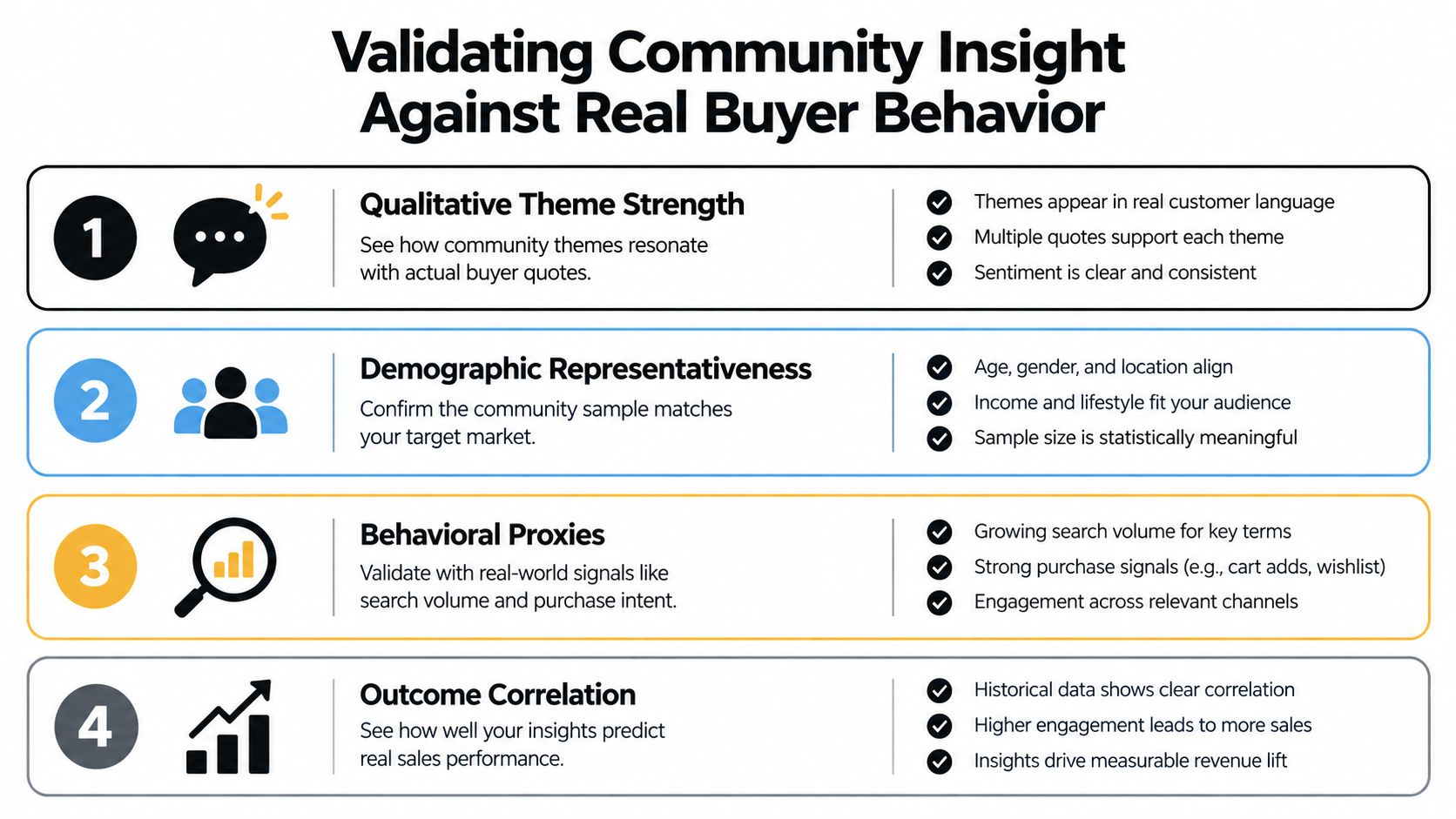
Use the four layer check in the infographic below before you act on any candidate insight.
The four layers in practice
First, qualitative theme strength. Does the pain recur across independent threads and time periods, with specific situations and workarounds? Vague agreement is weak. Repeated stories about the same broken step are stronger.
Second, demographic representativeness. Compare who is posting with who would buy. If your buyer is an operations manager at a mid sized firm but your evidence comes from students and hobbyists, downgrade it. Methodological work on online sampling warns that frames are often incomplete and self selection overrepresents motivated responders, as shown in a methodological case study of online research community sampling, which reported 553 registrations but only 181 valid responses, a 32.7% valid response rate. Sign ups and post counts inflate confidence unless you measure conversion separately.
Third, behavioral proxies. Look for search demand around the workaround, spending on adjacent tools, job posts mentioning the task, and marketplace reviews describing switching. You're asking whether people act on this pain when no community audience is watching. Transactional and search behavior won't confirm your exact solution, but they can falsify a fantasy market quickly.
Fourth, external contact. Run short interviews or a small survey outside the source community. Recruit people who match the buyer profile but didn't write the original posts, then test whether the pain, language, and current spend hold up. Structured customer discovery interviews work well here because you can probe past behavior instead of collecting polite opinions about a future product.
A simple scoring rubric
Score each layer low, medium, or high, and require strength in at least three layers before you invest serious build time.
- Theme strength: Recurring, specific, and costly in time or money.
- Fit: Posters resemble actual buyers with budget authority.
- Behavior: Independent evidence of searching, buying, or switching.
- Confirmation: Outsiders repeat the pain without being led.
Consider a loud complaint about a free tool's interface. It scores high on volume, low on fit and behavior, because posters resist paying for anything. Contrast a smaller thread where agency owners describe paying contractors to fix reporting errors. Volume is lower, but fit, behavior, and confirmation are strong. The quieter signal is the better market. Loud enough means validated across layers, not merely visible.
How Moderation and Platform Governance Distort What You See
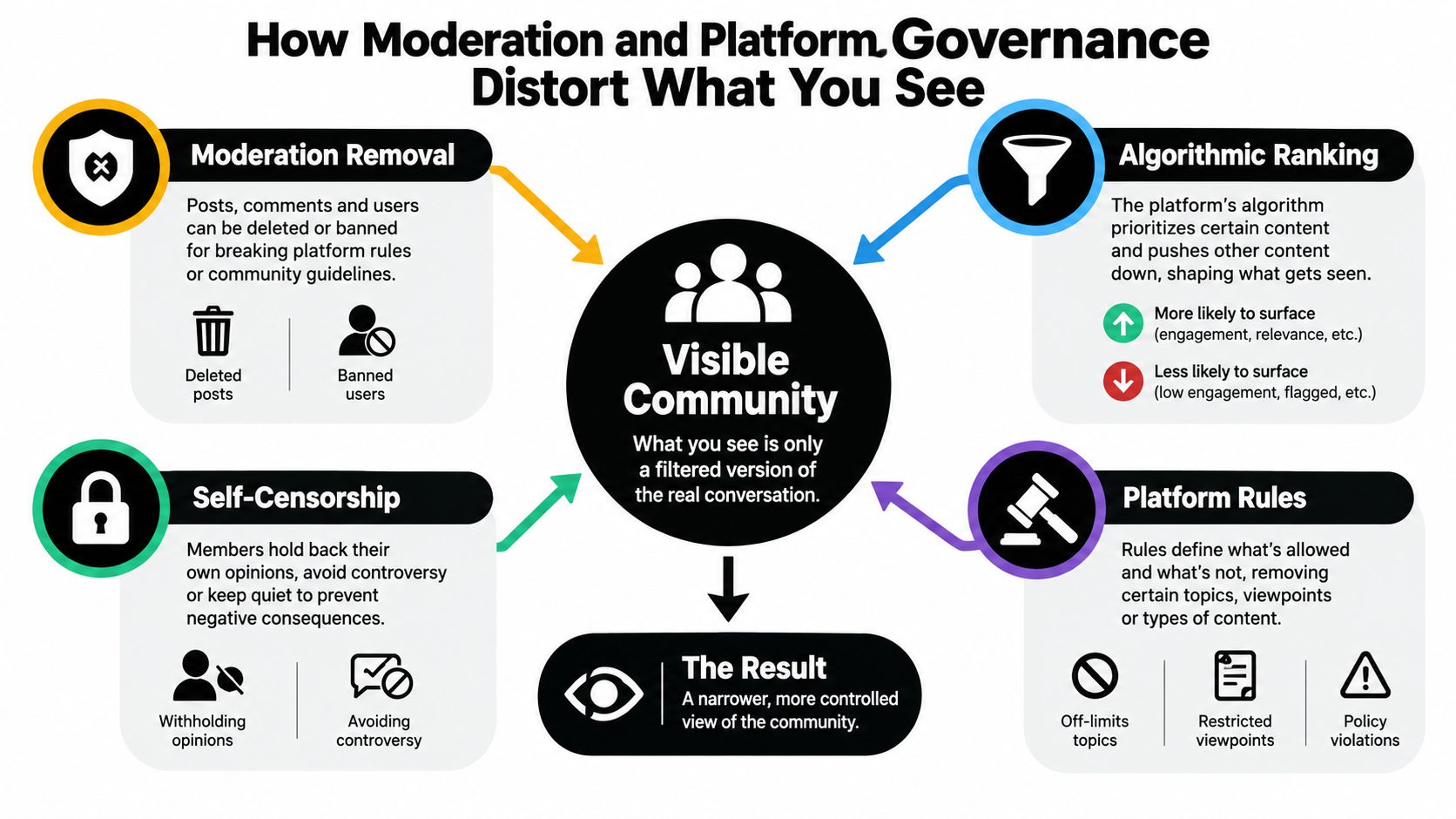
Visible posts aren't a fair sample of what members think. They're what survived rules, ranking, deletion, and self censorship. If you don't record that context, you'll compare sentiment across platforms as if each one shows reality the same way. It doesn't.
Recent trust and safety evidence makes the distortion concrete. A 2025 assessment covering 184 federated services and more than 7 million hosted accounts found the moderator to member ratio had worsened from roughly 1 to 1,200 active accounts to 1 to 3,500, and one in five moderators reported burnout or trauma, according to the 2025 Social Web Trust and Safety Needs Assessment. Small communities and single user instances were also poorly served by tools built for large flagship communities. Under moderated spaces don't just get noisier. They lose certain voices entirely.
The concept map below shows the main forces filtering what reaches your spreadsheet.
What to record alongside every data point
Add governance fields to your tagging sheet.
- Moderation context: Public rules, banned topics, and whether commercial or competitor mentions are removed.
- Deletion signals: Removed comments, locked threads, and moderator notes in the material you collect.
- Safety climate: Whether harassment or pile ons appear tolerated, which can silence less powerful members.
- Ranking effects: Whether early votes, pins, or algorithmic sorting pushed one viewpoint to the top.
Cross country work adds another layer. In a representative 10 country survey of about 13,500 people cited in the same trust and safety reporting context, 59% viewed rudeness, intolerance, or hate as unavoidable on social media, while 79% supported removing incitements to violence. Norms about acceptable speech differ, so identical complaints may stay visible in one market and vanish in another.
If you're building or running a research community yourself, guidance on online community moderation that scales from BUNCH helps you think about enforcement capacity before it becomes a data quality problem. For external listening, the discipline is simpler. Don't treat absence of a complaint as absence of a problem until you've checked whether the platform allows that complaint to exist. Governance aware sampling means your conclusions carry their context with them.
A 90-Day Operating Cadence for Community Research
A cadence turns good intentions into outputs a founder can defend. Split the work into three blocks, each with a clear deliverable, and resist collecting more data than you can tag and validate. Practitioner evidence shows why planning matters. In practitioner research on online community effectiveness, nearly 90% of experienced users said communities met expectations, yet 71% identified poor internal promotion, 61% cited attempts to run communities internally, and 60% cited inadequate advance planning as effectiveness problems.
Days 1 to 30 and 31 to 60
In the first block, write the research brief, map communities, set exclusion rules, and build the smallest listening stack that covers your shortlist. Your output is a research backlog of questions ranked by decision value, plus a tagging sheet with governance fields included. Assign one owner for analysis and one for stakeholder decisions, even if both roles sit with the founder on different days.
In the second block, tag in weekly batches and promote only recurring themes into validation. Run behavioral checks, recruit outsiders for short interviews, and start a small owned panel only if you'll use it repeatedly. Measure invitation to active participant conversion, activity completion, repeat participation, and attrition separately. Don't overload members with repetitive tasks, and don't let the panel become a cheap substitute for representative quantitative research.
Days 61 to 90 and the questions founders ask
Close with a decision review and bias audit. Compare your sample against the intended market, revisit deleted or excluded material, and package each surviving insight with its four layer validation score. Kill communities that produce volume without buyer fit. Keeping them because they're active is how echo chambers become strategy.
Small teams ask the same practical questions at this stage.
- Which tools first: Start with native search, saved queries, and a spreadsheet or Notion or Airtable base. Add APIs only when manual work breaks.
- Who moderates an owned panel: One named person with a weekly time budget. Unowned moderation becomes inconsistent moderation.
- How often to refresh a panel: When repeat voices dominate, demographics drift, or the same members answer every activity.
- When quoting is defensible: Briefly, for public posts, when wording is evidence and identification risk is low. Paraphrase everything else.
High participation only matters when it changes a decision someone owns.
End each cycle by tracking insight adoption, not just activity. Which finding shaped a landing page test, a pricing conversation, or a decision not to build? That record is your proof the program works. It also tells you exactly which communities deserve another 90 days and which ones were just loud.
Stop mistaking thread volume for demand and start with signals you can validate. Find Startup Idea surfaces startup ideas sourced from real Hacker News and Reddit pain points, so you can begin with concrete customer language and then apply the representativeness, behavioral, and interview checks in this guide. Visit the site, pick one promising pain point, and run it through your four layer score before you write a line of code.