How to Validate Startup Idea
How to validate startup idea. Learn how to validate a startup idea with real experiments, customer interviews, and falsifiable tests that reveal true demand
The popular advice to “ask people whether they like your idea, then build an MVP” is backward. You don't need encouragement to start a company. You need evidence that would stop you from building the wrong one, plus a credible explanation of how customers will discover, approve, and pay for it.
Treat startup validation as an attempt to disprove your business hypothesis. Test the problem before developing the product, but check commercial feasibility alongside it. A painful problem isn't enough if the person who wants your solution can't buy it.
Why Most Founders Validate the Wrong Thing
A founder presents a polished concept, collects enthusiastic responses, and calls the idea validated. Nothing meaningful has changed. Nobody has abandoned an existing tool, allocated a budget, or accepted the inconvenience of trying something new.
The historical warning is clear. CB Insights' widely cited analysis of more than 110 startup post-mortems identified “no market need” in 42% of cases, making it the most frequently reported failure reason in that dataset, as summarized by Startups.com's examination of startup failure. That's a retrospective finding, not a prediction for your company, but it makes demand the wrong assumption to leave untested.
Replace encouragement with a falsifiable claim
Start by writing what must be true for the business to deserve your time. Specify the customer, the painful situation, the current alternative, and the action you expect them to take.
A useful hypothesis might be: finance managers at service agencies struggle to reconcile contractor invoices before client billing, and they'll authorize a paid pilot that reduces that work. This is a hypothetical business, not a customer success story. Its value is that you can investigate each assumption separately.
Now write the opposite case. Perhaps reconciliation is annoying but manageable, the accounting platform already handles it, or the finance manager has no discretionary budget.
Practical rule: Before running a validation experiment, write down what result would make you stop. If every possible result supports building, you're not testing anything.
RapidNative's guide on how to validate startup idea is a useful companion resource for organizing the process. Keep the distinction between completing validation activities and earning permission to build.
Judge signals by what customers sacrifice
Different responses answer different questions. Don't combine them into a single reassuring traction total.
- Compliments reveal a reaction to your explanation, not a purchasing decision.
- Waitlist registrations reveal curiosity and permission to follow up.
- Workflow changes reveal whether customers will tolerate disruption to pursue the outcome.
- Financial or operational commitments reveal whether the offer deserves resources now.
Your job isn't to dismiss every positive response. It's to ask what that response proves, then design the next test around what remains unknown. A promising conversation should produce a sharper question, not an immediate development backlog.
Proving the Problem Is Real and Recurring
Consider a hypothetical SaaS product for reconciling contractor invoices at service agencies. Don't begin by showing a dashboard. Begin by finding out whether reconciliation creates a recurring business problem that someone already takes seriously.
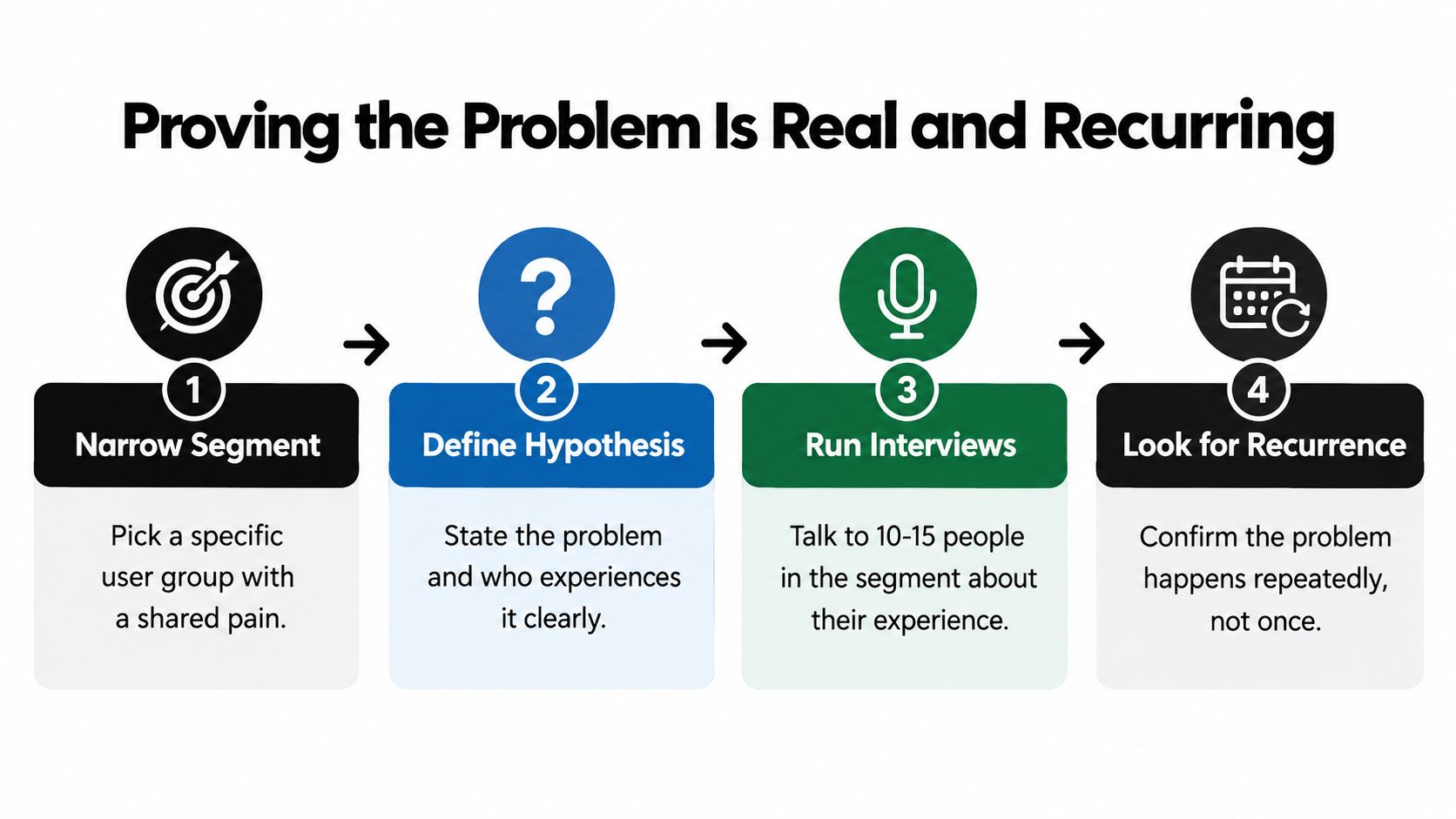
Use this process map to keep discovery focused on the problem rather than your proposed interface.
Define the segment and the job
“Agencies” is too broad. Start with finance managers at agencies that use contractors, bill clients against project work, and reconcile invoices manually. Those operating conditions matter more than a broad industry label.
Define the job-to-be-done as an outcome: prepare accurate client billing without repeatedly chasing project managers for invoice clarification. Don't define it as using automated reconciliation software. That would make your proposed solution part of the question.
Write a problem hypothesis that includes the trigger, the person responsible, and the consequence of failure. Leave unverified costs blank until customers provide evidence.
Investigate the last occurrence
Ask the finance manager to reconstruct a recent billing cycle. Keep the conversation anchored in events, documents, and decisions rather than predictions.
- Trace the trigger. What happened that required reconciliation, and who noticed?
- Inspect the workaround. Ask them to describe the spreadsheet, email chain, or accounting process they used.
- Establish recurrence. Does this happen during normal operations, or was the example an unusual exception?
- Identify the consequence. Did it delay billing, create rework, or require somebody else's intervention?
- Locate responsibility. Who owns the process, pays for existing tools, and approves a replacement?
Use a consistent question structure so you can compare accounts. The customer discovery interview guide can help you prepare conversations without turning them into pitches.
Document the workaround, then request access
Capture each customer's account in an evidence ledger: recent incident, current process, recurrence, reported cost, existing spending, and responsible buyer. Distinguish what they demonstrated from what they estimated. A remembered time cost isn't the same as a measured one.
The recommended problem-first validation sequence in the CB Insights failure report moves from a narrow segment and recent behavior toward a concrete offer and credible commitment.
For the invoice concept, a suitable next step could be permission to examine redacted records or an introduction to the person who approves finance software. Request only the data necessary, explain its handling, and accept that confidentiality may require a different test.
A customer who declines access may still have the problem. Record the reason rather than interpreting every refusal as absent demand. Your hypothesis should become more precise as you learn.
Choosing the Right Cheap Experiment
Choose an experiment by the uncertainty you need to resolve, not by what you enjoy building. A developer may prefer a prototype when the unanswered question is whether a buyer will authorize a purchase.
Cheap doesn't mean effortless. It means limiting the cost of learning before you commit to a larger product. Compare the experiments on what they reveal and what they leave unresolved.
Four Cheap Validation Experiments Compared
| Experiment | What it really tests | Typical cost | Weakness to watch |
|---|---|---|---|
| Landing-page smoke test | Whether a specific offer attracts action through a chosen channel | Page setup, outreach, and optional advertising | Traffic or messaging problems can resemble weak demand |
| Concierge MVP | Whether customers value an outcome delivered manually | Founder labor and operational effort | Bespoke service can conceal an unscalable delivery process |
| Clickable prototype | Whether users understand and can navigate a proposed workflow | Design work and moderated sessions | Task completion doesn't establish willingness to purchase |
| Presale or deposit-based offer | Whether buyers will make a financial commitment to a defined offer | Sales effort, payment administration, and delivery obligations | Unclear terms or unrealistic promises make the result unreliable |
Match the test to the unresolved risk
Use a landing-page smoke test when you need to evaluate positioning and channel response. Present a specific outcome, identify the intended customer, and give visitors a relevant next action. Otter A/B's fake door test guide is a companion reference for planning this format.
Don't imply that an unavailable product is ready. Explain its status when visitors take the next step, and make any collection of contact or payment information transparent.
Choose a concierge MVP when you can deliver the core result manually. For the hypothetical invoice product, that might mean producing a reconciliation report from agreed inputs without building an integration. Record the exceptions and support work instead of absorbing them.
A clickable prototype fits a usability question. Ask participants to complete a realistic task without coaching. If the purchase assumption is still unresolved, pair the session with a commercial conversation rather than declaring success because users moved through the screens.
Use a presale or deposit offer when you can state the scope, price, delivery conditions, and refund policy clearly. You're testing a transaction, so the offer must be concrete enough for the buyer to assess.
Don't build a miniature company to test a sentence. Build the smallest experiment that can expose the assumption you're most likely to be wrong about.
The guide to what an MVP is provides useful context for keeping scope tied to learning. My recommendation is to avoid combining every experiment at once. Run the test that answers the immediate decision, then spend more only when the result justifies another question.
Setting the Numbers That Make You Stop
There isn't a universal interview count, landing-page conversion rate, or paid-pilot threshold that validates every startup. Your stopping rules must reflect the segment, the offer, the acquisition channel, and the economics.
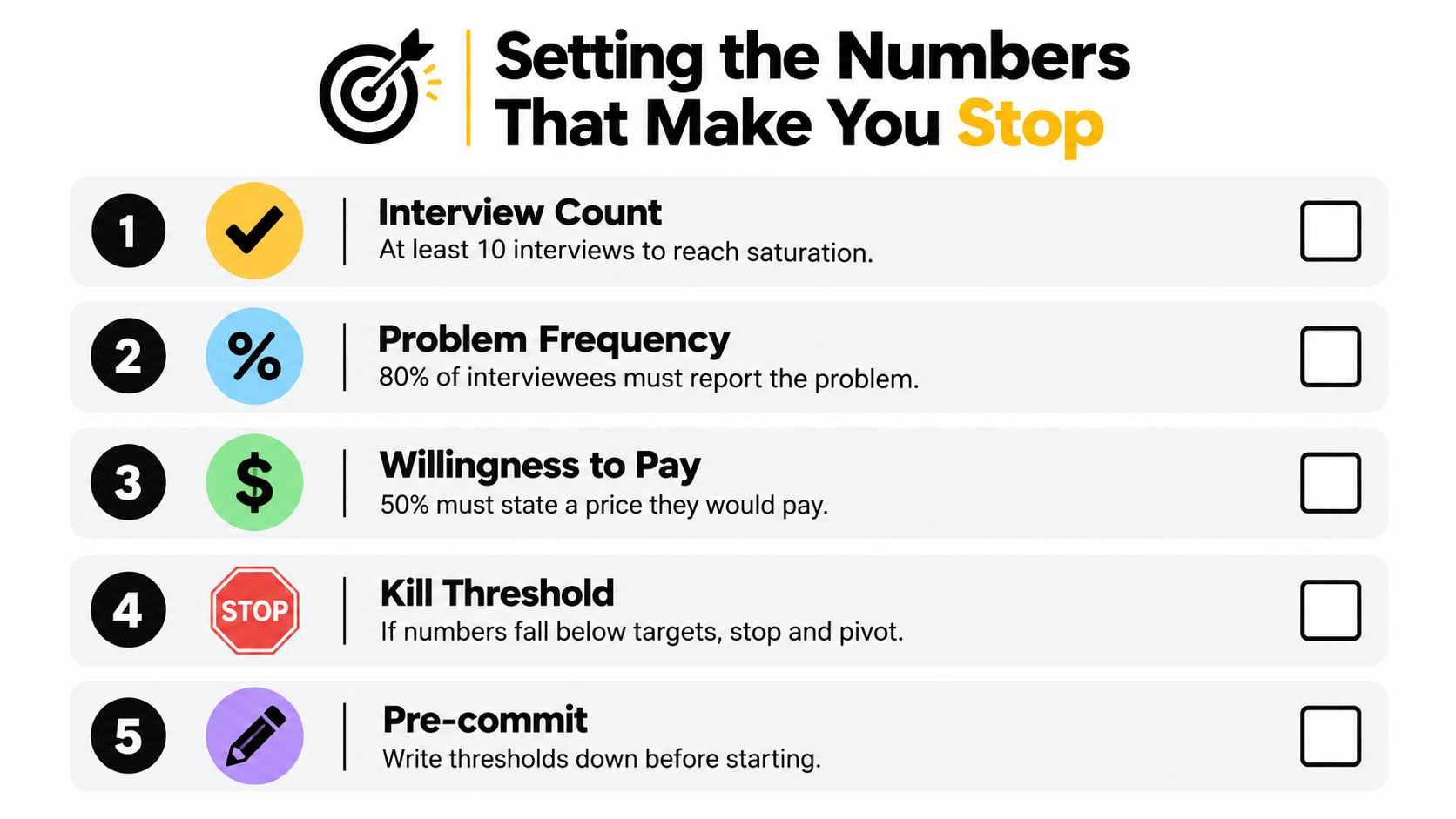
The checklist below is a reminder to pre-commit. Treat any numerical targets displayed in it as illustrative, not established benchmarks. In particular, stating a price someone might pay isn't equivalent to making a purchase.
Derive thresholds from the decision
For interviews, preselect a bounded set of qualified prospects and a deadline. Require coverage of the relevant user and buyer roles. Don't keep recruiting increasingly friendly participants until your original conclusion becomes comfortable.
For a smoke test, define the denominator before launch. Qualified visitors from your intended channel are more useful than a mixture of unrelated traffic. Separate registrations, qualified inquiries, and purchase attempts.
A commercially meaningful conversion threshold comes from your own cost assumptions:
Estimated acquisition cost = acquisition spending ÷ customers acquired
Before sales exist, label the result an estimate. Don't calculate customer acquisition cost using email signups and describe those signups as customers.
For a paid-pilot offer, define what counts as acceptance. An agreed price with no payment date, accountable buyer, or implementation step isn't the same as an authorized pilot.
Write a decision contract
Put the following conditions in writing before collecting results:
- Continue when qualified customers demonstrate the target problem and accept the defined next step under conditions you can deliver.
- Narrow the segment when evidence concentrates around a specific operating situation rather than your broader audience.
- Revise the offer when customers recognize the problem but reject the proposed outcome, scope, or terms.
- Stop the current version when repeated qualified conversations reveal low urgency, satisfactory alternatives, or no credible path to commitment.
- Investigate an inconclusive test when faulty tracking, unsuitable traffic, or unclear messaging prevents a fair judgment.
The case for commitment-based validation and advance stopping rules is stronger than a search for a universal pass mark. Set your thresholds from the minimum business you need to sustain, then keep them fixed during the experiment.
Decision discipline: Change a failed hypothesis openly. Don't rewrite yesterday's success criteria to make today's result pass.
A negative finding should identify what failed. “This segment won't authorize this offer through this channel” is actionable. “Nobody wants it” may be an unjustified conclusion from a poorly designed test.
Validating That Anyone Can Actually Buy It
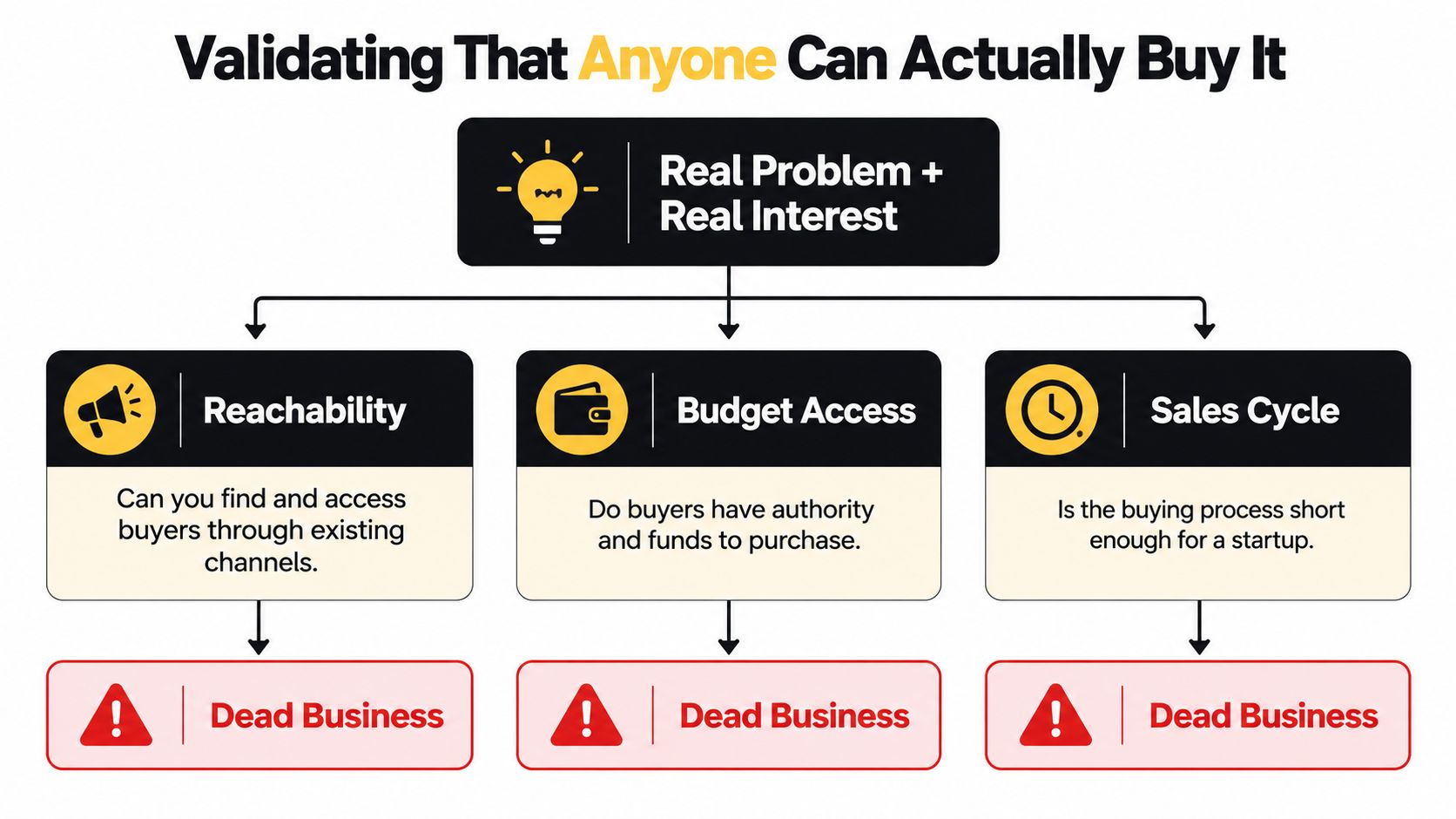
The hypothetical finance manager wants the reconciliation product. The controller controls spending, security must approve data access, and project managers would need to change their process. You haven't reached a sale just because the user wants another demonstration.
Failure summaries place cash exhaustion at roughly 29% and competition at about 19%, as discussed in The Week's analysis of startup failure and commercial blind spots. These historical categories don't prove what will sink your company, but they support checking whether demand can become sustainable revenue.
Use this diagram to identify purchasing obstacles. A failed branch is a reason to investigate or redesign the business, not automatic proof that it can never work.
Follow the buying process to the end
Ask the user to introduce the economic buyer, then walk through a realistic purchase. Which budget would fund it? Who can reject it? What contracts, security reviews, or implementation resources would be required?
Include switching friction in the offer. Customers aren't comparing your features only with a competitor's features. They're considering migration, training, internal explanations, and the risk of interrupting a working process.
Test reachability through the channel you expect to use commercially. A warm introduction can help you learn, but it doesn't establish that cold outreach, partnerships, or paid acquisition will work. Prometheus Agency's market expansion planning framework is a useful companion for examining the route to buyers before increasing growth spending.
Keep a segment-specific commercial ledger
Use a compact record rather than a single validation score.
| Evidence area | What to record |
|---|---|
| Pain | Demonstrated consequence and current alternative |
| Buyer authority | Budget owner, approvers, and spending process |
| Channel access | How qualified prospects were reached |
| Conversion | Movement between explicitly defined buying stages |
| Sales duration | Observed time and unresolved purchasing steps |
| Price | Accepted terms, not merely a suggested amount |
| Retention | Repeat use or renewal evidence, when available |
| Delivery cost | Labor, infrastructure, support, and exceptions |
Run a manual pilot through the intended purchasing route. Track founder time spent selling, onboarding, and handling problems. If you ignore unpaid labor, you can mistake an expensive consulting engagement for attractive software economics.
Use business model generation guidance to connect this ledger to how you intend to earn revenue. Mark unknowns as unknowns, especially retention and future acquisition costs.
My investment filter is straightforward: can you acquire, serve, and retain this customer without relying on an untested miracle? If the answer depends on effortless procurement or dramatically cheaper delivery later, keep validating before scaling.
Your 14-Day Validation Sprint and Common Pitfalls
Use a 14-day sprint as a proposed working schedule, not a promise of complete validation. The output should be a documented decision and a clear account of what remains uncertain.
Put interviews and buyer follow-ups on your calendar before spending time on product design.

Schedule checkpoints rather than busywork
- Opening checkpoint. Define the segment, problem hypothesis, commercial risks, and stopping criteria. Identify prospects who match the operating conditions you've chosen.
- Discovery checkpoint. Begin with a small batch of interviews, inspect the available evidence, and identify missing buyer roles. Expand the conversations if important contradictions remain.
- Experiment checkpoint. Launch the cheapest suitable test with a clear offer, eligibility criteria, and next action. Record refusals as carefully as acceptances.
- Commercial checkpoint. Follow commitments through approval, payment, and implementation steps. Update the ledger with observed effort and unresolved obstacles.
- Decision checkpoint. Compare results with your original criteria. Continue, narrow, revise, or stop, and write the reason.
Don't call an incomplete sales process a rejection merely because your sprint ended. Record the outstanding approval and its expected next step. Equally, don't treat an indefinitely postponed decision as a completed commitment.
Use the video below alongside your written experiment plan.
Remove the easy escape routes
Friends are convenient interview subjects, but convenience isn't segment fit. Surveying them can leave you with answers from people who would never face the purchasing decision.
Keep compliments outside your commitment totals. Label a waitlist as a waitlist, and don't let user enthusiasm substitute for a conversation with the budget owner. These mistakes don't require dishonesty, only a founder who wants the answer to be yes.
Finish with a written verdict that names the strongest evidence, the failed assumptions, and the next justified expense. Your immediate next action is simple: write the hypothesis and stopping rule today, then send interview invitations to qualified prospects.
Find Startup Idea offers startup concepts sourced from real Hacker News and Reddit pain points, giving you an alternative to brainstorming from a blank page. Visit Find Startup Idea, choose a problem you can investigate, and test it against real buyer behavior before you build.