8 Go to Market Examples: Startup Launch Strategies
Explore 8 go to market examples from startups, covering target segments, channels, pricing, launch tactics, and early metrics you can adapt.

Two startups can use the same channel and get opposite results. One can pour money into paid acquisition and watch CAC outrun revenue, while another can turn the product into the channel and grow because sharing is part of the experience. That's why the best go to market example isn't a trophy case, it's a decision tool. The right motion depends on the segment, the price point, and how much product proof buyers need before they act. If you want a broader starting point, this overview of best GTM strategies for startups is useful, but the faster path is to match the motion to the buying reality.
The most useful way to study go-to-market examples is to ask four questions. Who is the target segment, how does the product reach them, how is it priced, and what early metric proves the motion is working? That keeps you from copying a famous launch without copying the conditions that made it work. The eight motions below are written as playbooks you can test, not success stories you admire from a distance.
1. Product-Led Growth
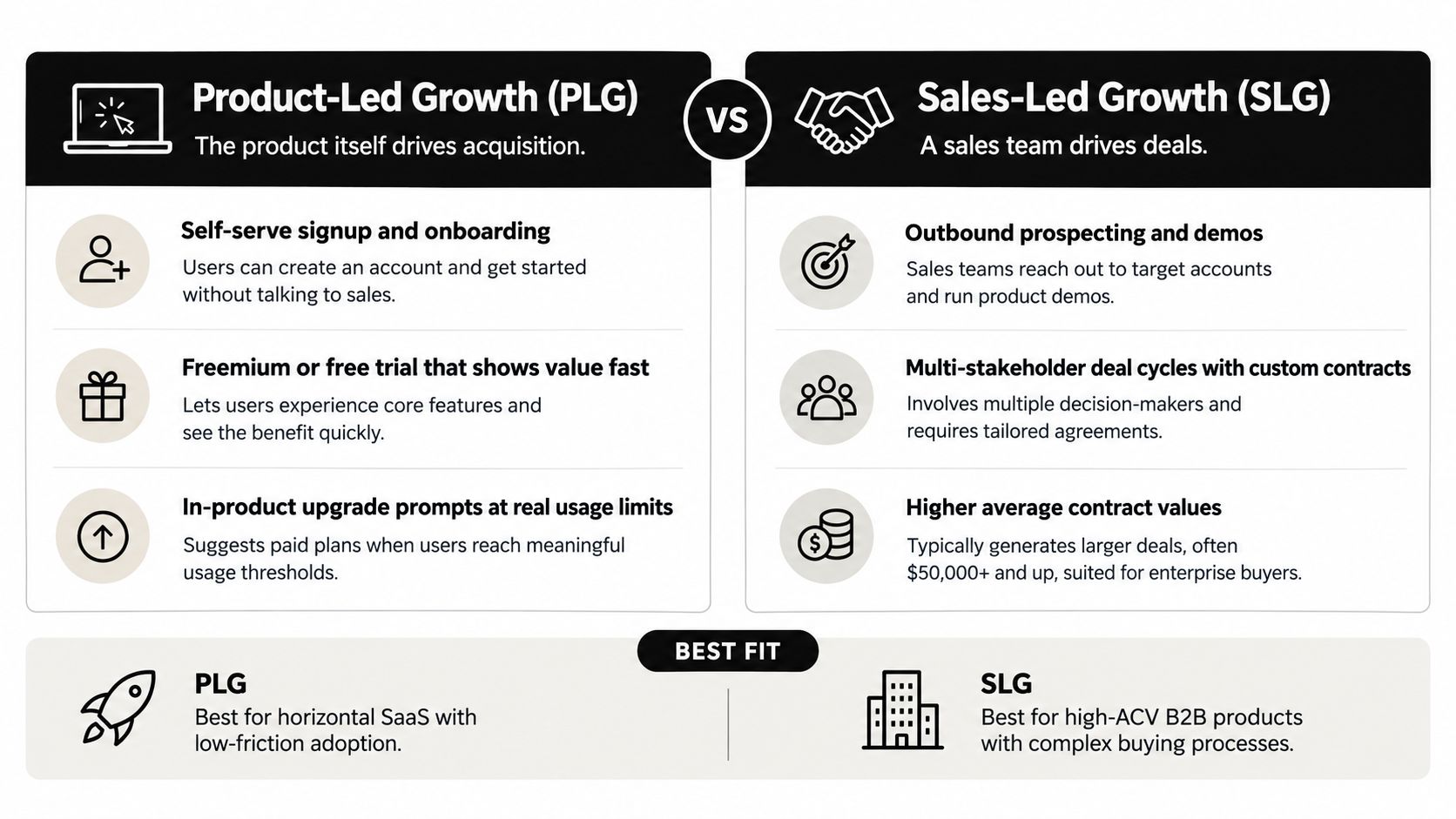
Product-led growth works when users can feel value before they ever talk to sales. Slack, Calendly, and Notion all fit that pattern in different ways, because each product lets an individual start small and then pull other people in once collaboration becomes the obvious next step. The channel is the product, and that changes the whole launch math.
What to copy and what not to copy
The target segment is usually individual users or small teams with a clear, repeated pain. The channel mix leans on self-serve sign-up, onboarding, in-product prompts, and team invitations. Pricing usually starts with a free tier or trial, then moves to paid plans when users hit a real limit, not an arbitrary paywall.
Practical rule: put the upgrade moment where the user feels the constraint, not where finance wants one.
The low-cost test is simple. Build a landing page, define one activation event, and see whether people will sign up before you've built the full product. If they won't, product-led growth probably isn't the first motion to bet on. If they will, instrument onboarding so you can see which actions predict upgrade and retention.
A useful internal reference for product design and business modeling is the Business Model Generation resource, because PLG only works when the value proposition, pricing, and usage pattern line up cleanly.
2. Sales-Led Growth
Sales-led growth fits complex products with higher perceived risk. Salesforce, Workday, and Palantir all rely on a human to shape the deal because the buyer usually needs security review, implementation context, procurement support, or custom terms before signing. If the purchase is expensive or politically sensitive inside the account, a rep is often part of the product, not just the wrapper around it.
Where the motion wins
The target segment is usually a defined list of accounts, often by industry, company size, or workflow complexity. The channel mix centers on outbound prospecting, demos, discovery calls, pilots, and account follow-up. Pricing is commonly negotiated, because the contract has to match buyer risk, usage scope, and implementation effort.
The launch tactic should be narrow, not broad. Start with a small number of ideal customer profiles, personalize the outreach, and use a paid pilot with clear success criteria so the buyer can commit without taking a full leap. That works better than blasting generic demos to anyone who fills out a form.
A simple test is to write the sales playbook before you scale the team. If the rep can't explain the problem, the evaluation path, and the next step in one meeting, the motion isn't ready. Pair that with a customer success plan early, because sales-led motions break quickly when onboarding is weak and renewals depend on heroics.
3. Community-Led Growth
Community-led growth works when the product improves as more users share knowledge, templates, feedback, or status inside a group. Notion, Figma, and HubSpot all show different versions of that pattern. The community is not just a support layer, it becomes part of the acquisition and retention engine.
Build a reason for members to show up
The target segment is usually users who care about belonging, craft, or shared workflows. The channel mix can include forums, private groups, creator ecosystems, events, certification, and user-generated resources. Pricing often supports an accessible entry point, because value compounds when people stay active.
The launch tactic should start small. Find a handful of power users, give them direct access to the team, and give them something useful to contribute, like a template library, a plugin ecosystem, or a knowledge base. That creates a reason to participate before you ask them to promote the product.
You should track active contributors, answers posted, and member-sourced signups, not just member count. A large dormant group looks impressive and does very little. If the audience isn't producing useful artifacts or helping others solve problems, the community is decorative.
For founders looking at audience formation and distribution through groups, the online communities for entrepreneurs guide is a practical companion because community-led growth only works when the group has a real shared use case.
Participation has to feel useful before it feels branded.
4. Viral and Referral Growth
Referral growth works when the product already creates a natural reason to invite someone else. Dropbox is the cleanest example, because the product rewarded both sides with extra storage after the invitee installed the app. That reward was directly tied to product use, which kept the economics simple and the incentive understandable.
Design the invite into the workflow
The target segment is usually users who collaborate, share output, or benefit when others join the same system. The channel mix is built into the product through invitations, shared files, collaborative links, or referral rewards. Pricing needs a low marginal cost reward, otherwise the incentive eats the business.
Dropbox is also a reminder that the channel only worked because the product already had clear utility. After launching in 2008, it had about 100,000 registered users by September 2008, then grew to roughly 4 million over about 15 months, with referrals eventually driving about 35% of daily sign-ups and producing a reported permanent 60% increase in sign-ups, according to the case summary at Real Growth Matters. That kind of growth didn't come from a clever button alone, it came from product value, activation, and sharing logic working together.
The low-cost test is to run a referral loop with a small cohort and watch both volume and quality. If people invite others but those users never activate, the loop is noisy, not scalable. Measure the invitation moment, the install or signup event, and whether the new user understands the product.
A referral motion should reward both sides and should feel native to usage. If you have to explain the incentive too much, the product probably isn't the right fit for viral spread.
5. Content and SEO-Led Growth
Content and SEO-led growth works when buyers search for the problem before they search for the brand. HubSpot, Ahrefs, and Backlinko all built durable demand by publishing useful explanations, tools, and guides that matched intent at different stages. This motion is slower than paid acquisition, but it compounds if the content stays relevant.
Match the search intent to the buyer stage
The target segment is usually self-educating buyers, often early in the journey. The channel mix includes educational posts, comparison pages, free tools, courses, and topical updates. Pricing can be freemium or demo-led, because content's job is to create trust before the buyer requests more proof.
Start with long-tail keywords where you can realistically earn attention. A new company doesn't need to outwrite everyone on day one, it needs to own a narrow problem, then expand from there. One useful tactic is to build a free tool that solves a single pain point and earns links naturally.
If the content doesn't help a buyer do something, it usually won't help you rank for long.
The low-cost test is to publish a small cluster of posts around one problem and see whether they attract qualified traffic, email signups, or demo requests. Use the language you hear in Reddit threads, Hacker News, support tickets, and sales calls. That's often more useful than a generic keyword list.
For a startup content workflow, the startup content marketing guide is a solid reference point because the motion only works when the content maps directly to demand.
6. Founder-Led Build in Public
Founder-led growth works when the founder's credibility, speed, and transparency are part of the product story. Pieter Levels, Marc Lou, and Justin Welsh show different versions of this motion, but the core pattern is the same, the founder becomes a distribution asset by showing the work publicly. That can drive early trust fast, especially in categories where buyers want to see how the thing gets built.
Use the founder as a signal, not a crutch
The target segment is usually early adopters, peers, or buyers who like direct access. The channel mix is platform-specific, often X, LinkedIn, Indie Hackers, or YouTube. Pricing can be anything from free tools to courses to software, but the founder's voice has to feel useful, not promotional.
The launch tactic should center on specific updates, lessons, and decisions. Share what you're building, what failed, and what changed. People follow useful process, not generic motivation. The better posts usually contain product decisions or customer insights the audience can apply immediately.
A low-cost test is to post the idea before building the full thing and watch for meaningful replies, signups, or requests to try it. If the audience only likes the post, that's not enough. You want signals that people care enough to commit time, email, or money.
Founder-led growth works best when the process is documented, because the business eventually has to outlast the founder's daily posting cadence. The personal brand can open the door, but the product and onboarding have to close the loop.
7. Concierge MVP and Do Things That Don't Scale Growth
This motion is for validation, not polish. Zappos, Airbnb, and Dropbox all used manual effort early on to prove that people would engage, book, or sign up. The point is to learn from the market before you automate the wrong thing.
Sell the outcome before the machine exists
The target segment is usually a narrow group with a painful problem and a clear desired result. The channel mix can be a landing page, a demo video, a manual service, or direct outreach. Pricing should come early, because payment is a much stronger signal than polite interest.
The Dropbox demo video is a strong example here. Instead of waiting for a full product to explain the value, the team used a simple demonstration to show the workflow and collect signups, which is exactly what a concierge-style test is supposed to do. The product didn't need to be finished before it could be understood.
The low-cost test is to define the proof you need before you start. That might be a handful of paid pilots, a deposit, or a scheduled implementation call. Record every manual step, because those steps often become the roadmap.
For founders who are still shaping the product, the what is MVP guide helps because the best early-stage GTM is often a manual version of the future system.
8. Partnership, Integration, and Marketplace-Led Growth
Partnership-led growth works when your product already fits inside a platform your buyers use every day. Zapier, the Shopify App Store, and Atlassian Marketplace each show how distribution can come from an ecosystem instead of standalone demand. That changes acquisition from chasing strangers to showing up where work already happens.
Meet buyers inside their workflow
The target segment is usually users of a dominant platform. The channel mix includes integrations, app listings, co-marketing, and partner tutorials. Pricing can range from freemium to usage-based to subscription, but the buyer's first decision is usually whether the integration solves a real workflow gap.
The launch tactic should begin with the platform your users already request most. Look at forum posts, support tickets, and community threads to see what people keep asking for. Then build the integration they actually want, not the one that sounds strategic in a deck.
A marketplace listing is not a shortcut. It's a placement decision, and it only works if the integration removes friction immediately.
The low-cost test is to ship one integration and measure install interest, activation, and follow-on usage. If the app listing gets attention but no one keeps using it, the fit is weak. If the partnership creates steady inbound and lowers the friction to trial, the motion can become one of your cheapest acquisition paths.
For partnership structure and channel planning, the partner program best practices guide is relevant because the channel usually works best when the product fits neatly into an existing ecosystem.
8 Go-to-Market Strategy Comparison
| Strategy | 🔄 Implementation complexity | 💡 Resource requirements | ⚡ Speed / Efficiency | 📊 Expected outcomes | ⭐ Key advantages |
|---|---|---|---|---|---|
| Product-Led Growth (PLG) | 🔄 Medium, strong UX, onboarding, analytics | 💡 Moderate, engineers, product design, analytics | ⚡ Fast adoption; low incremental CAC over time | 📊 Scalable signups, usage-driven expansion | ⭐ Low CAC, rapid feedback loop, bottom-up growth |
| Sales-Led Growth (SLG) | 🔄 High, sales processes, legal, enterprise ops | 💡 High, AEs, SDRs, CS, longer runway | ⚡ Slow, long cycles, high CAC | 📊 Large ACV deals, predictable pipeline when mature | ⭐ Higher revenue per customer, fits complex enterprise needs |
| Community-Led Growth | 🔄 Medium, ongoing moderation and programming | 💡 Low–Moderate, community managers, events, content | ⚡ Slow start; high efficiency long-term | 📊 Strong retention, organic advocacy, user-generated value | ⭐ Trust-based acquisition, network effects, moat |
| Viral & Referral Growth | 🔄 Medium, design viral loops & tracking | 💡 Moderate, engineering + incentives and analytics | ⚡ Potentially very fast if viral coefficient >1 | 📊 Exponential user growth with low CAC (if successful) | ⭐ Compounding growth and high referral trust |
| Content & SEO-Led Growth | 🔄 Medium, strategy, technical SEO, content ops | 💡 Moderate, writers, SEO tools, time investment | ⚡ Slow to start (6–12+ months); compounding later | 📊 Sustainable organic traffic and inbound leads | ⭐ Compounding ROI and authority for search intent buyers |
| Founder-Led Build in Public | 🔄 Low–Medium, consistent public output and engagement | 💡 Low, founder time, content tools | ⚡ Fast initial traction; limited scalability | 📊 Early users, press, investor interest; strong personal brand | ⭐ Very low cost to acquire first users; authentic trust |
| Concierge MVP / Do-Things-That-Don't-Scale | 🔄 Low tech but high manual effort | 💡 Low cash, very high founder time and customer contact | ⚡ Fast validation; not scalable without productization | 📊 Validated demand, deep customer insights, paid pilots | ⭐ Low-risk validation and strong early reference customers |
| Partnership, Integration & Marketplace-Led Growth | 🔄 Medium, integrations, partner processes, listings | 💡 Moderate, engineering, BD, co-marketing | ⚡ Variable, can be fast via partner audiences | 📊 Access to platform users, improved retention via integrations | ⭐ Built-in distribution, credibility, lower acquisition friction |
Pick One Motion to Test Before You Scale
The biggest mistake in a go to market example is copying the visible tactic and ignoring the hidden fit. A free trial, a referral loop, a sales team, or a marketplace listing all look effective from the outside, but each one depends on segment, urgency, product complexity, and how buyers prefer to buy. If your users need guidance, don't force a pure self-serve motion. If the product is simple and repeatable, don't bury it under heavy process.
The practical decision is to start with the motion that matches the buying behavior you can already observe. For product-led growth, the early proof is activation. For sales-led growth, it's qualified conversations and pilot quality. For community-led or founder-led growth, it's repeated participation and real replies. For referral or integration-led growth, it's whether people keep inviting, sharing, or installing after first use.
Pick one low-cost test and define the metric before you spend real money. A good first test might be a landing page plus one traffic source, a small pilot list, a referral cohort, or a single marketplace integration. What matters is not activity, it's the earliest signal that people are willing to move forward.
If you're still deciding what to validate, start with the strongest proof of demand you can get in the first 30 days. That might be an activation event, a scheduled demo, a referral-driven signup, or a paid pilot. Once you know which signal moves, you can build the rest of the motion around it.
Find Startup Idea helps founders spot real pain points and turn them into launchable opportunities. If you're comparing go to market example options and want a place to validate ideas before you commit budget, visit Find Startup Idea and use it to sharpen the segment, signal, and motion you test next.