How to Get Startup Ideas That Actually Sell
Learn how to get startup ideas using proven frameworks, real pain point signals, and validation methods that separate viable opportunities
"Find a problem" is incomplete advice. People complain about inconveniences they'll never pay to fix, and enthusiastic feedback can leave you with a polished product nobody buys. If you want to learn how to get startup ideas that sell, start with what people already sacrifice: money, staff time, delayed revenue, or the effort of maintaining an awkward workaround.
Your job isn't to invent something impressive and then search for demand. It's to identify an expensive behavior, understand who authorizes the spending, and test whether you can offer a better outcome.
Why Most Startup Ideas Die Before They Launch
Brainstorming feels productive because you can leave the room with something tangible: a name, a feature list, perhaps a rough interface. None of those tells you whether a customer has a reason to change.
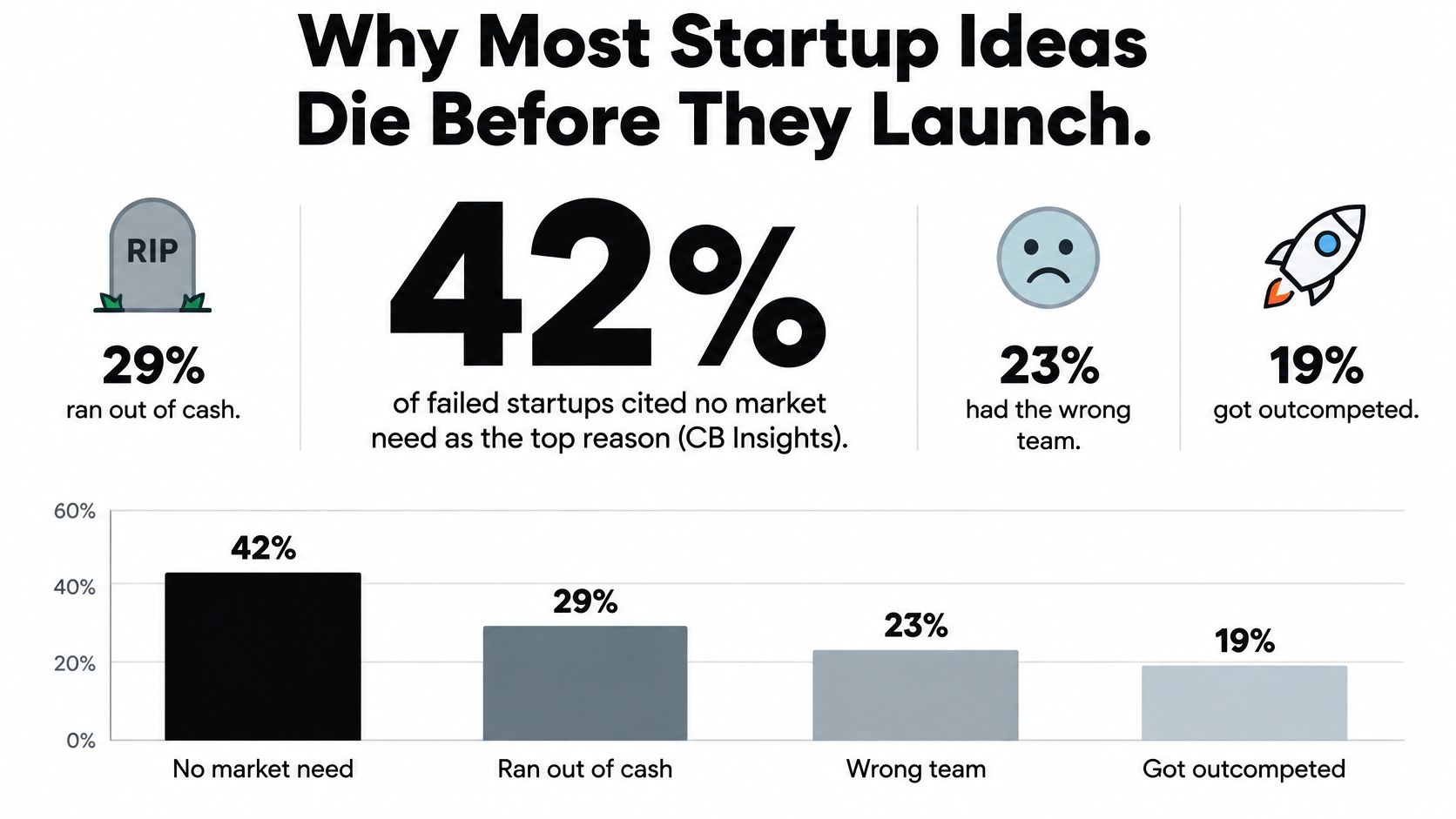
In a CB Insights analysis of 101 failed startup post-mortems, 42% cited no market need as a primary reason for failure, making it the most frequently reported cause. That finding concerns a sample of failed companies, not the probability that any particular startup will fail. Its practical lesson is still uncomfortable: strong engineering and serious effort can produce something customers don't need enough.
Replace product conviction with customer evidence
A founder can become attached to a solution before understanding the work it's supposed to replace. After that, interviews become sales pitches, objections become feature requests, and every encouraging comment becomes permission to keep building.
Reverse that sequence. Investigate a customer's current situation before choosing a product format.
- Name the customer precisely. “Small businesses” doesn't tell you whose workflow to observe. An independent agency owner responsible for client approvals does.
- Locate the consequence. Distinguish an irritating interface from a delay that prevents someone from invoicing.
- Identify the current response. Find out whether the customer tolerates the problem, delegates it, buys software, or pays a specialist.
Practical rule: Treat an idea as a claim about customer behavior, not as a description of software.
Research doesn't eliminate uncertainty. It changes which uncertainty you tackle first. Before debating your technology stack, establish whether a reachable buyer considers the outcome important enough to pursue.
There's a trade-off: customer research feels slower than building a demo. But a demo can answer whether you can create something without answering whether you should. The expensive mistake isn't discarding a weak idea. It's protecting one because you've already invested in it.
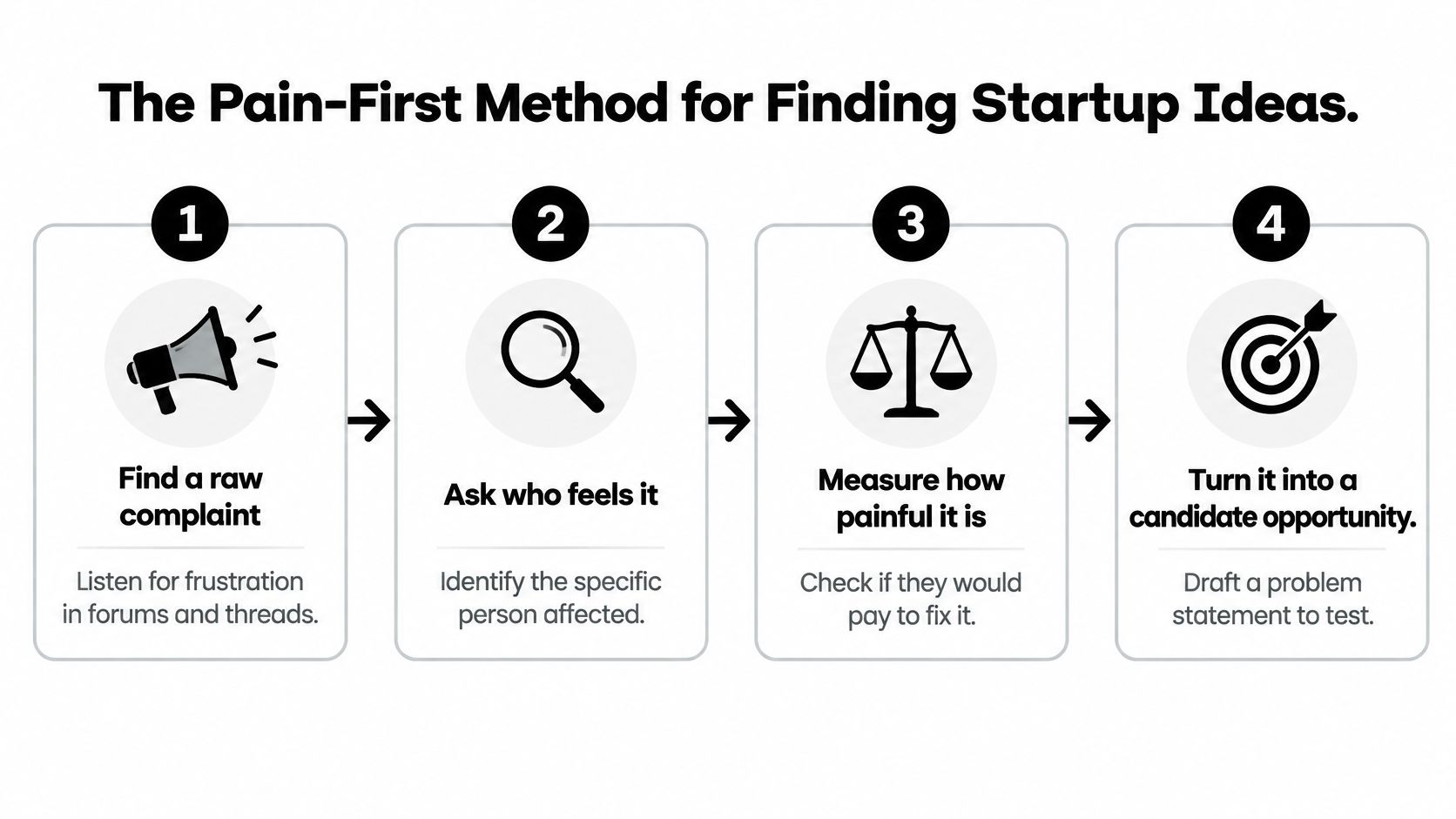
The Pain-First Method for Finding Startup Ideas
Start with a narrow group whose work you can inspect. Choose people you understand or can realistically reach, rather than an industry selected solely because its market sounds enormous.
Then turn a complaint into a candidate opportunity using questions about recurrence, consequences, current remedies, and purchasing responsibility. These aren't substitutes for judgment. They're a way to stop vague frustration from passing as demand.
Ask what happened, not what sounds useful
Use these prompts when examining an unfamiliar workflow:
- When does this happen? Establish the trigger and whether it belongs to normal operations or an unusual incident.
- What happens if it remains unresolved? Look for a missed deadline, interrupted service, lost work, or another concrete consequence.
- How is it handled today? Ask to see the process, including handoffs and exceptions.
- Who can authorize a replacement? Separate the person doing the work from the person responsible for its budget.
Consider hypothetical scheduling chaos for a solo consultant. A messy calendar alone isn't a compelling opportunity. Repeated appointment conflicts that require personal follow-up deserve investigation, particularly if the consultant already pays someone to coordinate bookings.
Manual compliance reporting at a small clinic raises different questions. The task may matter greatly, but you'd need to understand access permissions, specialist review, and the consequences of mistakes before proposing automation. High stakes can create demand while also making delivery much harder.
Capture the workflow around the complaint
Steve Blank's customer-discovery approach emphasizes testing assumptions with actual customers rather than relying on internal agreement. Apply that discipline by asking someone to reconstruct a recent incident, show the relevant documents, and explain each decision.
For client-feedback research, PinDrop's resource on how teams pin comments on deployed sites offers a concrete workflow to investigate. Ask whether feedback collection is the bottleneck, or whether approvals stall because nobody owns the decision. A better commenting interface won't fix unclear authority.
Use these pain point examples to sharpen your problem statements, not to skip investigation. Write each candidate as a customer, a task, an obstacle, and a consequence.
Opportunity-seeking itself isn't unusual: the Global Entrepreneurship Monitor's 2017/18 report found that 74% of entrepreneurs across 54 economies were pursuing opportunity rather than starting from necessity. The harder work is determining whether the opportunity you perceive also matters to a buyer.
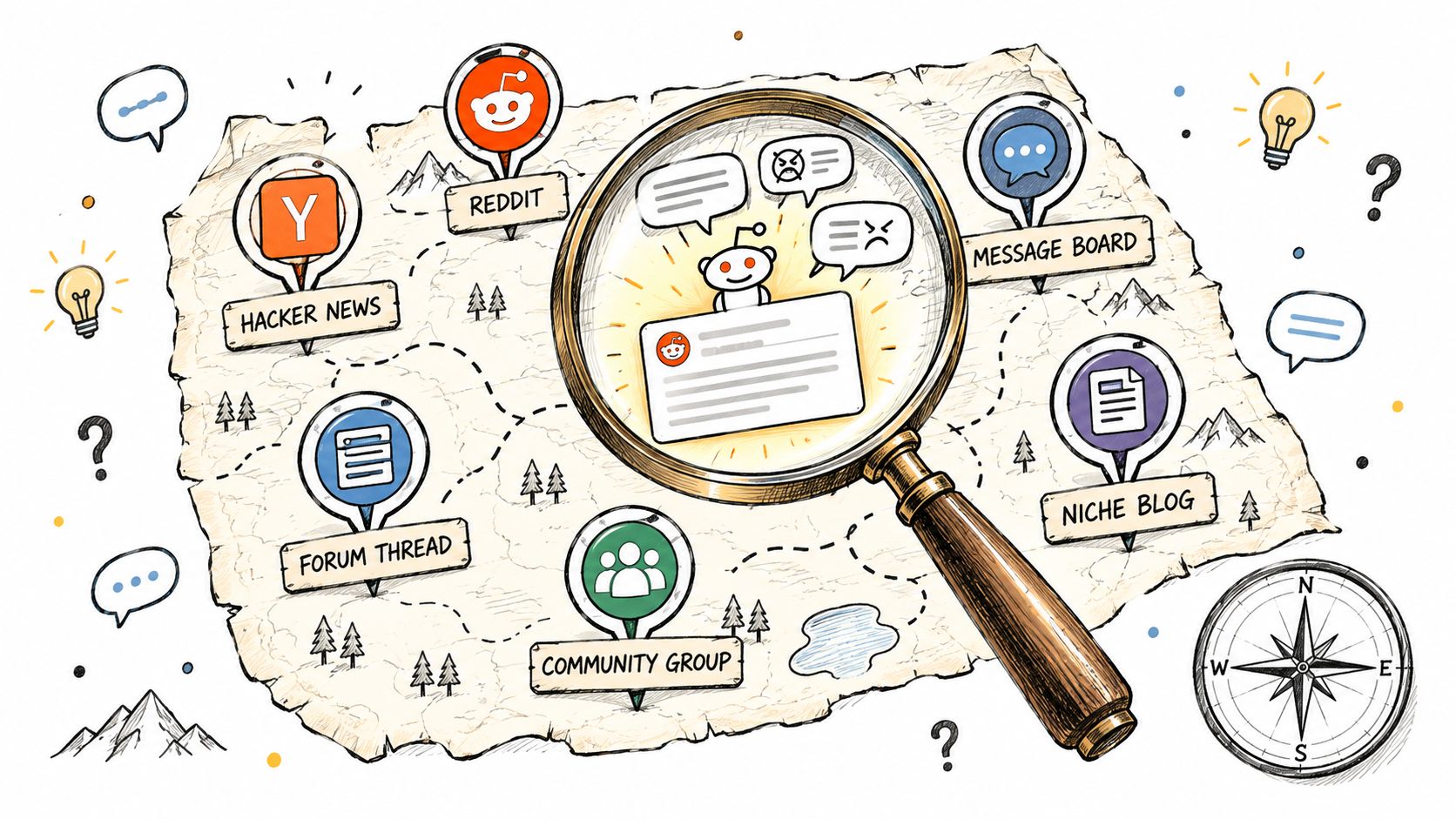
Hunting Grounds Where Real Startup Ideas Live
Search where people explain unfinished work, not just where founders discuss products. A useful discovery record includes the original complaint, the person's role, the task involved, and a question you still need answered.
The examples below are search prompts and hypothetical signals, not documented customer cases. Their purpose is to help you recognize operational detail without mistaking a vivid post for proof.
Look for descriptions of work
| Hunting ground | Search or investigation prompt | Signal worth following |
|---|---|---|
| Hacker News | Search for “manual,” “export,” or “reconcile” alongside a technical task | A detailed account of maintaining a brittle internal process |
| Industry-specific Reddit communities | Combine an occupation with “spreadsheet” or “alternative” | Practitioners independently describing the same awkward handoff |
| App Store and G2 reviews | Examine critical reviews within a product category | A missing capability tied to a specific job rather than general dislike |
| Job postings | Look for duties involving data entry, reconciliation, and report preparation | A recurring task someone is hiring a person to perform |
| LinkedIn posts | Follow operators discussing deadlines and process failures | A named operational consequence and someone accountable for it |
| Customer-support transcripts | With permission, group requests by the underlying task | Repeated attempts to accomplish something the existing product obstructs |
An angry review about pricing may offer little beyond dissatisfaction. A review explaining that a team exports records, corrects them manually, and imports them elsewhere gives you a process to investigate.
Likewise, a job posting isn't automatic evidence that software should replace a role. The listed task may depend on judgment, relationships, or accountability that the posting doesn't fully describe. Ask what portion is repetitive and what portion requires expertise.
Follow the workaround, including its advantages
A workaround signal is evidence that someone has assembled a substitute: a Notion template, an elaborate spreadsheet, a script, or a chain of email reminders. Investigate who maintains it, what breaks, and why they haven't replaced it.
Don't assume the workaround is inferior in every respect. A spreadsheet may be easy to modify, familiar to colleagues, and already approved internally. Your proposed product has to preserve what users value while fixing what costs them.
Bookmark relevant searches, subscribe to available community feeds, and keep a research inbox separate from your product backlog. This guide to online communities for market research can help structure that collection process. Save permissioned evidence and anonymized notes, not private customer information you have no right to retain.
Scoring Opportunities So You Pick the Right One
A painful problem isn't automatically an attractive business. You also need a buyer, a practical route to that buyer, and a way to deliver the result without consuming more resources than the customer will fund.
A separate CB Insights post-mortem analysis identified poor product-market fit in 43% of cases, bad timing in 29%, and unsustainable unit economics in 19%. Don't combine those figures with the earlier analysis as though they describe the same sample. Use them as a reminder to evaluate commercial feasibility alongside customer frustration.
Five-Factor Pain Scoring Model
Use the following as a working prioritization rubric, not a scientifically validated predictor. The score bands organize your judgment; they don't establish a universal threshold for success.
| Factor | What to Measure | Score 1-3 (Weak) | Score 4-5 (Strong) |
|---|---|---|---|
| Frequency | How routinely the task or failure occurs | Isolated, irregular, or poorly understood | Embedded in a recurring workflow |
| Severity | Consequences of leaving it unresolved | Mild inconvenience or preference | Identifiable operational or financial consequences |
| Evidence | Actions already taken to address it | Opinions, compliments, or hypothetical interest | Existing spending, maintained workarounds, or attempted replacement |
| Buyer authority | Ownership of budget and purchasing decisions | Interested users but no identifiable sponsor | A responsible buyer with a credible approval path |
| Distribution | Your ability to reach suitable customers | Broad audience and speculative acquisition | Specific prospects accessible through a plausible channel |
Record the evidence beside every rating. An unsupported high score is still an assumption. If you don't know who approves spending, write “unknown” rather than awarding a comfortable middle rating.
A total can help sort your notes. It can't compensate for a missing buyer or an impossible delivery requirement.
Compare scenarios without manufacturing certainty
Consider hypothetical reconciliation work at an agency. If an operations manager can demonstrate the recurring task, identify its consequences, introduce the budget-holder, and explain previous attempts to replace it, you have a strong candidate for further testing.
Compare that with a consumer wishlist app requested by enthusiastic forum participants. Interest may be genuine, but without evidence of purchasing behavior or a credible acquisition route, the commercial case remains weaker. That doesn't make it worthless. It means you shouldn't fund it on the strength of compliments.
Avoid declaring that a particular total makes an idea fundable. A severe weakness can outweigh strong ratings elsewhere, especially when regulation, implementation, or customer acquisition exceeds your resources.
Connect the opportunity to business model generation: who pays, what they purchase, how you deliver, and which costs rise with usage. Choose the next experiment based on the weakest critical assumption, not merely the highest total.
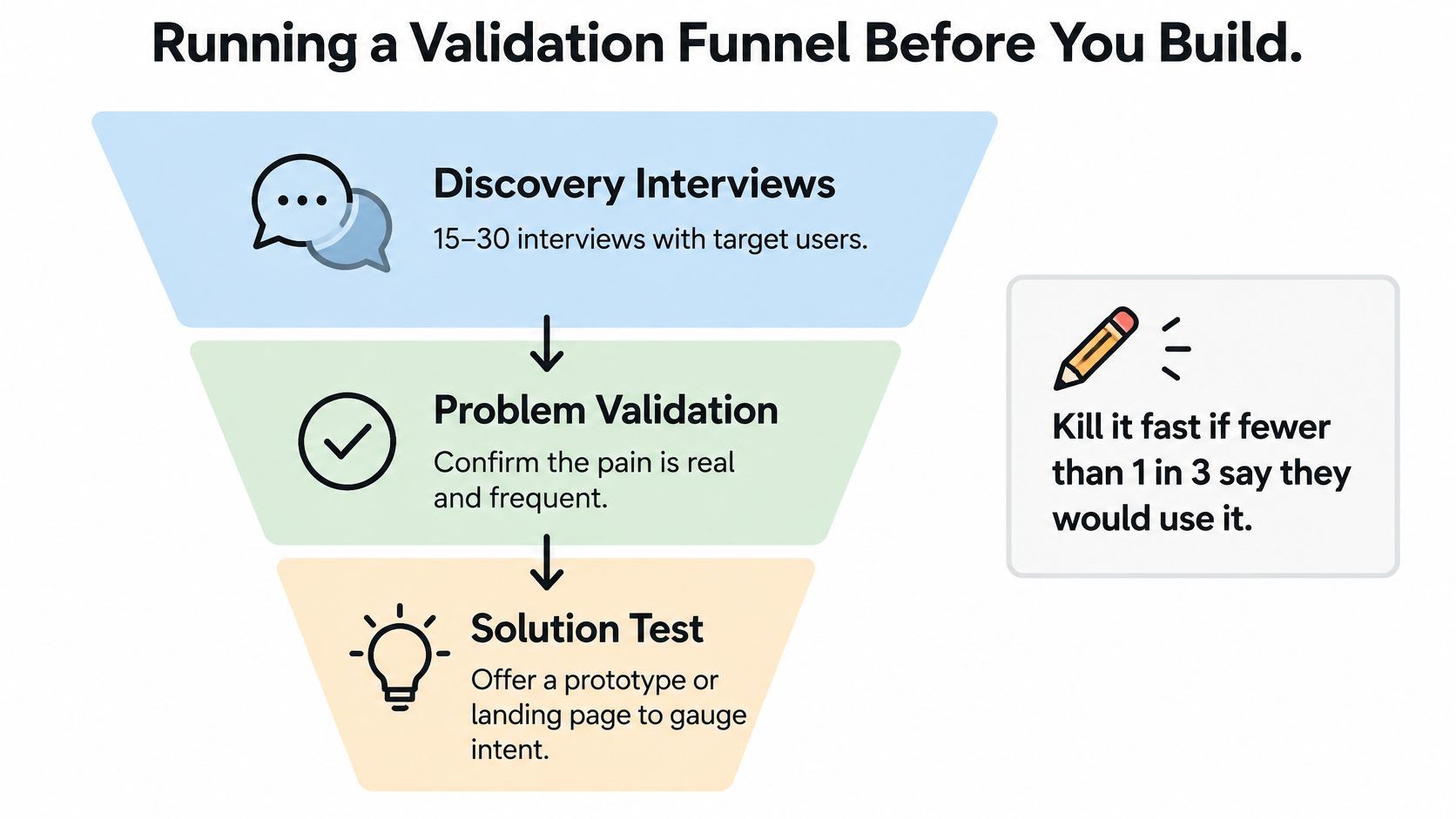
Running a Validation Funnel Before You Build
The point of validation is to expose reasons not to proceed while changing direction is still inexpensive. Don't ask an interviewee to approve your ambition. Ask them to help you understand their work.
Founder research cited by LivePlan reports that 78% of new business owners needed startup financing in 2025, with personal savings still the most common source. When your own money is at stake, a clear experiment is more useful than a reassuring conversation.
Discovery should reconstruct an incident
Recruit people who match the segment, including those who have rejected or abandoned alternatives. Friends can help you rehearse, but their encouragement shouldn't determine whether you invest.
- Reconstruct the sequence. Ask what triggered the most recent occurrence and what happened afterward.
- Inspect the process. Request a walkthrough using redacted records or a demonstration that respects confidentiality.
- Trace the purchase path. Establish who evaluates replacements, who approves them, and what could block adoption.
- Investigate failed attempts. Find out what they tried, why it didn't work, and what made staying put acceptable.
Keep your product pitch out of the early conversation. Otherwise, you risk collecting reactions to your explanation rather than evidence about the customer's situation.
Ask for a commitment proportional to your promise
Once you understand the task, offer a bounded test: a manually delivered service, a prototype evaluated with representative data, or a paid pilot with clear terms. Specify the deliverable, customer responsibilities, acceptance criteria, and what happens if you can't deliver.
An email signup indicates interest. A scheduled evaluation involving the budget-holder requires more effort. A paid engagement tests something different again, but even payment doesn't prove you can deliver profitably or retain the customer.
Grow My Acorn's guidance to validate your business idea first is a useful starting point for keeping this work ahead of major launch commitments. The discipline is in defining what you'll accept as evidence before you hear the answers.
Stop condition: Pause when suitable prospects acknowledge the issue but repeatedly decline a clearly scoped next step, and investigate why before adding features.
Don't treat a generic stated-intent cutoff, including one shown in a funnel graphic, as a reliable decision rule. Proceed when the problem pattern is consistent, the purchasing path is understood, and qualified buyers make meaningful commitments. Stop or revise when those conditions remain absent.
Where AI Changes the Opportunity Landscape in 2026
AI can help you build, but it doesn't remove the need to find a buyer. A prototype that's easier to create may still require difficult integration, careful review, and sustained customer support.
In a survey of 1,051 founders, 60% used AI to help launch a business in 2025, double the rate reported two years earlier, while 50% said it made starting significantly faster or less expensive. That's evidence of founders' reported experience, not proof that software development costs have disappeared.
Ask what a competitor can't reproduce easily
My recommendation is to evaluate AI-enabled opportunities by the customer context surrounding the model. A generic interface is a weak foundation if another founder can offer the same output without overcoming a meaningful operational obstacle.
- Proprietary workflow data. Explore whether permissioned records and customer feedback can improve a specialized process. Access alone isn't enough; you need usable data and a legitimate basis for handling it.
- Regulated or high-trust work. Investigate tasks requiring traceability, expert approval, and clear responsibility. These requirements may support differentiation, but they also increase delivery obligations.
- Difficult distribution. Existing access to a specialized buyer group may matter more than an unusual feature. Verify that relationships can produce purchasing conversations, not just friendly introductions.
The remaining opportunities often look less like standalone apps and more like operational businesses. A service that turns inconsistent source material into a reviewed deliverable can be worth testing if customers pay for the finished result. An integration that handles exceptions across legacy systems may also deserve investigation, even when the interface looks unremarkable.
Match the opportunity to your constraints
Technical capability doesn't automatically qualify you to serve a high-stakes industry. If you lack domain expertise, access to reviewers, or the capital to support a lengthy buying process, choose a narrower problem or a different segment.
A service-first approach can help you learn the workflow before automating it. The trade-off is that revenue may initially depend heavily on your labor, so you must examine delivery costs rather than celebrating sales alone.
Ask a hard question before building: if a competitor used the same model, why would the buyer still choose you? Look for an answer grounded in execution, customer access, trusted review, or integration. “Our prompts are better” isn't a durable plan by itself.
Your 30-Day Idea Pipeline Routine
Treat the month as a research cycle, not a deadline for forcing a business into existence. Use a spreadsheet for evidence, a document for interview notes, and your calendar for outreach and follow-up. Elaborate tooling won't compensate for avoiding customer conversations.
Collect, narrow, investigate, commit
- Opening week, collect evidence. Choose a customer segment and gather relevant complaints, reviews, job descriptions, and workflow observations. Save each original reference alongside the task, consequence, and unanswered question. Your checkpoint is whether a recognizable pattern exists.
- Following week, prioritize. Apply the scoring rubric and separate evidence from assumptions. Keep candidates you can realistically investigate. Ask whether you know how to contact both practitioners and purchasing decision-makers.
- Interview week, examine behavior. Speak with suitable prospects and document differences as carefully as similarities. If people use the same words for different problems, split the segment rather than forcing a single explanation.
- Closing week, request commitment. Present a bounded offer to qualified buyers. Record what they accept, what they refuse, and the conditions attached. Don't substitute a waiting list for a purchasing test.
Finish with a decision
Protect recurring calendar time for collection, outreach, conversations, and synthesis. Avoid spending the entire routine browsing communities while postponing the uncomfortable request.
End with a short decision memo: the customer, the problem, the evidence, the unresolved risks, and the next experiment. Continue when you have a credible commercial path. Revise or stop when the evidence points elsewhere.
A discarded hypothesis is a useful outcome if it saves you from building the wrong thing.
Find Startup Idea offers startup ideas sourced from real Hacker News and Reddit pain points, giving you starting points for customer research rather than a blank brainstorming page. Visit Find Startup Idea, choose a problem relevant to customers you can reach, and investigate the economic behavior behind it before you build.