Startup Marketing Strategy: A Practical 2026 Playbook
Build a startup marketing strategy that actually works in 2026. Learn positioning, channel selection, growth experiments, and measurement tailored
You've got a product to ship, a social feed to maintain, and an ad campaign that produces signups nobody can explain. Your cofounder wants more content. Your first customers still need help getting started. The dashboard looks busy, but you can't tell whether another marketing dollar will bring in a customer who stays.
A useful startup marketing strategy settles that question before you increase spending. Pick a buyer, prove the problem matters, and judge acquisition by what customers do after they arrive. Treat retention as a budget decision and AI as a supervised workflow, not a shortcut around either.
Why Most Startup Marketing Plans Fail Before They Start
The most common mistake is starting with promotion instead of problem validation. Founders choose platforms, commission content, and buy traffic before they can explain whose problem they solve or why that person would switch from an existing workaround.
A synthesis of startup postmortems attributes 14% of failures to poor marketing, an indicator of marketing's material role rather than proof that it independently caused those failures, according to the startup statistics synthesis. The operational lesson isn't to publish more. It's to make customer discovery, positioning, distribution, and measurement part of building the business.
Diagnose the constraint before funding activity
A marketing plan should identify the decision you need to make next. A publishing schedule can't tell you whether the audience is wrong, the promise is weak, or the product disappoints people after signup.
Use the customer's behavior to locate the problem:
- No meaningful response: Revisit the buyer, urgency, and offer before changing creative.
- Interest without commitment: Examine the buying process, objections, and requested next step.
- Signups without useful product activity: Investigate onboarding and whether your promise matches the experience.
- Initial use without continued value: Pause expansion and learn why customers leave.
These are diagnostic starting points, not automatic verdicts. Speak to people at the point where they stopped, then compare their explanations with what they did.
Build a decision sequence, not a task list
Start with a specific buyer and a costly problem. Translate that problem into positioning, select a reachable channel, and run an experiment with a clear decision attached. Expand only after you understand downstream customer behavior.
For organizing those choices, FOMOchat's go to market strategy framework is a resource to consider alongside a simple positioning document and experiment log. Use a framework to expose assumptions, not to make an untested plan look finished.
Practical rule: Don't approve a marketing activity unless its owner can name the assumption it tests and the decision its result will inform.
If demand is unclear, your immediate job is learning. If customers buy but leave, your immediate job is fixing the experience. Hiring someone to generate more attention won't resolve either problem.
Finding the Beachhead Customer and Sharpening Your Positioning
Consider a hypothetical product for managing client approvals. “Agencies” is too broad a starting audience. An agency operations manager chasing overdue feedback before a client launch gives you something concrete to investigate: a trigger, a workflow, and a consequence.
CB Insights identified lack of market need in 42% of failed startups in its startup postmortem analysis. That finding supports doing discovery before committing to a product or marketing promise. It doesn't establish that every founder should use the same discovery process.
Make the positioning decisions explicit
Separate the buyer, the job, the alternative, and the evidence rather than squeezing them into a slogan.
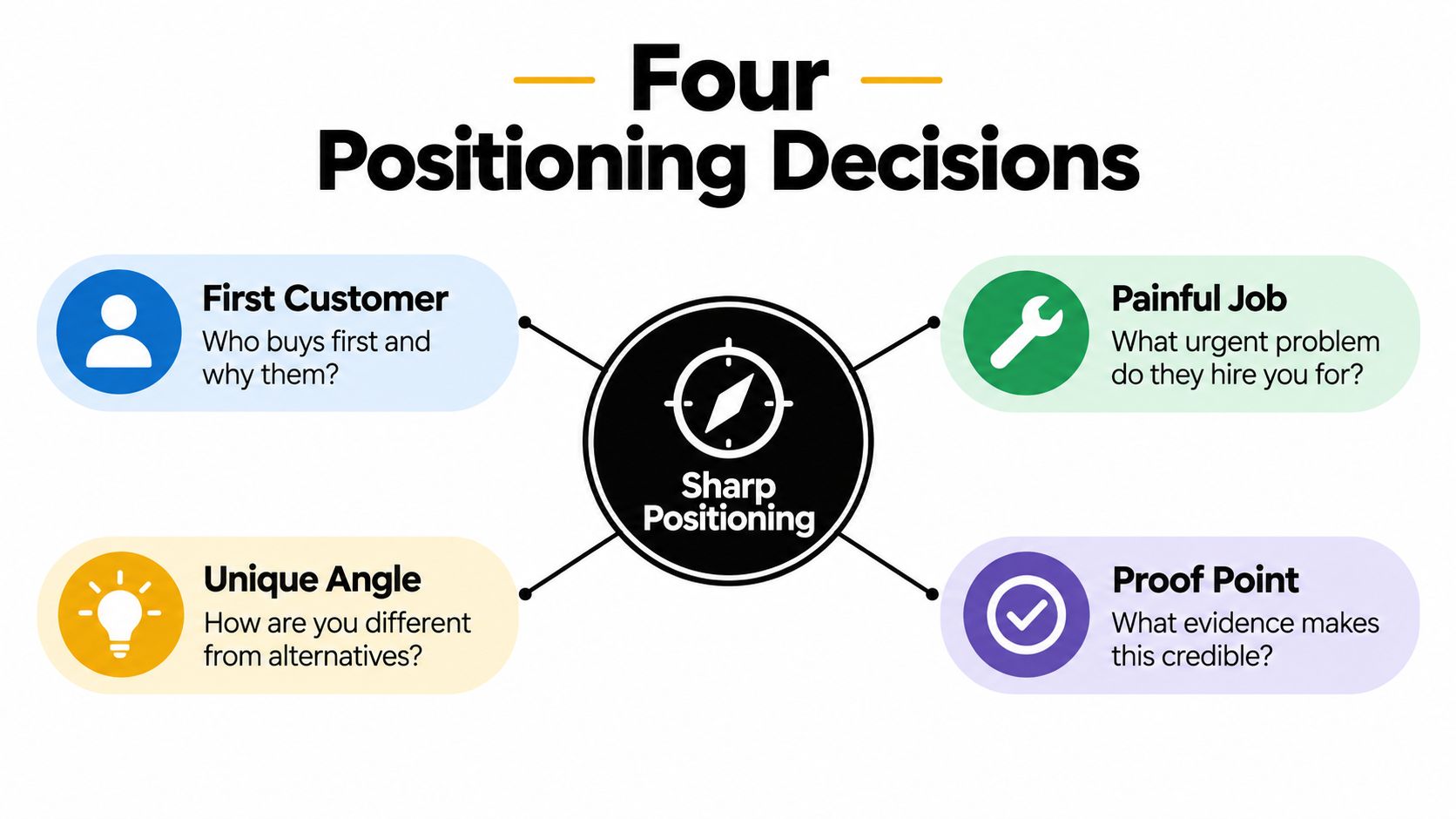
For the hypothetical approval product, useful decisions would look like this:
- First customer: The operations manager responsible for keeping client launches on schedule, not everyone employed by an agency.
- Painful job: Obtain clear approval without repeatedly chasing stakeholders across email and chat.
- Unique angle: Replace scattered requests with a shared approval queue. Compare against the current workaround, not just competing software.
- Proof point: Demonstrate the actual workflow. Don't claim faster launches until you have evidence.
A testable positioning sentence could be: Keep client approvals in a shared queue so agency operations managers can see who's blocking launch. It describes a recognizable job without inventing a performance promise.
Interview for evidence, not encouragement
Ask about the most recent delayed approval. Who chased it? What did they use? What happened when nobody responded? Ask what they've already tried, whether they've spent money addressing it, and who could authorize a change.
Use this guide to customer discovery interviews to structure those conversations. Avoid pitching midway through the interview, because you need the customer's account of the problem before you introduce your explanation.
For content-led acquisition, Narrareach's guide to identify your ideal readers is another resource to consider. Keep readers and buyers distinct: someone may enjoy your advice without owning the problem or controlling the purchase.
Finish with a one-page brief containing the target buyer, triggering event, current alternative, core promise, supporting evidence, and disqualifying conditions. Test future assets against it. If a headline appeals to someone outside that brief, decide whether you've discovered a better segment or merely written a broader headline.
Picking the Right Channels Without Burning Your Budget
Choose channels by buyer access and learning value, not founder preference. A platform you enjoy using may still be a poor place to reach someone with buying authority.
In a 2025 study of 204 startups, 95% used social media, compared with 36% using websites, 25% SEO, 19% email marketing, and 12% paid search. This is a snapshot of that sample, not a universal prescription. My interpretation is that founders should challenge default social activity and protect the infrastructure needed to convert and retain interest.
Channel Tradeoffs at a Glance
Treat these assessments as planning judgments. Your audience, skills, offer, and competitive environment will change the trade-offs.
| Channel | Upfront Cost | Time to First Result | Signal Quality |
|---|---|---|---|
| Paid social | Media budget plus creative work | Quick to launch and observe responses | Weak if measured by clicks; more useful with qualified actions |
| SEO | Research, writing, and technical effort | Slower and uncertain | Useful when queries match buying intent |
| Community participation | Founder attention and contribution | Conversations can begin early; trust takes time | Rich problem language, but buying authority needs checking |
| Partnerships | Relationship-building and enablement | Dependent on partner commitment | Useful when audiences and incentives align |
| Targeted outbound | Research and personalized outreach | Early direct feedback | Clear objections from identifiable prospects |
| Educational content | Production and distribution effort | Depends on access to an audience | Useful when readers progress toward a buying action |
Choose a primary channel you can operate well
Before demand is clear, I'd favor targeted outreach or participation in an existing community. You can ask follow-up questions and learn why someone declines. Don't build your own community just to avoid talking directly to prospects.
For an established problem that buyers actively search for, consider search-focused acquisition. For a product whose value is easiest to demonstrate visually, test video or paid social. If video fits, Taja AI's distribution tips for video creators are a resource to consider when planning distribution alongside production.
Commit to a primary channel, an experimental channel, and an owned channel. Keep the experimental effort small enough that it doesn't interrupt delivery on the primary channel. Protect your website, customer records, and permission-based email access rather than relying entirely on a platform audience.
Use a go-to-market example as a planning reference, not a channel shopping list. Write down why your buyer should be reachable through each proposed channel and what evidence would make you reject it.
Budget founder time as well as cash. Outbound research, community participation, and content aren't free merely because you haven't bought media.
Designing Growth Experiments That Actually Produce Signal
“Publish more posts and see whether signups improve” isn't a useful experiment. You've left the audience, message, exposure, and success condition undefined. Whatever happens, someone can explain it away.
A stronger version tests a specific promise with a defined audience and asks for a meaningful action. For the hypothetical agency product, compare an approval-chasing message with a workflow-visibility message, while keeping the offer and audience consistent.
Write the decision before launching
Use this hypothesis template:
We believe [change] for [segment] will move [metric] because [reason grounded in customer evidence].
Turn that belief into a bounded test with a success condition.
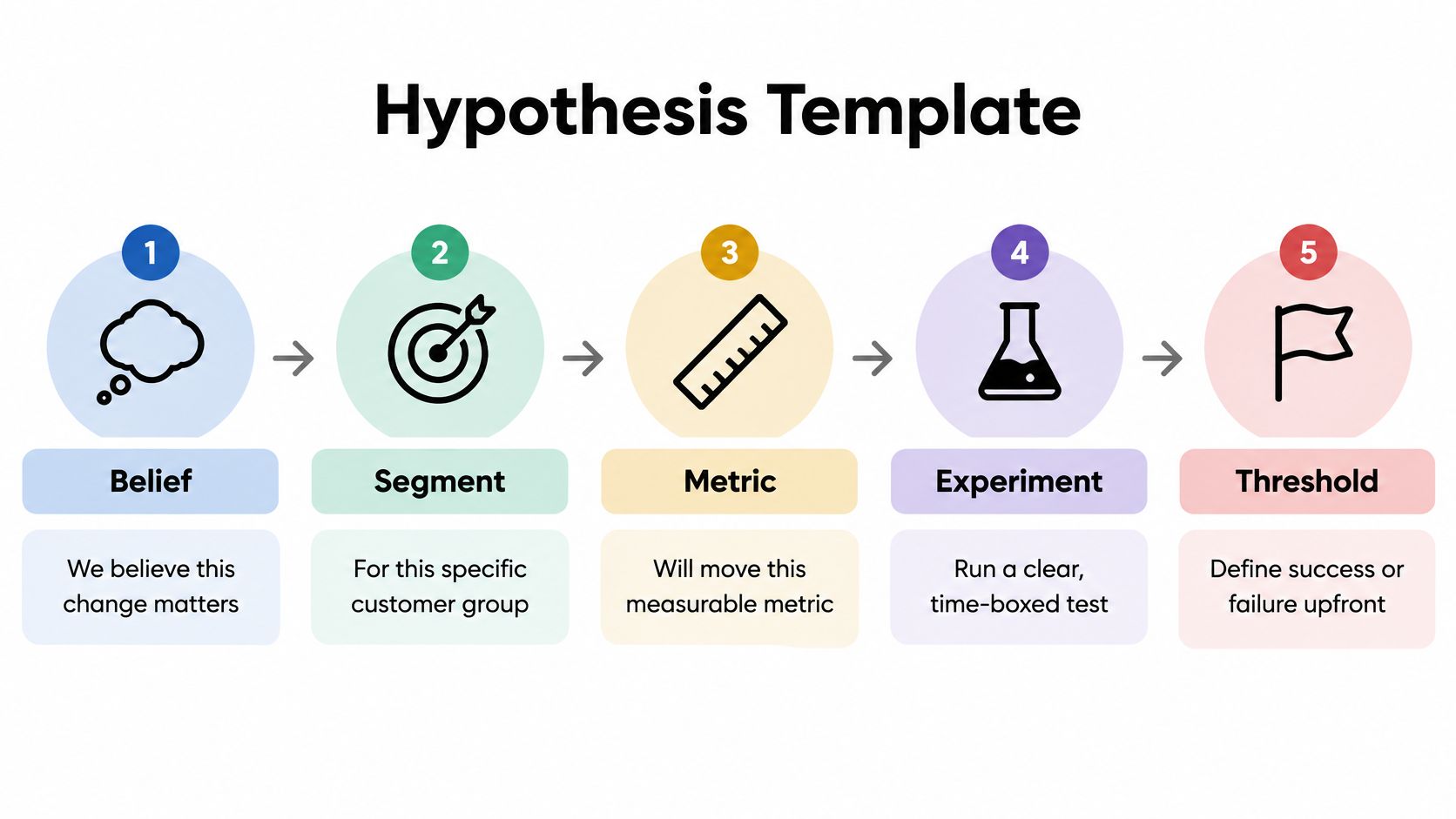
For the approval example, the metric could be qualified demo requests, with qualification defined before launch. The reason might be recurring interview evidence that chasing stakeholders is the buyer's immediate concern.
Document the operating conditions:
- Audience eligibility: Specify the role, problem, and buying context required for inclusion.
- Primary outcome: Choose an action that advances the purchase or validation process.
- Exposure and duration: Set a feasible test window and record how many eligible people encountered the offer.
- Decision threshold: Derive the minimum acceptable result from delivery capacity and acquisition economics, not a borrowed benchmark.
- Stop conditions: Halt for broken tracking, misleading claims, excessive complaints, or spending beyond the agreed cap.
Match confidence to the evidence available
For a controlled comparison, sample requirements depend on baseline conversion, the smallest improvement worth acting on, and the confidence needed for the decision. Don't manufacture a universal sample target. If traffic is too limited, run a directional test and label the conclusion accordingly.
Keep a backlog ordered by the importance of the assumption and the effort required to test it. A useful initial backlog might include a landing-page promise, a demo request versus a waitlist, and an onboarding intervention. Use the startup idea validation guide as a companion when testing commitment before a full build.
Record failed tests as carefully as successful ones. Capture the hypothesis, conditions, outcome, customer feedback, and resulting decision. Otherwise, you'll eventually pay to test the same assumption again.
When to Stop Buying Attention and Invest in Retention
I'd rather see a resource-constrained startup help suitable customers succeed than buy another batch of signups it can't retain. Acquisition still matters, but increasing it before understanding customer losses is a budget decision you should be prepared to defend.
Use this image as a reminder to inspect where spending goes before increasing it.

The 2025 Slush startup survey reports that 55% of young businesses identify customer acquisition as their biggest marketing challenge, while 33% describe email as underused and 15% use SMS. Those figures don't prove that adding email or SMS fixes retention. Start with the customer's reason for disengaging, then choose an intervention.
Set a payback boundary your cash position can support
Define customer acquisition payback as the time required for a cohort's cumulative contribution margin to recover its acquisition cost. Include relevant acquisition costs and account for variable service costs, refunds, and cancellations.
Choose your maximum acceptable payback period from your cash constraints. Then apply this trigger:
Stop increasing spend on an acquisition source when its observed cohorts can't recover acquisition costs within your approved payback window.
Compare cohorts at equivalent ages. Don't judge recently acquired customers against customers who've had much longer to purchase again.
For a visual discussion to accompany that review:
Match the intervention to the drop-off
- Customers never reach initial value: Prioritize onboarding, setup assistance, and removal of unnecessary steps.
- Customers succeed initially but don't return: Investigate usage cadence, then test lifecycle messages tied to a genuine next task.
- Customers need coordination or expertise: Consider a customer-success motion, with its cost included in the economics.
- Satisfied customers recommend you voluntarily: Test a referral request and assess the referred customers' quality.
- Previously active customers disengage: Try a relevant win-back message after checking whether their need still exists.
Don't use retention work to avoid an uncomfortable demand conclusion. If customers don't have a recurring need, repeated reminders won't create one. For an infrequent-purchase business, assess completed value delivery, appropriate repeat purchases, and referrals rather than forcing a weekly-use metric.
Adding AI to Your Marketing Without Losing Quality or Trust
Buying an AI tool doesn't resolve unclear positioning or weak customer evidence. It gives your team another way to produce work, which means you need rules for what enters the workflow and who approves what leaves it.
A survey reported by MediaPost found that 72% of recently founded small businesses planned to use AI for marketing, including content creation and brainstorming at 37% each, customer-data analysis at 32%, and personalization or segmentation at 31%. Among AI-using small businesses, 58% reported saving more than 20 hours monthly. Saved time is an efficiency outcome, not evidence of additional demand.
Automate preparation, retain accountable judgment
Use AI for draft generation, approved-source summaries, ad variations, segmentation ideas, and preliminary analysis. Treat its output as material to inspect, not authority to publish.
The division of responsibility should remain explicit.
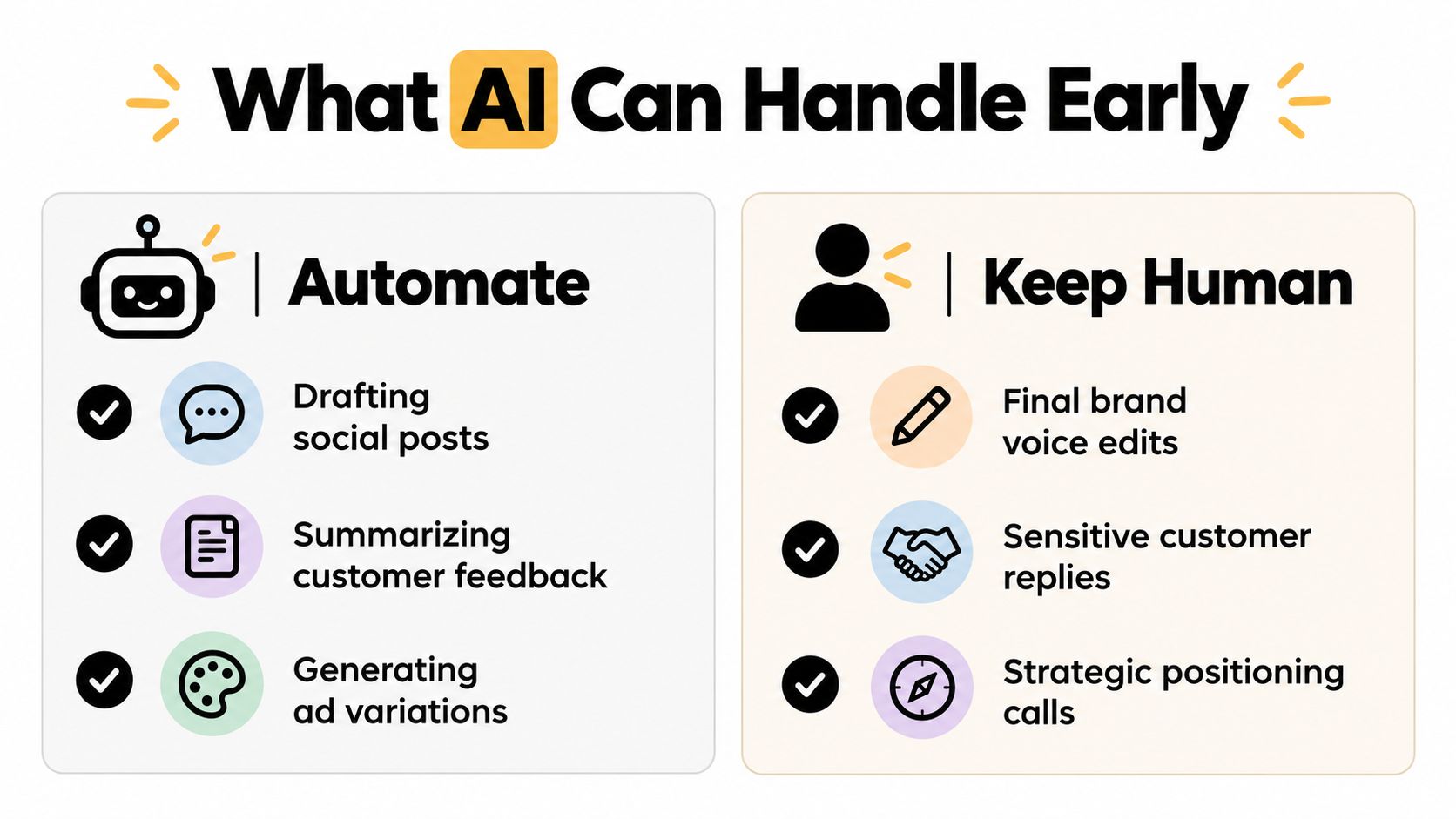
Keep strategic positioning, pricing decisions, final brand edits, sensitive customer replies, and legally significant claims under human control. Ask a named person to approve consequential output rather than assigning responsibility vaguely to “the team.”
Establish a lightweight governance checklist
You don't need an elaborate committee. You need operating rules people can follow:
- Permitted data: Define what staff may upload. Exclude confidential customer records and personal information unless the environment and authorization explicitly permit them.
- Approval checkpoints: Require review before publication, audience targeting changes, and customer-facing automation.
- Claim verification: Trace factual statements to approved evidence. Check that summaries preserve the customer's meaning.
- Disclosure rules: Specify when customers should be told about automated interactions, consistent with applicable requirements.
- Brand-quality tests: Check accuracy, specificity, tone, unsupported promises, and whether the draft answers a real customer question.
- Experiment holdouts: Where feasible, preserve a comparable non-AI workflow or audience group to assess incremental impact.
Measure the entire workflow, including editing, fact-checking, and rework. A faster first draft isn't necessarily a faster approved asset.
Evaluate growth separately through qualified conversion, retention, complaints, and cost per retained customer. Where volume can't support a credible comparison, report the operational benefit without claiming a revenue lift. Keep a record of the prompt, approved inputs, reviewer, and published version so someone can investigate mistakes.
Your 30 60 90 Day Marketing Plan and What to Measure
Treat the quarter as a sequence of investment decisions, not a campaign calendar. Each phase should end with evidence that changes what you fund, stop, or delegate.
Days 1–30 establish the foundation
Complete behavioral interviews, write the positioning brief, and choose the primary channel. Assign an owner to tracking and verify that acquisition records connect to subsequent product and purchase activity.
Define the measurement vocabulary before launch. Everyone should agree on what makes a lead qualified, which action represents activation, and what continued value looks like for your product.
Days 31–60 test acquisition and retention together
Launch a focused acquisition experiment alongside a retention intervention. Keep their hypotheses separate so you can distinguish better-fit prospects from an improved customer experience.
Review the funnel by segment and acquisition source:
| Metric | Definition | Decision it informs |
|---|---|---|
| Visitor-to-lead conversion | Leads divided by eligible visitors | Whether the promise and requested action resonate |
| Qualified-lead rate | Qualified leads divided by all leads | Whether you're attracting intended buyers |
| Activation | Eligible customers reaching the defined initial-value action | Whether customers experience the promised benefit |
| Retention | A cohort continuing the relevant value-producing behavior | Whether value persists |
| Paid conversion | Eligible prospects or users becoming paying customers | Whether interest becomes commercial commitment |
Document denominators and observation windows. Otherwise, team members can use the same metric name while measuring different behavior.
Days 61–90 reallocate and operationalize
Read the metrics together. Better visitor conversion with weaker qualification isn't an obvious win. Strong activation followed by poor retention warrants a different response from poor activation throughout.
Increase investment only where customer quality and payback support it. Stop experiments that reached their rejection criteria, and preserve inconclusive results as inconclusive.
- Double down: Fund the validated channel and segment combination.
- Repair: Assign the clearest remaining customer-experience constraint.
- Hand off: Delegate repeatable work with documented approval rules.
Your startup marketing strategy should finish the quarter with fewer unsupported assumptions, not merely more published assets.
Find Startup Idea offers startup ideas sourced from real Hacker News and Reddit pain points, alongside guidance for validating demand. Visit to choose a problem worth investigating, then turn it into a customer interview plan and a concrete commitment test before spending on promotion.