Problem Solution Fit: How to Test It Before You Build
Learn what problem solution fit means, how it differs from product-market fit, which signals to track, and how to test assumptions before you build.
You've talked to a dozen people, and every conversation went well. They nodded, they said they'd try it, a few even asked when it launches. You're excited, and you're also uneasy, because none of them has paid, changed anything, or given up anything more than twenty pleasant minutes. That gap between polite interest and real commitment is exactly where most ideas die. Problem solution fit is how you close it before you build.
What Problem-Solution Fit Means and Why It Comes First
Before you design a restaurant kitchen, confirm that hungry people live nearby and want this food. The nicest ovens in the world won't fill tables on an empty street.

Problem-solution fit is the point where you have evidence that a specific group has a frequent, costly problem and that your proposed solution addresses it well enough that they'd change behavior or pay.
Two Milestones Founders Often Merge
This stage asks whether the problem deserves a solution. Product-market fit asks whether a built product keeps customers over time. If you skip the first question, you'll measure retention, revenue, and growth on something that solved an optional problem from the start.
| Question | Problem-Solution Fit | Product-Market Fit |
|---|---|---|
| Core question | Is a costly problem worth solving with this solution? | Do enough customers keep using and paying for the product? |
| Stage | Idea, interviews and prototype | Live product with real users |
| Main evidence | Problem frequency, current workarounds, commitment to pay | Retention curves, repeat usage, revenue growth |
| Typical failure | Solving an interesting problem nobody urgently needs | Strong sign-ups that churn once the novelty fades |
Watch for a third pattern, market-message fit. Your sales copy converts visitors, but the product doesn't deliver the promised value once people get inside. Sign-ups and conversions alone confirm neither milestone, because good copy can sell a weak solution once.
Why Interesting Is Not Enough
The classic warning comes from a 2014 analysis of 101 startup post-mortems reported by Observer, where "no market need" was the leading cause of failure in 42% of cases, ahead of "ran out of cash" at 29% and "not the right team" at 23%, with companies often reporting multiple causes. That sample covered venture-backed post-mortems, not every business, but the ordering still teaches the right lesson.
A pile of complaints doesn't clear the bar by itself. You need recurring pain, existing workarounds, identifiable users, and willingness to change or pay. Without those four, you're building something technically impressive for people who'll happily keep tolerating the problem.
Don't ask whether people like your solution. Ask what the problem already costs them.
Signs That Problem-Solution Fit Is Emerging
A signal only counts when it's tied to a value event, the moment your product delivers its promised outcome. A login isn't a value event. A completed workflow, a successful transaction, or a measurable result is.
The Retention Curve Tells You First
The most telling pattern is the cohort retention curve. A curve that drops early and then levels off above zero means a durable group has built your product into its routine, while a curve trending toward zero means the solution hasn't earned a lasting role, as described in this overview of startup product-market fit statistics. Segment that curve by acquisition channel and customer type.
Segmentation matters twice over. One strong segment can hide several dead ones, and retention from the wrong buyer inflates your average without telling you anything about the customers you actually want.
| Indicator | Healthy signal | Weak signal | How to measure |
|---|---|---|---|
| Retention curve | Drops early, then levels off above zero | Keeps trending toward zero across cohorts | Cohort retention by week, tied to a value event |
| Activation | Most new users complete the core action in week one | Sign-ups that never reach the core action | % of new users reaching the core action within a set window |
| Repeat usage | Users return without reminders and repeat the workflow | Use happens only after prompts | Repeat sessions per active user per month |
| Very disappointed survey | Over 40% of activated users would be very disappointed to lose it | 40% or fewer say they would be very disappointed | Survey asked only of activated users |
| Willingness to pay | Paid pilot or deposit accepted | Only free feedback or hypothetical "I would pay" answers | Paid conversion within the target cohort |
| Support burden | Questions about advanced use | Repeated questions about basic setup | Support tickets per 100 active users |
Activation Thresholds Are Company Specific
Good teams define one early action that predicts continued use, then set a threshold for it. Find yours by comparing what retained users did in their first sessions against what churned users skipped. Because these thresholds vary by product, derive yours from your own cohorts rather than copying a number from another company.
Your threshold depends on your usage cycle, purchase context, and how quickly value arrives. A weekly tool and a quarterly reporting tool can't share the same activation window.
Surveys Predict, Behavior Proves
The Sean Ellis survey in the table is useful, but it's predictive rather than conclusive. People can say they'd be very disappointed to lose a product they rarely open and never pay for. I treat the score as a hypothesis and pair it with paid conversion, repeat usage, referrals, and support burden before trusting it.
Practical rule: Pick one value event and one threshold before you measure anything. Thresholds chosen after you see the data will always flatter you.
A smaller cohort that returns unprompted and expands its usage beats a large, enthusiastic cohort that drifts away. Scale acquisition only after retention stabilizes and your unit economics still work.
Telling Real Demand From Polite Interest
A warm interview isn't validation. A friendly conversation costs the respondent nothing, so it proves almost nothing, yet founders routinely count nodding as demand.
Most guidance treats interviews, waitlists, and landing page clicks as evidence a problem matters, but those signals produce false positives because people can call a problem annoying while tolerating it, lacking budget, or relying on a workaround, a gap this analysis of startup failure patterns highlights. I score evidence differently, by what the customer gives up to produce it.
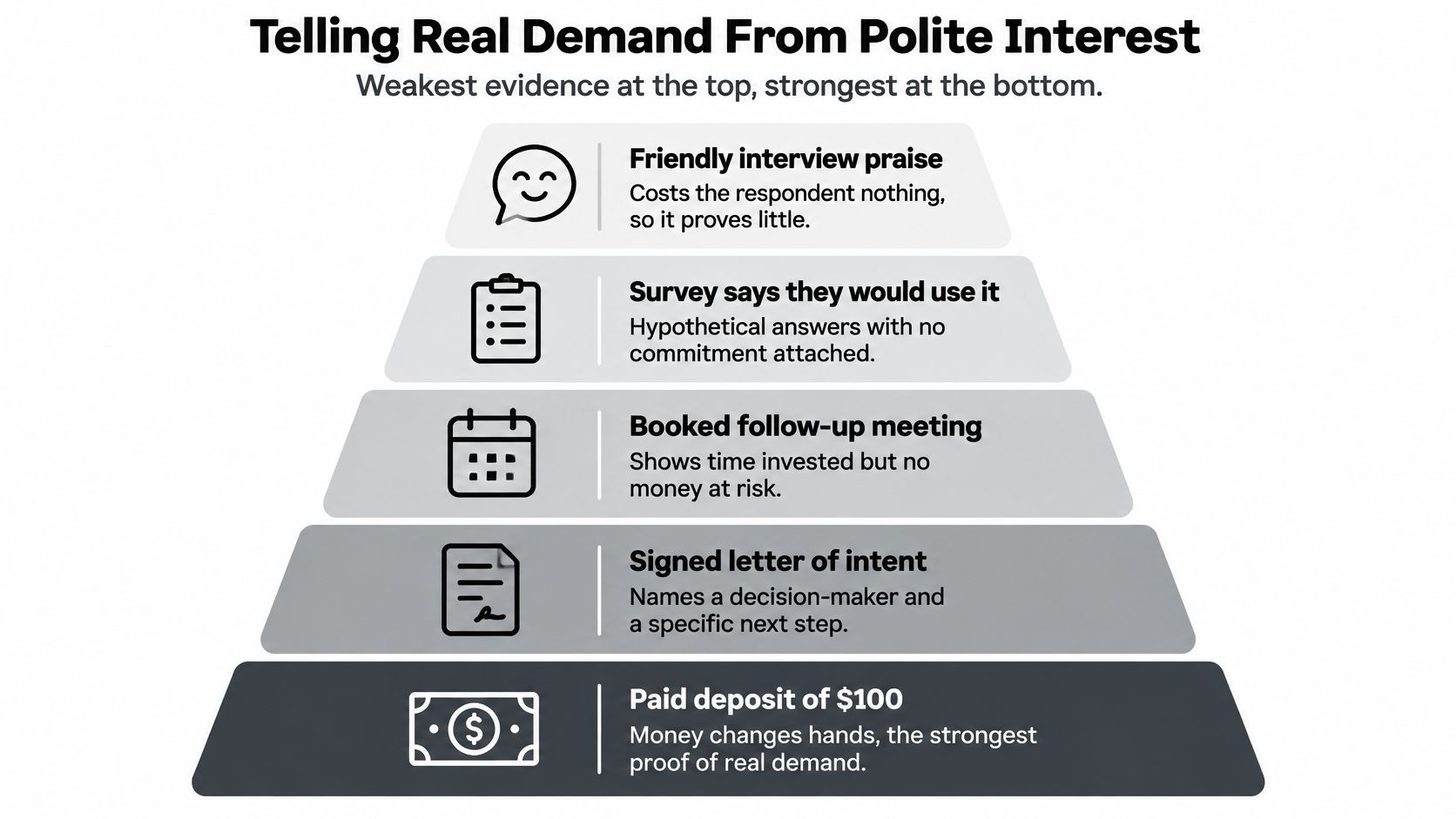
| Evidence | What the customer gives up | Strength | Where it misleads |
|---|---|---|---|
| Positive interview reaction | Only a few minutes of time | Weak | People endorse hypothetical products |
| Waitlist signup or landing-page click | An email address | Weak | Costs nothing and rarely signals budget |
| Described recent workaround | Time or money already spent | Moderate | Shows the pain is real, not that it is urgent now |
| Switching activity or measurable loss | A changed workflow or documented cost | Strong | Can reflect a one-off event |
| Deposit or paid pilot | Cash committed | Very strong | May come from a buyer without final authority |
| Proprietary data access or procurement step | Access, internal approval and time | Strongest | Slow to obtain, so rarely attempted early |
How to Score What You Hear
Rate every piece of evidence on four factors:
- Cost to the customer: Did they spend money, time, or political capital, or just words?
- Recency: Did this happen last week, or are they recalling something from two years ago?
- Frequency: Does the problem recur on a schedule, or did it bite once?
- Decision authority: Can this person sign off, or are they speaking for someone who can?
Count only the top two tiers toward a go or no-go decision. Everything below them is context, useful for shaping questions, worthless as proof. This is also where structured startup market research helps, because it forces you to find buyers outside your existing network instead of recycling friendly opinions.
We hold a simple standard here. Validating a product idea means proving that real strangers, not friends or coworkers, will give money, time or a clear yes before the product is built. Spending more than $500 on validation usually means avoiding the harder part, which is talking to people.
When a deposit does arrive, watch it properly. Lightweight tools for tracking Stripe sales let you see paid pilots land in real time, so commitment shows up as revenue rather than as a note in a spreadsheet. Fit is a commitment threshold, not an interview count, and articulate users plus social media engagement can easily impersonate a market that will never pay.
How to Test Problem-Solution Fit Step by Step
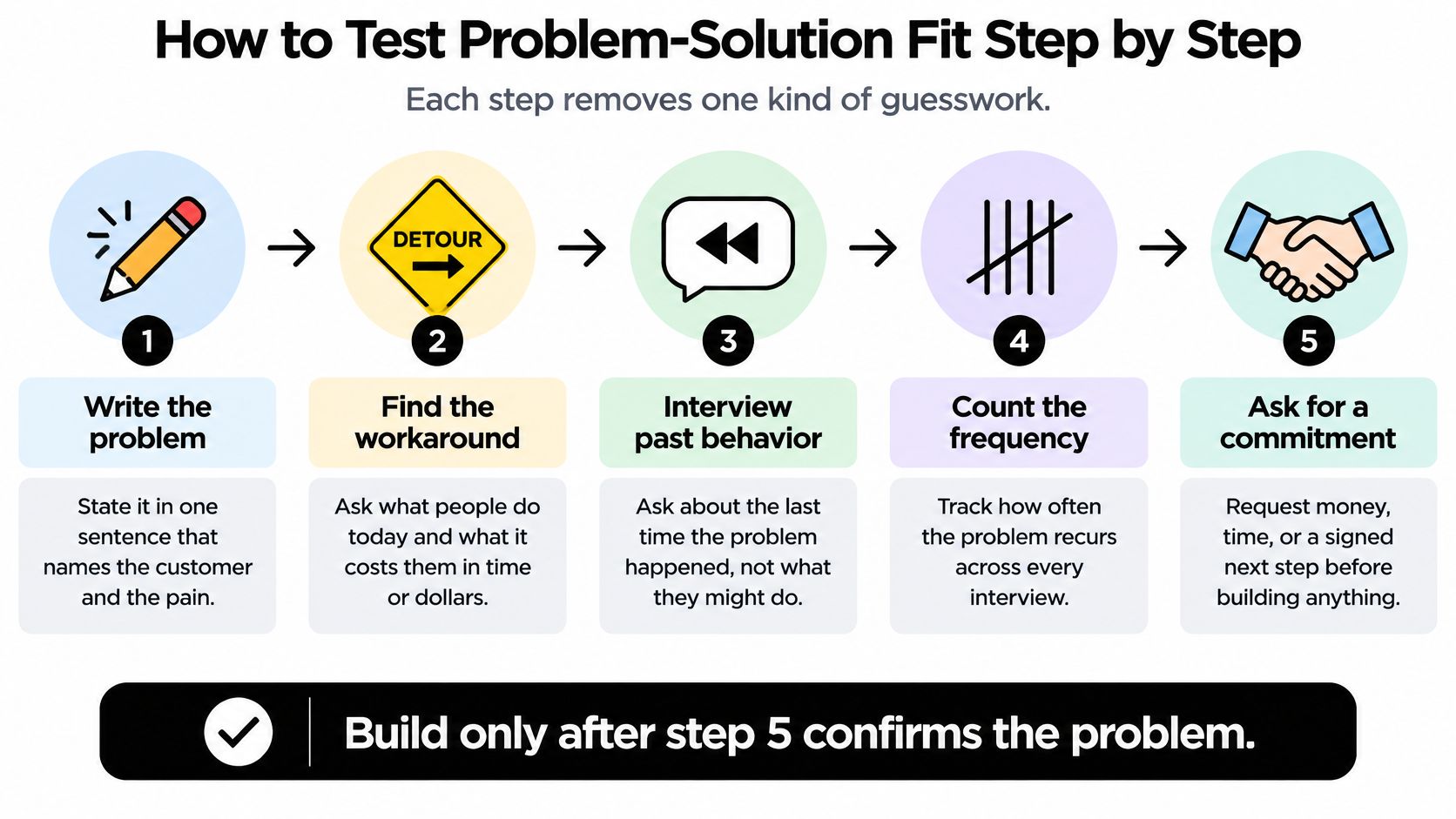
Each step below removes one kind of guesswork, and the order matters. You'll confirm the problem before you test a solution, and you'll set your pass rule before you see any results.
The Seven Steps
Write the problem in one sentence naming a real buyer. This is our first validation step, and if you can't do it, the idea isn't sharp enough yet. "Small clinics lose revenue to no-shows" works. "Healthcare communication is broken" doesn't, because nobody in it can buy anything.
Define five things before building. Name the target user, the triggering situation, the current workaround, the required outcome, and the price at which the buyer would commit. This turns a vague idea into a falsifiable claim, the approach laid out in this evidence-based customer discovery training course, which also requires the problem to be important to customers, technically solvable, and backed by a credible payment path.
Verify frequency and severity through past behavior. Ask about the last time the problem happened, what it cost in time or money, and what the person tried. Our guide to customer discovery interviews covers question wording in depth. Stop interviewing when new conversations repeat the same workaround, not when you hit a fixed count.
Test a narrow prototype against the current workaround. Your competitor isn't another startup, it's the spreadsheet, the phone call, or the sticky note. The prototype wins only if it saves time, cuts errors, or removes a step the buyer already dislikes.
Set a pass or fail rule in advance. Decide the share of qualified prospects who must complete the target action or accept a paid pilot. Without a pre-set rule, you'll reinterpret courtesy feedback as demand, because every result looks encouraging when nothing can fail.
Measure activation, repeat use, and conversion in a defined cohort. Fix the window before you start and track the same group through it. If you're testing a landing page as part of this, a website traffic checker for service businesses helps you sanity check whether similar service sites really draw visitors, so you don't misread low traffic as low demand.
Label every hypothesis and build only what's confirmed. Mark each one validated, invalidated, or needing modification. The minimum feature set should come from observed use, not from the product specification you wrote before meeting a customer.
A short walkthrough of this validation loop in practice is worth watching before your first round of tests.
What You Should Be Holding at the End
You should finish with a one-page hypothesis log. Each row states the hypothesis, the test you ran, the pass rule you set in advance, and the verdict. That single page is your evidence that problem solution fit exists, or your proof that it doesn't yet.
The strongest evidence is behavioral. A user changes a workflow, hands over data, returns without prompting, or commits money.
Following One Idea Through a Fit Test
Say a founder wants to build a reminder add-on for independent dental clinics. This example is hypothetical, but every step mirrors the test sequence above.
Week One Brings Encouragement, Not Evidence
She ran her first calls in early March, speaking to office managers at six clinics. Every manager agreed missed appointments were annoying, and most said a better reminder tool sounded useful. She logged those calls candidly as interest, not evidence, because nobody had described a cost, a workaround, or a budget.
In the second week she changed her questions. Instead of asking whether no-shows were a problem, she asked about the last one. One manager reported spending about two hours a week calling patients by hand to confirm appointments. That same clinic had already tried a free texting app, which patients mostly ignored.
Those two details changed the picture. The pain recurred weekly, someone was already paying for it in staff time, and a previous solution had failed for a specific reason she could design against. She now had a workaround to beat, manual calls, and a failure mode to avoid, messages patients didn't act on.
The Prototype and the Pass Rule
By late March she had a narrow prototype that did one thing, send a single confirmation text asking the patient to reply. The target action was a patient replying to confirm, not the text being delivered. Before running it, she set the pass rule, at least half of invited appointments confirmed by reply.
She tested it in two clinics over the following two weeks. Both cleared the threshold, and both agreed to a paid pilot with a deposit. On commitment evidence alone, that looked like a clean pass, and she nearly started building the full product.
Where It Stalled
Then one pilot froze. The office manager who loved the tool couldn't move it forward, because the clinic owner controlled the budget and had never seen the cost or the confirmation results. The deposit sat in limbo while the manager waited for a conversation that kept slipping.
She reran the conversation with the owner in mid-April, leading with the two hours of weekly calling and the confirmation rate from the test. The owner cared about recovered appointment slots, not message features, and approved the pilot on those terms.
Her verdict in the log read, problem real and frequent, first buyer wrong. Fit depended on finding who decides and pays, not only who feels the pain most sharply.
When Fit Holds Up Under Change and Multiple Buyers
A problem can hurt today and still make a poor foundation if its urgency depends on timing. Test durability before you commit, not after conditions shift under you.
Run the Three Scenario Test
- Current pain: What does the problem cost the customer right now, in their existing workflow?
- Pain after a plausible change: What survives a regulation update, a platform policy shift, a cheaper substitute, AI automation, or a downturn?
- Fallback without you: What does the customer do if your solution disappears tomorrow?
The third scenario is the most revealing. If the customer would shrug and return to a spreadsheet at no real cost, your value is thin, however warmly they speak about you. If losing you means rehiring manual labor or accepting measurable errors, the problem is structural.
Separate the Buyer Roles
In business markets, the user, the budget holder, and the compliance owner are often three different people. Each one can block adoption for a different reason. The user wants relief, the budget holder wants a return, and the compliance owner wants risk contained, and a pitch that satisfies only the first will stall with the other two.
Ask three questions for every account. Who gains if this works? Who pays for it? Who carries the implementation risk if it goes wrong? If you can't name all three people, you haven't found the buyer yet, you've found an audience.
Three Edge Cases That Break Good Problems
First, temporary urgency. A deadline, a policy window, or a seasonal crunch can make a minor annoyance feel critical for six weeks, then evaporate.
Second, an unstable channel. If adoption depends on one platform's algorithm, app store placement, or partner integration, someone else controls your distribution and can revoke it.
Third, capturing too little value. Your solution might save a customer a large sum while you can only charge a sliver of it, because procurement benchmarks you against a cheap generic tool. Timing and unsustainable economics are distinct failure patterns, as this data-driven look at why startups fail notes, so a real problem can still produce a weak business.
A painful problem is a starting point. A durable problem with an identifiable payer is an opportunity.
Decide Whether to Build, Iterate or Move On
Evidence without a decision date is just research. We set the final decision within 14 days, build, iterate on one variable, or move on, and we make the call on that date whatever the evidence looks like.
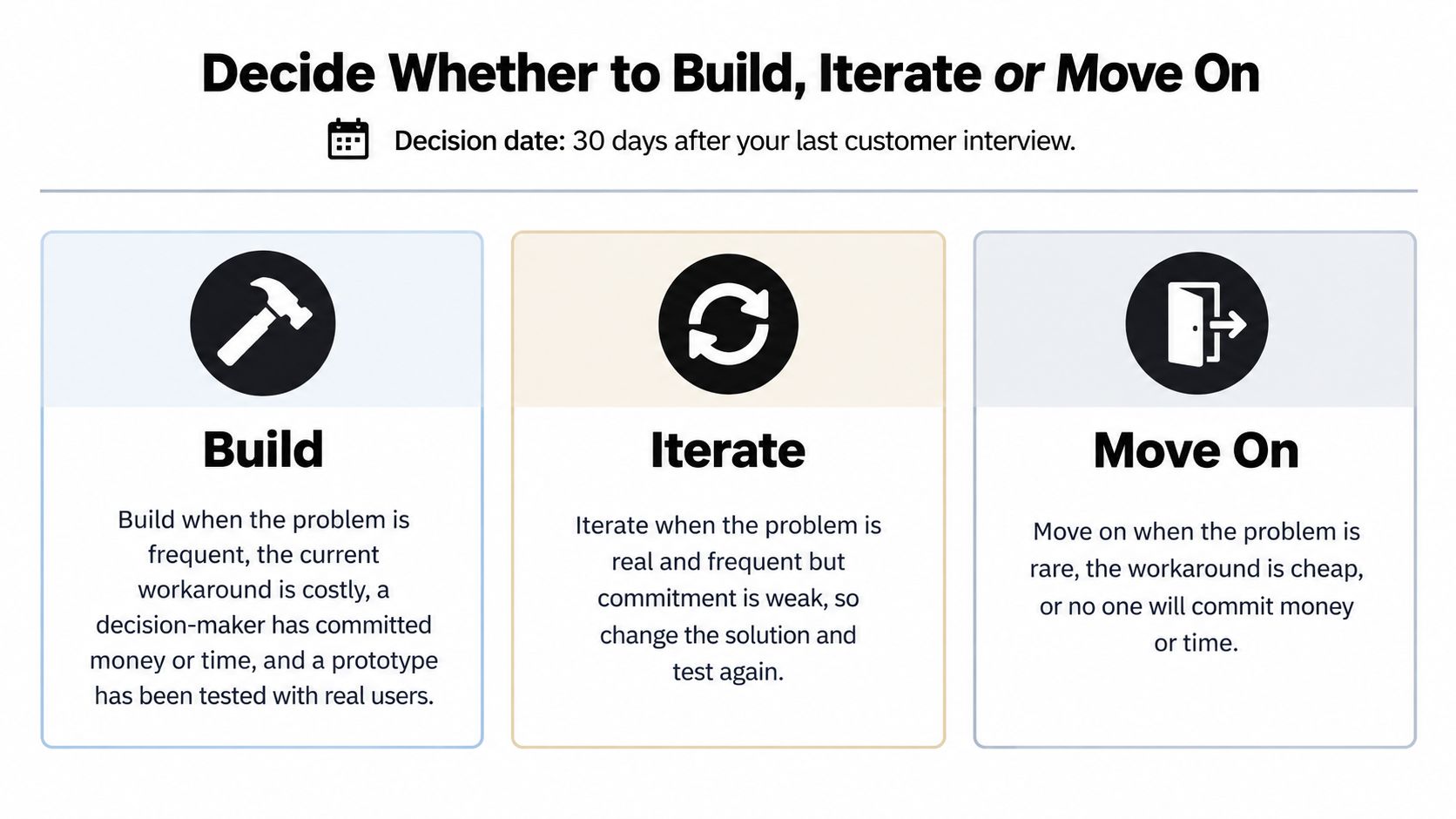
Build when the problem is frequent, the current workaround is costly, a decision maker has committed money or time, and retention stabilizes above zero. At that point, guidance on building an MVP for your startup and a clear definition of what an MVP actually includes will keep your first build scoped to what the evidence confirmed.
Iterate when behavior is close but one pass rule was missed. Change one variable, the segment, the value proposition, or the price, never all three at once, or you'll never learn which change worked.
Move on when retention still trends toward zero after you've iterated on both the problem and the segment. That's not a near miss. That's the market answering you.
The deadline exists because drift burns cash. In 2025, 29% of startup failures were attributed to running out of cash, according to CB Insights startup post-mortem figures reported by The Week, and spending before demand is confirmed feeds exactly that pattern. Keep your one-page hypothesis log current so the decision can be audited later, then start today by writing the one-sentence problem you want to test, naming the actual buyer, at the top of that log.
If you're still hunting for a problem worth this kind of testing, Find Startup Idea surfaces startup ideas sourced from real pain points people post on Hacker News and Reddit, so you start from complaints that already exist instead of inventing them. Pick one idea, write its problem in a single sentence naming a real buyer, and run the commitment test this week before you build anything.