Startup Market Research: How to Test Demand First
Learn startup market research step by step: a four-week sprint plan, demand tests, reliable data sources and market sizing that show whether to build.

No market need was the most-cited failure reason in CB Insights' post-mortem sample: 42%, ahead of ran out of cash at 29% and get outcompeted at 19%.
Market research exists to catch that signal before the build does. The questions are plain: do customers have a frequent, costly problem, will they change what they do now, and can you serve them profitably?
The common signals lie. Funding rounds, search volume, and upvotes measure attention rather than intent to pay. Rank evidence by what it costs the customer, from a free like up to a paid pilot, and set your decision thresholds before you collect anything.
Your Four-Week Startup Market Research Sprint
Use a four-week sprint as a planning structure, not a promise that every market can be validated on that schedule. Recruitment, procurement, and access to buyers may take longer. If you can't reach the intended customer, record that as a distribution risk rather than replacing them with easier interviewees.
The sprint should produce decision documents, not a presentation designed to make the idea look attractive.
| Week | Core question | Main method | Output |
|---|---|---|---|
| 1 | Who has the problem and how often do they feel it? | Pain-point mining, hypothesis list, segment definition | One-page problem brief with ranked hypotheses |
| 2 | Why do they live with the problem and what do they do now? | A bounded round of interviews per segment about past behavior | Interview synthesis with workarounds and spend |
| 3 | Will they act, pay, or commit? | Landing page, waitlist, or pre-order with a preset threshold | Conversion readout against the preset threshold |
| 4 | Is the market big enough, and can we serve it profitably? | Bottom-up sizing, unit economics check, kill criteria review | Sizing sheet and go, pivot, or kill memo |
Treat each row as a work block for a solo founder or small team. Don't turn the schedule into an unsupported estimate of how many hours research usually takes.
Define the segment before recruiting
“Small businesses” isn't a useful starting segment. Specify the buyer's role, workflow, purchase authority, location, and trigger for needing help.
A narrower description lets you distinguish a real pattern from unrelated complaints. An owner who manually reconciles invoices has different constraints from a finance employee who needs approval to change accounting software.
The problem brief should capture:
- The recurring job: What the customer needs to finish, and what interrupts it.
- The current alternative: Software, contractors, spreadsheets, internal labor, or just tolerating the problem.
- The adoption barrier: Budget, trust, migration effort, approval, or lack of urgency.
- The commercial assumption: Who pays and which delivery costs could make the offer unprofitable.
Make each output change a decision
The interview synthesis should separate observations from interpretations. “The buyer exports records before reconciliation” is an observation. “The buyer needs an integration” is a hypothesis.
The conversion readout should preserve the offer and audience used in the test. The sizing sheet should distinguish counted accounts from estimated accounts, and the final memo should identify which assumptions still lack evidence.
Practical rule: A sprint is a risk filter, not a revenue forecast.
A weak demand test can be a useful outcome if it prevents unnecessary development. Don't extend the sprint just to accumulate more encouraging comments. Extend it only when a specific unresolved question could change the decision.
Data Sources That Work Beyond Funded Startups
Funding databases map financed competitors, not customer demand. A company can raise on a convincing narrative while the underlying problem stays unproven. Funding totals measure investor conviction, and demand evidence has to come from buyers.
Treat every source as a partial view. Use the following comparison to decide what to investigate, then check current access terms and coverage before depending on a dataset.
| Source | What it reveals | Cost | Main limitation |
|---|---|---|---|
| BLS Business Employment Dynamics and Census County Business Patterns | Establishment counts and business dynamics, depending on the dataset | Public access | Business counts don't establish spending or pain |
| SAM.gov and EU TED tender portals | Public purchasing requirements and contract records | Public search | Public procurement may not resemble your target buying process |
| LinkedIn Jobs and Indeed | Roles, tools, and responsibilities employers mention | Check current access | A posting isn't proof of an approved software budget |
| Google Trends | Relative search interest and possible seasonality | Public tool | Interest isn't willingness to pay |
| Hacker News and Reddit search | Problem language, complaints, and workaround discussions | Public browsing where available | Contributors may differ from your intended buyers |
| App stores and G2-style review sites | Reported frustrations with existing products | Public reviews where available | Reviewers are a selected group of users |
| Trade association surveys | Sector-specific questions about pricing, adoption, and operations | Check membership requirements | Check dates, sampling, and sponsorship |
| Crunchbase and CB Insights | Financing activity and investor-backed competitors | Check current plans | Financing coverage isn't a census of potential customers |
| Find Startup Idea | Candidate ideas sourced from Hacker News and Reddit pain points | Check current access | Each candidate still needs independent verification |
Triangulate different kinds of evidence
Use a triangulation rule: combine buyer testimony, observable behavior, and market context. Several community threads repeating the same complaint still represent the same general source type.
Rank each piece of evidence by the cost the customer paid to produce it. A search spike, an upvote, or a supportive comment costs nothing. A reply to a direct question costs a few minutes of attention. A paid pilot costs real budget. Cheap signals are useful for finding language, but they cannot carry a go decision alone, so decide what each source needs to show before you start collecting.
Suppose buyers describe a burdensome compliance task. Look for purchasing requirements, relevant hiring responsibilities, or spending on an existing workaround. If those sources disagree, preserve the disagreement instead of averaging it away.
A quiet forum doesn't disprove demand among buyers who rarely post publicly. A busy forum doesn't prove that participants control budgets.
Use online communities for market research to identify language and recruit relevant people, not to declare a market validated. Before transferring a finding from a US community to Europe, India, or Latin America, check local urgency, regulation, pricing, and distribution constraints.
How to Turn Online Pain Points Into Testable Hypotheses
A technically workable product doesn't demonstrate demand. Neither does a thread full of people agreeing that a task is annoying.
The useful transition is from a complaint to a claim you can disprove. The published B2B startup experimentation framework organizes this work around measurement, hypothesis prioritization, discovery, and validation, rather than interviews alone.
The process below keeps the customer's problem separate from your proposed solution.
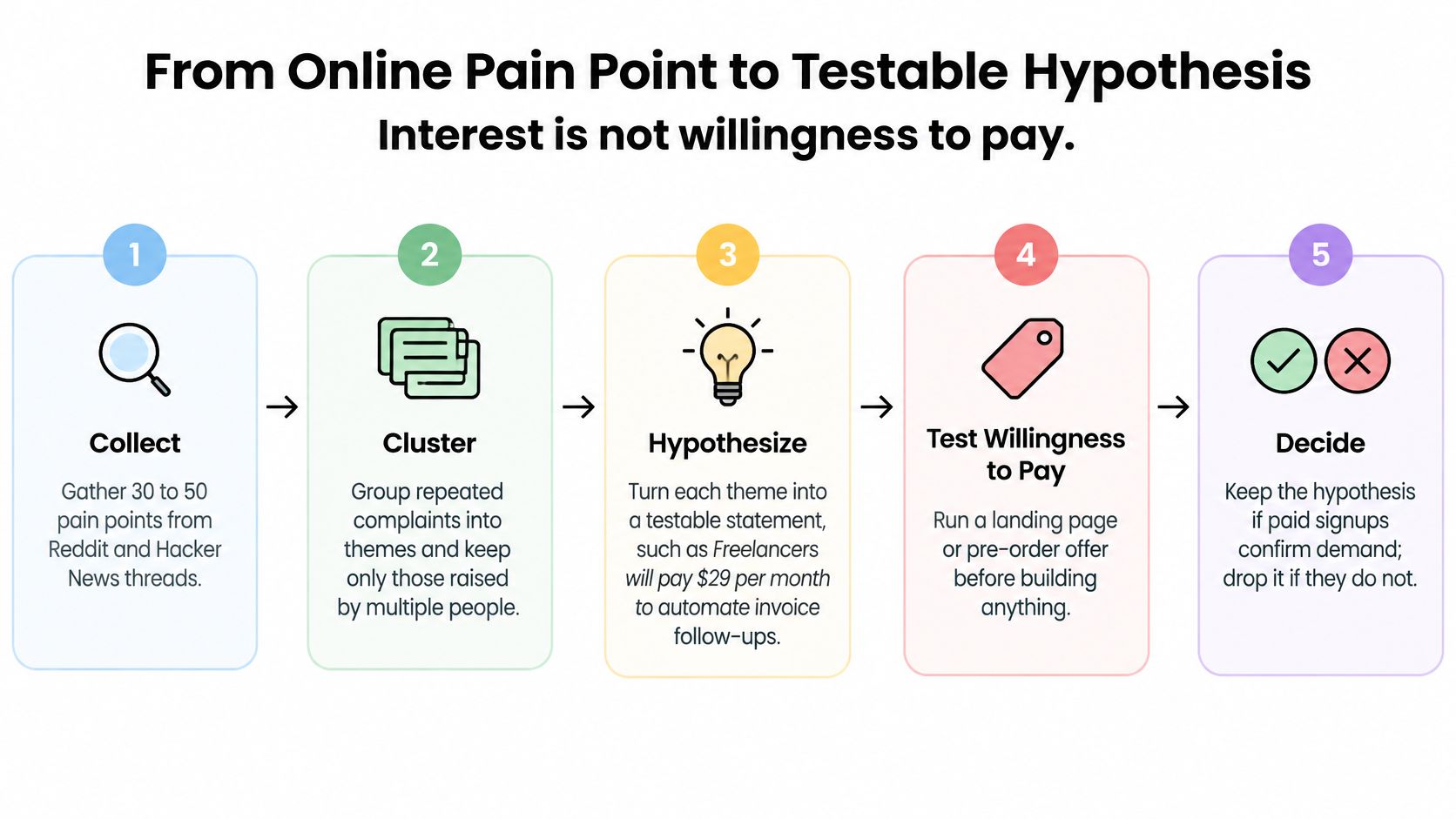
- Collect descriptions of the same job. Gather relevant posts and reviews, retaining the exact wording and source context. Don't combine complaints merely because they mention the same software category.
- Tag the customer, recurrence, consequence, and workaround. Keep missing information visible, because a post rarely tells you everything needed to judge commercial value.
- Rewrite each cluster as a falsifiable statement. Specify an audience and observable behavior instead of claiming that people need a better tool.
- Rank assumptions by problem frequency, workaround cost, and budget ownership. Investigate the assumption that could invalidate the business before polishing lower-risk details.
- Lock the test design before collecting new results. Record eligibility, sample requirements, observation window, success threshold, and the action you'll take if the hypothesis fails.
Use thresholds as decisions, not benchmarks
For example, the framework-linked validation approach supports test statements such as requiring at least 30% of screened users to report a weekly problem or at least 10% of qualified landing-page visitors to request access. These are illustrative decision thresholds, not established conversion benchmarks for your market.
Choose thresholds based on what would make the next investment reasonable. Keep problem incidence separate from purchase behavior: finding frequent pain doesn't establish that your proposed offer is the preferred solution.
Before: “Invoice reconciliation is painful.”
After: “By [closing date], the predefined share of screened finance buyers will document a recent reconciliation problem and an existing workaround; otherwise, we won't proceed with this segment.”
Replace the bracketed date before recruitment. Then use the evidence ladder below to decide whether the action you're measuring is strong enough for the decision at hand.
Customer Interviews and Evidence Strength Ranking
What a customer has already paid for is stronger evidence than what they say they might buy. Payment doesn't prove they'll choose your product, but it establishes that they've committed resources to addressing the problem.
Recruit people who match the segment, including those who tolerate the current process or recently rejected an alternative. Don't fill the interview pool only with enthusiastic responders.
Ask about the last occurrence: what triggered it, what they did, what it cost, and who else participated. Replace “Would you buy this?” with questions about the actual decision process.
Rank actions by the cost to the customer
Use this ladder as a practical ranking, not a universal scoring system. Stronger signals require closer inspection too: a refundable deposit and a binding purchase commitment aren't equivalent.
| Evidence | Signal strength | Example |
|---|---|---|
| Likes, upvotes, and “I would use this” comments | Weak | A popular complaint with no follow-up action |
| Interview descriptions of a recent, repeated problem | Moderate | A buyer describes the latest occurrence and shows the workflow |
| Existing workaround with spending | Strong | A buyer pays a freelancer or maintains another tool for a manual fix |
| Waitlist or landing-page sign-up | Moderate to strong | An eligible buyer requests access after seeing the proposed price |
| Letter of intent or refundable deposit | Strong, depending on terms | A buyer commits subject to a clearly documented condition |
| Paid pilot or first invoice | Strongest in this ladder | A buyer pays to test the proposed outcome |
Consider invoice reconciliation as a hypothetical example, not a case study. Complaints alone suggest something worth investigating. Evidence that buyers already pay a freelancer to resolve the issue gives you a concrete alternative to evaluate, including its price, reliability, and switching costs.
The ladder makes the distinction between enthusiasm and commitment visible.

Preserve context during synthesis
Recruit through the communities where the complaint appeared, relevant professional groups, and direct outreach to matching buyers. Explain that you're researching the workflow, rather than disguising a sales pitch as an interview.
With permission, record conversations or take verbatim notes. Label exact customer language separately from your interpretation, and retain details about role, purchase authority, and current tools.
A customer discovery interview guide can help standardize prompts without turning the conversation into a script. Carry the strongest unresolved purchasing question into the demand test rather than treating the interview itself as permission to build.
Run the Week-Three Demand Test
Write the pass condition before the landing page goes live. Record the target conversion rate, minimum qualified sample, closing date, and eligible action in a shared test document.
Build a landing page that names the buyer, desired outcome, proposed price, and next step. Use a clear primary call to action. If the product isn't ready, say so, and explain any deposit or refund terms plainly.
Keep the test interpretable
- Recruit from relevant channels. Start with the communities where you found the problem and targeted outreach to matching interviewees. Follow community rules rather than posting an unsolicited promotion.
- Count qualified visitors separately from general traffic. Define qualification in advance using the buyer profile, not whether someone later converts.
- Compare the observed result with the locked threshold. Don't lower the bar after seeing weak results. If the minimum eligible sample wasn't reached, mark the test inconclusive.
- Where appropriate, offer a pre-order, deposit, or paid discovery engagement. Describe exactly what the customer receives and what happens if you don't deliver.
- Preserve the test conditions. Save the page copy, price, traffic source, qualification method, and funnel events. If you change the offer, report the changed version separately.
An access request tests an access request. It doesn't establish purchase conversion, renewal, or profitable acquisition.
Don't promote a weak signal into a stronger conclusion just because the result looks encouraging.
Separate a failed offer from a failed experiment
A broken form, misleading message, or irrelevant audience can make a test uninterpretable. Check those conditions before deciding what the response means.
But don't use technical explanations as an automatic escape from disappointing evidence. If the intended buyers understood a credible offer and declined the specified action, that's a reason to stop or revise the proposition.
A passing result supports the next bounded commitment, usually a paid pilot. A failed result supports stopping the current offer. Neither result establishes the whole business model.
Sizing a Market From the Bottom Up
Mega-rounds captured 65% of venture funding in 2025, while deal counts fell 17% to 29,501, according to CB Insights' venture trends report. The same report puts AI companies' share of global venture funding at 48%. Keep those categories separate: not every mega-round was an AI round.
Those figures describe capital allocation, not your customers' budgets. For startup market research, build the revenue estimate from identifiable buyers and an offer you can deliver.
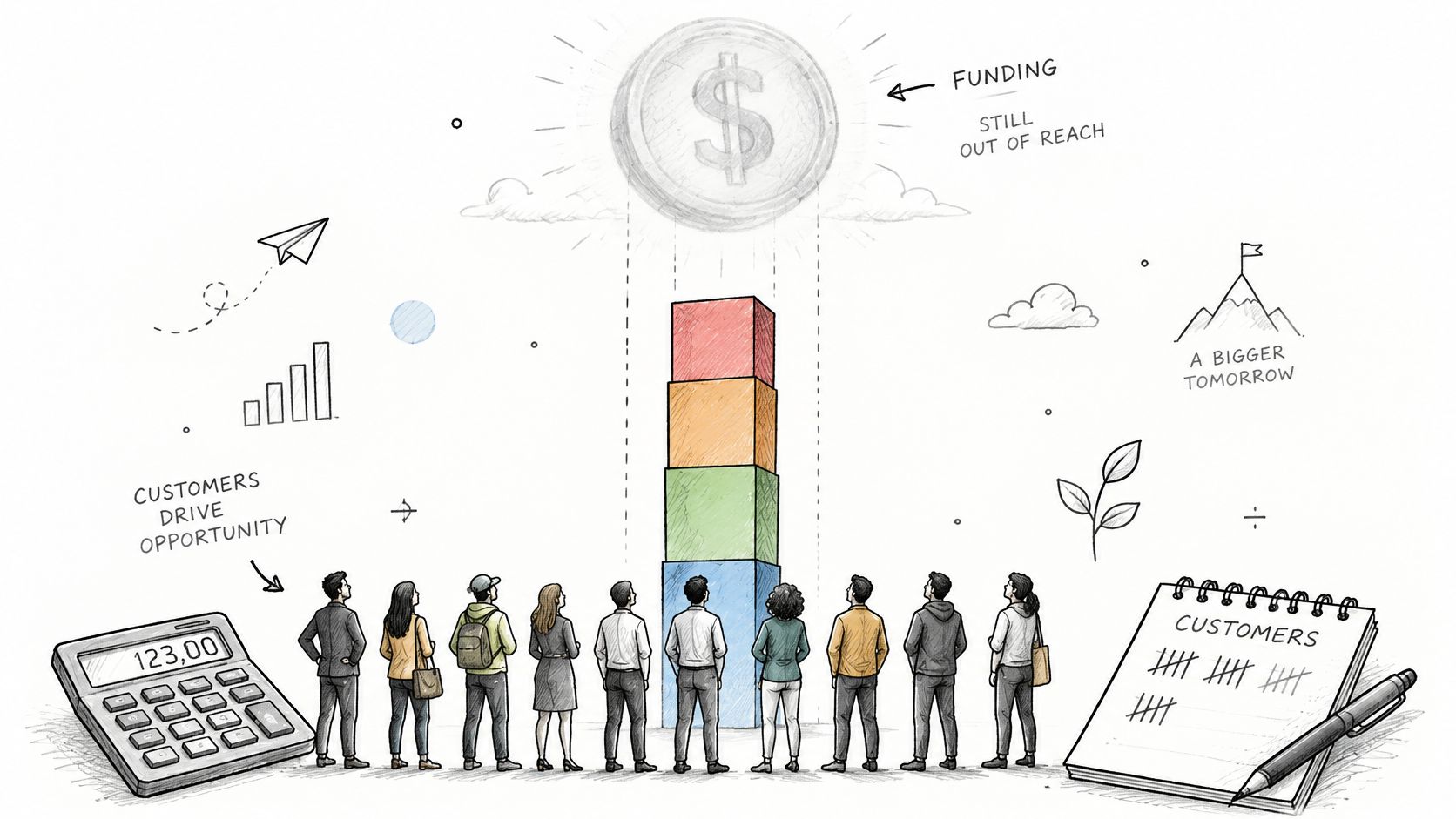
Think in terms of reachable accounts, not the apparent height of a category's funding stack.
Build the estimate from inspectable inputs
- Count candidate accounts. Use a relevant government dataset or directory, recording its date, geography, and unit of measurement.
- Filter for actual fit. Exclude accounts that lack the workflow, purchasing authority, technical conditions, or distribution access your offer requires.
- Use a supported price. Prefer pilot payments and negotiated offers. A comparable product's advertised price is context, not proof of your achievable price.
- Constrain adoption with evidence. Use observed purchasing behavior and sales capacity, while labeling untested assumptions explicitly.
The calculation is simple: matching accounts × attainable annual revenue per account × supported adoption assumption. The difficulty is defending each input.
For example, a practice-management offer should start with eligible practices in the intended geography, not everyone employed in healthcare. Filter that count to practices with the relevant workflow, then apply a price and adoption assumption that your own research can support. Without verified inputs, retain the formula rather than manufacturing a revenue total.
Distinguish the market you can describe from the market you can win
Total market covers the broader problem category. Serviceable market excludes buyers you can't serve because of geography, requirements, or product scope. Obtainable market further reflects distribution access, sales capacity, and buying behavior.
Plan around the obtainable estimate. Don't substitute waitlist conversion for paid adoption, or multiply an annual price by prospects who only expressed interest.
For additional context on evaluating an opportunity, use the accompanying video.
Finally, compare potential gross profit with delivery, onboarding, support, and acquisition costs. If the reachable segment can't support the operating plan, revisit scope or price before expanding the headline market.
Confirm Go or Kill Before You Build
Write kill criteria before authorizing development. OpenStax reports a 75% success rate for new products with well-defined and executed predevelopment activities, versus just over 31% when those activities were weak or absent, in its review of new-product success and failure factors.
Those product-development findings aren't a universal startup success rate. They support taking predevelopment work seriously, not claiming that research guarantees a successful launch.
Make the decision explicit rather than letting development begin by default.

Turn the research into a decision memo
- Group the evidence. Put quotes, observed behaviors, and test results into clusters by problem, buyer, and workaround. Keep contradictory evidence attached.
- Compare candidates on frequency, workaround cost, budget ownership, and reachable market. Avoid false precision: an unsupported score isn't better evidence than a clearly labeled unknown.
- Apply the original decision rules. Name the threshold met or missed, and identify any test that remained inconclusive.
- Choose go, pivot, or kill. Go means a bounded paid pilot. Pivot means testing a materially revised segment or problem. Kill means stopping the current candidate and recording why.
A stop memo should state what failed: access to buyers, problem recurrence, payment commitment, or viable economics. “People weren't excited” is too vague to guide the next attempt.
Before defining what belongs in an MVP, identify the remaining assumption that requires a working product to test. Don't build features to answer questions that a clearer offer or buyer conversation could resolve.
Start today by choosing the strongest candidates from your pain-point list and writing a test card for each. Define the audience, offer, action, closing date, and decision rule before spending engineering time.
Find Startup Idea offers startup candidates sourced from real Hacker News and Reddit pain points, giving you a starting point for investigating recurring customer problems. Visit Find Startup Idea, choose a problem that matches buyers you can reach, and turn it into a testable demand hypothesis before you build.