How to Build an Online Community That Lasts
Learn how to build an online community that lasts, from platform choice and onboarding to engagement loops, humane moderation, and sustainable monetization.
Growth is the advice most online communities get first. It's also a poor starting point. A large audience can still be a silent one, and adding members before you know what they need can leave you with a crowded space that nobody returns to.
A durable community starts with a specific reason for people to come together, then makes it safe and worthwhile to participate. The harder design work isn't collecting sign-ups. It's sharing participation beyond a small core and building moderation that people can sustain.
Why Most Online Communities Fail Before They Grow
Access isn't usually the main obstacle to building an online community. Pew Research Center reported that 65% of U.S. adults used social-networking sites in 2015, compared with 7% in 2005. Among U.S. internet users, adoption reached 76% in 2015, up from 10% in 2005. Participation also broadened across age groups: 35% of adults aged 65 and older used social media in 2015, compared with 2% in 2005. The lesson isn't that every audience wants another group. It's that the opportunity to connect is widespread, so communities have to earn attention with relevance, trust, and repeated value. (Pew Research Center's social-networking adoption timeline)
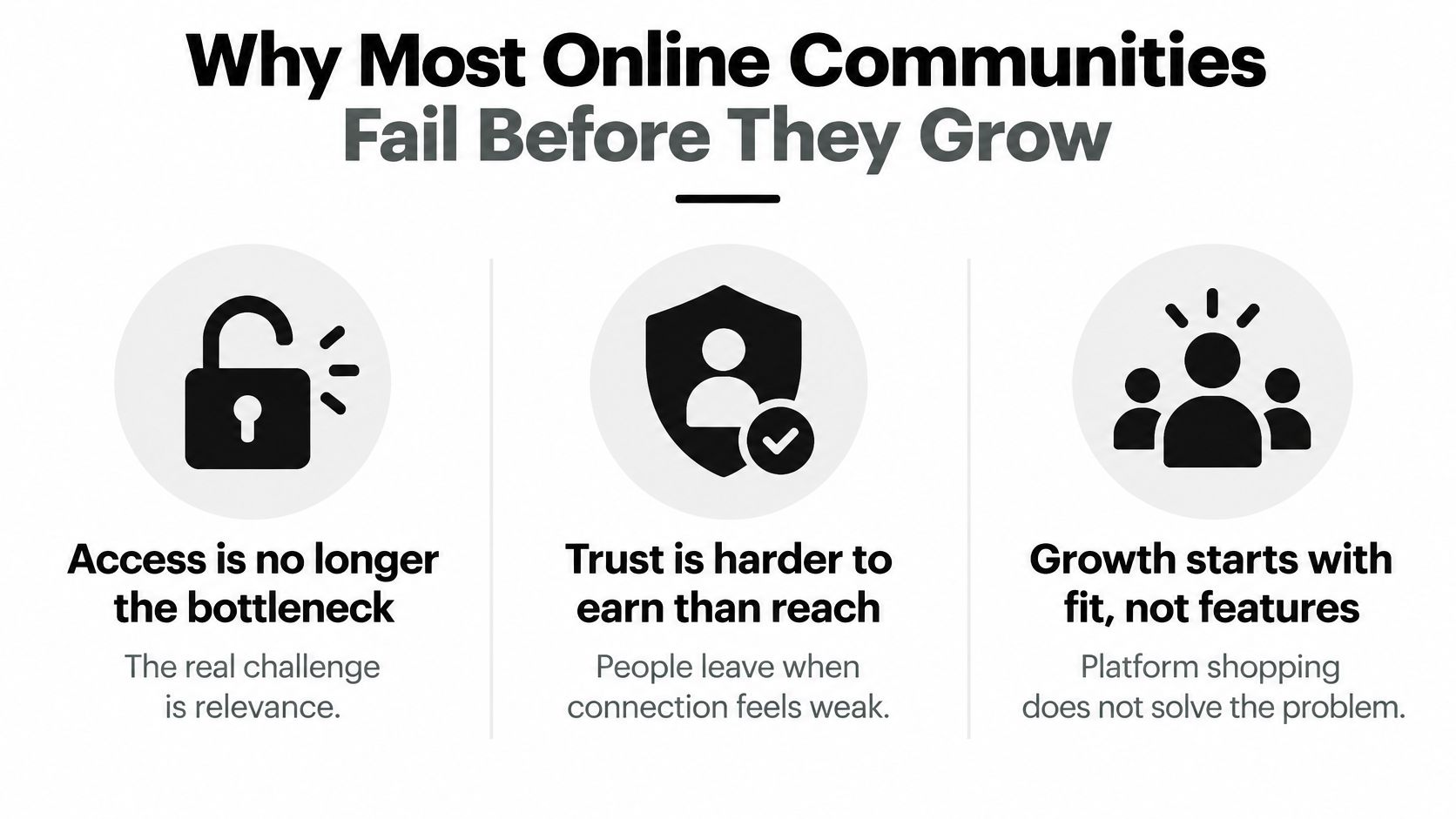
A spike in sign-ups can disguise two problems. Participation can concentrate in a small group, leaving everyone else to watch, while moderation can become unsustainable as the space grows. Neither is solved by posting more often or adding another channel. If members don't know why the space exists, or don't feel comfortable contributing, more reach may produce more quiet observers.
Start with a sentence that identifies both the people and the need: This community helps [specific people] [solve a shared problem or pursue a shared interest] by [how members help one another]. “A group for founders” is too broad to guide decisions. “A peer space where first-time founders can compare early customer research and get thoughtful feedback” gives you something concrete to design around.
Practical rule: Define the member need before you choose the platform. Features can make a good fit easier to use, but they can't create the fit.
That sentence will help you decide what belongs in the community, which conversations deserve a home, and what rules members need. If you want another practical perspective on the early decisions involved, how to build an online community offers a useful companion resource. Build around a lasting need, not a platform trend or one successful launch week.
Choosing a Platform and Defining Your Member Need
Write your member promise before comparing software. Keep it specific enough that a new visitor can tell whether the space is for them, and practical enough to shape its daily use. For example: Independent designers share honest feedback on client work and help one another handle difficult project decisions.
Then find out where prospective members already gather. Listen to the questions they ask, the advice they exchange, and what gets lost in the spaces they use now. A community is more likely to become part of someone's routine if it fits a behavior they already have. Researching existing communities and their audiences can also help you test whether the need is real before you invest in a full build, as outlined in this guide to online communities and market research.
Platform choice is a trade-off, not a contest for the longest feature list. A hosted community platform may give you a branded home and more control, while requiring you to build awareness and bring people there. Discord-style chat makes quick exchanges natural, but conversations can be harder to find later. Forums make topic-based discussions easier to organize and revisit, while social platforms offer built-in discovery at the cost of less control over the experience.
| Platform type | Ownership | Discoverability | Notification behavior | Migration risk |
|---|---|---|---|---|
| Hosted community platform | More control over the space; depends on the provider | Usually requires you to bring members in | Often configurable | Provider and export options matter |
| Chat server | Server is yours to manage; platform sets core product rules | Discovery varies; invitations often do the work | Fast, frequent, and adjustable by members | Conversation history and integrations may be difficult to move |
| Forum software | More control if self-hosted; maintenance becomes your responsibility | Searchable discussions can attract readers | Often less immediate than chat | Depends on hosting, software, and data export |
| Social platform group | Platform controls the environment and distribution | May benefit from existing network discovery | Governed by platform settings and feeds | High if access, reach, or features change |
Treat this table as a set of questions to investigate, not a promise that every product in a category behaves identically. Check whether members can search old conversations, control notifications, export useful content, and join without friction. Consider who'll handle administration and how you'd move if the platform stopped fitting the member promise.
Start with a small structure: a welcome space, a place for the central conversation, and a clear route to ask for help. Add a category only when members have a real reason to use it. Empty rooms don't make a community feel established. They make newcomers wonder where everyone went.
Designing Onboarding That Turns Visitors into Members
A newcomer can join, look around, and disappear without ever saying why. That's often not a rejection of the community. It's a sign that the first step felt awkward, unclear, or too demanding. Design onboarding as a short sequence that lets someone understand the space before asking them to be visible in it.
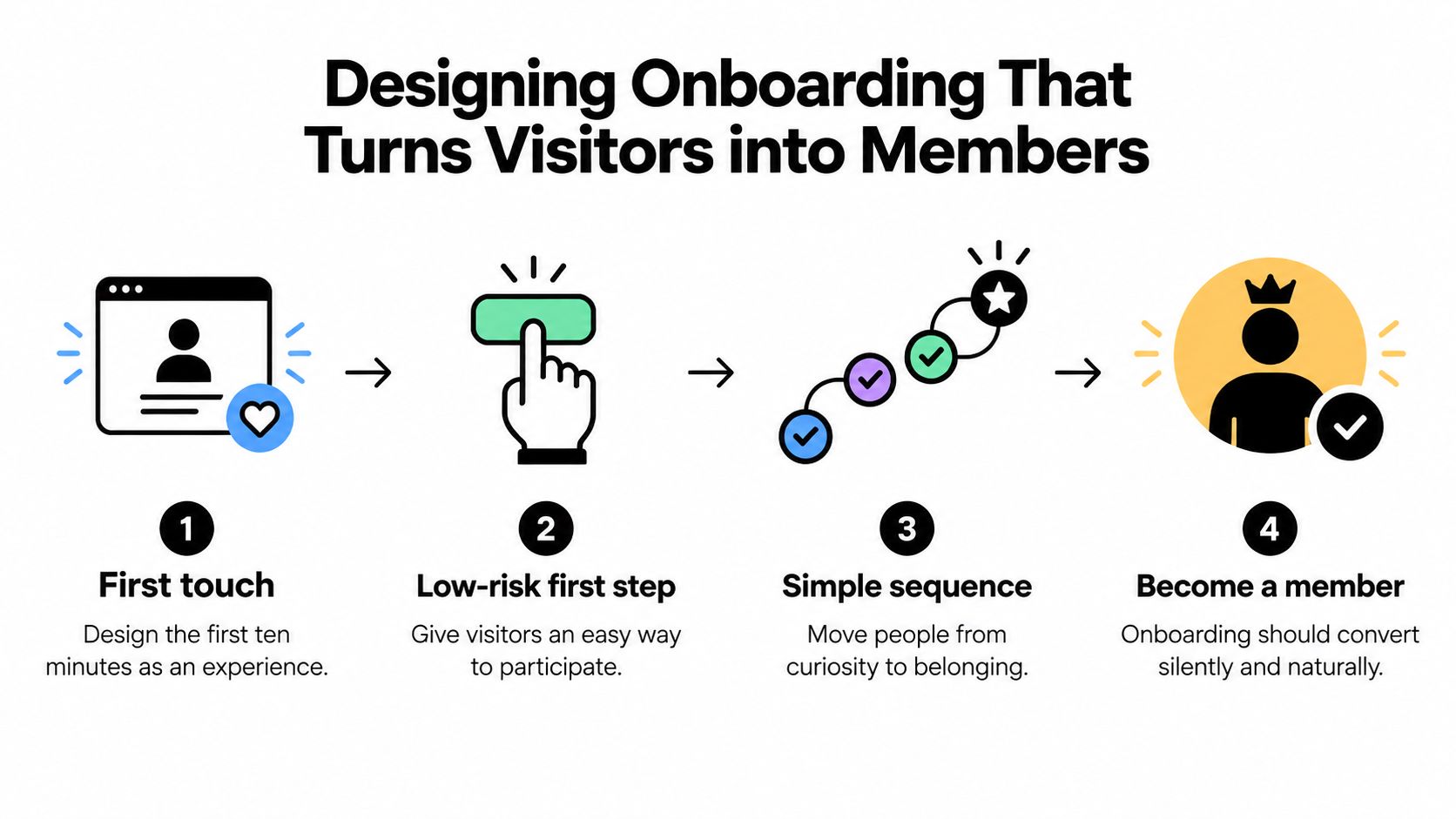
Begin with a welcome message that states the member promise in plain language. Point to the rules, explain how to find useful conversations, and name one easy next action. A long orientation post full of history may feel thorough, but most visitors need a simple answer to three things: why this place exists, what they can do here, and where to start.
Make the first contribution low-risk. A newcomer might read a pinned introduction, react to a discussion, vote in a poll, or answer one friendly question in a dedicated thread. If introductions help members connect, make the prompt short and optional. Asking for someone's role, goals, background, and personal story can make a welcome feel like an application form.
Make the next action obvious, small, and safe. A member who can participate without performing for the whole group is more likely to return.
The sequence matters. Reading comes before reacting; reacting can come before writing a full reply. Each action gives the member more context and lowers the social cost of the next one. A direct welcome from a real person can also make the space feel inhabited, especially when it responds to what the new member says rather than repeating a generic announcement.
Give newcomers a reason to come back that's connected to their interest, not a broadcast asking them to be more active. If someone joins to get feedback, point them toward an upcoming feedback thread or invite them to ask a small, specific question. If they go quiet, don't treat silence as proof they're uninterested. Send one considerate, relevant follow-up, and leave them free to observe.
Email can support onboarding when it points to a useful next step instead of filling inboxes with announcements. This resource on startup email marketing can help you think through how email fits into a broader member journey.
Use the video below as another way to consider the experience a newcomer encounters.
Building Engagement Loops That Broaden Participation
More posts don't necessarily mean more people feel welcome to contribute. A recurring pattern described in research around Jakob Nielsen's participation-inequality framework is the 90-9-1 pattern: roughly 90% of members observe, 9% contribute occasionally, and 1% contribute heavily. The same summary reports that Wikipedia had about 68,000 active contributors alongside 32 million unique visitors, and that its 1,000 heaviest editors produced roughly two-thirds of edits. Across four health-support networks, the top 1% of posters generated a weighted average of 74.7% of content. These figures describe different settings, not a target every community should expect to match. They do show why raw activity can hide how much the community depends on a few people. (Summary of participation inequality and the 90-9-1 framework)
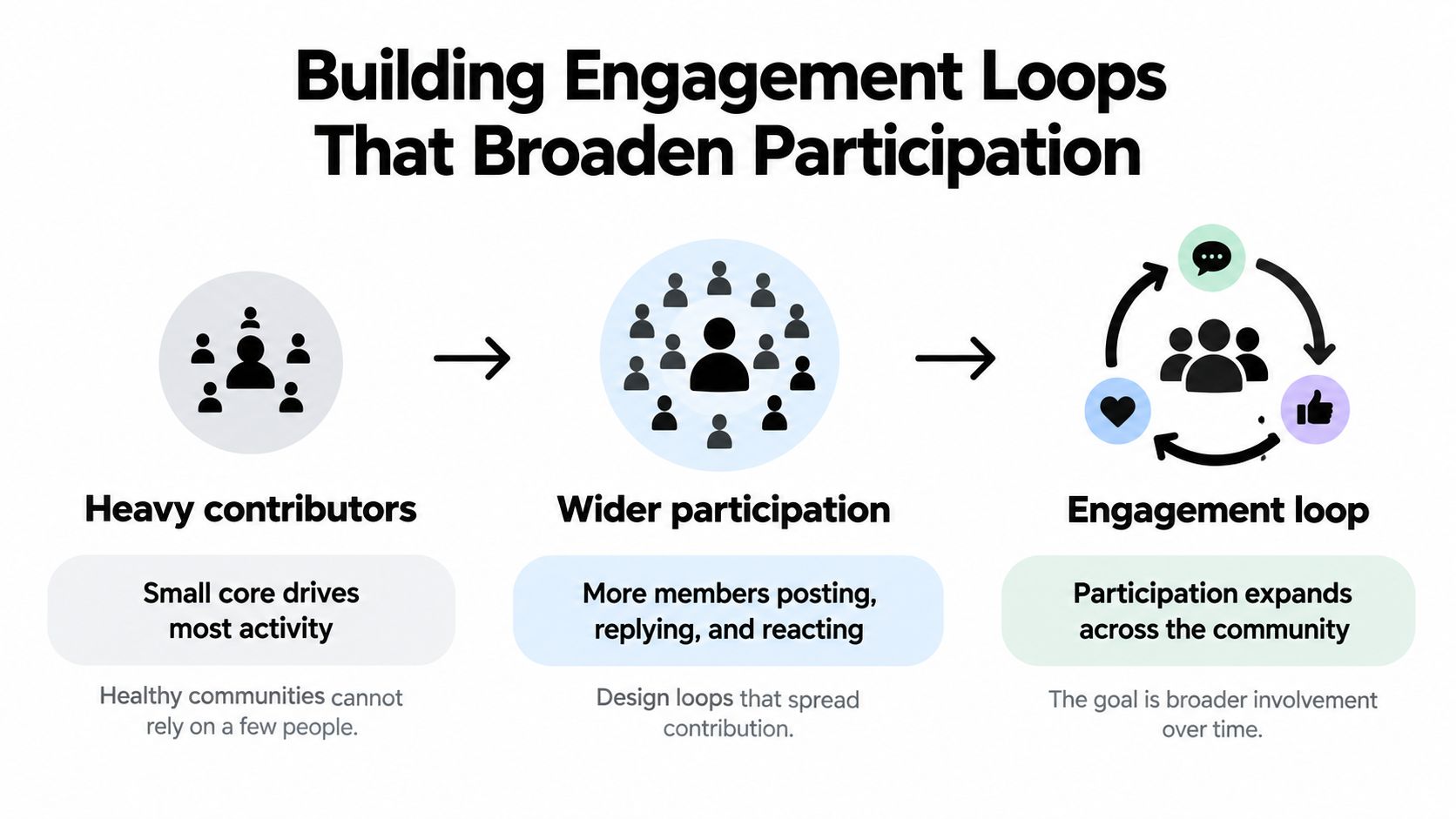
A healthy loop invites contribution, acknowledges it, and makes a future contribution feel easier. It shouldn't turn every member into a content producer. Readers still matter: they bring an audience, seek answers, and may contribute later when the question or format feels right. The useful question is whether more members can participate comfortably, not whether everyone posts.
Try lightweight formats that don't require a polished response:
- One-question threads: Ask for a specific experience or recommendation, rather than a broad essay.
- Reactions and polls: Give members a way to signal interest or preference without taking over the discussion.
- Rotating visibility: Invite different members to share a useful practice, host a discussion, or suggest the next topic.
- Member-to-member replies: Thank people for helpful answers and make space for members to respond to one another, not only to the moderator.
Don't reward volume by default. A leaderboard or prize for posting can raise activity while leaving participation concentrated, and members may begin writing for the incentive instead of the conversation. A better weekly routine is to offer one low-pressure prompt, follow up with thoughtful replies, and invite a different member to help shape the next discussion.
Track whether participation is broadening. Look at how many distinct members contribute, who's making a first contribution, and whether replies come from beyond the familiar core. Compare those patterns over time, rather than celebrating a jump in total posts on its own. If the same names still carry the conversation, change the format or invitation before adding more content.
A smaller conversation that members can enter safely is more useful than a busy feed that depends on the same few people.
Moderation Systems That Stay Humane at Scale
Rules on a page don't tell moderators what to do when a member reports a harmful post, when two people disagree about a decision, or when an enforcement action affects someone personally. A usable moderation system needs clear expectations, consistent decisions, understandable explanations, and support for the people enforcing the rules.
Research on self-harm and suicide-content communities found that members supported moderation while describing inconsistent decisions, unclear communication, difficult reporting processes, and risks for moderators with lived experience. Separate research found that members of tiny communities used positive language about moderators 6.1 times as often as members of very large communities. That finding doesn't prove size alone causes mistrust, but it's a warning against treating scale as a simple increase in reach. (Research on moderation and community size)
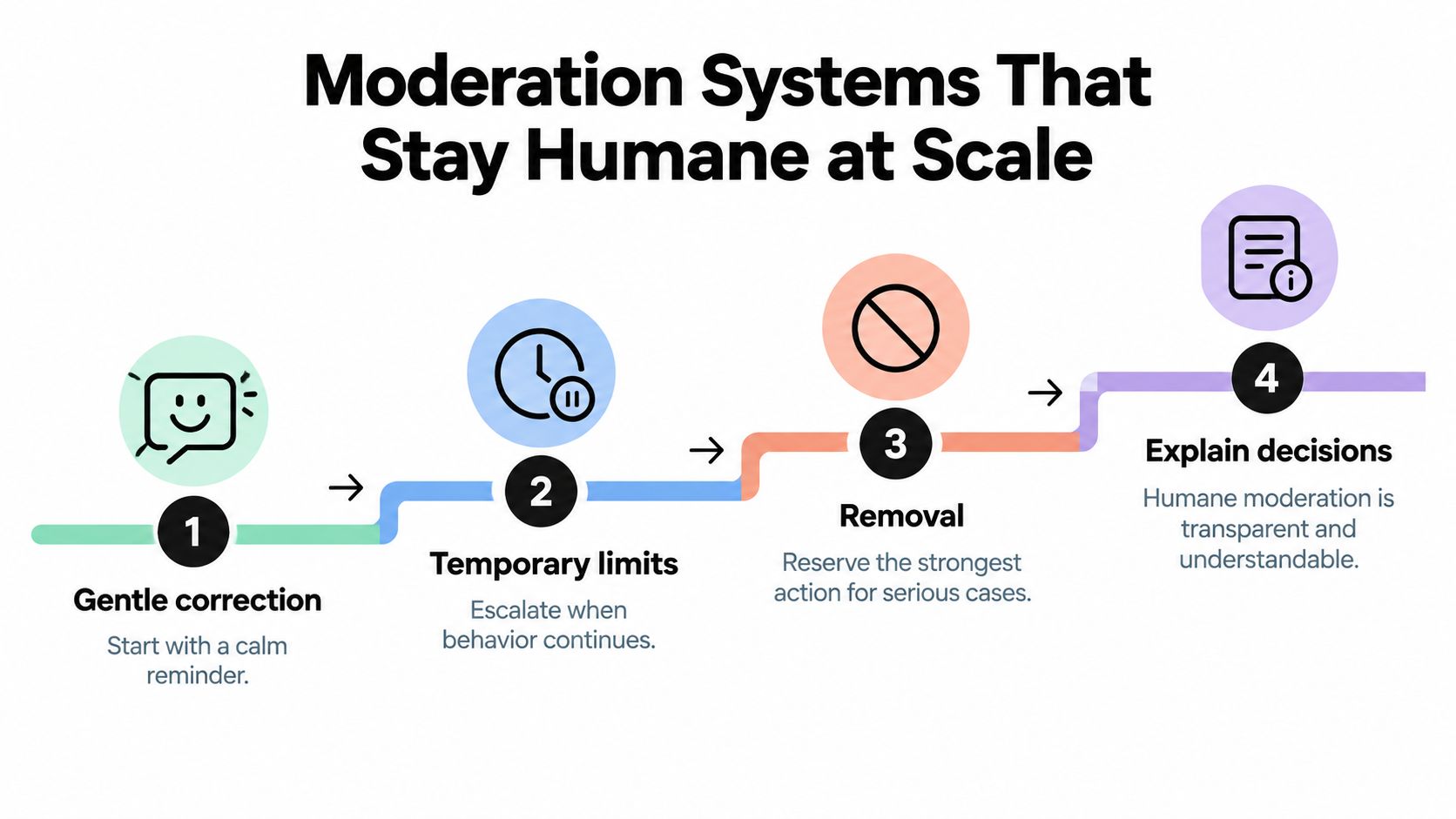
A graduated approach gives moderators room to respond proportionately. A minor misunderstanding might call for a calm reminder; repeated behavior may justify a temporary limit; serious or ongoing harm can require removal. Explain what rule was applied and what the member can do next. When a member can appeal to someone who wasn't involved in the original decision, they have a way to raise concerns without turning the main discussion into a dispute over enforcement.
Keep a private decision log with the issue, action, explanation, and any appeal outcome. Review patterns so different moderators don't apply the same rule in conflicting ways. A good starting resource for turning expectations into clear, usable guidance is these Discord community rule templates. Adapt rules to your topic and members rather than pasting in language that doesn't fit.
Reporting tools are useful, but don't rely on reports alone. Members may not report a problem, may struggle to describe it, or may not feel safe drawing attention to themselves. Give moderators a way to review the wider context, and establish a separate crisis process for sensitive material that identifies who responds, when to escalate, and what support to offer affected members.
Moderator wellbeing is part of the system, not an afterthought. Train moderators to apply the rules, give them access to supervision when difficult cases arise, and rotate demanding work when possible. If moderators have lived experience related to the subject matter, don't assume that experience makes them endlessly available or immune to harm. Track their workload and unresolved reports, and act before exhaustion becomes the price of keeping the space safe.
Monetization Models and Tools for Growing Communities
Community revenue should reinforce the member promise, not turn every conversation into a sales opportunity. Pick a model that fits what members already value, then make the exchange clear: what stays free, what payment provides, and whether paying changes someone's influence in the community.
| Model | Can fit when | Watch for |
|---|---|---|
| Membership dues or paid tiers | Members receive ongoing value they can describe | A paywall can narrow access or create status divisions |
| Sponsorships | Sponsors align with the topic and accept transparent boundaries | Members may lose trust if promotion shapes discussion |
| Courses and events | Members want structured learning or a shared experience | Don't confuse attendance with ongoing community health |
| Services | Members seek hands-on help that the team can deliver | A service business can crowd out member-to-member exchange |
These options aren't interchangeable. A paid tier can work when it offers specific extra value, but charging before members understand the benefit can make a promising space feel like a pitch. Sponsorships need visible disclosure and editorial boundaries. Events and courses can serve a real learning need, while services suit communities where direct expertise is part of the promise. Test one approach and listen to members before combining models.
Tools deserve the same scrutiny. A forum or community platform helps members hold conversations; a scheduling tool can help a small team plan public-facing posts without making the community feel automated. If you need help coordinating publishing, a social media scheduler is one option to evaluate alongside the platforms where your members talk. Don't confuse a steady calendar of promotional posts with a healthy member experience.
For founders and marketers still testing what to build, Find Startup Idea offers startup concepts sourced from real Hacker News and Reddit pain points, including community-related ideas. Use those ideas as prompts for validating a member need, not as proof that a particular model will work for your audience. A framework for comparing revenue logic and value delivery can also help you assess business model generation.
Your First 30 Days and the Metrics That Matter
Keep the first month focused on the member promise, the experience, and the people doing the work. Set up the minimum viable space, welcome a small group of relevant members, and make the first contribution easy. Publish clear moderation rules with an appeals path before activity makes hard decisions urgent.
Then establish a repeatable rhythm: run two or three low-pressure engagement loops, welcome newcomers personally, and review participation and moderator workload regularly. At the end of the month, ask whether contribution is spreading or still resting on the same core.
Track the share of members who contribute at least once, how contributions are distributed, first-time contributors, and moderator response time. These signals say more about community health than a rising member count on its own. If contribution remains concentrated, adjust onboarding or make prompts safer and easier to answer before adding more content.
Today, write the one-sentence member promise. Use it to decide who to invite first, what your welcome space needs, and which conversation you want members to have.
Find Startup Idea shares startup concepts drawn from real Hacker News and Reddit pain points, including ideas for community-focused products. If you're deciding what kind of community to build or how to validate its need, explore Find Startup Idea for practical directions to investigate.