What Is Competitor Research? How Startups Use It
Discover what is competitor research, why startups need it, and how to run one with reliable sources and clear, actionable findings.
Competitor research is the structured use of pricing pages, product information, customer feedback, and public records to understand competing alternatives and decide how to position, price, or build your product.
If your startup has no obvious rivals, does that mean you've found an opportunity, or that customers already solve the problem without buying anything? That's the gap a useful investigation must address. A list of similar businesses won't tell you whether buyers have a reason to change.
What Competitor Research Means for a Startup
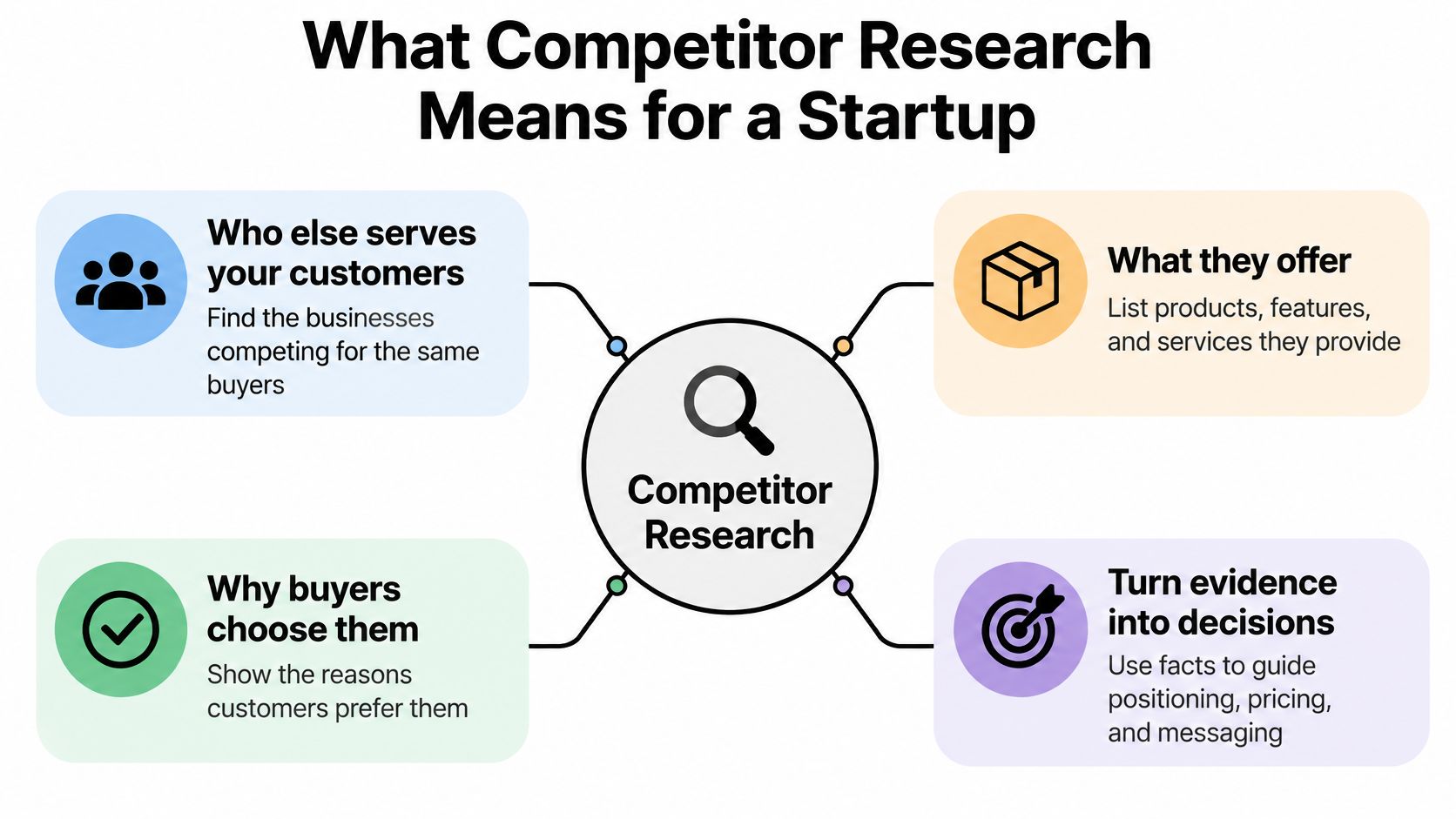
Competitor research turns evidence about customer choices into business decisions. You investigate who serves your intended customers, what those businesses offer, and why buyers choose them. Then you connect those observations to a decision you control.
A list of competitor names is like a street sign. It identifies a location, but it doesn't show the terrain, the obstacles, or the other roads customers might take. Research supplies that broader map, including alternatives outside your product category.
The connections matter more than the individual facts.
Look beyond rival products
In March–April 1979, Harvard Business Review published Michael Porter's article on competitive forces, establishing a foundation for examining industry economics rather than just rival companies, as described in Porter's competitive-forces framework. His five forces cover existing rivalry, new entrants, buyer bargaining power, supplier bargaining power, and substitutes.
For a founder, that changes the questions worth asking. Can customers switch easily? Does your service depend on a supplier that can raise its prices? Could an established company add your proposed feature to a product customers already use?
Say you're building invoicing software for freelancers. Another app's attractive design matters, but so does an accountant who handles invoices as part of an existing service. You're investigating the customer's buying situation, not judging websites.
Define a useful outcome
Your findings should help you identify a position you can defend, rather than encourage you to copy a larger company. The competitive analysis insights from LLMrefs offer an additional resource for organizing observations into a practical comparison.
Useful outcomes include:
- Clearer positioning. Describe the particular customer and job you serve better than available alternatives.
- Fewer strategic surprises. Recognize which competitors could respond to your launch and how.
- Less avoidable building. Challenge assumptions about unmet needs before committing development time.
An empty space on a feature chart isn't automatically an opportunity. Customers might not want the missing capability, or they might value it too little to pay.
Practical rule: A finding earns its place in your research when it could change something you do this week.
Direct, Indirect and Emerging Rivals
Start with the familiar comparison: direct competitors sell a similar product to a similar buyer. If you're building an invoicing app for freelancers, another freelancer-focused invoicing app belongs on your map.
Indirect competitors solve the same problem through a different offering. An accounting suite might include enough invoicing functionality that its customers don't need a separate app. Emerging competitors aren't established alternatives yet, but their public activity suggests they're moving toward your customer segment.
The easiest category to overlook is the non-purchase alternative. A customer might use a spreadsheet, delegate the task to a freelancer, adapt an existing tool, or put up with the problem. Xero's competitor-analysis guide provides a useful starting point for identifying businesses competing for the same customers; a startup's map should also capture what happens when those customers buy nothing.
Rival types and where their signals appear
| Rival type | Example for a startup | Signals to track |
|---|---|---|
| Direct competitor | Another invoicing app built for freelancers | Pricing page, feature releases, review themes |
| Indirect competitor | Accounting suite used to send invoices | Bundled features, partner integrations, changelog |
| Emerging competitor | New tool in private beta for your niche | Funding news, hiring for your segment, waitlist pages |
| Non-purchase alternative | Spreadsheet or manual invoicing | Support questions, forum workarounds, customer interviews |
Don't treat these categories as rigid labels. A broad accounting platform could become a direct competitor if it launches a dedicated freelancer product. Classify each alternative according to the customer decision you're studying.
Investigate the decision not to buy
Ask prospects to describe the last time they completed the task. What did they use? Where did they get stuck? Why haven't they replaced that method?
Look for manual processes in job descriptions, workaround instructions in forums, and support questions about exporting or transferring information. Guidance on using online communities for market research can help you find these conversations without turning every interaction into a sales pitch.
Rank alternatives by the urgency of the problem, the quality of the current workaround, switching effort, and willingness to pay. A large addressable market doesn't establish any of those conditions.
For each rival type, write a sentence describing the moment a customer would switch to you. If you can't name that moment, you haven't yet explained why your product needs to exist.
Where to Find Reliable Competitor Data
No single source is enough to establish a competitor's overall strength. A pricing page can confirm an advertised plan, but it can't establish customer satisfaction. A frustrated reviewer can describe a genuine problem without representing the wider customer base.
The discipline requires connecting different kinds of evidence. Porter's discussion of industry structure and strategy provides the strategic context: information becomes useful when it helps explain competitive pressure and how a business can respond.
Competitor evidence sources and how far to trust them
| Source | What it reveals | Reliability |
|---|---|---|
| Competitor website and pricing page | Intended positioning, plans, public prices | High for stated prices, low for claimed results |
| Changelog and release notes | Product direction and release pace | High, dated and public |
| Customer reviews and forum threads | Real pain points and praise | Medium, needs many samples |
| Job postings | Priorities, new markets, tools in use | Medium, shows intent rather than results |
| Executive interviews and press | Stated strategy and funding | Medium, often promotional |
| Patents and regulatory filings | Technical work and compliance moves | High, but slow to appear |
| Market reports | Segment size and trends | Assess methodology, coverage, and publication date |
Treat these reliability labels as working judgments, not guarantees. A dated release note establishes what the company announced, but you may still need to check which customers can access the feature.
Start with the competitor's website to understand its intended audience, promises, plans, and purchase process. Read the plan conditions too: minimum commitments, usage allowances, and add-ons can make apparently similar prices difficult to compare.
Match the source to the question
Use reviews and forum threads to investigate experiences, not to calculate an unsupported customer-satisfaction rate. Group comments by customer type and task so you don't confuse an enterprise administrator's complaint with a freelancer's needs.
Hiring notices and executive interviews are more useful for identifying possible priorities. A sales vacancy suggests an intention to invest, not proof of successful expansion. Patents and filings require similar care: documented technical activity doesn't establish a commercially available product.
Tools can help collect and organize these materials. Riff Analytics' overview of competitor research tools is a useful resource when choosing how to monitor pages and manage comparisons. Choose your evidence requirements before choosing software.
Keep broader demand questions in your market research for startups, rather than expecting competitor observations to answer everything.
For every entry, save the source page, publication date where available, access date, and relevant context. Those details let someone check the claim and tell whether an update has made it obsolete.
How to Run a Competitor Comparison Step by Step
A comparison should explain more than which company has the longest feature list. The Wiley encyclopedia entry on competitor analysis emphasizes understanding rivals' capabilities, objectives, and likely responses. Your practical output is a reasoned recommendation, including what competitors might do after you act.
Use this workflow to keep collection connected to a decision.
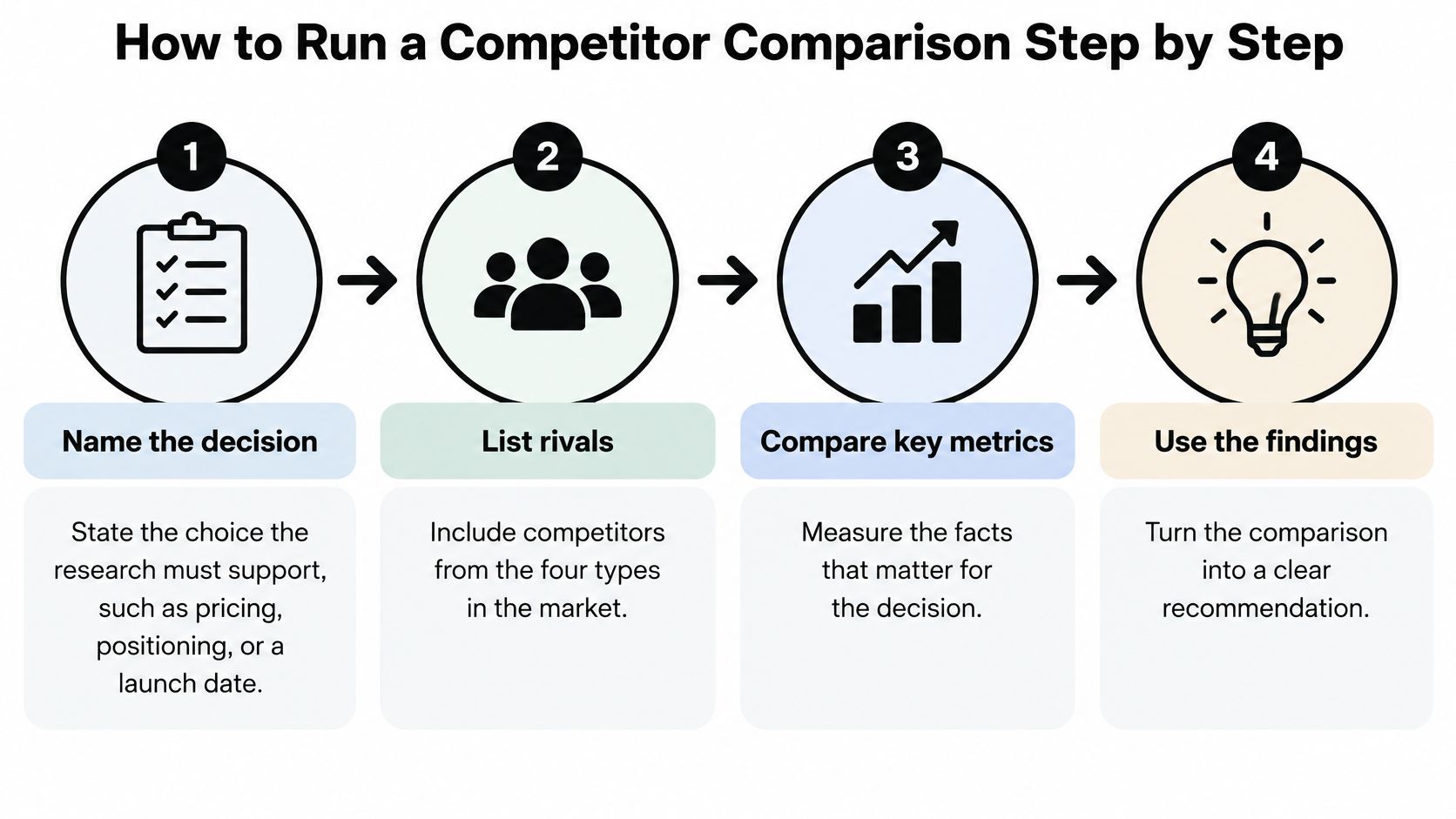
Build the comparison deliberately
Name the decision. Write down whether you're choosing a price, customer segment, positioning statement, or launch timing. Avoid an open-ended assignment to learn everything about the market.
List relevant alternatives. Include direct, indirect, emerging, and non-purchase options. Don't substitute the most famous brands for the alternatives your intended customers consider.
Define comparable metrics. Choose measures that affect your decision, such as price per user, onboarding requirements, distribution channels, and review themes. Specify what each means before collection, including billing terms and the task that marks completed onboarding.
Build a dated matrix. Attach evidence and a verified-or-assumed label to each entry. The common mistake is allowing an interpretation, such as weak customer support, to appear alongside directly observed facts without qualification.
Score only against a stated rubric. Use descriptive ratings such as strong, adequate, and weak, with a clear definition for each. A rating without supporting evidence is just your preference disguised as measurement.
Challenge decisive entries. Find independent corroboration for claims that could change your recommendation. Repeated copies of the same press release don't constitute independent confirmation.
Update after material changes. Revisit entries following launches, pricing changes, or evidence of a strategic shift. Don't assume an unchanged spreadsheet means an unchanged market.
Competitor matrix template
| Metric | Evidence status |
|---|---|
| Price per user | Verified or assumed |
| Onboarding steps | Verified or assumed |
| Release frequency | Verified or assumed |
| Distribution channel | Verified or assumed |
| Customer-review themes | Verified or assumed |
| Date last checked | Dated for every cell |
Use these as metric columns in a working spreadsheet, with a row for each rival. Beside each rival's measurement, retain its status, source, checking date, and a note explaining what evidence would change the rating.
For example, a public pricing page can verify an advertised charge. It cannot verify the average amount customers ultimately pay after negotiated discounts or usage charges.
For software founders connecting a matrix to a recommendation, Big Moves Marketing's guide to smarter SaaS market decisions provides a complementary framework. Finish your own comparison with the proposed action, the supporting evidence, and the strongest reason it might be wrong.
Reading the Findings for Startup Decisions
A gap matters only when you can explain it well enough to propose a test. Benchmarking means comparing performance, processes, or strategy against a relevant standard, not assuming every difference is a weakness.
A study published in Future Business Journal reports a positive relationship between competitive intelligence and market performance. That finding supports treating intelligence as a decision-making activity, but it doesn't prove that copying a competitor will improve your startup's results.
Common findings, what they usually mean, and the test to run
Treat the interpretations below as hypotheses, not established explanations.
| Finding | What it usually means | Test to run |
|---|---|---|
| Rival cuts price on its entry plan | Price may be a buying lever in that segment | Test a bundle at the same price rather than a cut |
| Repeated reviews complain about setup time | Onboarding may be an unmet need | Build a short setup path and measure where users drop off |
| Rival posts jobs for enterprise sales | It may be moving upmarket, potentially deprioritizing small teams | Target small teams with a narrower promise |
| Many buyers mention a spreadsheet | Inertia may be the main competitive obstacle | Interview users about the workaround you would replace |
| Rival ships features monthly in one niche | The segment may be crowded and fast-moving | Test an offer for a segment it ignores |
The monthly release pattern in the final row is a hypothetical observation, not a benchmark you should expect across markets. Its significance depends on whether those releases address needs your intended customers value.
Ask what could explain the advantage
Say a rival charges less. It might have lower operating costs, offer fewer services, subsidize acquisition, or target customers with simpler requirements. Each explanation implies a different response, so an automatic price cut would be premature.
Similarly, strong product reviews don't establish superior distribution. A rival might serve customers well while remaining difficult for new buyers to discover.
Separate what you observed, what you think explains it, and what you'll do to test that explanation.
Important conclusions should draw on independent evidence types. A pattern in reviews becomes more useful when buyer interviews describe the same difficulty. Conversely, an isolated job posting shouldn't become a confident prediction about a competitor abandoning its existing customers.
Translate the conclusion into an action within your control: a narrower offer, revised setup flow, pricing experiment, or different acquisition channel. Incorporate the action into your startup marketing strategy with a named owner and review point.
Rank proposed tests by cost, speed, and their ability to change the decision. Run the cheapest informative test first, not just the easiest task.
Using AI Without Trusting Bad Claims
A fluent summary isn't verified evidence. AI can organize competitor pages and group review themes, but it can also omit plan restrictions, combine outdated information with current material, or present an inference as a fact.
Keep a person responsible for checking consequential claims.

In Sedulo Group's 2025 survey of 109 life-sciences competitive-intelligence professionals, 53% reported at least moderate reliance on AI, while 6% had fully applied AI workflows, according to the survey announcement published by The National Law Review. These results describe a specialist professional group, not all startups.
The practical question isn't whether AI can summarize a page. It's whether the resulting insight is true, current, legally usable, and relevant to your decision.
Keep an audit trail
- Classify the statement. A published plan price is primary evidence; a prediction about the competitor's roadmap is inference.
- Check the timing. Keep publication and access dates, and confirm that the statement still applies.
- Preserve context. Retain qualifications around quoted text, including customer eligibility and product availability.
- Corroborate material claims. Inspect the original document and seek independent support before changing a consequential decision.
- Label uncertainty. Use unconfirmed when evidence is missing, rather than asking the system to complete the gap.
Don't upload confidential customer information, restricted documents, or proprietary material without authorization. Avoid collecting personal information through questionable scraping, and check that your intended use respects applicable access conditions and privacy obligations.
Use the video alongside your own source-checking checklist, not as a replacement for it.
A useful AI task is extracting stated plan features into a draft table with supporting passages. A poor task is declaring which competitor is losing customers when you have no reliable customer-loss evidence.
Treat an automated alert as a request to investigate, not permission to act.
Before adopting an AI-derived recommendation, make sure another person could reconstruct how you reached it from the saved sources.
Run Your First Competitor Map This Week
When founders ask what is competitor research, the most useful answer is a working document tied to a real choice. Keep your initial scope small enough to finish, and leave unanswered questions visible instead of filling them with guesses.
Use this week as a practical exercise, not an attempt to document the entire industry.
A focused working-week plan
- Monday, choose the decision. Name the price, segment, positioning promise, or launch choice you need to make. Write down what evidence would cause you to choose differently.
- Tuesday, map alternatives. Include recognizable rivals and ordinary workarounds such as spreadsheets, delegated tasks, and doing nothing. Prioritize alternatives prospects mention.
- Wednesday, assemble the matrix. Collect decision-relevant measurements and label unsupported entries. Leave a blank when you can't verify something.
- Thursday, speak with buyers. Ask prospects what they used previously, what triggered their search, and what they would have to replace. Request a description of a real task rather than an opinion about your proposed features.
- Friday, select a test. Turn the strongest opportunity into a hypothesis with an observable result and a review date. Record the result that would make you abandon it.
Your initial map is a draft whose job is to direct an experiment. It doesn't need polished slides; it needs enough evidence to distinguish a promising action from an attractive guess.
Require a meaningful commitment
Validation means proving that real strangers, not friends or coworkers, will give money, time, or a clear yes before the product is built. Compliments don't establish that someone will replace an existing workflow.
Before the week ends, choose the hypothesis to test first. State what you'll offer, whom you'll approach, what commitment you'll request, and what outcome would make you drop the idea.
Our startup ideas come from real HN and Reddit pain points, giving you concrete customer problems to investigate alongside competing alternatives. Visit Find Startup Idea to find a problem worth mapping and use our product validation playbook to test whether strangers will commit before you build.