Problem Statement Canvas: Fill It Out with Evidence
Use this problem statement canvas to define a target customer, pain point, and the evidence behind it, then decide whether to build or move on.
The most popular advice about the problem statement canvas is to fill it in fast with your team, keep it to one page, and move straight to ideation. Speed feels like progress, and a wall of sticky notes looks like research. Neither tells you whether the problem is real.
A filled canvas is a document. A validated problem is a decision input. The gap shows up months later, when the feature ships and the buyers who called the pain severe never open their wallets.
I would rather see a messy canvas with four rows backed by interview dates and support ticket numbers than a beautiful one built from founder intuition. What follows turns the template into an evidence-to-frame workflow with explicit thresholds for a build, iterate or move-on call.
The Problem Statement Canvas Blocks That Matter
A polished canvas can leave a team less accurate. Tidy boxes and a confident one-sentence statement raise everyone's certainty, and when those boxes hold founder assumptions instead of observed behavior, the confidence sits on nothing. The canvas earns its keep only when each row traces back to something a customer did or said.
So the canvas I use has ten blocks, not three. Customer, pain and outcome describe an idea. They don't decide anything. The extra fields force the questions that separate a real problem from a hobby horse.
| Canvas block | Prompt to answer | What good evidence looks like | Worked example |
|---|---|---|---|
| Target customer | Who exactly has this problem, in what role and company size? | Narrow enough to interview ten people this week | Operations manager at a 15 to 50 person freight brokerage |
| Trigger and context | When and where does the problem show up? | A recurring event, not all the time | Month-end close with 20+ carrier invoices in PDF and email |
| Pain point | What are they trying to do and what blocks them? | A task plus an obstacle, with no product name | Match invoices to shipments in spreadsheets |
| Current workaround | What do they do today instead? | Tools, manual steps, staff time and money already spent | Two spreadsheets, an email folder, six hours a week |
| Evidence | What have you seen or heard that is not an opinion? | Interview quotes, screen recordings, analytics or tickets | Eight interviews, three support tickets, two screen recordings |
| Frequency and severity | How often does it happen and how painful is it? | Counts per week or month plus a 1 to 5 severity rating | Weekly, 4/5 severity, delays close by two days |
| Cost and existing spend | What does the problem cost in time, money or risk? | Time multiplied by rate, overpayment, penalties or churn | Six hours a week and about 2% of invoices overpaid |
| Owner and buyer | Who owns the outcome and who can approve spend? | Named roles, budget path and veto holders | Ops manager owns the process, CFO approves, IT can block |
| Disconfirming signal | What would prove this problem is not worth solving? | A test you could actually run this month | Factoring software already auto-matches these invoices |
| One-sentence statement | Can you state customer, trigger, need, cause and consequence? | No feature or technology named | When month-end invoices arrive, ops managers struggle to match them because data sits in PDFs, costing six hours weekly |
A row without a name, a count, a date or a quote is a guess wearing a template.
A Worked Example You Can Copy
Take the freight brokerage row by row. The customer isn't "SMBs," it's the operations manager at a 15 to 50 person brokerage. The trigger isn't "invoice processing," it's month-end close with more than twenty carrier invoices arriving as PDFs and email attachments. The workaround is two spreadsheets and an email folder, six hours a week, with roughly 2% of invoices overpaid. Evidence is eight interviews, three support tickets and two screen recordings. The disconfirming signal is discovery that the brokerage's factoring software already auto-matches these invoices, which kills the idea in an afternoon instead of a quarter.
Start With a First Cut, Then Replace Adjectives
Griffith University's Problem Framing Canvas Handbook, documenting a process developed by Ingrid Burkett at the Griffith Centre for Systems Innovation, calls the opening pass a "first-cut" statement built on the five Ws: who, what, where, when and why. Use it exactly that way. Then replace the adjectives with names, counts and dates. "Frustrated" becomes a quote. "Often" becomes twice a week. The same handbook sorts problems into clear, complicated, complex and chaotic contexts, which stops a team from bolting a simple technical fix onto a systemic mess.
If you need candidate problems to put through this, a marketplace for bootstrapped startups is a reasonable place to scan for ideas other people already pay for. The canvas is what stops you committing to the first one that sounds clever.
How to Fill the Canvas Step by Step
Fill the canvas as seven passes, not one brainstorming sitting. Each pass leaves an artifact you keep: a named segment, a rewritten need, a cause chain, a current-state map, a dated evidence list, two competing frames and a signature from the person whose workflow or budget changes. The workflow below runs left to right, from the target user through to the tests that could disprove the frame.
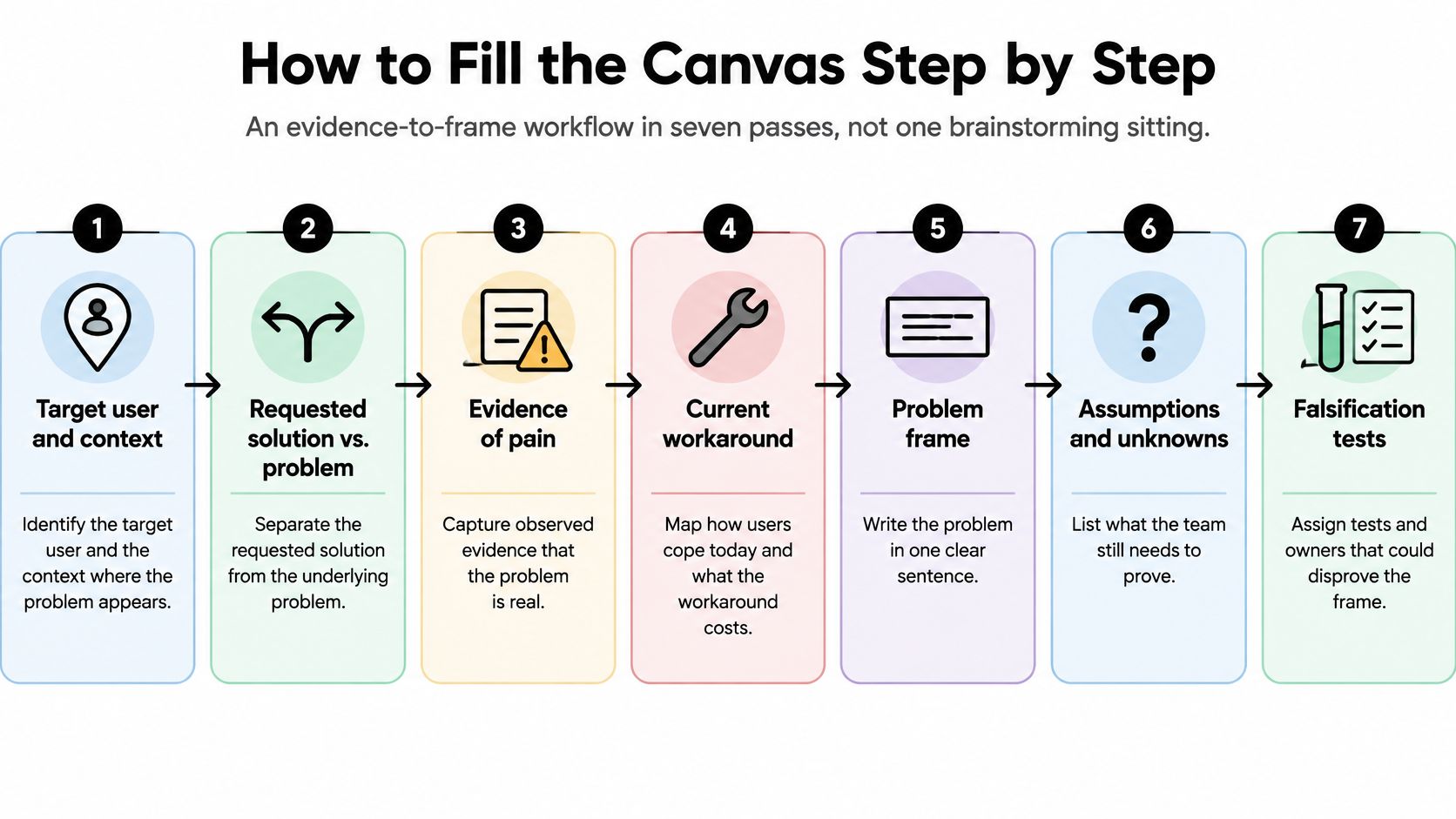
The seven passes follow the evidence-to-frame workflow set out in this design-science treatment of problem statements, which scores a finished frame on seven criteria: appropriate specificity, empirical grounding, stakeholder significance, tractable solvability, generalizable scope, solution novelty and clarity. Write those criteria on the wall before you start.
- Name the target user and the context. One role, one company size, one situation. If you can't list ten people you could interview this week, you have a slogan, not a segment.
- Separate the requested solution from the underlying need. A stakeholder asking for a chatbot has a triage problem. Write "triage refund requests," not "build an AI assistant," and the technology stays off the page.
- Probe causes with five whys. Ask why the delay happens, then why that happens. Stop when the answer names a process, a handoff or a missing data field rather than somebody's attitude.
- Map current state against desired state in two columns. Left column: what happens today, step by step, with the tools named. Right column: the same steps when the work goes well. The gap is your problem definition.
- Document observed evidence. Quotes about recent behavior, screen recordings, analytics, support tickets, with dates attached. Anything you can't attribute to an artifact or a named person stays out of the frame.
- Write at least two alternative frames. One says the cause is a data problem, another says it's an approval problem. Compare them against your evidence, then choose.
- Get agreement before anyone ideates. Show the frame to the workflow owner and the budget holder. If they rewrite your sentence, keep their words.
Time-box the first pass at 45 to 60 minutes solo, or 90 minutes with a team, then reopen the canvas after every five interviews. A frame that never changes is a frame nobody tested.
If you want to see the passes run live, this walkthrough covers the same sequence from target user to falsification test.
End the session with a How might we question built on the frame, something like "How might we let an ops manager confirm invoice matches without opening a PDF?" Keep it open enough that a designer, an engineer and a finance lead each propose a different answer. MITRE's Innovation Toolkit runs its problem framing canvas the same way: collect the words, interrogate context and stakeholders, compress into a statement and an actionable question, and gather research and data before you call it done. The payoff is consensus on what "done" means before implementation eats a quarter.
Write a Problem Statement That Excludes Your Solution
Translate the filled blocks into one sentence a stranger can repeat back to you.
When [trigger], [specific customer] struggles to [unmet need] because [cause], which costs [consequence].
Each slot does specific work. The trigger tells you when the pain is urgent, which is also when a buyer is most receptive. The customer should be concrete enough to find on LinkedIn, so "ops manager at a 15 to 50 person freight brokerage" beats "SMBs." The need is a job, not a feature: "match invoices to shipments," never "build an AI parser." The cause is the mechanism your evidence supports, such as data locked in PDFs rather than a vague "inefficiency." The consequence needs a number, because six hours a week and a two-day delayed close are what make the sentence expensive.
Practical rule: if your sentence could describe three different companies, it describes none.
Read the draft aloud to a real buyer and ask one question: "Is this what happens to you, or did I describe it wrong?" When they correct the trigger or the cost, take their phrasing and delete yours. Their words carry more weight in the next ten interviews than anything you invented at a desk.
The table below shows the failure mode that matters most, solution-loaded wording, and what a testable claim looks like instead.
| Weak statement | Why it fails | Stronger version |
|---|---|---|
| Users need a chatbot for support | Names a solution, not a need | When a price change triggers refund requests, support agents struggle to triage them because order history sits across three tools, costing a full day of first-response time |
| Small businesses are overwhelmed by accounting | No segment, trigger or consequence | When quarterly VAT filing arrives, five-person agencies struggle to reconcile receipts because card spend sits in three portals, costing eight hours and late-filing risk |
| SMB owners want better reporting | Generic persona and vague desire | When a five-person agency closes the month, the owner struggles to see which clients are profitable because hours and invoices live in separate tools, costing a weekend and missed billing |
| Warehouse teams need mobile scanning | Product-loaded and no workaround evidence | When pickers pull orders, warehouse leads struggle to confirm the right bin because locations live on paper pick lists, costing two hours a shift and mis-ships |
| Everyone hates expense reports | No buyer, frequency or cost | When field engineers submit weekly expenses, finance managers struggle to reconcile receipts because submissions arrive by email and paper, costing six hours weekly and 3% duplicate claims |
Notice what the stronger versions refuse to do. None of them names a product. Each one names a person, a moment, a task and a price for doing nothing. A sentence with those four properties survives a skeptical review because there's something to argue with.
Separate the User from the Buyer and Blocker
In B2B and operational problems, the person who feels the pain is rarely the person who can approve the fix. A warehouse picker loses two hours a shift to a failing scanner. The operations director owns the throughput target that loss damages. IT security can veto a new device on the floor. The CFO signs the budget. Four roles, one problem, four different definitions of whether it's worth solving.
Customer-discovery guidance on problem validation points at the same gap: most canvases model a single persona with a generic pain point and skip the actor-and-workflow map entirely, which is exactly where B2B opportunities hide. Users report severe pain and have no authority to change the process.
Interview rule: the person who feels the pain describes it best, and the person who signs the cheque decides whether it gets fixed. Talk to both before you write a line of code.
| Role | What they care about | Question to ask | Evidence they can give |
|---|---|---|---|
| User | Getting through the daily workflow without extra steps | "Walk me through the last time this went wrong" | Screen recording, workaround steps, time lost |
| Beneficiary | The outcome improving, even if they don't do the work | "What changes for you if this is fixed?" | Priority ranking, impact estimate |
| Problem owner | The metric that suffers when the problem continues | "Who owns this number today?" | Budget context, process map |
| Economic buyer | Payback, risk and budget timing | "What would you need to see to release budget?" | Approval criteria, spending range |
| Approver | Policy, security and procurement constraints | "What would block a new vendor?" | Checklist, required reviews |
| Blocker | Avoiding disruption, lock-in or extra work | "What would make you say no?" | Veto reasons, integration constraints |
| Affected third party | Their own workflow or compliance exposure | "How does this change your work?" | Downstream cost, compliance risk |
Name the Buyer and the Blocker Before You Build
Walk the workflow step by step and write down who performs each one and which tool, vendor, spreadsheet or manual handoff sits between the steps. That map surfaces the switching cost: a picker who needs both hands free won't adopt anything requiring taps, and a security team that reviews every device will stretch your go-live by months. Quantify procurement friction and the cost of doing nothing while you're there, because those two numbers decide whether the buyer moves this quarter or next year.
Before you assume anyone will pay, work out what willingness to pay looks like in this specific role and budget cycle. A canvas with a named buyer and a named blocker is complete. One with neither is a persona exercise.
Prove the Pain and Audit a Weak Canvas
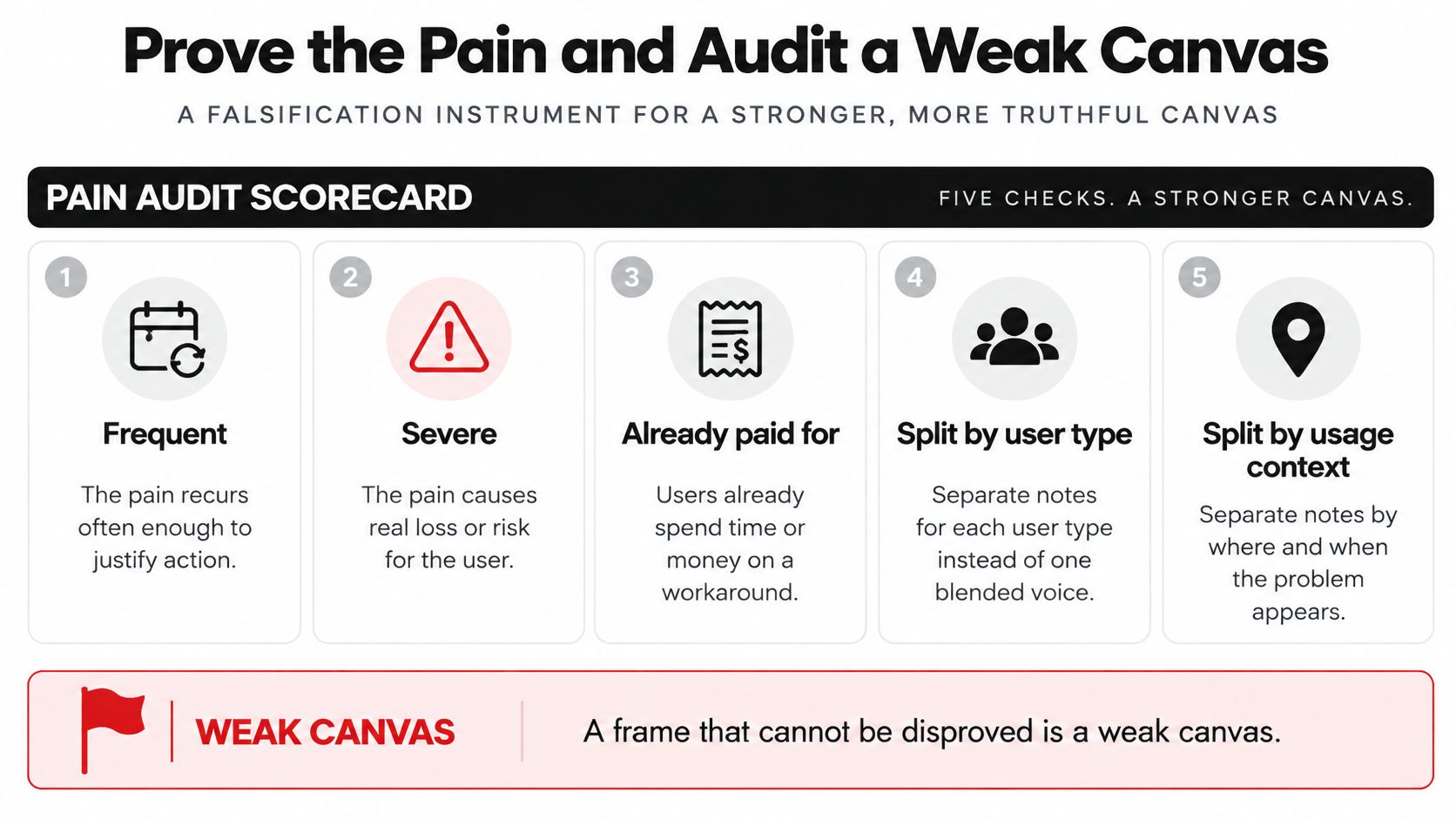
Once the frame is written, the canvas becomes a falsification instrument. Test whether the problem is frequent, painful enough to act on, and already attached to a costly or frustrating workaround. Then split your notes by user type and usage context instead of averaging responses across a market. The stakes are not academic: lack of market need accounts for 42% of startup failures, according to this problem validation guide for entrepreneurs, which puts evidence of problem significance well above your enthusiasm for the solution.
Run five checks. Is it frequent enough that the workflow repeats weekly or monthly? Is it severe enough to cause real loss or risk? Is it already paid for through staff time, spreadsheets, agencies or penalties? Do your notes separate one user type from another? Do they separate contexts, such as month-end versus mid-month, or one shift versus another?
The scorecard below is what a strong canvas looks like against those checks, and what a weak one fails to clear.
The Evidence Ladder
Most canvas guidance stops at describing the customer, pain and desired outcome. It never explains how to convert a qualitative statement into a build-or-no-build decision with behavioral proof behind it. Converting a pitch into a verdict needs fields templates skip, as this customer discovery guide to problem validation sets out: frequency, severity, time or money cost, existing spend, a decision-maker and a disconfirming signal.
| Evidence type | What it proves | Strength | How to collect this week |
|---|---|---|---|
| Paid pilot or deposit | Real commitment and a budget path | Strong | Ask for a two-week paid pilot after three interviews |
| Signed letter of intent | A named buyer will move forward | Strong | Send a one-page LOI after the pain is confirmed |
| Introduction to the budget owner | The problem matters beyond the user | Strong | Ask "who else feels this when it breaks?" |
| Data access or sample export | The problem is real enough to share data | Strong | Request an anonymized export or dashboard access |
| Repeated workaround spend | Existing time or money is already allocated | Medium | Ask for the last invoice, timesheet or vendor receipt |
| Analytics showing the behavior | Frequency and drop-off in the real workflow | Medium | Instrument the top three steps or review existing logs |
| Interview quote about the last episode | A concrete recent behavior | Medium | Ask "walk me through the last time this happened" |
| Polite interest or "I would use that" | Social courtesy, not commitment | Weak | Don't count it as validation; ask for a next step |
| Survey intent score | A hypothesis about future behavior | Weak | Use it to prioritize follow-up calls, not to decide |
When the frame finally holds, a structured proof of value is what turns a strong signal into a budget conversation with the person who controls the spend.
The Five-Minute Row Audit
Read every row and demand a source, a count, a date or a direct quote. "Customers are frustrated" fails. "Six of eight ops managers described manually rekeying invoices every Friday" passes, because you can check it and someone else can challenge it.
Six failures get caught here before ideation starts:
- Uninterviewable persona: "small businesses" or "millennials" instead of a role and a company size.
- Solution-loaded wording: "users need a chatbot" describes your roadmap, not their day.
- Stakeholder request counted as a need: a feature ask from a director isn't evidence of a workflow problem.
- Raw notes jumped into features: transcripts skipped the framing step entirely.
- One frame with no alternative: nothing was compared, so nothing was tested.
- Skipped alignment: the workflow owner and the buyer never saw the sentence.
Weak-canvas tell: a frame nobody could disprove in the next thirty days is a wish list with a border around it.
If the idea came from Hacker News or Reddit, the audit has to show frequency, severity, time or money cost, existing spend, a decision-maker and a disconfirming signal. One outsider reads the canvas cold and marks the weakest claim on it. That claim becomes your next interview, and the questions you ask come from this guide to identifying customer pain points rather than from a generic script.
Decide Whether to Build, Iterate or Move On
Close the canvas with a dated verdict, not a mood. Before the last interviews, write down three numbers you won't renegotiate: five of ten target users describe the same trigger, three can name the budget owner, and two commit to a paid pilot or a signed letter of intent. Those thresholds turn a discussion about conviction into a count.
Then take one of three exits. If all three clear, build only the smallest test that proves the workflow, never the full product. If one variable is weak, change that variable alone, whether it's the segment, the trigger, the workaround or the buyer. If the strongest signal in the folder is polite interest or "I would use that," stop.
The first validation step is the sentence and a real buyer. If you can't write it, the idea isn't sharp enough yet. For a solo founder working without a team to argue with, this guide to validating a startup idea runs the same decision on your own.
Our validation playbook tests any product idea, SaaS, physical, marketplace, consumer or course, in under two weeks for less than $200, and the verdict lands within 14 days: build, iterate on one variable, or move on. If you're weighing several framed problems at once, work through an opportunity assessment framework before you pick one.
Write the verdict on the canvas itself, with the date and the evidence that triggered it. A frame without a decision attached is just a nicer document.
Find Startup Idea gives you the other half of the canvas: problems pulled from real Hacker News and Reddit complaints, already attached to a role, a task and the wording people use when they describe them. Run those signals through the ten blocks, ladder the evidence, and set your thresholds before the first interview. Visit Find Startup Idea to pull problem signals and put a dated build, iterate or move-on decision on your canvas.