10 Business Model Ideas for Founders in 2026
Explore 10 business model ideas for founders in 2026, from SaaS and marketplaces to freemium, with use cases and ways to validate each before building.
Build first, figure out revenue later. That's the most popular advice founders follow, and it's backwards. You pick a business model by accident when you copy a pricing page the week you launch, then you spend the next six months rewriting it because buyers don't pay that way.
Most business model ideas don't fail because the model is exotic. They fail because nobody tested whether a specific buyer wants this delivery format, at this price, on this billing cycle. The OECD cross-country evidence on start-up dynamics found the average survival rate for new firms was just above 60% after three years, approximately 50% after five years, and slightly above 40% after seven years. Survival doesn't prove growth, either. You need repeat revenue, not polite interest.
Treat each model below as a hypothesis about how buyers already pay. Every one comes with a small test you can run before you build. If strangers won't pay, pause, or match by hand, the model isn't validated yet, however polished the product looks.
1. Software as a Service (SaaS)
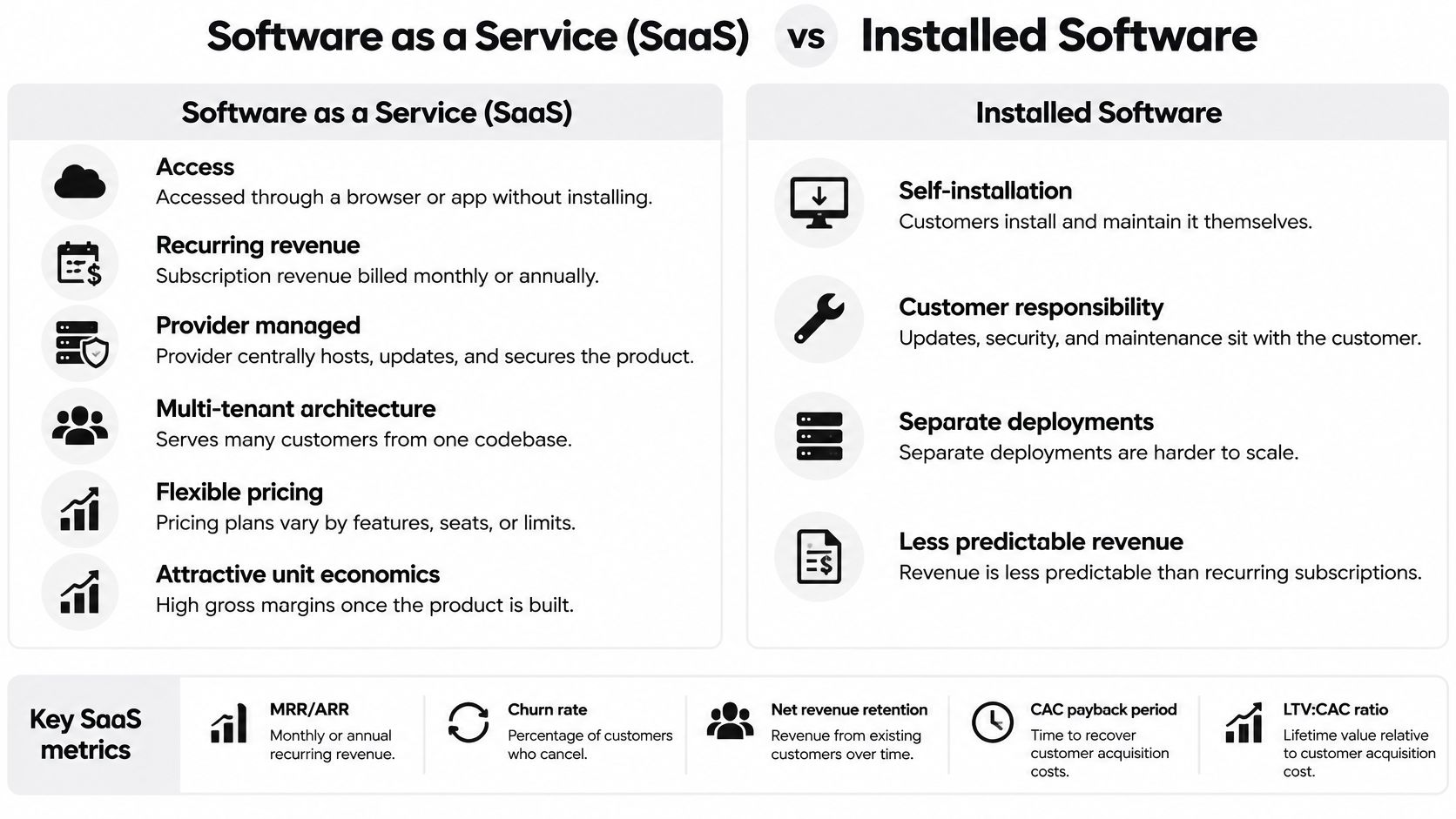
You host software centrally, customers use it in a browser or app, and they pay monthly or annually. Salesforce for CRM, HubSpot for marketing and sales, Slack for team communication, and Basecamp for project management show the appeal. One build serves many buyers, updates ship to everyone, and revenue repeats if the tool stays embedded in work.
The trap is assuming a recurring problem equals recurring billing. Confirm the buyer wants software, not a service or a one-time tool, and will tolerate a subscription. Start with one clear job, price on value delivered rather than your development cost, and watch churn and net revenue retention from your first cohorts.
Your two-week test
Build a landing page with Stripe checkout for a paid waitlist and run $50 to $150 of paid ads to strangers. The signal is 10 strangers paying anything inside 14 days, not compliments from coworkers. That discipline matters because CB Insights startup failure research found 43% of 431 VC-backed companies that shut down cited poor product-market fit. If nobody pays, you've bought useful negative evidence cheaply.
2. Micro-SaaS
Carrd makes simple one-page sites. Plausible Analytics offers privacy-focused web analytics. Nomad List sells cost-of-living and remote work data, and Remote OK runs a remote job board. None of these needs to become a giant platform to work for a tiny team.
That's the point of micro-SaaS. You solve a narrow, repeated problem for a niche you can reach, keep operating costs low, and charge from day one. It's often the most honest fit for ideas found in community threads, where the same complaint appears for months and larger vendors ignore it.
Here's how the model looks in practice for a solo builder.

Say moderators in one profession keep asking for a cleaner export tool. You don't need a roadmap deck. You need proof the pain costs time today.
- Mine repeated complaints: Search Reddit and Hacker News for the same workaround, phrased independently.
- Pre-sell narrowly: Put up a waitlist or pre-payment page before writing much code.
- Keep scope brutal: Ship the one workflow people described, nothing adjacent yet.
Startups.com analysis of startup post-mortems identified "no market need" affecting 42% of 101 publicly available startup post-mortems. Discussion shows existence. Pre-payment shows demand.
3. Marketplace (Two-Sided Platform)
A marketplace doesn't own the supply. It matches two sides and takes a commission, listing fee, or transaction fee. Airbnb matches hosts and guests, Etsy matches makers and buyers, Upwork matches freelancers and clients, and Uber matches riders and drivers. More good supply pulls in buyers, and more buyers pull in supply.
That flywheel is also the problem. At launch you have neither side, so a broad launch usually produces empty search results and churn. Pick one narrow category or geography, get liquidity there, and manually recruit whichever side is harder to attract.
The explainer below is a useful primer before you scope any platform build.
Measure fill rate and time to match, not sign-ups. Add reviews, verification, and escrow-style payments early because trust is part of the product. If you later need vendor storefronts and payouts, PuppetVendors marketplace solutions is one route, but don't buy infrastructure before liquidity.
Validation rule: Manually match the first 10 to 20 buyers and sellers before writing code, and aim for 5 paid matched transactions brokered by hand.
If you can't broker five deals with a spreadsheet and messages, software won't create demand for you.
4. Subscription Model
Some buyers don't want software at all. They want a result that keeps arriving. Dollar Shave Club replenished razors, Netflix and Spotify stream content, and Costco charges recurring membership fees for access. Different categories, same logic. The relationship continues because value continues.
That only works if the second month is still useful. A subscription forced onto a one-time need produces fast cancellations and refund requests. Use this model when consumption repeats, content refreshes, or access itself stays valuable. Annual plans can improve cash flow, but only after monthly cohorts prove people stay.
What to watch in the first cohorts
Make value obvious in the first 30 days. Track retention by acquisition channel, because a viral post and a buyer-intent search ad rarely retain alike. Offer a pause where the need is seasonal, since a pause preserves the relationship better than a hard cancellation.
For a broader framework on choosing between recurring and one-time revenue, see this guide to building a business model strategy. Then test it. Pre-sell one cycle at the full price and ask buyers to commit to renewal terms upfront. If they want the first box, episode, or report but won't accept recurrence, you've found a one-time product wearing subscription clothes.
5. Freemium
Free users aren't customers. They're a distribution bet. Dropbox gives free storage and charges for more, Zoom limits free meetings and sells paid features, Canva sells Pro and Teams plans on top of a free design tool, and Slack converts workspaces to paid plans. The bet pays only when serving free users is cheap and the upgrade trigger is natural.
Put the limit where users have already felt value but need more of it. Storage, seats, history, exports, and collaboration often work because growth creates the ceiling. Don't give away the one feature your best buyers would pay for, and don't gate basic activation so tightly that nobody reaches the useful moment.
This concept image captures the intended path from free access to paid status.

Track activation before you obsess over paid conversion. A user who never completes the core action won't upgrade later. Place prompts at the moment of highest intent, such as when someone hits a limit mid-task, not on a generic pricing banner.
Your test is a landing page with two clear tiers and a paid waitlist for the premium tier. If free interest is strong but nobody will pay to remove the limit, you have reach without a business.
6. Usage-Based (Pay-as-You-Go) Pricing
Usage pricing flips the conversation from access to consumption. Twilio charges for communications APIs, Stripe takes payment processing fees, Amazon Web Services charges for compute and storage, and the OpenAI API charges by tokens. Small customers can start cheaply, and your revenue grows when their usage grows.
The downside is unpredictability, for you and for them. Buyers fear a surprise bill. You face revenue that swings with their volume. Pick a metric that tracks value in the customer's language, such as messages delivered or invoices processed, not an internal unit they don't understand.
- Make spend visible: Ship usage dashboards and alerts before you scale billing.
- Lower the first run: Offer free credits so teams can test real workloads, not toy examples.
- Model your cut: Estimate fees for software sales before you promise margins.
- Stabilize later: Add committed-use discounts once usage patterns repeat.
Say you're selling an API that cleans addresses. Charge per successful verification and let a prospect run a sample file. Your test is whether they'll connect a real workflow and accept per-call billing. If they keep asking for a flat seat price, listen. They may be telling you how they budget.
7. Open-Core Model
Open-core gives away a usable open-source product and charges for what organizations need around it. GitLab sells paid DevOps capabilities, Elastic commercializes tools around Elasticsearch, MongoDB pairs open-source and commercial offerings, and Grafana Labs monetizes observability for larger teams. Community adoption builds trust, distribution, and contributions.
The hard decision is the boundary. If the free core is too weak, nobody adopts it. If it's too complete, companies self-host happily and never pay. The features teams usually pay for are boring and essential, such as single sign-on, audit logs, permissions, compliance controls, support, and a managed hosted version.
Decide which features are paid before launch and document that boundary publicly, so contributors aren't surprised later.
Choose your license with that same clarity. You want openness that invites adoption without making it trivial for a larger cloud provider to resell your work as its own service.
Don't start by building the enterprise tier. Release the core to a community you can reach, then interview the heaviest users about deployment pain. Offer paid hosting to a small group first. If teams love the code but won't pay for hosting, security, or support, you've built a popular project, not yet a company.
8. Done-For-You Services (Productized Services)
Software isn't always the fastest way to revenue. A productized service packages a specific outcome, scope, price, and turnaround into a repeatable offer. Bookkeeping subscriptions, fixed-price monthly design, and productized training such as Basecamp's Shape Up work all follow this logic. Tuft & Needle isn't a services firm, but its standardized direct offer shows the power of removing custom choices.
This model suits problems you already understand from the inside. An OECD study of Danish enterprises founded in 1994 found businesses started by entrepreneurs with prior experience in the same economic branch had a 69% survival rate after three years, compared with 51% for entrepreneurs without previous branch experience. That experience helps you price, scope, and find buyers.
AI implementation is a current example. Verizon Business State of Small Business Survey reported that in 2025, 38% of U.S. small and midsize businesses were leveraging artificial intelligence. Many still need workflow setup, data cleanup, and human review more than another dashboard.
Define the deliverable in one sentence and keep tiers to two or three. Agencies can even speed delivery with launch-ready websites from plain-language prompts, but the offer must stay fixed. For more starting points that don't require heavy capital, browse these low-cost business ideas.
Sell three spots manually first. Document every repeated task, because those repetitions tell you what to automate, delegate, or eventually turn into software.
9. Affiliate and Referral Model
You don't have to own the product to own the buyer relationship. Amazon Associates pays commissions on product sales, Wirecutter earns from product recommendations, software review sites earn from SaaS partner programs, and the early Dropbox referral program turned users into a growth channel. You supply trust, content, community, or tooling. A partner supplies fulfillment.
That's also the risk. A partner can cut rates, change terms, or close a program. Diversify across programs and don't build your whole margin on one dashboard you don't control. Disclose affiliate relationships clearly, because one hidden incentive can undo the trust that makes this model work.
The handoff in this image is the whole job. Your job is a credible recommendation, not delivery.

Focus on high-intent content. Comparisons, tutorials, calculators, and migration guides convert better than broad list posts because the reader is already deciding. Recommend only products you've tested.
Your test is one comparison page in a niche where buyers search before purchasing. Drive a small amount of targeted traffic and measure clicks and qualified sign-ups, not page views. If readers trust your take but won't click through, your intent match is wrong.
10. Community Membership Model
People pay for access to other people when those relationships help them learn, get work, stay accountable, or solve problems faster. Patreon supports creator memberships, Circle powers many paid communities, Indie Hackers built a founder community, and paid Discord or Reddit-adjacent tiers show the same pattern at smaller scale. You're selling belonging plus recurring usefulness, not a content archive.
That makes this model deceptive. A quiet group with a paywall is just a subscription to silence. You need rituals, introductions, events, and enough active members that a new joiner gets value in the first week. Start small and active rather than large and empty.
Design the recurring reason to show up
- Name the outcome: Learning, networking, deal flow, or accountability. Pick one primary promise.
- Create a rhythm: Weekly calls, monthly demos, or structured peer matching give members a habit.
- Watch engagement early: Falling participation predicts churn before cancellations show it.
If you're starting from zero, this playbook on how to build an online community covers the early mechanics. Then run a paid founding cohort with a fixed start date and limited seats. If people won't pay before the room exists, run free sessions first and prove the room is worth entering.
Ten business model ideas compared by best fit and key metrics
| Item | Best For | Key Metrics |
|---|---|---|
| Software as a Service (SaaS) | Founders solving recurring business workflow problems | MRR/ARR, churn rate, net revenue retention, CAC payback period, LTV:CAC ratio |
| Micro-SaaS | Solo founders and small teams validating niche software ideas | MRR, profit margin, trial-to-paid conversion rate, monthly churn |
| Marketplace (Two-Sided Platform) | Founders connecting supply and demand in a fragmented market | GMV, take rate, repeat purchase rate, liquidity or fill rate |
| Subscription Model | Businesses with repeat needs or ongoing value delivery | Monthly recurring revenue, churn rate, customer lifetime value, cohort retention |
| Freemium | Products with viral potential and clear upgrade triggers | Free-to-paid conversion rate, activation rate, viral coefficient, cost to serve free users |
| Usage-Based (Pay-as-You-Go) Pricing | Developer tools, APIs, and infrastructure products | Average revenue per user, usage growth per account, gross margin per unit, revenue predictability |
| Open-Core Model | Developer-focused infrastructure and tools | Community growth, free-to-enterprise conversion, support and subscription revenue, net dollar retention |
| Done-For-You Services (Productized Services) | Early-stage founders needing revenue and customer insight | Retainer MRR, client retention, delivery time, margin per client |
| Affiliate and Referral Model | Content creators, communities, and niche publishers | Click-through rate, conversion rate, earnings per click, revenue per visitor |
| Community Membership Model | Niche experts, creators, and founders building trusted audiences | Member retention, monthly active members, average revenue per member, engagement rate |
Pick One Model and Test It Within Two Weeks
Choose a business model based on how the buyer already pays for similar problems, who controls that budget, and what substitute they use now. A finance manager accustomed to buying per-seat software may resist token billing. A creator who pays for a community and templates may not want a standalone dashboard. Match the buying motion the customer already understands.
That is how you separate viable business model ideas from appealing conversation. Roughly half of new firms survive five years, according to Sova research on startup survival. A clever pricing name cannot remove business risk. Testing whether a buyer will pay, and whether revenue can repeat, can help you avoid months of building around an unproven billing assumption.
Start with the smallest falsifiable step: write the problem in one sentence with a real buyer. If you cannot name the buyer and state the problem plainly, the idea is not sharp enough to test. For example: independent bookkeepers spend Friday afternoons chasing client documents and already pay for practice software. That gives you a specific buyer, a recurring pain, and a place to reach potential customers.
Set the signal before spending. For SaaS or a digital product, create a landing page with Stripe checkout for a paid waitlist, then spend $50 to $150 on paid ads. The target is 10 strangers paying anything inside 14 days. Healthy benchmarks from cold ad traffic are 4% or more to email capture and 1% or more to a paid waitlist or pre-order. Friends, coworkers, and likes do not prove demand. Also confirm that the buyer wants software rather than a service or one-time tool, and will tolerate recurring billing.
Match the test to the model. For a physical product, use a Shopify or Kickstarter page showing the actual price, with $100 to $300 of paid traffic. A sample or 3D render is enough; production can wait. For a marketplace, manually match 10 to 20 buyers and sellers before writing code, then aim for 5 paid matched transactions brokered by hand. For a consumer app, look for an organic reach ratio above 5x views per follower and 1% or more click-through to the waitlist.
Keep the validation effort under two weeks and under $200 where possible. The goal is to test one narrow claim, not prove you can build a large company. A claim might be that a buyer will accept recurring billing, a supplier will pay a transaction fee, or a member will pay before a community is fully built. If the test fails, change the buyer, offer, or model before adding features.
Write down the result that would make you stop before ads run or interviews begin. A clear stopping rule keeps weak responses from becoming excuses to build more. Treat the test as evidence about the offer, not permission to rationalize a result you hoped to see.
If you need a starting point, Find Startup Idea's library contains 1000+ startup ideas sourced from real Hacker News and Reddit pain points across AI, SaaS, dev tools, consumer, and crypto. Browse its five categories, AI/LLM, Dev Tools, Consumer, B2B SaaS, and Crypto/Web3, save ideas you would put your name on, and generate a launch prompt. Choose one idea and one model, then run the test within two weeks.
Browse 1000+ business model ideas sourced from real Hacker News and Reddit pain points, save the ones you'd put your name on, and generate a launch prompt to start your two-week validation test. Visit Find Startup Idea to pick your first idea and prove strangers will pay before you build.