Is My Startup Idea Good? a Test You Can Run in 14 Days
Is my startup idea good? Score demand, market size, founder fit and unit economics, then validate with real buyers before you build anything.
The popular advice says to ask people if they'd use your product and build what gets a yes. That advice is how founders waste months. People are polite, surveys are cheap, and friends don't want to disappoint you. A better question isn't whether strangers like the concept. It's whether they already lose time or money to the problem and will commit something measurable before you build.
If you're asking, is my startup idea good, stop looking for a single verdict. Score demand, frequency, cost, payment behavior, and unit economics separately. Then check whether you're the right founder to build it now. An idea can pass on pain and fail on runway.
Score Your Idea Against Five Tests
You can reach a useful verdict in one afternoon. Your idea earns a go only when it clears all five tests. Score each test 0 to 2, for a maximum of 10. Below 6, revise or drop it. A total of 6 or higher is permission to run the two-week test, not permission to build. Founder fit, timing, and runway come later and can still kill a high score.
This is a demand-and-economics screen only. It follows the logic in the CB Insights startup failure analysis, which separates demonstrated pain, observable behavior or payment, and a plausible path to repeatable distribution with positive unit economics. Treat survey intent and headline market size as weak evidence, not proof.
How to Read the Card
Demand asks whether strangers describe the problem unprompted. Frequency asks how often the buyer hits it, since weekly problems beat yearly ones. Cost asks how many hours or dollars the problem drains each month.
Payment behavior asks whether anyone already spends money on a workaround. Unit economics asks whether gross margin can recover acquisition cost within a realistic runway. A survey saying people would use it doesn't count toward demand.
| Test | Strong signal | Red flag | Score it by |
|---|---|---|---|
| Demand | Named buyer describes the problem unprompted | Only friends and coworkers say it sounds good | Count of strangers who describe the pain in their own words |
| Frequency | Problem occurs weekly or more often | Problem shows up once or twice a year | Times per month the buyer hits the problem |
| Cost of the problem | Buyer already loses money or hours to it | Buyer calls it a minor annoyance | Estimated hours or dollars lost per month |
| Payment behavior | Buyer pays for a workaround today | No current spend on any alternative | Existing spend on tools, agencies or staff |
| Unit economics | Gross margin covers acquisition cost within runway | Payback period exceeds realistic runway | Contribution margin versus CAC payback in months |
A Pass and a Fail
Say you're scoring a tool that chases late invoices for freelancers. Freelancers chase payments every week, lose billable hours doing it, and already pay for reminder add-ons in their invoicing software. Demand, frequency, cost, and payment all score well because the behavior exists before your product does.
Now score a generic AI productivity app. Interviewees agree they feel disorganized, but nobody can name a buyer who pays today, a weekly trigger, or a dollar cost. That's a low score even if the technology is impressive.
Score honestly: If you can't point to observed behavior, score it 0. Optimism isn't evidence.
The stakes are concrete. In an analysis of 101 startup post-mortems, building a product without a market need was cited in 42% of failures, according to the CB Insights startup failure report. Causes overlap, so that figure isn't a probability for your idea. It does tell you which assumption kills most often.
Write a one-sentence problem statement with a real buyer. Score every test. Name the lowest-scoring test as your riskiest assumption and attack that first.
Prove the Problem Is Real, Not Just Liked
Enthusiasm is cheap. The useful question is what people do when the problem shows up and nobody's pitching them. Validating a product idea means proving that real strangers, not friends or coworkers, will give money, time, or a clear yes before the product is built.
Use a demand-signal ladder. Each rung proves more than the one below it, and each still leaves something unproven. Don't mistake a low rung for the top.
| Signal | What it proves | What it does not prove |
|---|---|---|
| Upvotes or likes on a complaint | Someone noticed the pain | That strangers will pay to fix it |
| Survey says they would buy | Stated interest | Willingness to pay or change behavior |
| Describes a current workaround unprompted | A real alternative is already in use | That a budget exists for a better one |
| Shares data or introduces a decision-maker | Serious engagement with the problem | Repeat use or retention |
| Signs a paid pilot or pre-orders | Money committed before the product exists | Long-term retention |
| Repeat usage after the first purchase | Ongoing value to the customer | The size of the reachable market |
What to Ask Instead of Would You Use This
Run 15 to 30 structured interviews. Ask about the last time the problem happened, what the person did next, and what it cost. Our guide to customer discovery interviews covers how to keep those questions anchored in past behavior.
Ignore the answer "I would definitely use that." It costs nothing to say. Listen instead for repeated language, named workarounds, and measurable consequences. If ten strangers describe the same painful moment in similar words, you're hearing a pattern.
Steve Blank's customer-development framework treats an idea as an untested hypothesis about the customer, problem, value proposition, and business model. On Steve Blank's customer development writing, he notes that information from roughly 100 customers is only at the edge of being sufficient to validate or invalidate business-model hypotheses. You don't need exactly 100 interviews for every idea. You do need more than a few enthusiastic opinions.
Separate the Three Roles
Users, decision-makers, and payers are often different people. A clinic receptionist may hate paper scheduling, the practice manager may choose the software, and the owner may approve the budget. Interviewing only the user tells you about pain, not payment.
A Reddit or Hacker News thread with hundreds of upvotes proves people recognize the pain. It doesn't prove a budget, a buyer, or a reachable market.
That's why founders who source ideas from complaints still need a payment test. It's also worth understanding the wider startup risks for aspiring acquisition entrepreneurs before you assume a visible complaint equals a viable company. Visibility and viability are different claims.
The first validation step is to write the problem in one sentence with a real buyer. If you can't do that, the idea isn't sharp enough. Then record the highest ladder rung you've reached, not the one you expect to reach.
Size the Reachable Market, Not the Headline Number
A headline market figure isn't a business. It counts every business that could in theory use the product, including buyers you'll never contact, can't afford to reach, or can't serve yet. Your early revenue comes from a much smaller group.
Compare that total with your reachable segment, the specific group you can contact through a channel you already have. Say your segment is dental clinics with three to ten staff in one metro area that still schedule on paper. That definition tells you who to email, call, or visit this month.
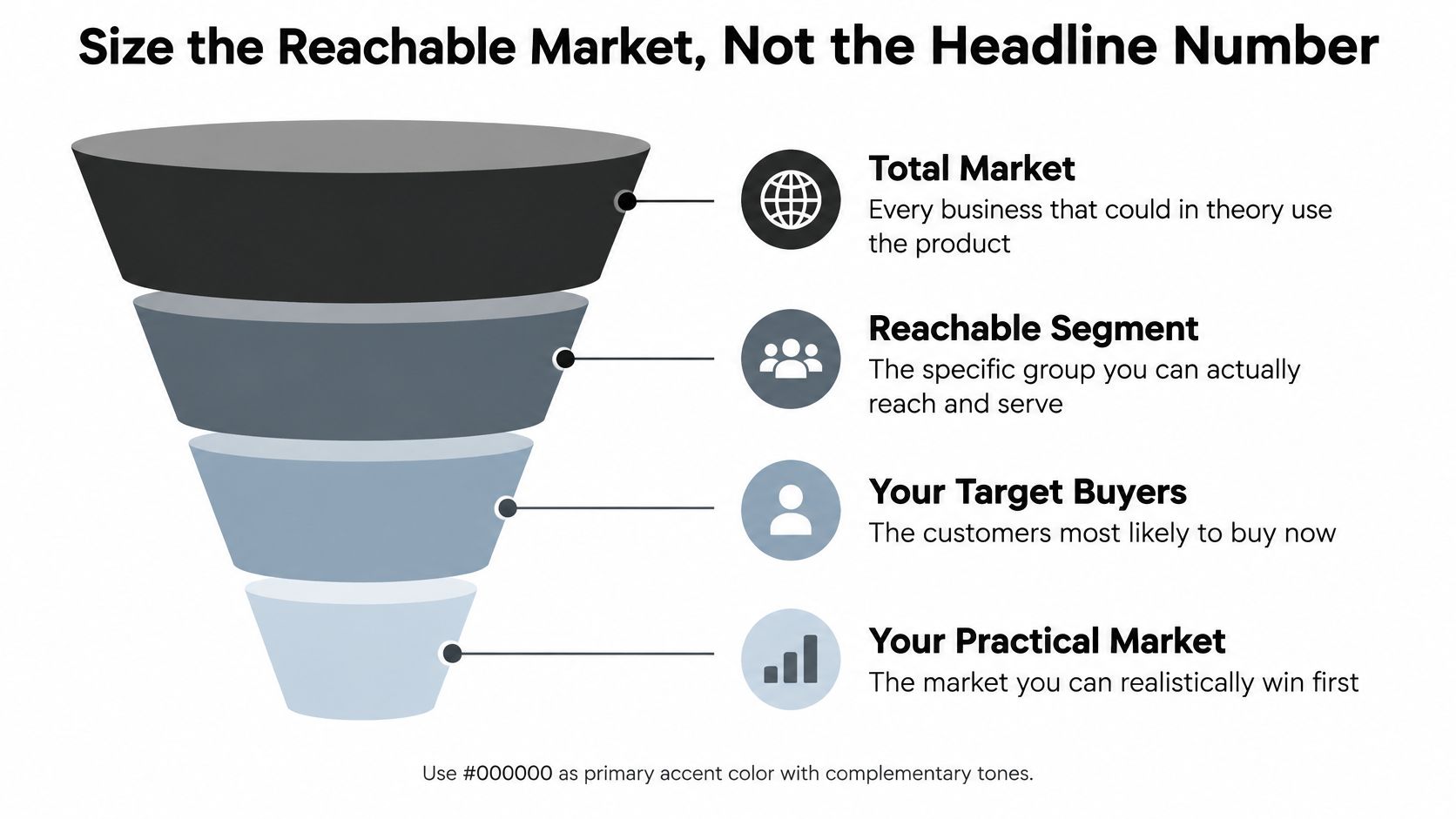
One Worked Calculation
Suppose 4,000 reachable clinics exist in your target region. A 2% conversion from outbound outreach yields 80 customers. At $150 per month, that's $12,000 in monthly recurring revenue.
| Step | Figure | What it assumes |
|---|---|---|
| Every business that could theoretically use it | Headline market, not a target | Too broad to contact or sell |
| Reachable segment, 3 to 10 staff dental clinics in one metro that still schedule on paper | 4,000 clinics | A channel the founder can actually reach |
| Converted from outbound outreach | 80 customers at 2% | Interview evidence must support the 2% rate |
| Price paid by the buyer | $150 per month | The payer, not the clinical user, controls the budget |
| Monthly recurring revenue before contact cost | $12,000 | Still has to cover acquisition cost inside runway |
Now pressure-test each assumption. How many accounts can you contact in a month? What does each contact cost in time or ad spend? Does the conversion rate from your interviews support 2%, or did you pick it because it makes the spreadsheet work?
Separate buyer, user, and payer in the same calculation. A hospital may have clinicians as users and a procurement team as payers, which changes your sales cycle and your close rate. Our primer on market research for startups goes deeper on building that segment before you estimate revenue.
The one-count test: Count how many accounts you can reach this month through a channel that costs little. If that number is smaller than the customers you need, the market is too small for your model.
Survey intent doesn't fix weak arithmetic. Neither does a large total market. You need a measured conversion from a named list.
Check Founder Fit, Timing and Runway
A genuine problem can still be a poor startup choice for you. Most idea content checks market attractiveness and skips four harder questions. Do you have an edge, is the timing right, can you reach customers at a reasonable cost, and can you survive long enough to learn?
The image below captures the decision. You're not choosing between a good idea and a bad one in the abstract. You're choosing whether this idea fits your resources now.
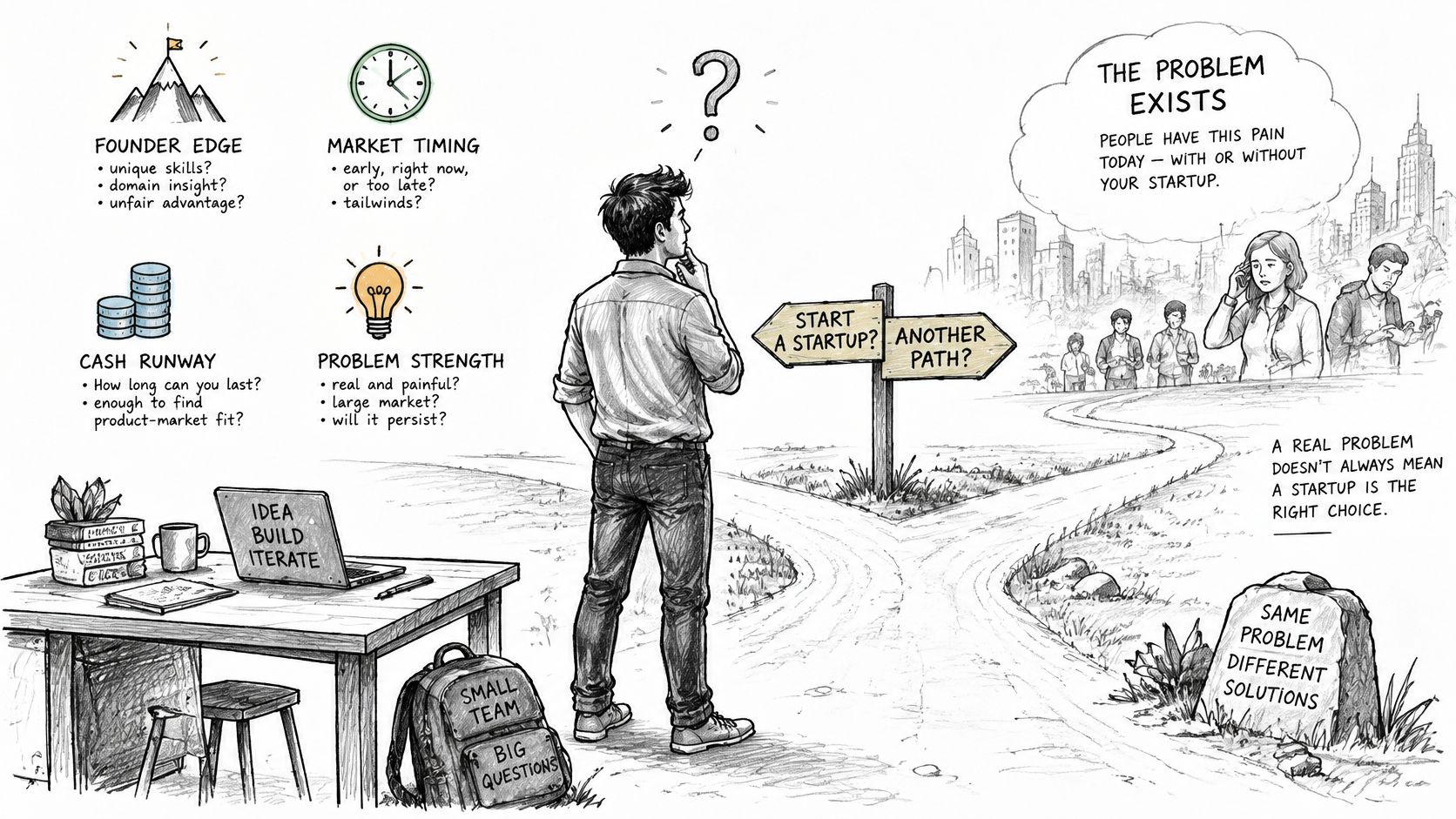
Failure causes go beyond lack of demand. Widely cited post-mortem summaries also identify running out of cash, team problems, competition, and pricing or cost issues as recurring causes, as summarized in LaunchRock's guide to why startups fail. An idea can solve a real problem and still fail because acquisition is inaccessible or the sales cycle outlasts your savings.
Say you're building an enterprise compliance tool with a nine-month sales cycle and you have six months of savings. The problem may be urgent and expensive. You still can't survive to your first renewal. That's a founder-fit failure, not a demand failure.
Model Three Scenarios
Build best case, base case, and failure case models. For each one, calculate the minimum customers, gross margin, conversion rate, and runway required to reach sustainability. If only the best case works, you don't have a plan.
Put survival ranges next to those scenarios. Across U.S. employer establishments founded from 1994 through 2022, an average of 67.7% survived at least two years, 49.2% survived five years, 33.9% survived ten years, and 25.5% survived fifteen years, according to the SBA Office of Advocacy small business FAQ. Closure includes insolvency, acquisition, relocation, retirement, or voluntary shutdown, so these aren't your personal failure odds. They do show that runway is about lasting long enough to learn.
The short video below is useful for pressure-testing timing and personal fit before you commit.
Now name your non-obvious advantage. It could be domain credibility, proprietary access, an existing audience, or a low-cost distribution channel. If your only advantage is "I want this," name that as a risk, not a strength.
Add a differentiation line beside it. Name the alternative buyers use today, what switching would cost them, and the one edge a funded competitor couldn't copy in a quarter. If you plan to raise, you can also browse US investors backing early-stage entrepreneurs to see whether your timing and segment match active investor focus.
Finish with a written checklist. One sentence on your advantage, your months of runway, and the expected sales cycle length, compared against each other on the same page.
Run the Two-Week Test for Your Business Model
Treat the one-sentence problem and your 15 to 30 interviews as already done. The next job is picking the cheapest test that fits your model, writing the pass threshold before you spend, driving strangers to it, and reading the result on day 14.
Different models produce different proof. A paid waitlist suits software, but it proves little for a marketplace that needs both sides to transact. Use the table as a lookup, not as inspiration to mix signals.
| Model | Test to run | Signal that counts as a yes |
|---|---|---|
| SaaS or digital product | Landing page with Stripe checkout for a paid waitlist plus $50 to $150 of paid ads | 10 strangers paying anything inside 14 days |
| Physical product | Shopify or Kickstarter page with the actual price plus $100 to $300 of paid traffic, a sample or 3D render is enough | Orders at the actual price, set the threshold before launch |
| Consumer app | Waitlist page measured against organic reach | Organic reach above 5x views per follower and 1% or more click-through to the waitlist |
| Marketplace | Manually match the first 10 to 20 buyers and sellers before writing code | 5 paid matched transactions brokered by hand |
| Course or info product | Presell the course before the first lesson exists | 10 to 20 paid signups before the first lesson exists |
The process visual below shows the sequence from model selection to decision.
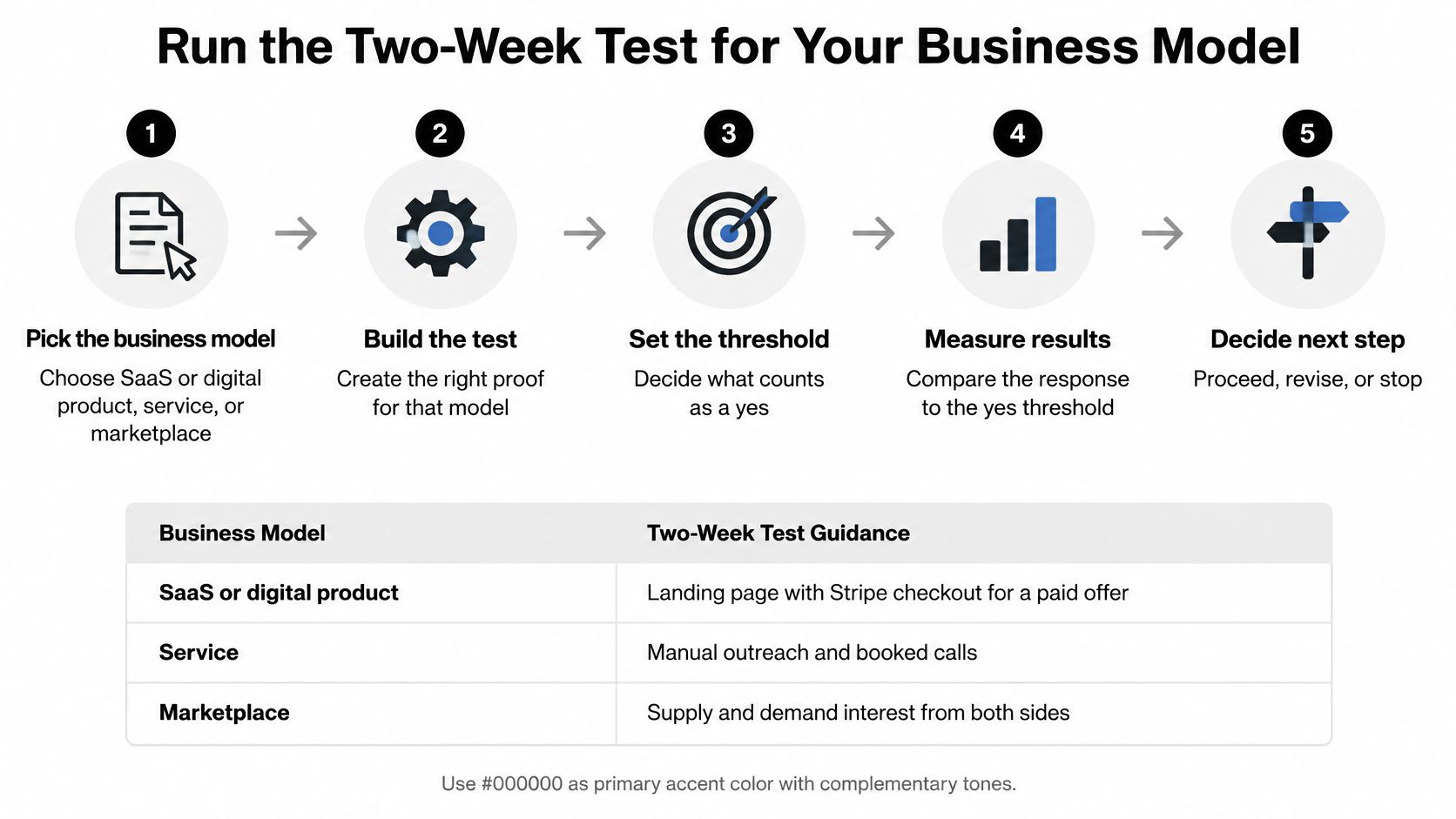
The Six Steps
- Write the problem in one sentence: Name a real buyer and the costly moment you're solving.
- Interview 15 to 30 people: Confirm the workaround and current spend before you build the test.
- Build the cheapest test for your model: Pick one row from the table and build only what that test requires.
- Drive 200 to 500 cold visits from strangers: Validation should bring 200 to 500 cold visits before you draw conclusions, so don't judge the result from your own network.
- Check the signal on day 14: Compare the result with the threshold you wrote before spending, not with a threshold you invent afterward.
- Decide: The final decision is made within 14 days, build, iterate on one variable, or move on.
For a SaaS product, the test is a landing page with Stripe checkout for a paid waitlist plus $50 to $150 of paid ads. Ten strangers paying anything inside 14 days is the signal. Email signups without payment don't meet it.
For a physical product, put the actual price on a Shopify or Kickstarter page and spend $100 to $300 on paid traffic. A sample or 3D render is enough, with no production yet. Discount the result if buyers only ordered at a teaser price.
For a marketplace, match the first 10 to 20 buyers and sellers by hand before writing code. Five paid matched transactions prove both sides will act. For a course, presell before the first lesson exists and look for 10 to 20 paid signups.
Spending more than $500 on validation usually means you're avoiding the harder part, which is talking to people.
Our overview of business model generation can help you map revenue and costs before you pick the test. Don't let that planning delay the offer. The threshold matters only if strangers can reach it.
Write the pass number down before launch. If you change it after seeing weak results, you're not testing anymore. You're negotiating with yourself.
Decide Build, Iterate or Move On
Turn the day-14 result into exactly one of three decisions and apply it the same day. A result you don't act on becomes another week of building without evidence. The rule is simple: one variable per iteration, one decision per two weeks.
Build when the preset signal in the model table is met. Ship only the behavior you already measured, such as the paid waitlist checkout or the five hand-matched marketplace transactions. Don't add features the test never touched, because they carry new assumptions you haven't priced.
Iterate when the result is a near miss with a pattern. Say seven of ten payments came from one segment or one price. Change a single variable, the price, the segment, or the headline, leave the other two fixed, and read the same test again in 14 days.
Move on when the signal was missed by a wide margin after real interviews and a real offer to strangers. The problem isn't frequent or costly enough, or payback doesn't fit your runway. The Acheloa Wellness guide to uncertain decisions is a helpful companion here, because the hard part isn't reading the number. It's acting on it when you've already invested effort.
A near miss with a pattern earns one more cycle. A clear miss with no pattern earns a stop.
This is also where better sourcing helps your next attempt. The startup ideas on our site are sourced from real HN and Reddit pain points, so you can start from observed complaints and then apply the same payment test. You can save the ideas you'd put your name on, and the site will generate a launch prompt for them. Our product validation playbook is meant for validating any product idea, SaaS, physical, marketplace, consumer, or course, in under two weeks with less than $200.
Close the cycle by naming the lowest score on your five-test card as the only assumption for the next round. Write its threshold down before any more building. That's how is my startup idea good stops being a debate and becomes a dated decision.
Stop asking friends whether your concept sounds promising and start with ideas drawn from real pain points, then score one against the five tests and run its two-week threshold. At Find Startup Idea, you can browse startup ideas sourced from HN and Reddit, save the ones you'd put your name on, and get a launch prompt to begin testing. Pick one idea today, write its one-sentence problem, and set your day-14 pass number before you build anything else.