How to Identify Customer Pain Points: A Practical Guide
Learn how to identify customer pain points through interviews, surveys, analytics and Reddit mining, with templates and example questions you can use this week.

You've read the reviews, skimmed the support tickets, and built a tidy list of complaints. Then you talk to customers and hear something else entirely. The loudest problems aren't always the ones costing people money, and the people who gave up never wrote anything down. Learning how to identify customer pain points means looking for silent, abandoned, and handoff pain alongside the complaints you can already see.
Pick the Discovery Method That Fits Your Question
Many begin with public reviews because they're free and fast. That's the trap. Reviews, tickets, and social threads show loud complaints from vocal users, while the friction that makes people leave rarely gets written down at all.
A better test is the gap between what customers expect and what they experience. PwC's Customer Experience Survey found that 54% of U.S. consumers believed customer experience at most companies needed improvement, while nearly 80% identified speed, convenience, knowledgeable help, and friendly service as important elements of a positive experience. In that same survey, 32% of consumers said they would stop doing business with a brand they loved after one bad experience. So don't chase vague claims like "customers want better service." Chase slow replies, confusing steps, weak expertise, or unfriendly service, and check whether they change behavior.
Pain Point Discovery Methods Compared
| Method | Best for | Signal strength | Time to first results | Typical sample |
|---|---|---|---|---|
| Customer interviews | Understanding the trigger, workaround and cost | High when you probe past the first answer | 1-2 weeks | 20-30 people |
| Surveys | Measuring how widespread a known friction is | Medium, stated rather than observed | 3-5 days | 100 or more responses |
| Analytics and behavior data | Locating drop-offs, repeat contacts and churn | High for where, weak for why | 1-2 days if tracking exists | All users in the funnel |
| Support tickets and reviews | Finding recurring complaints in customers' own words | Medium, skewed toward vocal users | Same day | Full history, sorted by theme |
| Social listening and HN or Reddit threads | Spotting unprompted complaints and homemade workarounds | Medium, public but self-selected | 1-3 days | Dozens of threads per topic |
Sequence the Methods, Don't Stack Them
Start with interviews to learn why something hurts, run a short survey to size how many people share it, then check analytics to confirm the behavior happens. Each method answers a different question, and skipping the order leaves you sizing problems you have not named correctly yet.
If you need a structured way to assess what customers need before you commit, SpecStory's customer needs assessment playbook is a useful companion for turning scattered notes into a clear brief.
Practical rule: Pick two methods that answer your current question, and write down the single question each one must answer before you start.
How to Run Interviews That Reveal Real Pain
Interviews fail when they're really pitches in disguise. People are polite, they say your idea sounds great, and you leave with compliments instead of evidence. Run them as investigations of past behavior and the same people will describe costs, workarounds and fixes they gave up on, none of which they would volunteer in a survey.
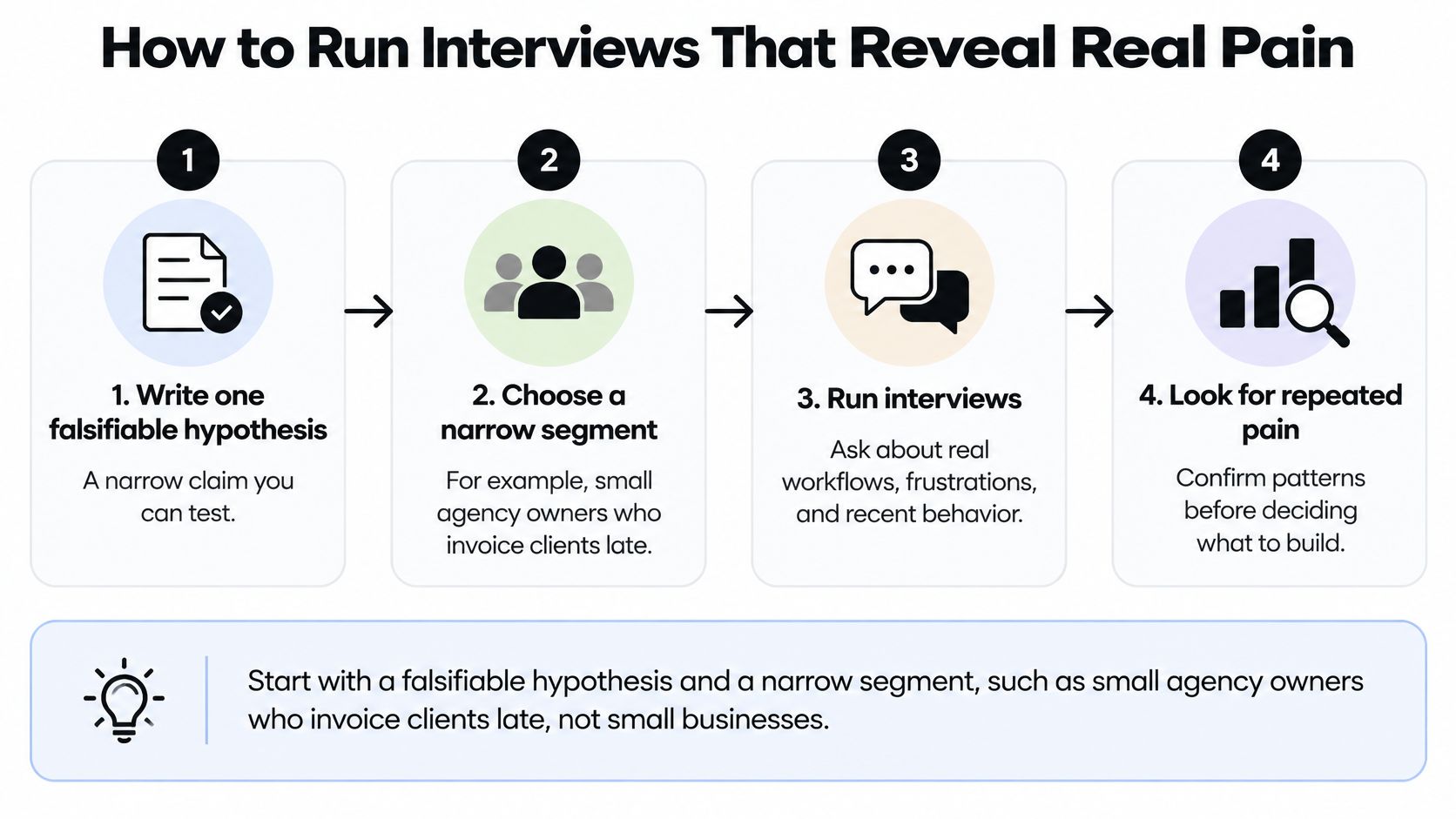
A Six Step Interview Protocol
- Write the hypothesis in one sentence and name the segment. "Small agency owners who invoice clients late lose cash flow" is testable. "Small businesses struggle with billing" isn't. A falsifiable claim tells you who to recruit and what would prove you wrong.
- Recruit from that segment, not your network. Friends and coworkers soften the truth. For a deeper walkthrough of recruiting and structuring these conversations, see this guide to running customer discovery interviews.
- Open with "Tell me about the last time this happened." Let the story run in chronological order without interrupting. The most recent real incident gives you specifics that general opinions never will.
- Probe for the workaround, the cost, and the consequence. Ask what they did next, what it cost in time or money, how often it happens, and what it changed afterward.
- Log each point as spontaneous or probed. Pain people raise unprompted carries more weight than pain they agree to after you suggest it. Keep the two lists separate in your notes.
- Stop when new interviews repeat existing themes. Once you're hearing the same struggles in the same words, more interviews add volume rather than insight.
A narrow, well-defined segment reaches that point quickly. If you are still hearing struggles you haven't logged before deep into the process, the segment is probably too broad; tighten it and keep going.
Questions That Get Past Polite Answers
Use questions anchored in a real event:
- "What were you trying to get done?" This surfaces the goal behind the complaint.
- "What did you try first?" This reveals the current workaround you're competing with.
- "What did that cost you?" Time, money, or embarrassment all count, and vague answers here mean weak pain.
- "What happened after that?" Consequences separate annoyance from urgency.
- "What have you stopped trying to fix?" Abandoned workarounds and given-up tasks are evidence too. The pain went quiet because people built a routine around it, so they rarely mention it unprompted.
Say an agency owner calls late invoices "just annoying." Annoyance is not yet a finding. Ask what happened the last time, what they did next and what it cost, and you might hear they now pay someone to chase payments or lost a client over a disputed bill. That is a cost you can weigh against a price.
Never pitch your solution or ask whether they'd use it. Hypothetical questions produce feature preferences, not evidence of an existing problem.
Separate the Ask From the Job
Customers "hire" products to get a job done, as Harvard Business School's summary of the jobs to be done framework puts it, and they "fire" products that perform that job poorly. A request for more features often hides uncertainty, coordination trouble, or a trust problem underneath. Your job is to separate the visible ask from the underlying struggle.
You should finish with a short list of recurring struggles, each written in the exact wording customers used, plus a second list of the fixes they abandoned. If you can't quote them, you didn't hear it clearly enough yet.
Survey Questions That Expose Real Friction
Surveys come after interviews, not before. Interviews name the pain in customers' own words, then a survey tells you how widespread and how costly it is. If you survey first, you're forcing people to react to your guesses.
Every question should ask about a specific recent event, not general satisfaction. "How satisfied are you?" tells you almost nothing you can act on.
Survey Question Templates by Purpose
| Purpose | Example question | What it reveals |
|---|---|---|
| Frequency | How often in the last month did you run into [the problem]? | Whether the pain is weekly, occasional or rare |
| Cost | What did it cost you in time or money the last time it happened? | Severity and willingness to pay |
| Workaround | What did you do instead the last time? | Current spend and what you are really competing against |
| Abandonment | Have you ever stopped a purchase or task because of [the friction]? | Silent pain behind drop-offs |
| Trigger | What were you trying to get done when it went wrong? | The job behind the complaint |
One Example Survey in Order
Say you're testing friction in client invoicing. Ask how often a late or disputed invoice happened last month, what the last one cost, what the respondent did instead, whether they ever abandoned a tool or delayed a project because of it, and what they were trying to get done at the time. Five questions, one incident each, in that order.
Keep the survey short and clean:
- One incident per question: Never bundle two events into a single answer.
- Neutral wording: Avoid loaded words like frustrating or annoying, which push people toward your conclusion.
- A free text "what happened" field: The story often contradicts the rating, and the story is usually right.
- Reuse the same questions in support: Consistent wording lets you compare survey answers with ticket language later.
How to Read the Results
A common but mild friction is a nuisance. A rarer one that costs real money or triggers cancellations is often the better opportunity, because people pay to remove losses, not irritations. Cross frequency with cost before you rank anything.
If few respondents report the problem in the last month, treat it as a hypothesis, not a finding.
Behavior Signals and Forum Threads That Show Silent Pain
The customers you most need to hear from are the ones who never complained. They abandoned the purchase, tolerated the problem, switched channels, or decided reporting it wasn't worth the effort. Medallia's consumer research on the state of customer experience found that 60% of respondents questioned whether it was worth taking time to tell companies about negative experiences. Low complaint volume can mean resignation, not satisfaction.
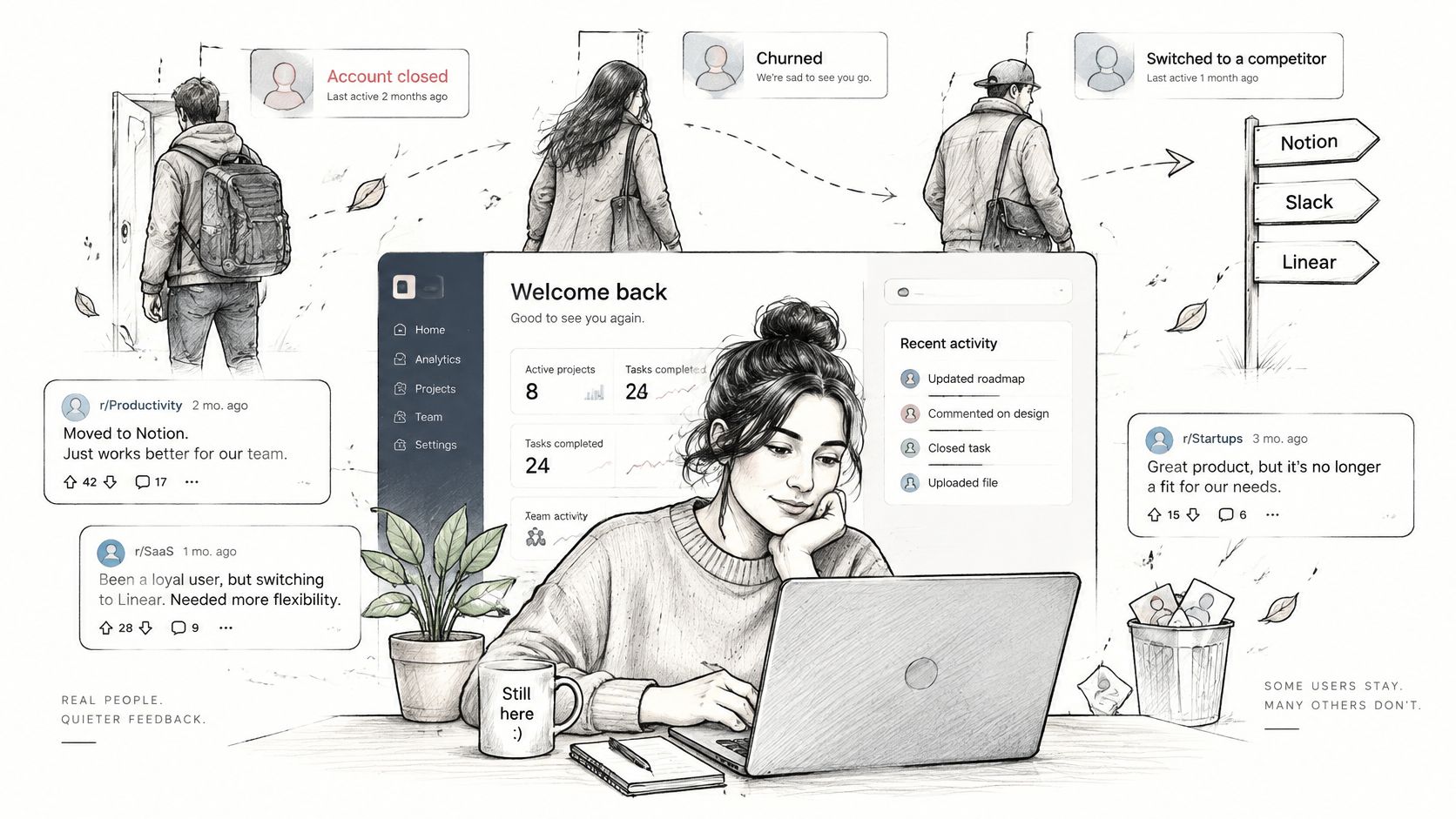
Signals to Pull Before You Ask Anyone Anything
Behavior shows you where people struggle even when they say nothing:
- Drop-offs at a specific step: A sharp exit at one screen or form field localizes the friction.
- Repeat contacts about the same issue: One ticket is a question, three contacts is an unresolved problem.
- Unusually long task times: Slow completion often means confusion, not care.
- Refunds and cancellations: Money leaving is the clearest severity signal you have.
- Switches to a named competitor: The destination tells you which job you're failing.
Sample people who abandoned, churned, or switched, not only active users. Active users are survivors, and survivors understate the pain.
Mining Forums for Unprompted Pain
Search Reddit and Hacker News for phrases like "I wish," "is there a way to," "I ended up using a spreadsheet," and "we pay for X just to." Record the exact wording, count how many separate people raise the same point, and note the workaround each person describes. This guide to using online communities for market research covers how to do that systematically, and the Painmap Io directory entry on IndieTool shows one tool built around surfacing exactly these kinds of public complaints.
Then match words to behavior. If people complain about a checkout step, check whether analytics show drop-offs there. If the numbers don't match the complaints, you may be looking at a one-off rather than a pattern.
A real pain point shows up in both words and behavior. One without the other is a lead, not a conclusion.
Pain Hidden in AI Handoffs and Lost Context
"Customers dislike AI" is too lazy a diagnosis to build on. The sharper question is whether the pain comes from the underlying task, from the AI interaction itself, or from losing context during escalation to a human. Those are three different problems with three different fixes.
The expectation gap is wide, according to Twilio's AI expectations research reported by Business Wire, which found that 76% of consumers wanted an AI agent to identify itself at the beginning of a conversation, 63% wanted an easy escalation path to a human, and 78% had tried to bypass AI agents. People aren't rejecting automation outright. They're rejecting opacity and dead ends.
Map the Handoff, Not Just the Chat
- Map the full path across chatbot, email, phone, and human support, in the order customers travel it.
- Log every repeated explanation. Each time a customer restates their issue, mark it. Repetition is context loss made visible.
- Note contradictory answers from different channels. Conflicting information destroys trust faster than a slow reply.
- Record when the AI discloses that it's automated, at the start or only after the customer asks.
- Count failed transfers and dropped conversations where the customer has to start over.
- Test whether an accountable person can be reached inside the journey, and how many steps it takes.
A Quick Diagnostic Example
Say a customer explains a billing error to a chatbot, repeats it in an email, then explains it a third time to a human agent. The bill isn't the pain point anymore. The context loss is, and the fix is carrying the conversation history across channels, not improving the invoice.
Conventional interviews miss this because customers describe the whole episode as "support was bad." Mapping the journey step by step gives you a specific, buildable problem instead of a mood.
Score Each Pain Point and Decide What to Build
Collecting pain points is easy. Ranking them is where many groups stall, because a long list feels like progress and choosing feels like risk. I'd rather see three scored candidates than thirty unsorted complaints.
First, write each candidate as one sentence with a named buyer. That's our first validation step, and if you can't do it, the idea isn't sharp enough yet. "Agency owners lose a week of cash flow when clients dispute invoices by email" is a candidate. "Billing is painful" is not.
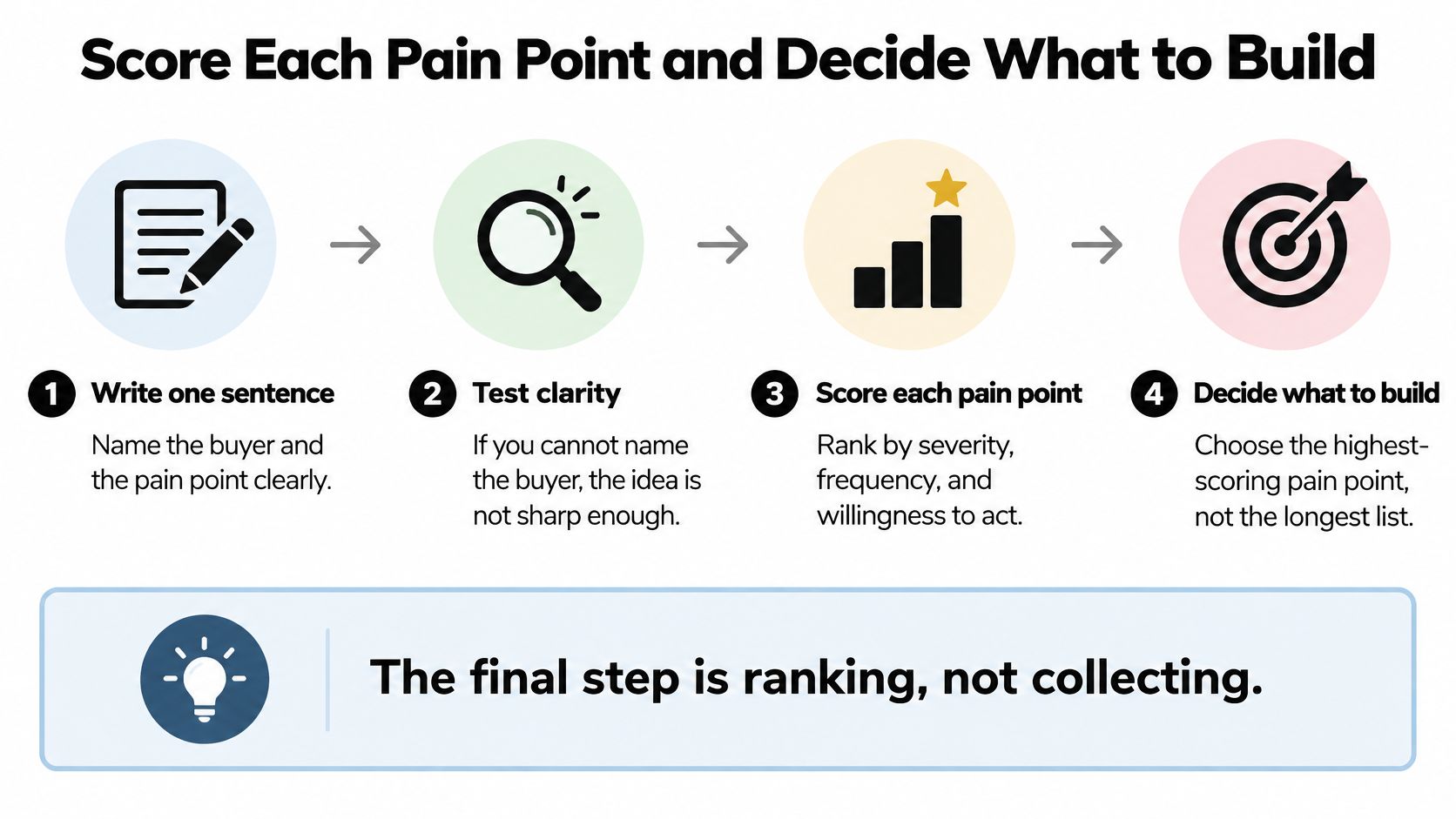
Scoring Criteria for Customer Pain Points
| Criterion | Question to ask | Strong signal |
|---|---|---|
| Frequency | How often does this happen to one customer? | Weekly or more, in most interviews |
| Severity | What does it cost in money, time or churn? | Measurable loss, not just annoyance |
| Reach | How many people in the segment report it? | Raised independently by many separate people |
| Current spend | Do people already pay for or hack around it? | Paid tools or recurring manual workarounds |
| Clarity | Can you state it in one sentence with a named buyer? | Yes, with a buyer you can reach |
Mark each criterion strong, weak, or unknown. Keep candidates that score strong on severity and current spend even when they're less frequent. A rare friction that costs real money usually beats a common annoyance nobody pays to fix.
A Worked Example With Three Candidates
Say your interviews surfaced late client invoices for agency owners, a slow handoff in billing support, and recurring spreadsheet reconciliation. Score all three. If reconciliation only scores strong on frequency while late invoices score strong on severity and current spend, drop the reconciliation idea, however often people mention it. This is the core of reaching problem solution fit, matching one sharp problem to one buyer who already feels its cost.
Then test before building. For a SaaS or digital product, the validation signal is 10 strangers paying anything inside 14 days. Strangers, not friends, and for software the buyer must accept recurring billing rather than a one-time favor.
Choose one pain point this week. Write its one-sentence problem with the buyer, collect three interview quotes that prove it, and either run the test or move to the next candidate.
At Find Startup Idea, you can browse startup ideas sourced from real HN and Reddit pain points, so you start from problems people are already describing in public rather than inventing your own. Save the ideas you'd put your name on and the site will generate a launch prompt for them, giving you a concrete candidate to score against the criteria above.