Find Product Market Fit: A 14-Day Playbook
Find product market fit with a scorecard, a 14-day stranger test, and model-specific signals for retention, NPS, and real willingness to pay.

In 2024, 43% of failed venture-backed startups cited poor product-market fit as a root cause, according to Preuve's account of CB Insights' analysis of 431 startup failures. That's a warning against confusing a product people admire with a product they need.
To find product market fit, you need evidence that a particular buyer gets a meaningful result, commits something valuable, and comes back when the problem returns. A fourteen-day test can help you decide whether that evidence deserves more investment. It can't compress a long renewal cycle into a fortnight or turn a small survey into proof.
Why Market Need Beats a Clever Product
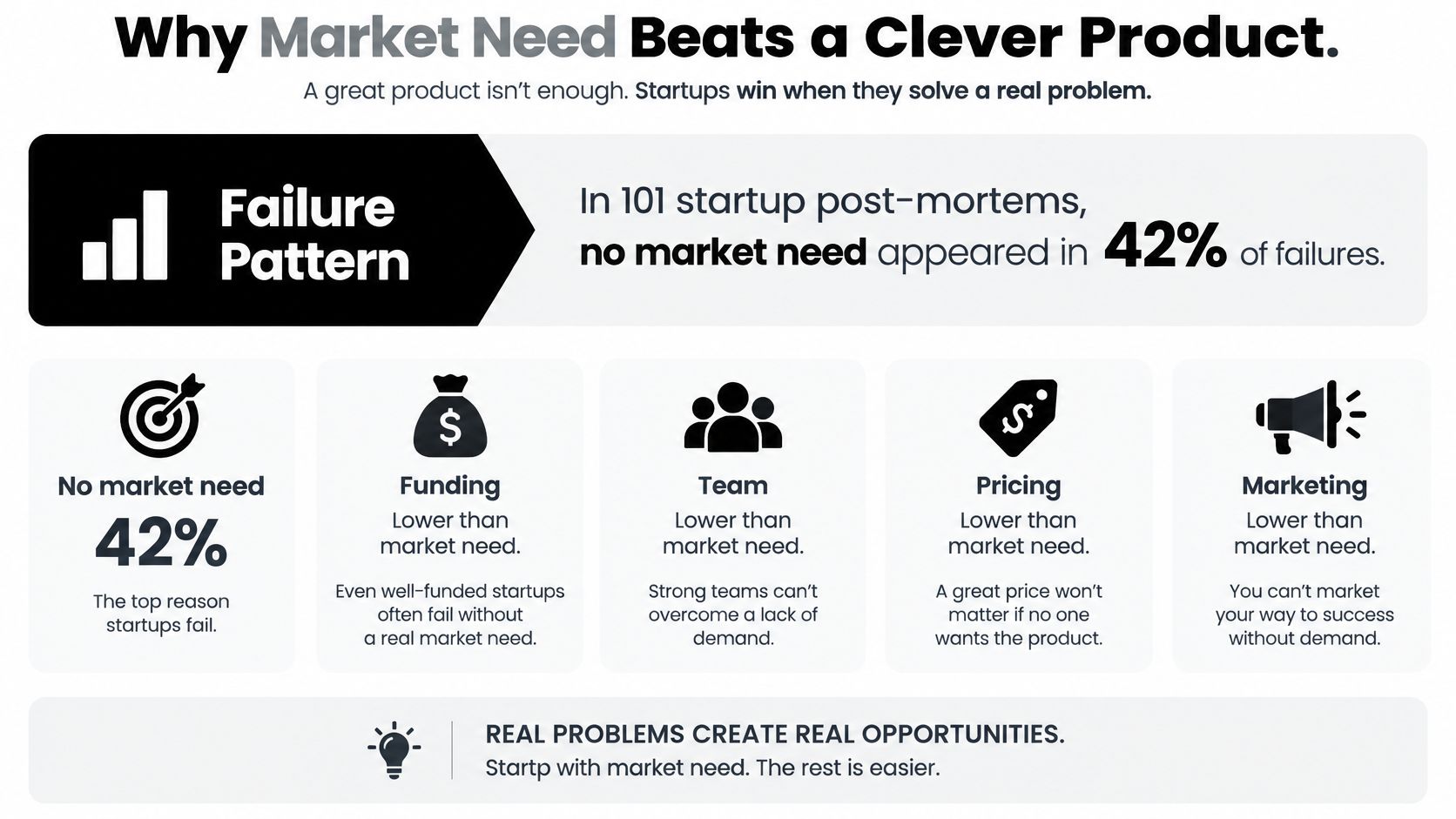
In an analysis of 101 startup post-mortems, “no market need” appeared in 42% of failures, ahead of funding, team, pricing, and marketing issues, according to Observer's account of the failure analysis. Founders could name multiple causes, so the percentages weren't mutually exclusive. This describes failed companies, not the odds that your idea will fail.
Say a founder has a polished prototype and a waitlist filled with friends. Everyone praises the interface, but the activated cohort stops returning. The founder has evidence of encouragement, not dependence.
Product-market fit means a specific customer has enough reason to change behavior or pay, and would struggle to replace the value delivered. Better technology alone doesn't establish that.
Start with customer discovery interviews about existing behavior. Ask buyers what happened the last time the problem occurred, how they handled it, and what that workaround cost them.
Starting question: Who is the buyer, and what job do they already spend money or effort getting done?
Write a concrete answer before scoring anything. A vague buyer makes every later metric harder to interpret.
The Scorecard That Shows Product Market Fit
Score a segment, not your enthusiasm. Put survey responses, acquisition behavior, payment, and unaided return on the same sheet. Resist the urge to average them, because a warm survey cannot cancel out absent payments.
The Sean Ellis question asks users how they would feel if they could no longer use the product, and a strong share of "very disappointed" answers is a commonly used checkpoint for product-market fit. Treat that result as a hypothesis about one segment, not a verdict. It only earns confidence when three things agree: the same respondents keep coming back without prompting, someone pays, and the behavior clusters around the outcome your business model sells. When the disappointment score points one way and retention or willingness to pay points the other, the score loses.
That is why a result near the line stays provisional when the respondent pool is small, selected, or disconnected from observed behavior.
Product-market fit scorecard
| Signal | Pass | Weak read | Who counts |
|---|---|---|---|
| Sean Ellis very disappointed | A meaningful share of qualified users, backed by behavior | Only a handful of answers, or praise without payment | Recently active users who experienced the core value |
| Small survey sample | Provisional result with counts shown | A thin sample presented as certainty | Keep tiny persona groups descriptive |
| Cold email capture | 4%+ of visitors | Under 4% | Strangers, not friends or coworkers |
| Cold paid waitlist or pre-order | 1%+ of visitors | Under 1% | Prospects who haven't used a free build |
| NPS after a value moment | Recommendation supported by payment and repeat use | Praise without commitment or return | Customers who finished the job |
| Unaided return | Activated cohort returns without reminders | One spike, then silence | Activated users with another opportunity to use it |
The cold-traffic thresholds are validation checkpoints for a priced offer, not universal product-market-fit standards. Email capture signals interest; a paid commitment asks the prospect to give up something more valuable. Read them the way a mechanic reads a gauge: a single reading means little, but several gauges agreeing tell you the engine works.
Ask people who can judge the loss
For a frequently used tool, define a recent activity window before sending the survey. For an episodic purchase, qualify respondents by whether they completed the relevant job, rather than excluding them because they didn't log in recently. A buyer who used the product twice and would miss it is worth more to your score than a daily visitor who never reached the outcome.
Keep a record of:
- Eligibility: What someone had to experience before receiving the question.
- Coverage: Who received the survey and who answered.
- Commitment: Whether respondents paid, used a free version, or received intensive founder support.
- Context: The segment, use case, and acquisition source behind each response.
An AI product needs particularly clear eligibility, since sending prompts is not the same as finishing a job. Before surveying, map the workflow and the result users should achieve. An AI workflow assessment from Thareja Technologies, offered by Thareja Technologies Inc., can be a resource for defining that workflow before measuring satisfaction.
Treat NPS as a relationship check, not a substitute for demand. Someone can recommend your concept while continuing to solve the problem elsewhere.
Mark each row pass, noisy, or fail. A noisy result needs better observation; a failure needs a changed hypothesis. Circle the weakest meaningful row rather than celebrating the strongest one.
Value Events for Each Business Model
A login isn't always useful work. A marketplace buyer might visit rarely but complete an important purchase. An enterprise user might love the interface while the budget owner sees no reason to renew. An AI customer might send prompts without producing an acceptable deliverable.
Choose a value event, the observable economic or operational outcome the customer came for. The demand problem discussed in DesignRush's startup failure overview is a reason to test that outcome, rather than impose subscription-style engagement measures on every business.
Fit signals by business model
| Model | Value event | Pass line | Do not trust |
|---|---|---|---|
| SaaS or digital | Paid use and tolerance for recurring billing | 10 strangers pay anything inside 14 days | Free signups |
| Marketplace | Completed transactions and local liquidity | 5 paid matched transactions brokered by hand | Signups on one side only |
| Consumer app | Organic reach into a waitlist | Above 5x views per follower and 1%+ click-through | Paid installs |
| Enterprise software | Renewal intent, expansion, and time-to-value | User adoption plus buyer commitment and stakeholder involvement | Love from a single demo user |
| AI tool | A finished workflow | The same users successfully complete the job again | Raw prompt counts |
| Hardware or episodic buy | A priced pre-order or repeat purchase | Cash at the actual price, with clear delivery terms | An invented daily-use curve |
Our SaaS, marketplace, and consumer checkpoints are early validation signals. They don't establish durable retention, sustainable acquisition costs, or a viable margin by themselves.
For SaaS, ask whether customers want software at all. A buyer paying for your manual help may want a service, while another may want a one-time utility rather than a recurring bill. Those are different businesses, even if the first payment looks identical.
Match the promise to the transaction
Say you're testing a local equipment marketplace. Broker transactions manually and record the location, availability, completion, and whether each side would transact again. A nationwide signup total can hide the fact that buyers can't find suitable equipment nearby.
For an AI bookkeeping tool, count an accepted reconciliation, not generated text. Include the review and correction work needed before the user considers the job finished.
Use business model generation to clarify who receives value, who pays, and when. If the promise remains feature-heavy, explore compelling value proposition examples from Stamina to help describe the outcome buyers should recognize.
Courses need the same discipline: seek paid enrollment before creating the lessons, with transparent terms about what exists and when delivery begins. Circle the value event that matches your business, and use the other rows only if your model changes.
How to Run the Fourteen Day Fit Test
Validation means strangers commit money, time, or a clear yes before you build the full product. The test should expose a risky assumption, not produce a launch screenshot.
Keep the offer honest. A pre-order page must explain that the product isn't ready; a concierge test must disclose what you'll deliver. Don't collect money under an impression you can't fulfill.
Set up the experiment
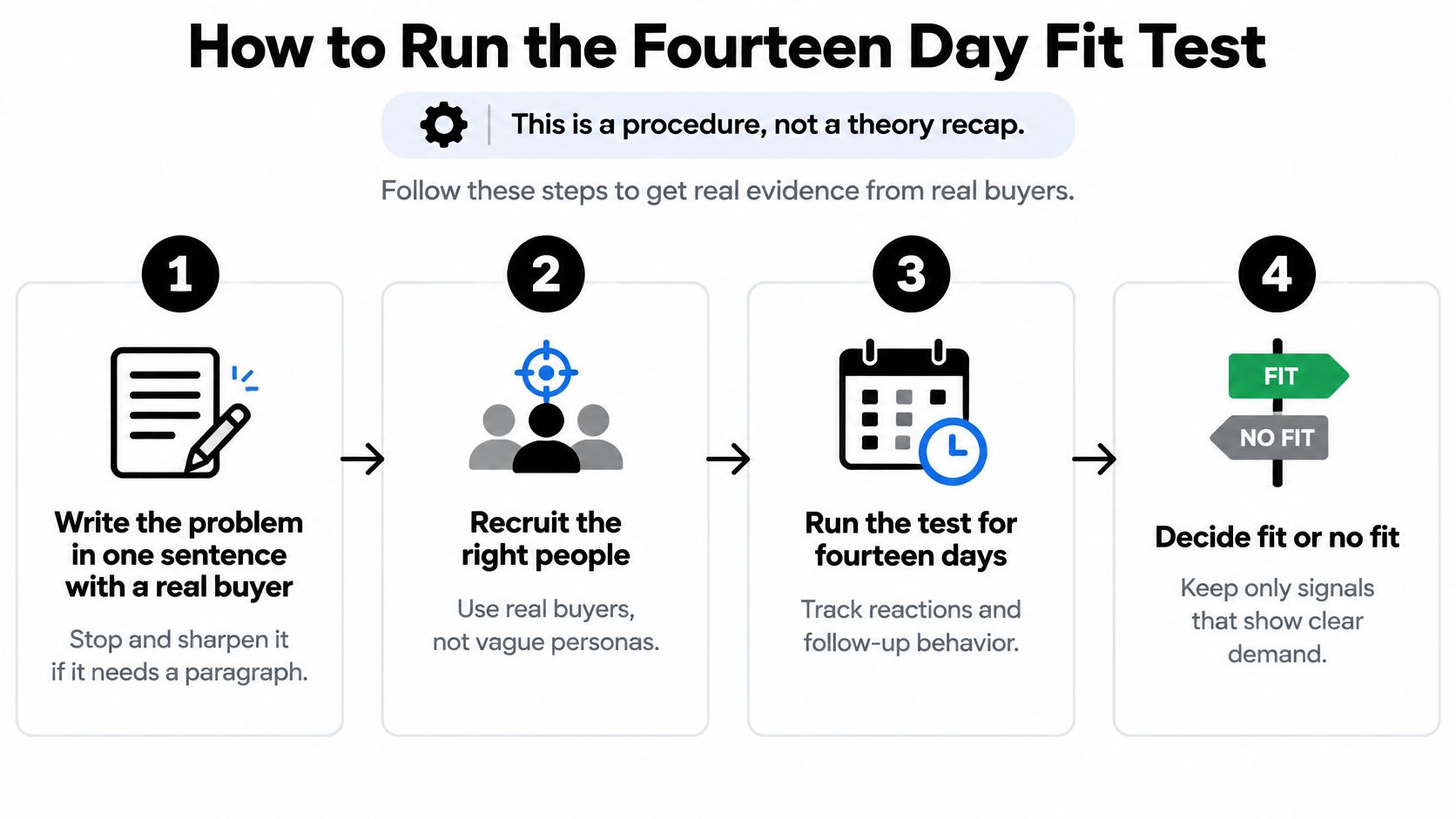
Write the problem in a sentence with a real buyer.
Freelance bookkeepers need to reconcile client payments without copying transactions between spreadsheets is testable. Small businesses need better finance tools isn't sharp enough. If you need a paragraph to identify the buyer and job, narrow the idea before spending.Choose a segment with a shared situation.
Recruit people who use a similar workaround and face a similar trigger. Ask about the last occurrence, the person responsible, and the consequences of leaving it unresolved. Don't group prospects together merely because they share a job title.Publish a priced offer.
For digital products, use a landing page and Stripe checkout for a clearly described paid waitlist. For a service, deliver the outcome manually; for hardware, show a sample or render with the actual price and delivery conditions. Use the minimum viable product guide to keep the delivery scope focused on the assumption you're testing.Recruit a cold audience.
Our validation process calls for 200–500 cold visits from strangers before drawing conclusions about the offer. Keep friends, coworkers, bots, and your own visits out of the denominator. If you can't reach suitable buyers, record an acquisition problem rather than pretending broad, irrelevant traffic tested demand.
Observe without moving every variable
Record the essential behavior.
Track visits to email capture, visits to paid commitment, and unaided return or referral. Keep acquisition sources separate so a warm introduction doesn't inflate your cold result. Record refunds and cancellations alongside payments.Send the disappointment question on day ten, when users qualify.
Ask people who experienced the outcome, not everyone who clicked the page. A payment without delivery can support an offer test, but it doesn't qualify someone to judge the loss of a product they haven't used. If nobody has reached value, record insufficient exposure instead of forcing a survey.Make the decision on day fourteen.
Mark the scorecard using the evidence available, including noisy or incomplete rows. Choose a next action without changing the audience, price, and promise together. A short test can justify another experiment without proving lasting fit.
The common mistake is to rescue a weak result while the experiment is still running. You rewrite the headline, lower the price, and switch audiences, then can't tell which offer anyone accepted.
Experiment discipline: Date your next-test note and name the variable you're allowed to change before editing the page.
Keep necessary bug fixes separate from hypothesis changes. Fixing a broken checkout makes the test usable; replacing the offer creates a different test.
How to Read Retention NPS and Referrals
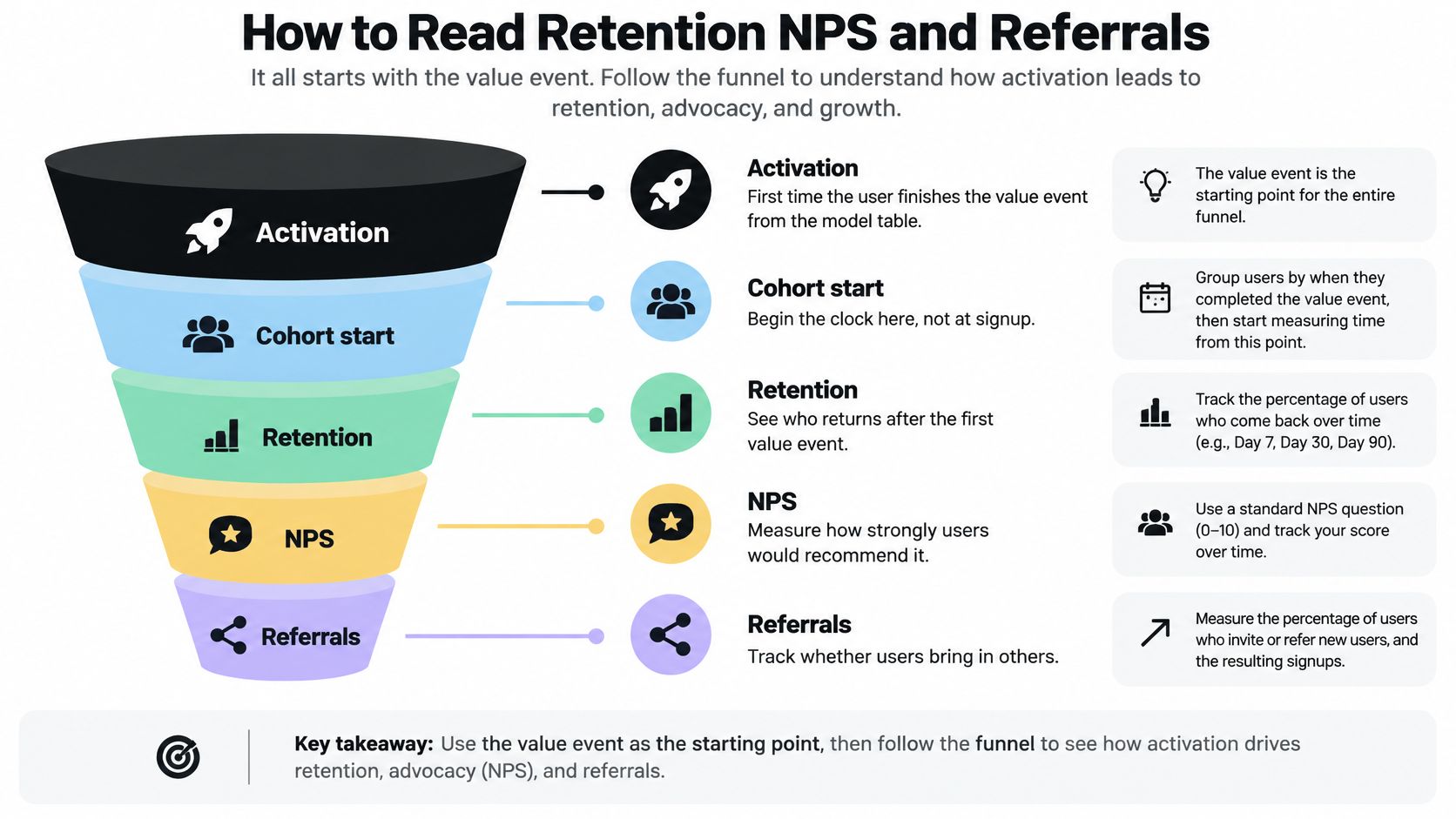
Activation starts when the user finishes the value event, not when they create an account. For a bookkeeping tool, that might mean accepting a completed reconciliation. For a marketplace, it might mean completing a transaction rather than contacting a seller.
Start the retention clock at that event. Otherwise, you mix customers who received value with visitors who never got through onboarding, and you lose the distinction between a delivery problem and a reason to return.
Build cohorts around an opportunity to return
Use a spreadsheet before adding a complex analytics stack. Record the activation period, activated users, and those who returned without a reminder.
| Activation period | Activated users | Returned without a reminder |
|---|---|---|
| Cohort label | Count completing the value event | Count completing another relevant event |
Choose an observation window that fits the job. A recurring administrative task needs a different window from an occasional equipment purchase. Don't label someone lost before they've had a reasonable opportunity to need the product again.
Separate unaided return from founder-assisted return. Both can teach you something, but repeated personal prompting can conceal whether the product has become useful on its own.
Survey after the outcome
Ask NPS after customers can judge what you delivered. At signup, they can rate the promise or onboarding experience, not the completed job.
Use the disappointment question with the same qualified group, offering “very disappointed,” “somewhat disappointed,” and “not disappointed.” Then ask what benefit they would miss and what they would use instead. Preserve their language rather than translating every answer into your preferred positioning.
- Promoters who don't pay: Investigate whether they're fans, beneficiaries, or actual buyers.
- Strong disappointment responses: Identify the job and circumstances behind the dependence.
- Nonrespondents: Compare their activation and usage with respondents before assuming the answers represent everyone.
Referrals need attribution too. Ask the new prospect who referred them and whether the referring customer had completed the core job.
A launch post or directory listing can generate traffic without demonstrating customer dependence. Once you have a segment worth reaching, you can build backlinks through startup directories with StartupSubmit, but label those arrivals as acquisition, not customer referrals.
Keep a reusable metric note with the activation definition, cohort window, survey date, sample size, and acquisition source. That gives future comparisons a consistent meaning.
Fixes When Signals Conflict
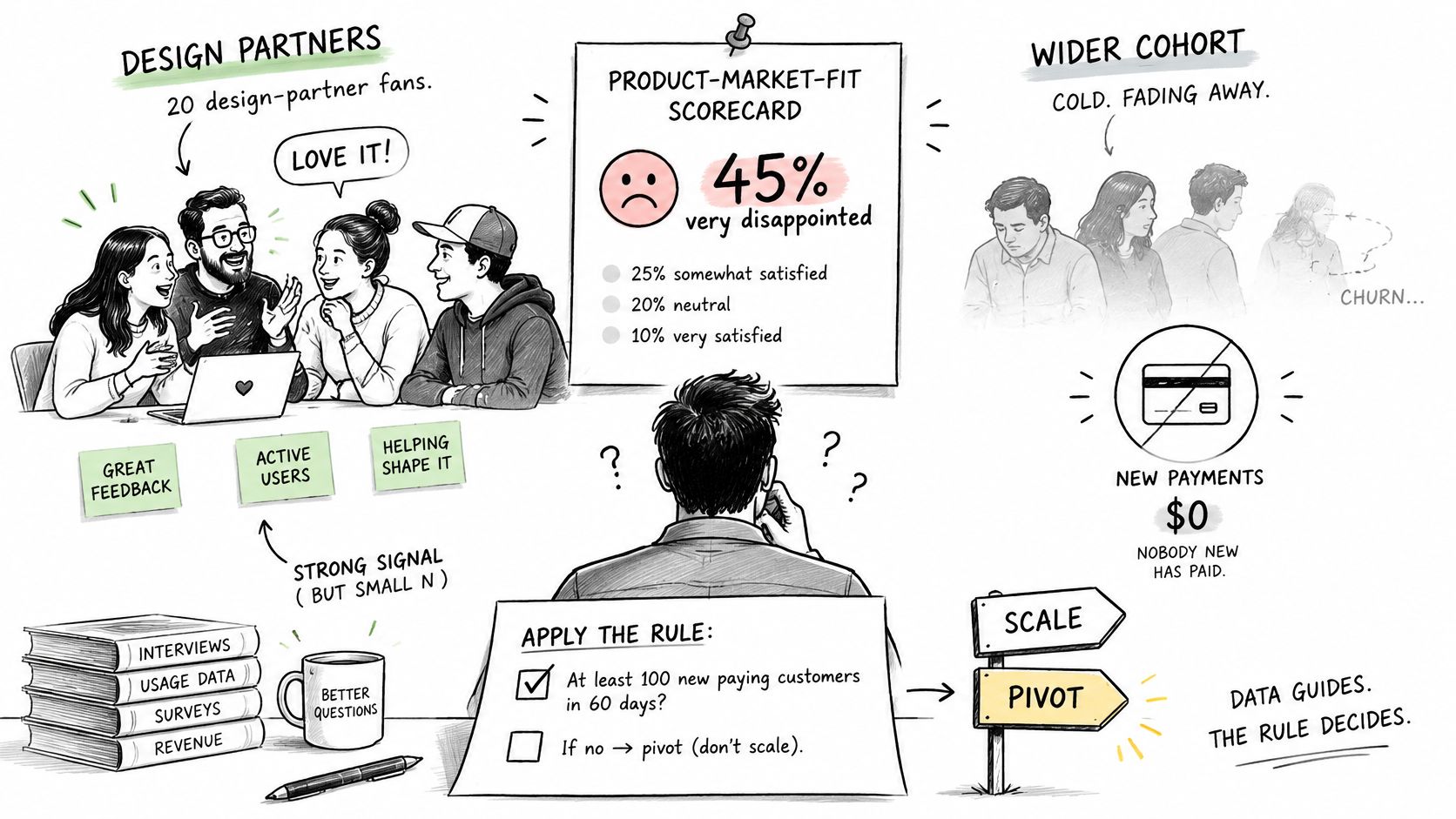
Suppose enthusiastic design partners give you a flattering disappointment score, but newly acquired customers don't return and fresh prospects won't pay. You haven't uncovered a paradox. You've measured different people under different conditions.
A survey strengthens a hypothesis; it doesn't overrule behavior. AAJ Consult's product-market-fit signals guide notes that 50 responses near a 40% score can carry an estimated margin of error of about 13 percentage points. That uncertainty is large enough to make a borderline result materially ambiguous.
Diagnose the disagreement
| Signal clash | Likely cause | Fix for next fortnight |
|---|---|---|
| Survey high, retention low | Enthusiastic fans or unusual founder support dominate | Survey a defined recently active group and hold expansion spend |
| Retention decent, survey low | Required task, weak differentiation, or an unclear promise | Investigate alternatives, then change the promise or segment |
| Friends pay, cold traffic stays silent | Personal support is being mistaken for demand | Exclude network commitments and restart with strangers |
| Borderline score from a small respondent pool | Sampling noise | Collect more qualified responses before persona splits |
| Only happy users answer email | Selection bias | Invite a random sample of activated users and examine nonresponse |
A confidence interval addresses sampling uncertainty, not every source of error. It can't repair a survey sent only to your most enthusiastic customers. More responses from the wrong population give you a more precise description of the wrong group.
There's no customer count that makes a biased sample trustworthy. With a small cohort, show the underlying counts and use interviews to generate hypotheses. Don't slice that cohort into persona percentages and treat each slice as a separate market verdict.
Change the cause you can test
A favorable answer matters most when the same kind of customer also accepts the price and repeats the value event.
Treat the table's causes as diagnoses to investigate, not automatic conclusions. Low retention might reflect an onboarding failure, a long usage cycle, or an unmet promise rather than weak need.
Choose a variable for the next fortnight: segment, offer, or price. Keep the others stable enough to interpret the outcome. If repeated clean tests produce neither payment nor unaided return, stop treating branding as the default explanation and look for a more urgent problem.
Choose Build Iterate or Walk Away
Build when strangers complete the relevant value event and your positive signals don't depend on a tiny, unusually supported group. Invest in delivering that outcome reliably before expanding the feature list.
Iterate when you can identify a specific obstacle and write a test that could disprove your explanation. Walk away when clean cold tests keep producing no meaningful commitment and no return.
Write a dated decision note
- Decision: Build, iterate, or move on.
- Reason or variable: The evidence behind the decision, or the change you'll test.
- Settling metric: The behavior that would justify a different conclusion.
Make that call within the test period. Long-cycle businesses may need more observation before claiming fit, but they still need a concrete next decision rather than an indefinite maybe.
If you iterate, rewrite the problem sentence before touching the roadmap. If you move on, look for a sharper pain instead of putting a new logo on the same unsupported promise. A technically impressive idea can still fail the demand test.
Run the same scorecard on the next hypothesis. Consistent measurement makes it harder to redefine success after seeing the result.
Find Startup Idea offers ideas sourced from real HN and Reddit pain points, plus a validation playbook for testing customer commitment before building. Visit Find Startup Idea, choose a problem with an identifiable buyer, and turn it into a priced offer and a dated fit test.