Market Validation: What Counts as Real Demand
Market validation means strangers pay before you build. Use the evidence ladder, a 14-day test, and benchmarks that separate demand from likes.

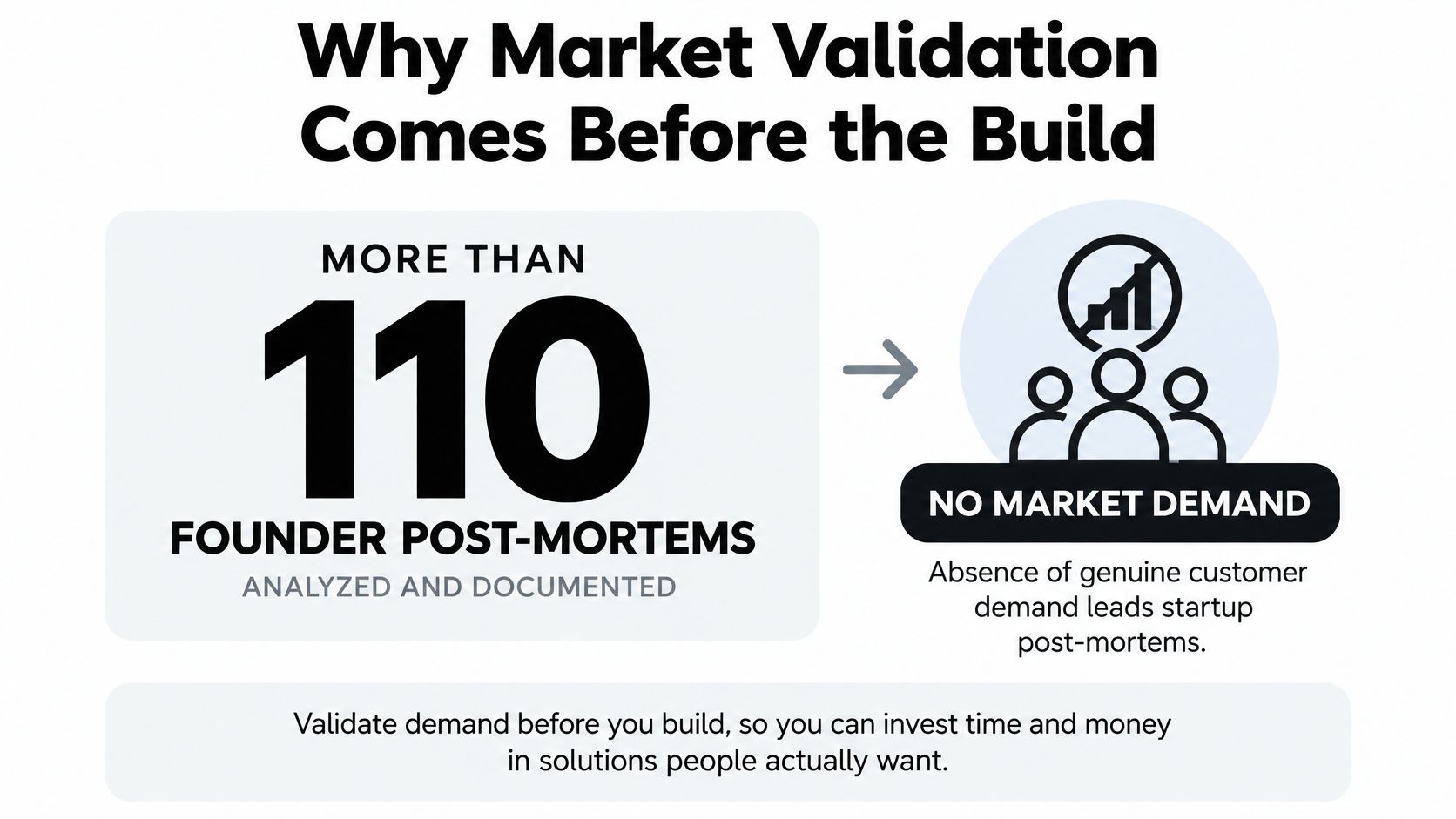
“No market need” accounted for 42% of failures in CB Insights' analysis of more than 110 founder post-mortems, as summarized by Launchrock's guide to startup failure. The uncomfortable lesson isn't that founders can't build products. It's that building a working product and finding someone who needs it enough to pay are different achievements.
Why Market Validation Comes Before the Build
Market validation means proving that real strangers, not friends or coworkers, will give money, time, or a clear yes before you build the product. Those commitments aren't equally strong, but each moves the conversation away from your opinion and toward a customer's behavior.
Say you're planning software that organizes invoices for independent designers. Designers complain about administration online, and your friends like the concept. Neither tells you whether designers lose enough time to justify another subscription, or whether their accounting software already handles the difficult part.
Think of validation as a fire drill. You check whether people leave the building, not whether they admire the alarm. A polished prototype can demonstrate your design skills without testing whether buyers will change their routines.
The central risk is building before checking demand.
Check the buying situation
Before committing to code or inventory, answer these questions:
- Urgency: What happens if the customer leaves the problem unsolved?
- Buyer: Who can authorize spending, rather than merely recommend the product?
- Alternatives: What does the customer use now, including spreadsheets or manual work?
- Willingness to pay: What offer will the buyer purchase?
- Reachability: Where can you consistently find suitable prospects?
Market research for startups helps you understand the environment. Validation asks a narrower question: will this customer commit to this offer?
If you're still choosing a format, the digital product ideas from Julip can help you compare possibilities. Treat each possibility as a hypothesis, not a business opportunity that's already been proven.
The opening failure finding describes documented failed companies, not the probability that every untested startup will fail. Its practical value is the warning: technical execution doesn't establish demand. Use an evidence ladder to decide whether you've learned enough to justify the next investment.
The Evidence Ladder from Talk to Payment
| Level | Typical signal | Does not prove | Enough to build |
|---|---|---|---|
| Stated interest | Interviews, surveys, likes, praise | Budget, urgency, or a switch trigger | No |
| Behavioral commitment | Work email, waitlist, or booked call | That anyone will pay | Rarely |
| Economic commitment | Pre-order, deposit, paid pilot, or signed LOI | That demand repeats | Yes, to start |
| Repeatable retention | Second payment or renewed use | That the market will scale | Yes, to continue |
Evidence gets stronger when customers accept a meaningful cost. Answering a survey costs little. Attending a working session requires time. Paying requires the buyer to choose your offer over another use for the money.
Stated interest is useful for discovering language and problems. It doesn't establish a business. Likes, retweets, and enthusiastic comments are encouragement, not validation.
Our practical screening rule is simple:
Likes don't count; strangers giving money or a work email do. But a work email earns a follow-up test, not permission to fund months of development.
A landing-page visitor who supplies a work address has taken a measurable action. That still leaves the central question unanswered: will a specific buyer pay a stated price from an identifiable budget?
Find the person behind the payment
A real problem doesn't automatically support a viable price. Startup Super School's startup-failure summary identifies pricing or cost problems in 19% of failures, separately from market need.
For a business-to-business product, map the people involved:
- User: Experiences the problem and operates the product.
- Economic buyer: Controls the budget and approves the expense.
- Procurement contact: Handles purchasing terms and vendor onboarding.
- Security reviewer: Assesses access, data handling, and implementation risks.
Say a project coordinator wants your reporting tool. Ask which department would pay, who signs off, and what must happen before purchasing can begin. A delighted coordinator without a route to approval isn't the same as a buyer.
Document the current workaround's cost, then present a clear price and scope. A signed letter of intent, or LOI, is stronger when it names the price, buyer, and purchasing conditions. It still isn't collected revenue, especially if it's nonbinding.
For software as a service, or SaaS, confirm that the buyer wants software rather than a managed service or one-time tool, and will tolerate recurring billing. Your business model must fit how the customer wants to buy.
Don't spend months building on stated interest or behavioral commitment alone. Seek economic commitment first, then test whether customers return after the initial excitement.
Common Validation Methods Compared
Choose the method by the question you need answered. Interviews help explain a problem; a checkout tests whether someone will purchase an offer. Using an interview to prove payment is like using a thermometer to measure distance.
| Method | Best for | Evidence level | Typical cost |
|---|---|---|---|
| Customer interviews | Finding recurring, costly pain | Level 1, stated interest | Recruiting and interview time |
| Surveys | Checking whether a pain is shared across a group | Level 1, stated interest | Distribution and optional survey tools |
| Waitlist or landing page | Testing message and click intent | Level 2, behavioral commitment | About $50 to $150 of ads |
| Pre-order or deposit | Testing price and payment | Level 3, economic commitment | Product page at real price, no production |
| Concierge or manual service | Testing a marketplace before code | Level 3 when customers pay | Founder delivery and coordination time |
| Paid pilot | Confirming budget owner and switching trigger | Level 3, economic commitment | Scoped delivery and onboarding work |
Our SaaS testing approach uses the advertising range shown above as a starting allocation, not a promise of sufficient traffic. Audience costs and the offer determine how far it goes.
Match the test to the uncertainty
In customer discovery interviews, ask about the last time the problem happened. Have the prospect describe the workaround, its consequences, and who paid for it. Asking whether they'd buy invites speculation.
Use surveys to check whether other people recognize the same pain, without treating their answers as purchase orders. For landing pages, show the actual offer and distinguish email capture from a paid checkout.
Shopify or Kickstarter can support a physical-product pre-order test with a sample or render before production. Be explicit about what exists, what buyers receive, and the delivery and refund conditions.
A concierge test means performing the proposed service manually. For a marketplace, you could introduce buyers to sellers yourself and collect payment for successful matches rather than build matching software.
A paid pilot tests a bounded outcome with a real customer. Agree on scope, payment, success criteria, and the purchasing route before work begins. Free implementation dressed up as a pilot won't answer the budget question.
How to Run a Fourteen Day Validation Test
Treat the test as a sequence of decisions, not a rush to publish a landing page. A longitudinal study of 152 NSF-supported startup teams found a linked process in which teams formulated business hypotheses, probed them with prospective customers, and then converged on a business idea.
Learning means changing your understanding of the opportunity, not collecting cheerful interviews. Keep a decision log with the assumption, test, required behavior, result, and next action.
Use this sequence to keep the work focused.
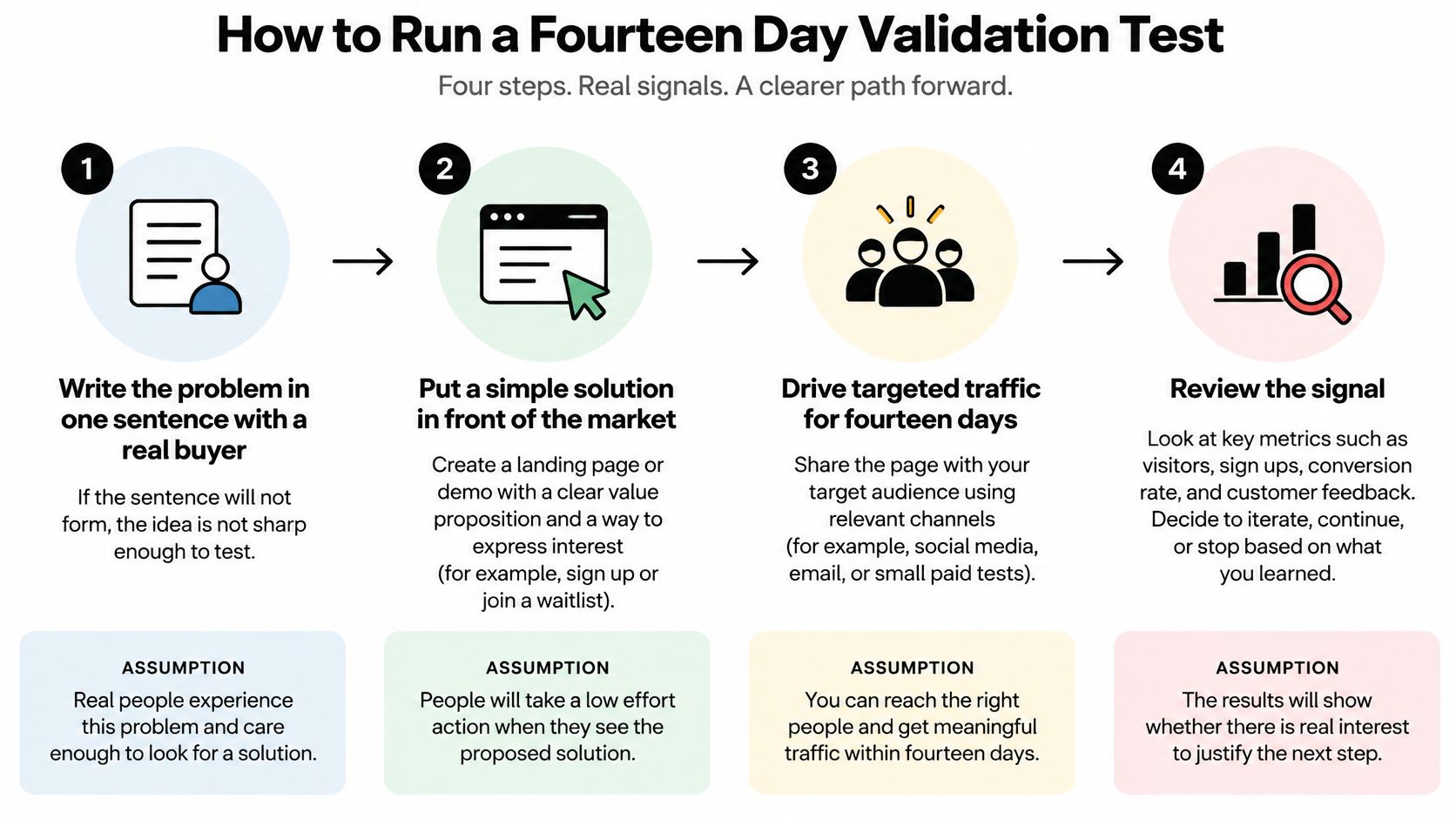
Turn assumptions into offers
Write the problem with a real buyer.
For example, describe an agency owner who needs to reconcile contractor invoices before approving payments. Offer a short discussion about their current process. If you can't write a clear problem sentence, the idea isn't sharp enough; a broad label such as productivity platform won't fix it.Make the risky belief falsifiable.
Falsifiable means you can observe something that proves the belief wrong. For the agency example, test whether the owner can show a recent reconciliation problem and identify the budget for fixing it. Use a workflow review, not a feature poll. The failure mode is accepting general frustration without checking its consequences.Choose the cheapest honest payment test.
For SaaS, use a landing page with Stripe checkout for a paid waitlist. For a physical product, our process uses a Shopify or Kickstarter page at the actual price, a sample or 3D render, and $100 to $300 of paid traffic, without starting production. Clearly explain the pre-launch status; don't collect money under the impression that a finished product ships immediately.Put the offer in front of strangers.
Use targeted outreach or cold advertising that reaches the buyer in your problem sentence. Offer the same defined outcome rather than customizing your pitch until everyone agrees. For a marketplace, our approach is to manually match the first 10 to 20 buyers and sellers before writing code. Friendly favors are the failure mode, so record existing relationships separately.Score the behavior you specified.
Review payments, qualified commitments, and objections against the original decision rule. Continue, change a variable, or stop. Offering another prototype revision isn't a passing result when the buyer or core problem was wrong.
Set a spending cap before launching. Our rule of thumb is that spending more than $500 on validation usually means avoiding the harder work of talking to people. Don't treat a bigger advertising bill as a substitute for understanding why prospects decline.
Benchmarks That Separate Demand from Noise
These are our operating benchmarks, not universal conversion laws. Use them to set a decision rule before traffic arrives, while keeping the audience, offer, and acquisition channel consistent.
| Signal | Pass threshold | Below this means |
|---|---|---|
| Cold visits before a verdict | 200 to 500 strangers | Sample is too small or too friendly |
| Email capture from cold ads | 4% or higher | Offer or audience is unclear |
| Paid waitlist or pre-order | 1% or higher of cold visits | Interest without a budget |
| SaaS or digital payers | 10 strangers paying within 14 days | Economic commitment hasn't reached the build bar |
A miss tells you where to investigate, not automatically what caused it. Weak email capture suggests an audience or message problem; email capture without purchases suggests that interest hasn't translated into spending. Inspect the checkout and ask qualified prospects why they stopped before deciding that price alone caused the result.
A pass gives you permission for a bounded next step, not a claim that the whole business works. Record what customers bought, which channel reached them, and how much manual help they needed. A discounted experiment may validate that experiment without validating your intended full-price offer.
Keep the measurement honest
Separate friends, existing contacts, and cold visitors in your records. A supportive network can inflate results, while a widely shared post can attract people who enjoy the topic but don't face the problem.
Avoid treating these as substitutes for buyer behavior:
- Retweets: People may share an interesting argument without wanting the product.
- Survey enthusiasm: A stated intention doesn't show an approved purchase.
- Unqualified waitlist growth: An address alone doesn't identify a suitable customer.
- Page views: Exposure doesn't establish urgency or purchasing authority.
The concern hasn't disappeared in newer failure analyses. A reported 2024 review summarized by MNB Research examined 431 venture-backed companies that had shut down since 2023 and identified poor product-market fit in 43% of cases.
Write the threshold before the ads run. Changing it after seeing the results turns a test into a justification.
Log the numerator and denominator, not just the percentage. Keep completed purchases separate from checkout starts, and record refunds alongside payments. Your next decision should rest on what customers did, with enough context to repeat the test.
Ideas That Passed and Ideas That Only Sounded Good
Consider these hypothetical cases, scored using our operating rules rather than presented as documented company results. The distinction is between an attractive story and an observable commitment.
Manual work can expose that distinction before software exists.
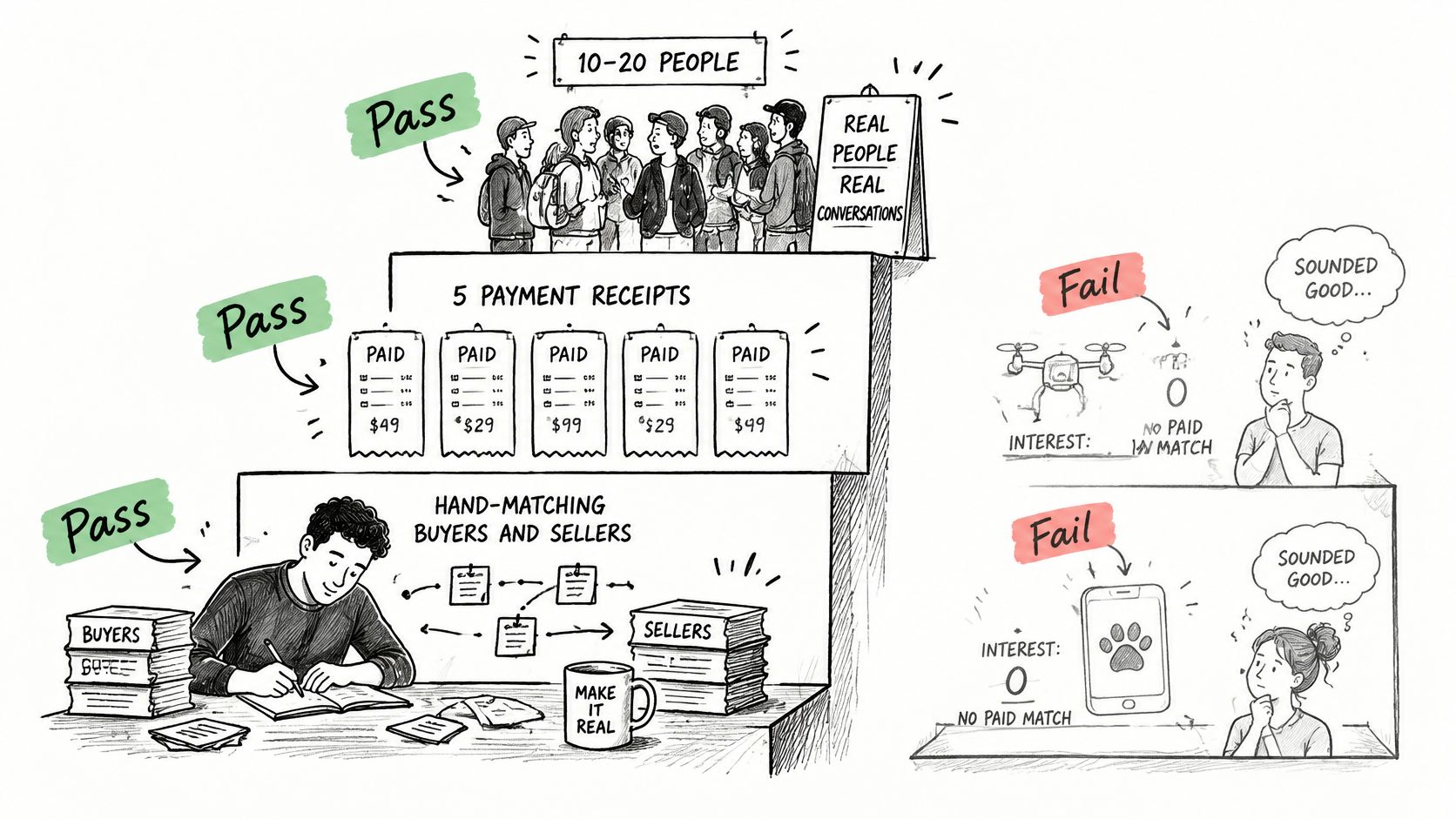
| Case | Verdict | Evidence | Why it counts |
|---|---|---|---|
| Marketplace | Pass | Five paid matches brokered by hand after 10 to 20 manual introductions | Money changed hands without software |
| Course | Pass | 10 to 20 paid signups before the first lesson exists | Payment came before the product |
| SaaS | Pass | Ten strangers check out on a paid waitlist within 14 days and ask for recurring software | The wallet moved on a recurring offer |
| Consumer app | Fail | Thousands of views and flattering comments; organic reach under 5 views per follower; waitlist click-through under 1% | Attention without commitment |
| B2B tool | Fail | Twenty enthusiastic interviews and a polished prototype; no budget owner and no paid pilot | Comments without a budget |
Interpret the verdict, not the applause
The marketplace founder has evidence that customers will pay for a match, but still needs to learn whether delivery can become efficient. The course creator has buyers before investing in lessons, but now owes them a clearly described learning outcome. The SaaS founder has tested a recurring offer rather than accidentally validating a one-time service.
For educators choosing a topic, AmaJova's digital product inspiration for educators can help translate expertise into possible offers. Narrow the topic to a buyer's concrete outcome before accepting signups, such as helping a school administrator complete a specific planning task.
The consumer app's visibility doesn't pass our screening rule of organic reach above 5 views per follower and at least 1% click-through to the waitlist. Even passing that screen would justify a stronger test, not establish willingness to pay.
A validated idea changes a stranger's wallet or calendar; an invalidated idea changes only the comment thread.
The B2B founder needs to revisit the opportunity, not polish the dashboard. A synthesis from Stanford's Technology Ventures Program found that negative customer feedback improves commercialization outcomes when entrepreneurs reconsider the core opportunity, while surface-level feature changes produce weaker learning.
A real pain can still fail commercially when the workaround is cheap or the buyer can't switch. Record that distinction so you don't confuse an implementation obstacle with a request for more features.
For an additional perspective on testing an opportunity before committing to a build, watch the following video.
When a Yes Fails the Next Market Change
A customer can pay today for something they won't need tomorrow. Scenario validation means checking whether your offer remains useful under plausible changes, after you've obtained a payment signal rather than instead of obtaining one.
Ask buyers to compare concrete alternatives. Don't ask whether they'll remain loyal in the abstract; ask what they'd choose if the circumstances changed.
Use these stresses to challenge the same offer.
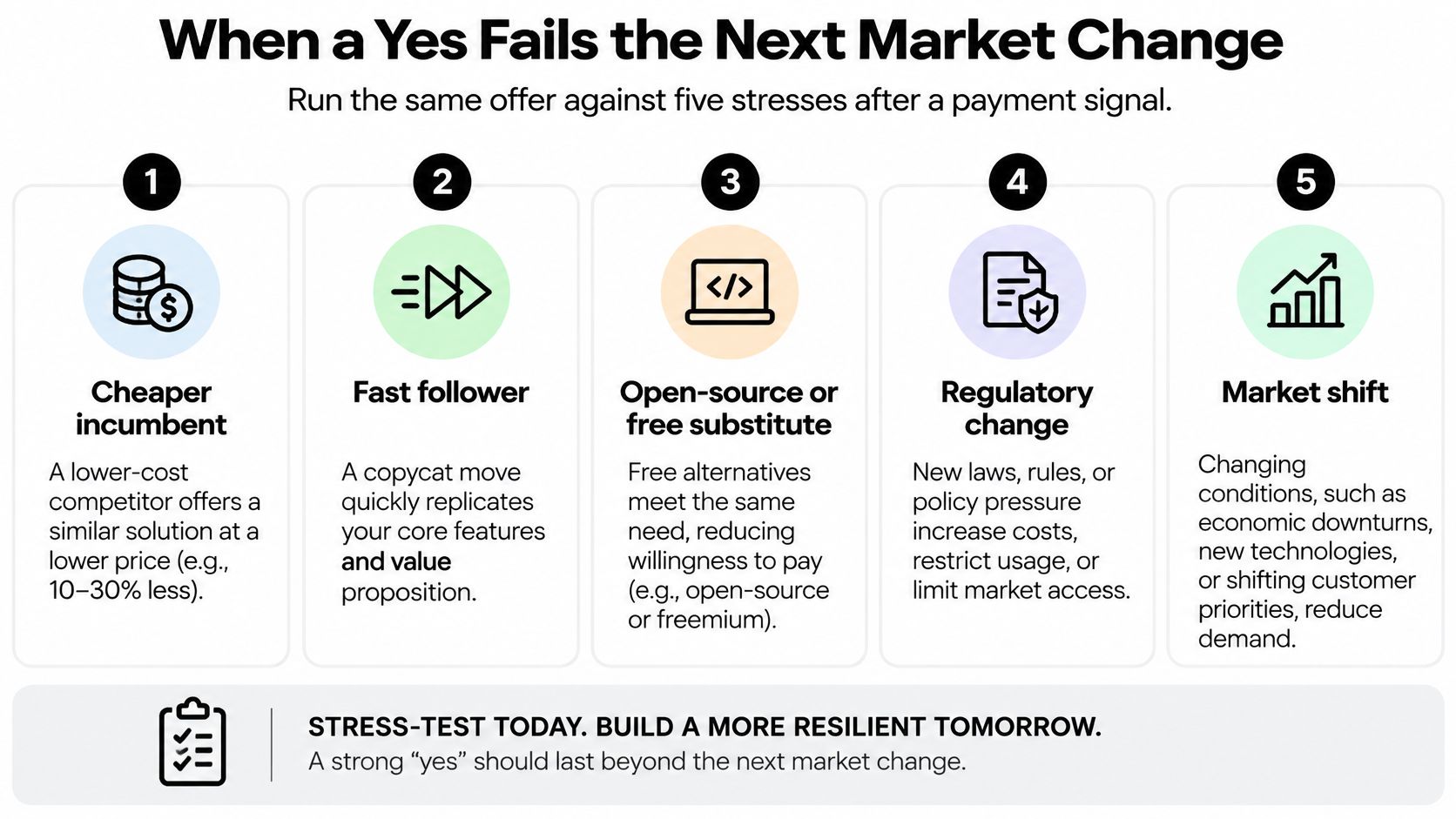
Stress-test the purchasing decision
- Cheaper incumbent: If an established supplier bundles the feature into an existing subscription, what would still justify your invoice?
- Fast follower: If a competitor copies the visible workflow, would buyers choose you for integration, trust, specialized knowledge, or another concrete reason?
- Free substitute: Could customers get an acceptable result from an open-source tool, and what work would they still need you to perform?
- Regulatory or platform constraint: Could a change in access permissions, platform terms, or legal requirements prevent delivery?
- Technology improvement: If a new AI capability performs the task directly, which valuable part of your outcome remains?
A payment that disappears under a stress doesn't mean the original problem was imaginary. It may expose a timing, distribution, or defensibility problem. Investigate whether the buyer's reason for choosing you survives, rather than inventing a more persuasive sales explanation.
Check each market separately
International interest isn't the same as local feasibility. Check payment infrastructure, language, data residency, purchasing norms, and applicable legal requirements before treating responses from different countries as equivalent. The Global Entrepreneurship Monitor's international entrepreneurship assessment provides a useful reminder that entrepreneurial conditions and opportunity perceptions differ across economies.
For crypto or on-chain products, our behavioral signal is 100 or more self-attributed wallets engaging with a testnet within 30 days. That tests participation rather than a community poll, but it doesn't by itself establish paid demand or prove that each wallet represents an independent buyer.
The durable question isn't whether people want the product. It's why your solution will remain valuable, reachable, and hard to replace when buyers have different options.
Choose Build, One Change or Stop
Build, change one variable, or stop. Make that decision within the validation window rather than extending the experiment until you find a flattering result.
Build when strangers have made economic commitments, you can reach suitable buyers, and a quick substitute check hasn't exposed an obvious reason the offer will become unnecessary. Keep the initial scope tied to the outcome customers purchased. Don't use a narrow success to justify every feature on your original roadmap.
Make the next action explicit
- Build: Deliver the smallest version that fulfills the paid promise, then check whether customers continue.
- Change one variable: If the problem is confirmed but the offer fails, name the variable before spending again. Change the audience, price, or offer, not all of them together.
- Stop: If the core buyer or problem was wrong and strangers won't pay, close the test. Don't hide the result inside a redesign.
Encouragement isn't a fourth verdict. Neither is indefinite interviewing without making an offer.
Start this week by writing down the buyer, the problem, and the price. Put an honest paid offer in front of cold prospects, and book the day-14 decision before you begin building. Keep the experiment small enough that you can accept an unwelcome answer and act on it.
Find Startup Idea collects problems expressed in real Hacker News and Reddit threads, so you can start with a stranger's pain rather than a blank page. Visit Find Startup Idea, save the ideas you'd put your name on, and generate a launch prompt to turn a promising problem into your next validation test.