How to Find Gaps in the Market Worth Pursuing
How to find gaps in the market by interviewing customers, auditing competitors and scoring pain before you test demand with paying buyers.

You've got a pricing page open in one tab, a Reddit thread in another, and a landing page you started building on Tuesday. Somewhere in the last month a friend told you your idea sounded useful, and you took that as a yes. Nothing has happened since. No signup, no payment, no one asking when it ships.
That gap between polite agreement and actual behavior is where most idea searches go wrong. Learning how to find gaps in the market isn't about generating more candidates. It's about killing the weak ones fast, using evidence a stranger produces with their wallet or their calendar rather than their encouragement.
I'd rather run five cheap tests in a month than spend a quarter building something nobody was struggling without. The search below is the sequence I recommend, and every stage has a finish condition so you can't keep "researching" forever.
The Five-Stage Gap Search at a Glance
A market gap is an observable unmet job, not a missing product. Someone already cares about a task, and the options they have perform it poorly, inconsistently, or at a price they resent. The absence of a product proves nothing. The presence of a struggling buyer with a spreadsheet propping up a broken process proves a lot.
Here's the whole sequence in one view, from first conversation to the day you commit or walk away.
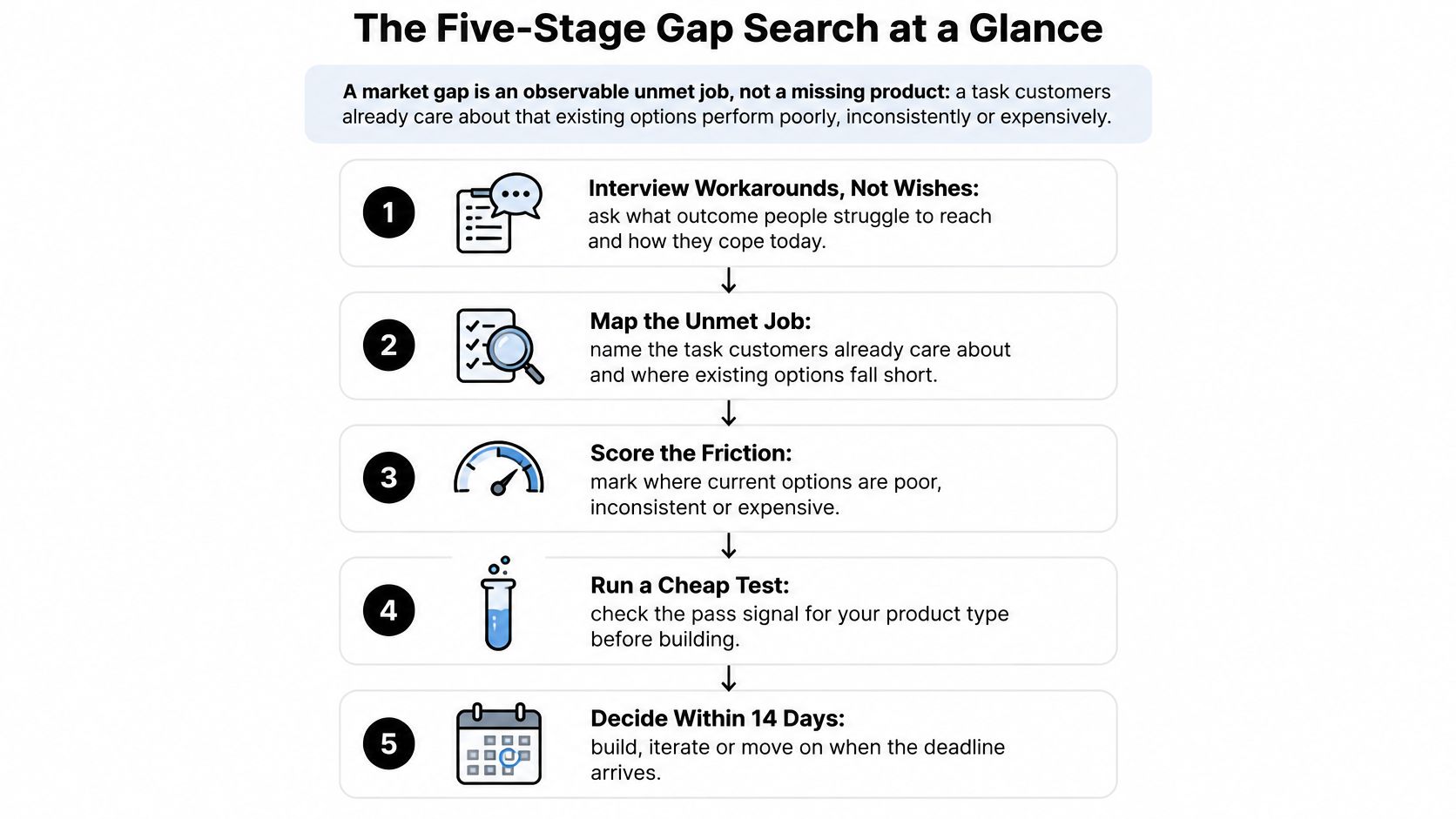
Gap search stages, outputs and finish conditions
| Stage | What You Do | Output | Finished When |
|---|---|---|---|
| 1. Collect pain signals | Interview recent buyers about workarounds, abandoned purchases and manual steps | Ranked list of recurring problems | The same problem appears across several independent conversations |
| 2. Map competitors | Audit alternatives, reviews and manual workarounds | Gap map by type of failure | Each candidate has a named failure in existing options |
| 3. Score candidates | Rate frequency, financial cost, workaround spend and willingness to switch | Ranked shortlist | Top candidates clear the scoring thresholds |
| 4. Validate with strangers | Run a cheap test that asks for money, time or a clear yes | Measured evidence from cold traffic | The pass signal for your product type is met |
| 5. Decide | Build, iterate one variable or move on | Recorded decision | Decision made within 14 days |
What this costs before anyone writes code
The first three stages need a spreadsheet, a calendar with conversations booked into it, and a week of reading reviews and forum threads. No development team, no designer, no incorporation. You're buying information, and at this point information is cheap.
Practical rule: if a stage requires you to build something before it can produce an answer, you've skipped a stage.
The expensive mistake isn't a failed test. It's a build that answers a question a landing page could have answered for the price of a few ads.
Your first move tonight
Open a blank sheet and write three candidate problems, each in one sentence, each with the name of a real person who has that problem next to it. Not a persona. A person you could message.
If you can't name someone for a candidate, drop it and write another. If you can't compress the problem into a sentence, it isn't sharp enough to test yet, and no amount of market reading will fix that. Three sentences with three names is a better starting position than a document full of trends.
Interview People About Their Workarounds, Not Their Wishes
The framework behind this is Harvard Business School's jobs to be done approach, which argues companies should focus less on demographic profiles and more on the practical job customers are trying to accomplish, with opportunities emerging when that job is poorly performed, inconvenient, expensive, unreliable or fragmented across several solutions, as set out in the Harvard Business School listing of Clayton Christensen and coauthors' 2016 Harvard Business Review article. That reframes the question from "what product should be built?" to "what outcome are people already struggling to achieve?"
The routine below turns that idea into a week of conversations.
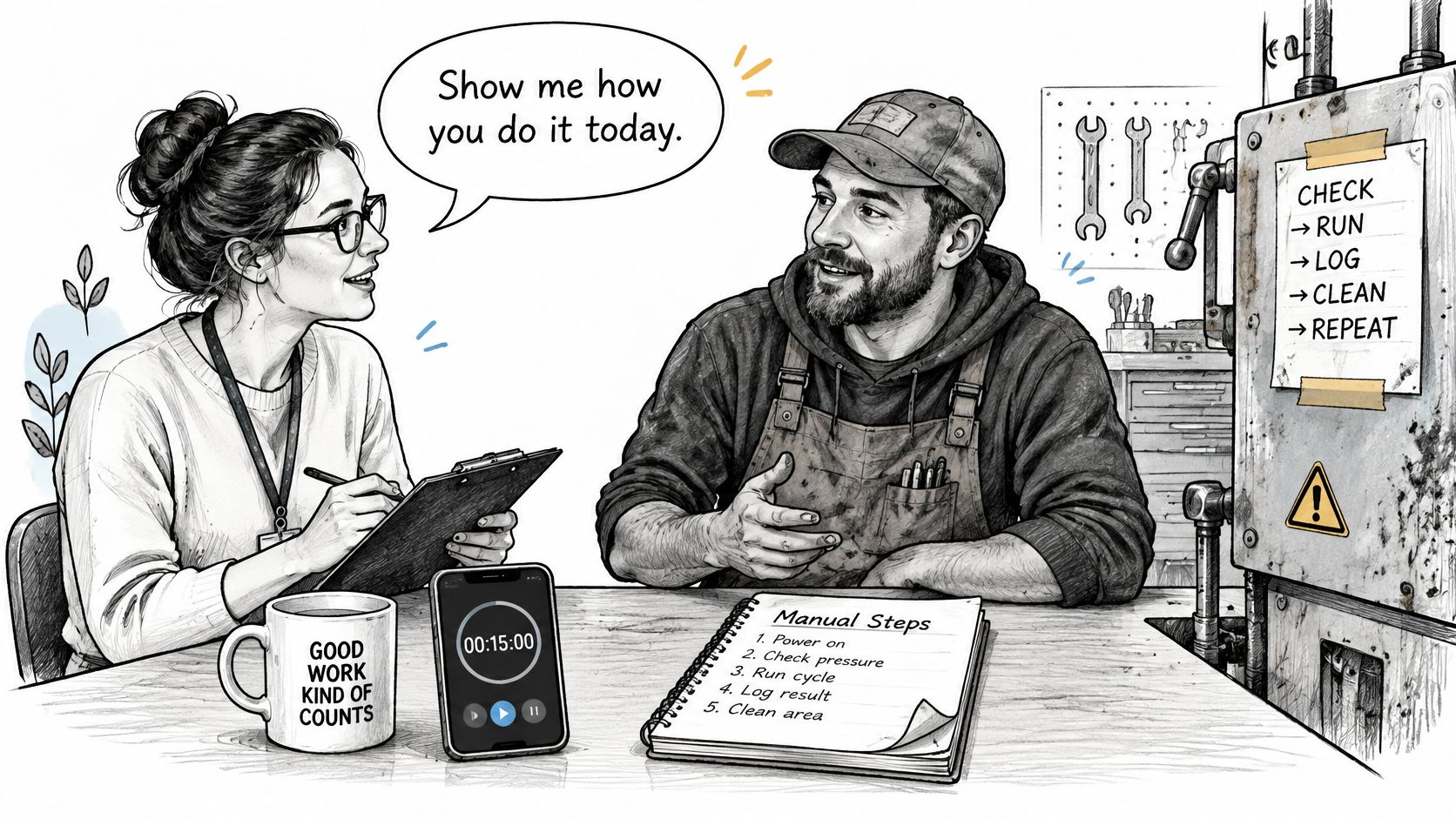
The six questions that produce usable evidence
- Recruit people who did the job recently. Aim for ten to fifteen conversations with people who attempted the task in the last month, not friends or coworkers. Recent memory gives you specifics; general opinion gives you flattery.
- Ask them to walk through the last attempt. "Show me what you did on Tuesday" produces steps, tools and delays. Let them narrate in order and write down every tool they name.
- Hunt the workarounds. Spreadsheets, copied-and-pasted exports, a freelancer on retainer, two products duct-taped together. A workaround is a confession that the market failed them and they paid anyway.
- Ask what they already pay for and what they abandoned. An abandoned purchase tells you what they wanted and what broke. Both halves matter, and the second half is where competitors leak.
- Pin down frequency and cost. How many times a month, how many hours, what invoice. Vague annoyance doesn't survive this question; real pain gets a number attached to it.
- Write the problem in one sentence with a real buyer. The first validation step is to write the problem in one sentence with a real buyer, and if that can't be done, the idea isn't sharp enough. Do this before you sketch anything.
Why "would you use this?" ruins your data
People are polite about ideas and honest about their habits. Ask someone whether they'd use your product and they'll answer the social question, which is "do I want to encourage this person in front of me." Ask what they did last week and they answer the factual one.
Phone beats a survey here because you can hear hesitation and follow it. Dial Milo's guide to getting honest answers by phone is useful on the mechanics of asking follow-ups without leading the answer, which is exactly where most founder interviews go soft.
For question wording and note-taking structure, our own customer discovery interview guide covers the sequencing in more detail.
A short walkthrough of the interview approach in practice:
Tally the repeats, not the enthusiasm
After the conversations, count how many people independently described the same workaround. That tally is your ranking. One person with a vivid story is an anecdote; several people coping the same expensive way is a pattern.
A gap is defined by an observable unmet job, not by novelty alone.
Audit Competitors for the Failures They Leave Behind
Say an operations manager pays a freelancer every week to reformat exports from two tools that don't talk to each other. Both tools have thousands of customers and good ratings. The gap sits in the seam between them, and neither vendor has any incentive to close it.
That failure type is worth checking first: users combining several products by hand. It leaves a paper trail of invoices and recurring calendar blocks, which is behavioral evidence rather than opinion. A feature request costs nothing to write. A weekly payment to a freelancer is a vote with money.
Pull the five to ten closest alternatives, then read their recent one- and two-star reviews, their support forums, and public threads where people ask for a replacement. Sort every complaint into one of six buckets. Our competitor research breakdown covers how to run that audit systematically.
Failure types found in competitor reviews and forums
| Failure type | What It Looks Like | Example |
|---|---|---|
| Missing function | Customers ask for a capability no option offers | Freelancer adds a step the tool lacks |
| Poor execution | The feature exists but breaks or performs badly | Recurring one- and two-star reviews on reliability |
| Wrong price | Buyers pay for features they never use or cannot afford the core | Users buy a premium plan only to reach one function |
| Wrong segment | The product is built for a different buyer | Enterprise tool forced onto a five-person team |
| Too many tools | Users must combine several products by hand | Weekly reformatting of exports between two tools |
| Poor onboarding | Users give up before reaching the first result | Forum threads asking how to set up the basics |
A crowded category isn't a closed category
A competitor with many users doesn't prove there's no gap. Users tolerate flaws they'd pay to remove, and they stay because switching is annoying, not because they're satisfied. Read for resignation, not for rage. "We just do it manually" is a stronger signal than a one-star rant about pricing, because it describes a habit that already costs time or money.
Feature pages serve a different purpose in the audit. They show what vendors think buyers want, which is often not what buyers complain about. A vendor checklist like this guide to what to look for in tutoring software is a typical specimen: a polished list of advertised functions. Hold any such page against the review threads for that category and count the functions vendors promote while users still patch them by hand. The mismatch is the lead.
Three signals need to appear together before a failure earns your attention: repeated complaints, costly workarounds, and demand that exceeds available supply. Any one alone is noise. A complaint without a workaround is a preference. A workaround without repetition is one person's quirk.
Where small firms are stuck right now
Verizon's 2025 survey of 600 U.S. SMB owners and decision-makers found 38% were actively using AI across functions including analysis, marketing and customer service, while 54% struggled to keep online content current and follow changing social-media trends.
Read those together and the opportunity isn't another AI tool. It's a narrow workflow that keeps published content accurate and approved after the AI has generated it. The bottleneck moved downstream of adoption, and that's where the unowned work sits. Incumbents in the content space compete on generation, so the reviews to read are the ones complaining about what happens after the draft exists.
Finish with a gap map. List each candidate, the competitor that fails it, and the failure type from the table. If you can't name the competitor whose customers are paying for the workaround, you don't have a gap yet. You have a guess.
Score Each Gap by Pain, Cost and Willingness to Switch
Rate every candidate from one to five on each criterion below, then total the columns. The table does the arguing for you, because it forces you to write down evidence instead of adjectives. Where you have no evidence yet, score low rather than generous. A three you can't defend is how weak ideas survive to the build stage.
Scoring criteria with strong and weak signals
| Criterion | Question to Ask | Strong Signal | Weak Signal |
|---|---|---|---|
| Frequency | How often does the problem occur? | Weekly or daily | Once a year or only when asked |
| Financial consequence | What does it cost the buyer when it goes wrong? | Lost revenue or fines | Mild annoyance |
| Workaround cost | What do they pay or spend to cope? | Paid freelancer or many manual hours | Free shortcut they tolerate |
| Willingness to switch | Have they changed tools or paid for a substitute? | Has switched or paid for an alternative | Says it would be nice to have |
| Segment reachability | Can you reach these buyers at a sensible cost? | Concentrated in communities or channels | Scattered with no clear channel |
Notice what the strong column has in common. Every strong signal is a behavior: money spent, hours burned, a tool replaced. Every weak signal is an attitude, something people say rather than do. That split is the whole point of scoring. Complaints are cheap, and people hand them out to be polite. Payment and manual labor are the only currencies that tell the truth about a gap.
Two scores that override the total
A weak mark on frequency or workaround cost disqualifies a candidate regardless of how well it scores elsewhere. An annual problem with a free tolerated shortcut adds up to a mediocre business even when the financial consequence is dramatic, because you'll spend every month hunting for someone currently in pain.
Founders who skip this discipline pay for it in the failure statistics. CB Insights' 2021 analysis of startup failure post-mortems found "no market need" cited in 35% of cases, second only to running out of cash at 38%. Technically impressive products die on that line every year, and later shutdown reviews keep showing the same pattern. Existing demand has to show up before the build starts, not after.
Narrow and expensive beats broad and mild
Take a dental clinic where front-desk staff rebuild appointment reminders by hand every morning. That's a small buyer group with a daily task, a payroll cost, and lost revenue when a slot goes unfilled. Compare it with a consumer habit millions of people mildly dislike and nobody pays to fix.
Search volume ranks the second one higher. Your bank account won't. Rank by frequency, financial consequence, current workaround spend and willingness to switch, and treat audience size as a tiebreaker rather than a criterion. The product opportunity matrix is a useful way to lay those candidates side by side once the scores are in.
An interesting problem and a valuable problem are different categories, and only one of them pays invoices.
Cut to a shortlist you can actually test
Keep two or three candidates. More than that and you'll run shallow tests on all of them and learn nothing conclusive from any. Write the top scorer's problem sentence at the top of a fresh sheet, because that sentence becomes your landing page headline. If you can't compress the pain into one sentence with a real buyer in it, the idea isn't sharp enough yet, and no score on the table will fix that.
Validate the Gap With Strangers Who Pay Before You Build
Validating a product idea means proving that real strangers, not friends or coworkers, will give money, time or a clear yes before the product is built. Your network's enthusiasm is a social act. A stranger's card payment is a market fact.
Plan for 200-500 cold visits from strangers before you draw any conclusion. A handful of visitors tells you nothing, in either direction, and the most common self-inflicted wound in this stage is declaring failure on traffic that was never large enough to produce a signal.
Validation tests and pass signals by product type
| Product Type | Test to Run | Pass Signal | Budget |
|---|---|---|---|
| SaaS or digital product | Landing page with Stripe checkout for a paid waitlist | 10 strangers paying anything within 14 days | $50-$150 of paid ads |
| Physical product | Shopify or Kickstarter page with the actual price | 1%+ of cold visitors pre-ordering at the real price | $100-$300 of paid traffic |
| Course or info product | Sales page offering paid places | 10-20 paid signups before the first lesson exists | $50-$150 of paid ads |
| Marketplace | Hand-match the first 10-20 buyers and sellers | 5 paid matched transactions brokered by hand | No ad spend, your own outreach time |
| Consumer app | Waitlist page with organic posts and a clear call to join | Above 5x views per follower and 1%+ click-through to the waitlist | No ad spend, organic posts only |
Software and physical goods
For a SaaS or digital product, publish a landing page with a real Stripe checkout behind a paid waitlist and put $50-$150 of ads behind it. Charge something, even a token amount, because a free email address measures curiosity and a payment measures intent. On cold ad traffic, healthy benchmarks are 4%+ to email capture and 1%+ to a paid waitlist or pre-order.
For a physical product, put the actual price on a Shopify or Kickstarter page and add $100-$300 of paid traffic. A sample or a 3D render is enough at this stage, with no production run yet. Discounting the price to make the test pass invalidates the test, since you'd be validating a business you don't intend to run.
Courses, marketplaces and consumer apps
A course sells on the outline. Offer 10-20 paid places before the first lesson exists, and refund everyone if you don't hit the number. If people won't pay for the promise, they won't watch the videos.
A marketplace gets validated by hand. Manually match the first 10-20 buyers and sellers before writing any code, and look for 5 paid matched transactions you brokered yourself. Doing it manually also teaches you the matching rules you'd otherwise guess at in software.
A consumer app lives or dies on organic pull, so measure reach against followers and clicks through to the waitlist rather than paying for installs you'd never afford at scale.
Write the money terms before you take money
Pre-orders and paid waitlists create obligations, so state delivery expectations and refund conditions in plain language on the checkout page. Coto & Waddington's payment terms guide for Miami founders is a practical reference on the clauses that keep a pre-sale from turning into a dispute.
Close the test by writing one line in your sheet: pass, fail or inconclusive, with the numbers beside it.
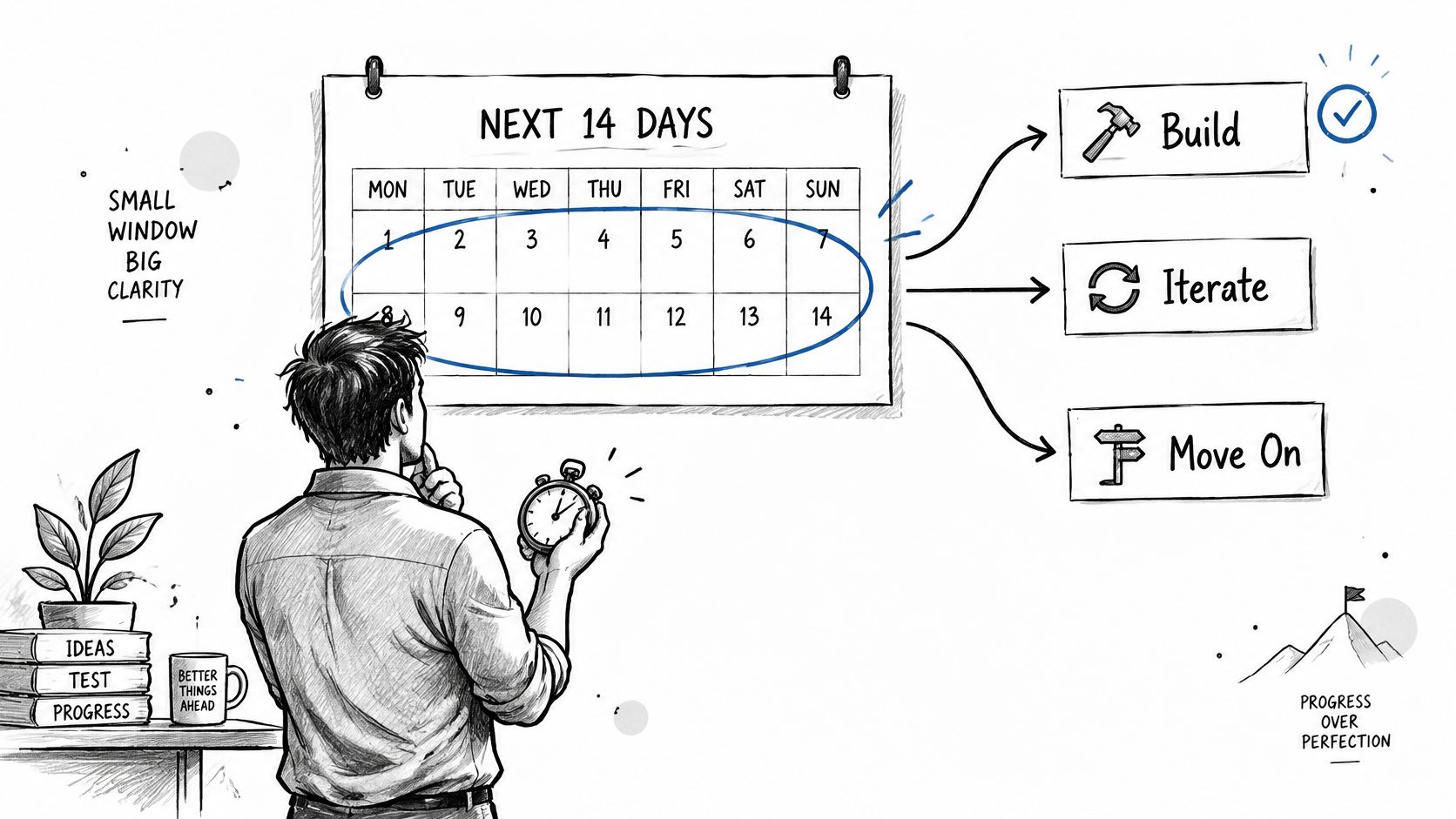
Decide Within 14 Days to Build, Iterate or Move On
The final decision is made within 14 days: build, iterate on one variable, or move on. Put the date in your calendar the day the test goes live, because open-ended tests don't end, they just get quieter while you keep tweaking the copy.
Build when the signal is met
If your product type's pass signal is met and the people who paid are strangers you've never spoken to, start building. You now have a named buyer, a price they accepted, and a problem sentence they responded to, which is more than most products launch with.
Keep those first payers close. They're your earliest feedback loop and your first honest critics, and they've already told you what they expected by paying.
Iterate on one variable when it's close
A near miss deserves one more run, not a rebuild. Change one thing: the price, the headline, or the audience you're targeting. Then retest against the same pass signal.
- Price: if visitors reached checkout and abandoned, test a lower entry tier before you conclude the problem isn't real.
- Headline: if traffic bounced before scrolling, your problem sentence didn't match their pain, so rewrite it in the buyer's words.
- Audience: if the clicks came but nobody engaged, you aimed a real solution at the wrong segment.
Record the decision in a single sentence, for example "Iterate: headline B, same audience, retest for 14 days." One sentence keeps you honest about what you changed.
Move on when a fair test fails
If you had the cold traffic, the price and a clear ask, and nobody paid, that's an answer. Take it. The cost of the test was small; the cost of building on top of it isn't.
The trap to avoid is lowering the pass signal after a failed run so the result can be rescued. Moving the goalposts converts a cheap failure into an expensive one, and it's the single most common way founders talk themselves into a product nobody needs.
Key takeaway: a gap is real when strangers pay for the fix, not when they agree it sounds useful.
Take your shortlist through the five stages and let the evidence rank it for you. If you need candidate problems to start from, our idea library is sourced from real HN and Reddit pain points, so each one arrives with a complaint trail you can check against the same rules rather than a trend you have to take on faith.
Find Startup Idea maintains a library of 1000+ startup ideas across AI, SaaS, dev tools, consumer and crypto, each traced back to real Hacker News and Reddit complaints, plus a validation playbook for testing any product type in under two weeks with less than $200. Pick two or three candidates that match a buyer you can reach, then run them through the scoring and payment tests above before you write a line of code. Browse the categories and start your shortlist at Find Startup Idea.