How to Find People to Interview for Customer Research
Learn how to find people to interview, from defining who qualifies to recruiting and scheduling the right prospects. Practical steps for founders.
The most repeated advice about how to find people to interview is to post in a community, ask your network, and offer a gift card. Follow it and you'll get replies, mostly from people who already like you, already use something close to your product, or want the gift card. None of that advice is wrong. It just has no measurement in it, so you discover too late that a busy week produced three usable conversations and eight polite dead ends.
Recruiting is a sampling problem wearing a marketing costume. I treat it as a funnel with named stages, quotas that keep the sample honest, and a channel mix I compare against itself, and I assume most first messages will go unanswered. That assumption is what keeps a recruiting plan from collapsing on Thursday afternoon.
The counterintuitive part, and the one most guides skip, is that the channel producing the most replies often hands you the least representative people. Volume feels like progress. It usually isn't.
How Many People to Contact for Ten Interviews
Ten completed interviews is a sensible target. Getting there takes far more than ten messages, and the distance between those two numbers is where most recruiting plans fall apart.
Recruiting runs as a funnel with six stages, and every one leaks. You invite people, some express interest, fewer finish a screener, fewer still book a slot, some of those don't show, and a handful of conversations produce notes you can quote. Count the stages separately. A reply is not a booking, and a booking is not a conversation.
The drop-off is not a startup quirk. Pew Research Center's American Trends Panel invited 23,176 adults in one 2022 recruitment effort, and 20,341 agreed and completed an initial profile survey, an 87.8% conversion at that stage, yet the panel's cumulative response rate for the cited survey was 4% once nonresponse and later attrition were counted. Willingness has a ceiling even among motivated people: Pew's 2025 methodology reports that 57% of surveyed AI experts were willing to participate in an interview.
| Stage | What to count | Benchmark |
|---|---|---|
| Invited | People sent a first message | Pew's 2022 panel invited 23,176 adults |
| Expressed interest | Replies that say yes or maybe, logged separately | A maybe is unsigned until the screener comes back |
| Completed screener | Respondents who answer the eligibility questions | 87.8% of invited panelists in the same effort agreed and finished the initial profile |
| Scheduled | Slots on a calendar with a written confirmation | Book only after the screener returns |
| Attended | Booked interviews that actually happened | Compare against bookings weekly, not at the end of the month |
| Completed | Interviews with notes you can quote | The same panel's cumulative response rate was 4% |
Read that top to bottom and the arithmetic turns uncomfortable. If a fifth of your messages earn a reply, half of those repliers pass the screener, and half of the screened people show up, you need roughly twenty first messages per completed interview. Ten conversations means about 200 invitations. Treat that as a starting assumption, then run a pilot of 20 to 30 messages and replace it with your own rates.
Paying to skip the work is the expensive shortcut. Spending more than $500 on validation usually means avoiding the harder part, which is talking to people.
Keep a waitlist of qualified people who said yes but couldn't take your first slot. Attrition is normal, and the waitlist is what stops a single cancellation from costing you a day.
Define Who Counts as a Real Participant
Ask one question before anything else. When did you last run into this problem, and what did you do about it? People who can't name a specific recent instance, with a date and an action attached, are not your sample. They'll still take the call. They'll still give you opinions, which is precisely the problem.
Write the sampling frame first. That's the list you'd draw from if you could, described precisely enough that a stranger could apply it: freelance designers who invoice at least three clients a month, or operations managers at companies with 50 to 500 staff. If you can't describe the frame in one sentence, no screener can enforce it.
Then build three to five questions around behavior, not opinion:
- Recency: when the problem last occurred, with a month attached.
- Workaround: what they tried, including the spreadsheet or the person they asked.
- Cost: hours or money the workaround burned.
- Stake: whether they personally fix the problem or just observe it.
Exclude anyone with a commercial interest in your answer. Competitors, vendors, consultants who'd like the retainer, and people who are paid to have opinions will all confirm your idea for free.
The exclusion that saves the most time: no specific instance in the last quarter means no interview, no matter how interesting the person sounds on paper.
Real strangers matter more than friends here. Proving a product idea means proving that real strangers, not friends or coworkers, will give money, time or a clear yes before the product is built, and a friendly contact gives you the least honest version of that signal. A screener is only as good as the profile behind it, and Fetchin on predicting realized customer value makes a useful case that the buyer definition you write down now shapes every number you read later. If you're still deciding which problem deserves screening, the guide to identifying customer pain points does the work before you send a message.
Set quotas before you send anything: role, company size, geography, usage frequency, and how recently the problem hit. Pew's survey methods describe as many as seven contact attempts staggered across days and times, with recontact of refusals, and its high-effort design lifted cooperation from 14% to 27%. Poor yield is often a design choice rather than a market fact. A sample of ten enthusiastic people who all share one job title is still a biased sample.
Channels That Reach Your Target People
One channel rarely fills a sample, and the fastest way to choose between them is to look at a case where the winner was clear.
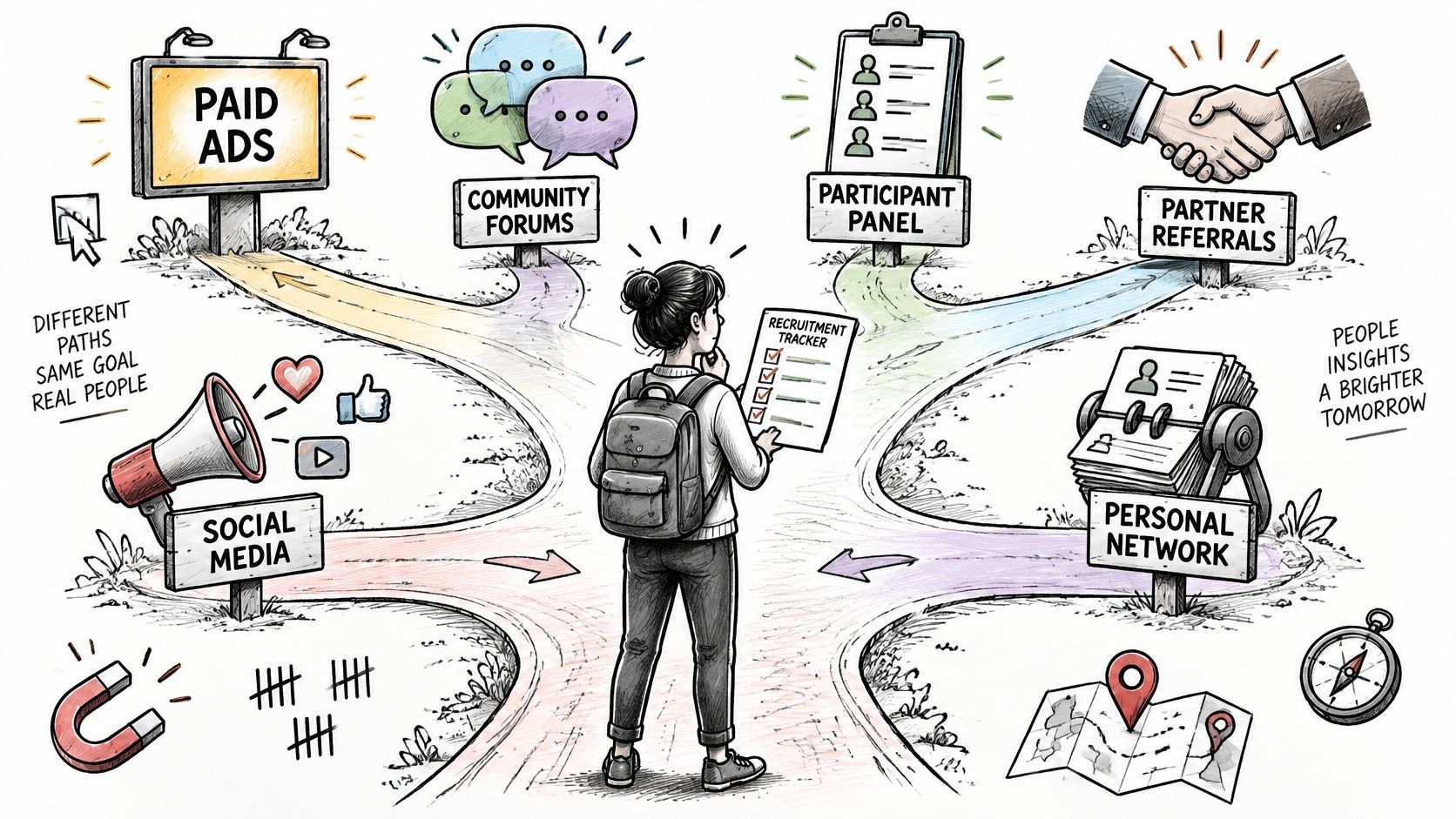
In a 2025 caregiver study, paid Facebook advertising was reported as the most effective method among those tested, reaching older adults across a wide geographic area, and it produced 355 qualifying respondents with a mean age of 60.9 years. Strong result, narrow claim. It says paid social beat the alternatives for that audience in that study. It doesn't crown paid social generally.
Here's the trap. A panel with a million people in it can still leave you with a tiny, lopsided sample: one 2025 JMIR study recruited 22 interview participants from a panel of more than 1 million U.S. adults, and reported that 13 of them, or 59.1%, were female. You only know that mix because the team reported it. Reply count tells you nothing about coverage.
| Channel | Best for | Main risk | Track separately |
|---|---|---|---|
| Targeted paid ads | People your network can't reach | Skews toward frequent ad clickers | Cost per eligible respondent |
| Community groups and forums | Niche roles and topics with active members | Active posters differ from quiet customers | Reply rate by group |
| Professional gatekeepers | Associations, newsletters, trainers | The gatekeeper decides who you hear from | Invitations sent per gatekeeper |
| Existing customer lists | People already using the product | Misses churned users and non-adopters | Eligibility rate |
| Referrals | Warm intros to qualified people | Friends of friends inherit your bias | Show-up rate |
| Direct outreach by email or social | Fast, targeted contact | Low reply rates, needs volume | Contact and reply rate |
Pick three channels, not six, and keep the counts apart. Compare eligibility rate rather than reply volume, since 40 replies that fail the screener cost you more than five that pass. Check each source against your quotas for role, company size and geography, then drop or rebalance whichever channel over-supplies one group. Pain shows up in public before it shows up in a survey, which is why the startup ideas on our site are sourced from real HN and Reddit pain points, and why a forum thread is often the cheapest place to find someone describing the problem in their own words. The mechanics of doing that well are covered in using online communities for market research.
When Trust Blocks the Reply
Adding a fourth follow-up to a community that already feels studied doesn't raise your response rate. It lowers it. More outreach is the standard fix for a thin sample, and in some populations it's the reason the sample stays thin.
A 2025 maternal-child food-insecurity study identified 11 recruitment barriers across community, service and family levels. The recurring ones weren't apathy. They were distrust of researchers, fatigue from being over-surveyed, fear tied to immigration status or mandatory reporting, doubt about whether an advertisement was legitimate, and incentives that felt too small to justify the risk.
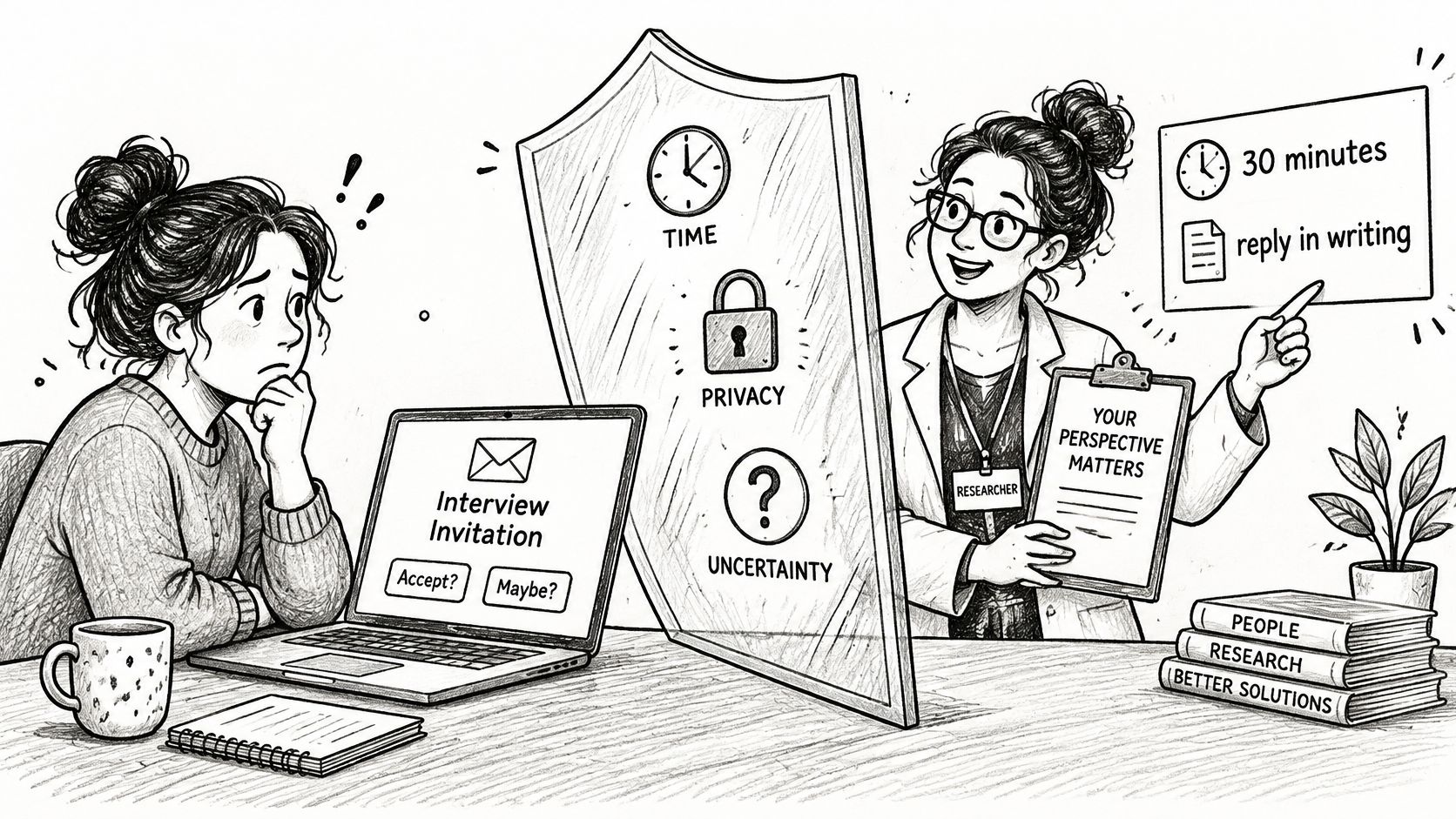
People don't decline because they're uninterested. They decline because the risk they can see is larger than the value you've offered.
A trust-first approach replaces volume with sequencing:
- Let someone trusted open the door. A community worker, clinician or peer leader makes the first introduction, and you arrive with their endorsement rather than as a stranger with a calendar link.
- Say what happens to the data in the first message, in plain words, including who can see it and how it will be stored.
- Name who you are and who funds the work. Anonymity reads as risk.
- Translate the invitation and cut institutional jargon, so it reads like a person asking rather than a form arriving.
- Keep eligibility screening separate from identifying details until the person has agreed to take part.
- Don't promise a benefit you can't deliver, such as a product fix or a payment that depends on approvals.
When a community already feels exploited, the fix is slower than another channel. Ask the gatekeeper what they'd want from you, offer to share findings back, and let the relationship come before the invitation list. Legitimacy does more for your response rate than a third platform ever will.
How to Invite, Follow Up and Book Interviews
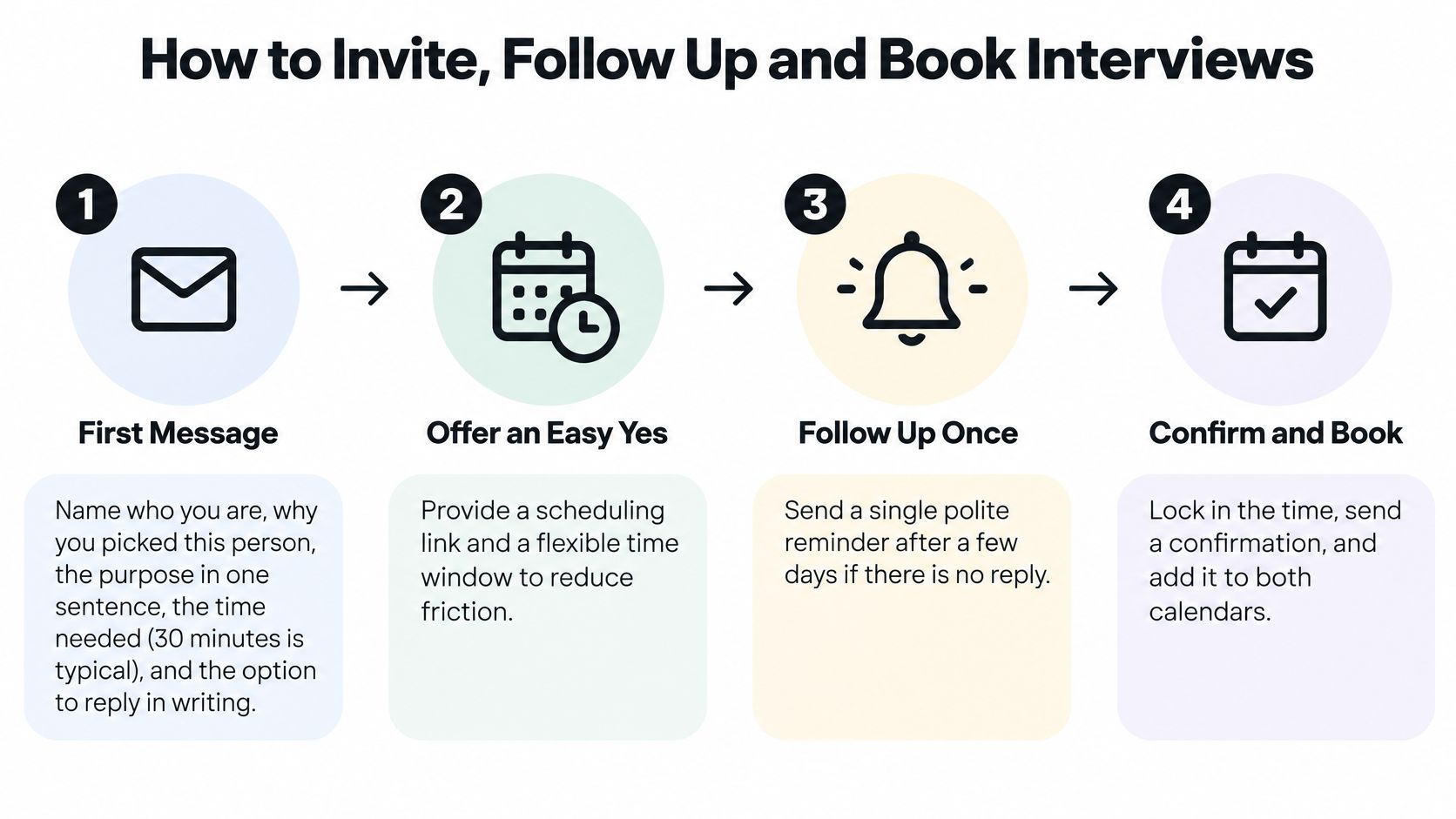
The invitation is a small piece of writing with one job: make saying yes easy for the right person and easy to decline for the wrong one. Work through it in this order.
Lead with why you picked them. One line on who you are, one on the specific reason you're writing to this person (their thread, their role, their company size), one on the purpose. Ask for 30 minutes and offer a written reply as an alternative. The usual slip is describing your idea first, which turns an invitation into a pitch and invites polite encouragement instead of honesty.
State the incentive up front. A gift card, a donation to a cause they name, or early access to results. Putting it in message one removes the awkwardness of message three. Slip: dangling the incentive only after they've ignored you twice, which reads as a bribe.
Screen before you book. Send the three to five questions in the same thread and hold the scheduling link until answers come back. Slip: blasting the calendar link to everyone and discovering on the call that four of five don't match the frame.
Stagger the follow-ups. Day two with a new time slot, day five with a different day of the week, a final note around day nine. Vary the time of day each time, and stop at the cap you set. Pew's recruitment work lifted its response rate from 9% to 22% by extending the field period, making up to 15 to 25 contact attempts, using incentives, sending advance letters and using experienced interviewers. That's the benchmark for a hard-to-reach segment, not a target for a normal one. Cap ordinary segments at three or four touches and save persistence for the people you can't replace.
Confirm within a day, remind 24 hours out. A confirmation that names the time, the platform and what you'll ask about cuts no-shows more than any other single step. Slip: letting a confirmed interview sit untouched for two weeks, then chasing it the morning of.
Recontact each breakoff once, then move on. When a slot falls through, the next qualified name comes off the waitlist the same day, not next month.
If your outreach runs from a new domain, the messages never reach the inbox and the funnel looks like disinterest. Run email warmup before the campaign so deliverability isn't masquerading as a recruitment failure.
Keep the conversation itself anchored in past behavior rather than your concept, which is the discipline behind these Mom Test questions. And report conversion separately by source. A blended reply rate hides the channel that's supplying only one kind of person.
Book Your First Ten Conversations This Week
A recruiting plan that lives in a document doesn't get tested. This one runs in five days.
Day one is writing, not sending: the target of ten completed interviews, the sampling frame in one sentence, three to five screener questions, and quotas for role and company size. Day two picks three channels and lists 60 candidates split across them, so no single source dominates the sample. Day three sends 20 to 30 first messages and logs every stage in one shared sheet. Day four compares reply and eligibility rates by channel, drops the weakest source, and adds the next group from your list.
Day five books the first slots, confirms each within a day, and fills the waitlist with qualified names. Sixty prospects is a week of outreach, not a full sample, so let day four's numbers size the rest of the list before you commit to next week's effort.
By Friday you'll know your own reply rate, your screener pass rate and your show-up rate, which is more than most founders learn from a month of posting in communities. Write the target and the screener today.
Find Startup Idea is built for the moment a conversation turns into a conviction: real problems people already describe in public, collected so you can judge whether an idea is worth your name on it. You can save the ideas you'd put your name on and the site generates a launch prompt to get you moving. Before you build anything, book the ten conversations, then visit Find Startup Idea to hold your findings against problems worth solving.