Opportunity Assessment Framework: Stop-or-Build Criteria
Use this opportunity assessment framework to score customer pain, demand, feasibility and business potential, with clear tests and stop-or-build thresholds.
The most repeated advice about evaluating a startup idea is to size the market, scan the competition, then build a minimum viable product and watch what happens. It sounds rigorous. It's backwards.
Market size tells you how many people could theoretically pay. It says nothing about whether you can reach them, whether they already spend money on the problem, or whether they'd spend it with you. Building first spends your scarcest resource, engineering time, on the assumption that's most expensive to disprove.
A better sequence is short, cheap and uncomfortable. It starts with a written scorecard, moves to the single assumption most likely to kill the idea, and ends with a decision you committed to before you saw the results. That's the job an opportunity assessment framework does, and what follows is the version I'd walk a founder through on day one.
What an Opportunity Assessment Framework Actually Decides
Most startup ideas die of a familiar disease. Someone notices an annoying problem, gets excited, and three months later there's a login screen, a database and no customer. Nobody ever asked whether the problem was worth solving.
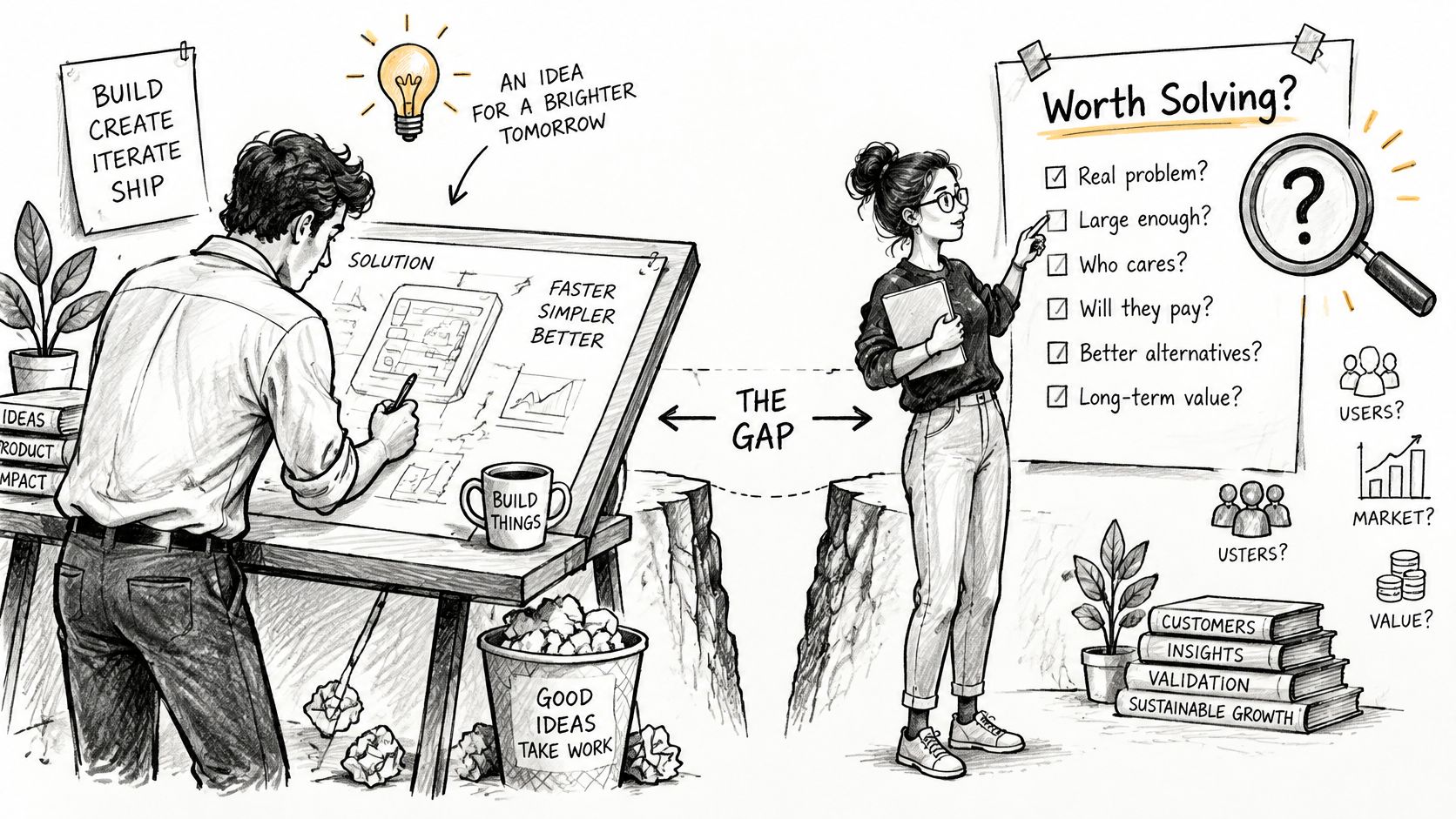
The framework is the pre-flight checklist for that moment. A checklist doesn't fly the plane. It stops a crew from taking off with a missing part, and it forces someone to say out loud that the part is missing. In practice it's a repeatable set of questions that settles two things: what to learn next, and whether the idea has earned more of your time, money or code.
The idea has a long lineage. The Stage-Gate model, developed from Robert Cooper's research in the 1970s and introduced commercially in 1986, placed decision gates between stages of investigation so teams had to show evidence before more resources were committed, as the Stage-Gate innovation process documentation describes. That structure turned opportunity evaluation from an informal brainstorm into a repeatable process built on market, technical, financial and operational criteria.
Founders now run that process under pressure. In 2024, 19% of U.S. adults were engaged in starting or running a new business, matching the historic high recorded two years earlier, according to the Global Entrepreneurship Monitor 2024/2025 United States Report. A crowded field makes a written decision rule more valuable, not less.
A market-size score answers one question, how big is the prize. It says nothing about whether the pain recurs weekly or yearly, whether the buyer controls a budget, or whether you can reach them at a cost the business survives. The framework adds those criteria and attaches a decision to each one.
By the end you'll hold three things:
- A five-criterion scorecard where every number carries its own confidence rating.
- A test order that starts with the assumption most likely to kill the idea.
- A written stop rule that settles the question on a deadline instead of drifting for a year.
The Five Criteria Every Idea Must Be Scored On
A huge market and a friend who says they would buy can both be true and still leave you with nothing worth building. The scorecard treats that mood as one input among five, then forces a decision from the weakest evidence, not the biggest prize.
Score each criterion from 1 to 5. A 1 means you assumed it. A 5 means you watched a stranger's behavior confirm it. Write a confidence rating of low, medium, or high in the same cell, beside the number. Confidence does not change the math. It records how much you should trust the number, and it breaks ties later.
| Criterion | Question it answers | Strong signal | Weak signal | Evidence to collect |
|---|---|---|---|---|
| Customer pain | Does a defined segment feel this problem often? | Named buyers describe it unprompted and already pay for a workaround | Complaints with no named buyer or existing spend | Interview quotes, current workaround costs |
| Demand frequency | How often does the problem occur? | Weekly or daily, with urgency | Yearly or rarely | Usage logs, diary studies, repeat mentions |
| Reachable market | Can you reach these buyers at an acceptable cost? | Clear channels where buyers already gather | No known channel | Channel tests, cost per lead |
| Economic value | Will buyers pay a price that sustains the business? | Buyers accept a price at checkout or preorder | Buyers only say they would pay | Paid waitlist results, preorders |
| Execution feasibility | Can a small team deliver it within budget and regulation? | Deliverable with current skills and tools | Needs scarce expertise or a licence the team lacks | Prototype build, regulatory check |
Work the rows in that order. Pain comes first because founders inflate it. A note-taking tool for lawyers earns a 5 only if three named partners at three different firms describe the same billing problem without being prompted. If they nod while you describe it, that is a 2, however warm the meeting felt. Frequency comes next and shapes the model as much as the score: weekly pain can support a subscription, and annual pain usually supports a one-time purchase or nothing at all. Reach is about channels, not population. If that column stalls, stop collecting more opinions and do desk research. Our guide to market research for startups covers the sources worth an afternoon.
Economic value is where stated intent misleads. "I would pay" is a sentence. A checkout or a preorder is a score. Execution feasibility then checks skills, licences, and timelines a small team can meet.
Each criterion also carries its own confidence rating, kept separate from the 1-to-5 score. Published research on lean and agile startup practice recommends that split: score problem severity, frequency, reachable market, economic value, and execution feasibility, then assign confidence from the quality of evidence behind the number, as a study of lean startup experimentation sets out.
The asymmetry that matters: a 3 built on paid preorders outranks a 5 built on two friendly conversations. Record confidence beside the score and let it break ties. Do not multiply it into the total.
The scorecard works like a pre-flight checklist. One failed item grounds the plane. You do not average a broken altimeter with a full fuel tank. Apply the written stop threshold before any sum: if customer pain or economic value scores 2 or below, stop. A sound opportunity needs both a real problem and a buyer who pays. Channel access does not rescue a missing one.
Otherwise add the five scores for a total out of 25 and use that plain sum to rank ideas for the next test round. When two ideas land on the same total, take the one with higher confidence. Founder fit stays outside these five scores on purpose, so personal enthusiasm cannot inflate or deflate the market evidence.
How to Test Your Riskiest Assumptions First
Testing starts with the assumption that would end the idea, not the feature you're excited to build. That one rule reorders everything below.
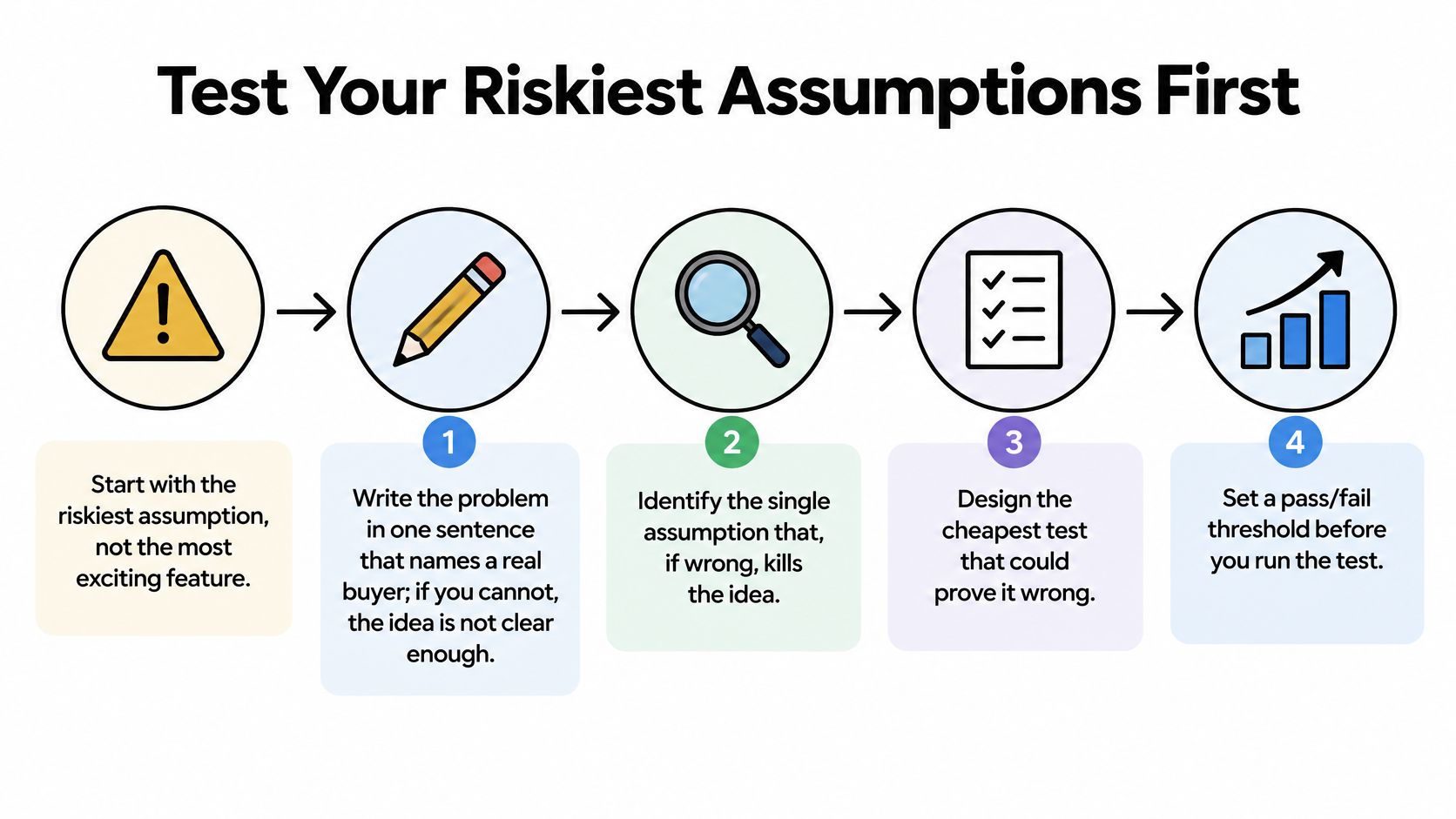
Write the problem in one sentence that names a real buyer. "Accounts receivable clerks at mid-size freight brokers re-key invoices into three systems every week" is testable. "Businesses waste time on admin" is not. If the sharp version won't come, no experiment will save the idea.
List the hypotheses the idea depends on. Cover the customer, the problem, the value proposition, the stakeholders, the pricing and the delivery model. The customer-discovery process supported by the U.S. National Science Foundation recommends that spread before development begins, as the NSF Lean LaunchPad research explains. Writing them down turns a belief into something a stranger can contradict.
Rank the list by uncertainty and impact. The top of the list is the hypothesis that is both likely to be wrong and fatal if it is. Price tolerance usually sits there, and founders usually test the logo instead, because the logo is more fun.
Design the cheapest experiment that could change your mind. Five interviews, a landing page, or a version of the service you deliver by hand for two customers. The test only has to move the decision, not prove the business.
Write the threshold and the next action before you collect a single response. "Three of five prospects agree to a paid pilot" is a threshold. Without one written down in advance, you'll rationalize whatever you hear.
Run it on strangers. Validating an idea means proving that real strangers, not friends or coworkers, will give money, time or a clear yes before the product exists. Former colleagues are the most expensive research sample available, because they're polite.
Marketplaces need a physical version of the same test. Match the first 10 to 20 buyers and sellers by hand, over email and spreadsheets, before you write any code. Ten manual matches teach you what the platform must automate; failing at ten teaches you that the platform was never the problem.
Engineering teams hit the same wall from the other side. A risk that isn't written down with an owner and a trigger never gets handled, which is why a software development risk management guide reads like a validation checklist with different vocabulary. How you ask matters as much as how many you ask, and our guide to customer discovery interviews covers how to stop a founder pitching halfway through question two.
The step is finished when every hypothesis has a recorded result and a named decision: keep it, revise it, or throw it out. Anything short of that is a conversation you enjoyed.
Which Evidence Actually Proves Demand
Positive opinion is cheap. Behavior is expensive, and that price gap is the entire game.
| Evidence type | What it proves | Strength | Typical cost |
|---|---|---|---|
| Forum complaints on HN or Reddit | Pain exists somewhere | Weak | Free |
| Customer interviews | Language, workflow and unmet needs | Medium | Time only |
| Surveys | Stated interest | Weak | Low |
| Prototype or mockup usage | Real behavior with a rough product | Medium | Low |
| Landing page with paid waitlist and $50 to $150 of ads | Willingness to commit money | Strong | $50 to $150 |
| Preorders or paid pilot | Payment for the actual offer | Strongest | Price of the offer |
| Switching commitment | Customers drop their current alternative | Strongest | Time plus a discount or free migration |
Interviews sit in the middle for a reason. They're the best tool for learning a customer's vocabulary, the shape of their workflow and the workarounds they've built, and close to the worst tool for predicting payment. Someone who says "I'd definitely use that" has spent nothing.
Interview to learn how the problem is described. Ask for money to learn whether it gets solved.
Prototype usage climbs one rung because it records behavior against a rough product, though curiosity and demand look identical at that stage. For a SaaS or digital product, the clean test is a landing page with a Stripe checkout for a paid waitlist plus $50 to $150 of paid ads pointing strangers at it. Set the pass line before the campaign starts, for example twenty paid signups from a thousand visitors. Missing that line buys you a real answer for the price of dinner.
Frequency on Reddit or Hacker News is the most seductive false signal available. A thread with two hundred replies proves the pain exists somewhere. It doesn't prove those two hundred people hold budgets or share a workflow, and the thread may hide a segment of thirty with money and nobody in the visible conversation.
Timing explains a lot of the rest. A buyer who ignored you six months ago may be mid-migration today, which is the same logic behind timing outreach to organizational changes. Treat each rung as a separate round rather than one gate, as laid out in our guide to market validation.
So rank segments, not markets. A smaller segment with weekly pain, named buyers and an expensive workaround outranks a large segment backed only by survey interest, because the first contains a purchase and the second contains a mood.
Founder Fit Checks Most Scorecards Skip
Is this opportunity attractive for this founder, in this market, with this distribution access and credibility? The scorecard can't answer that, and most frameworks never ask it.
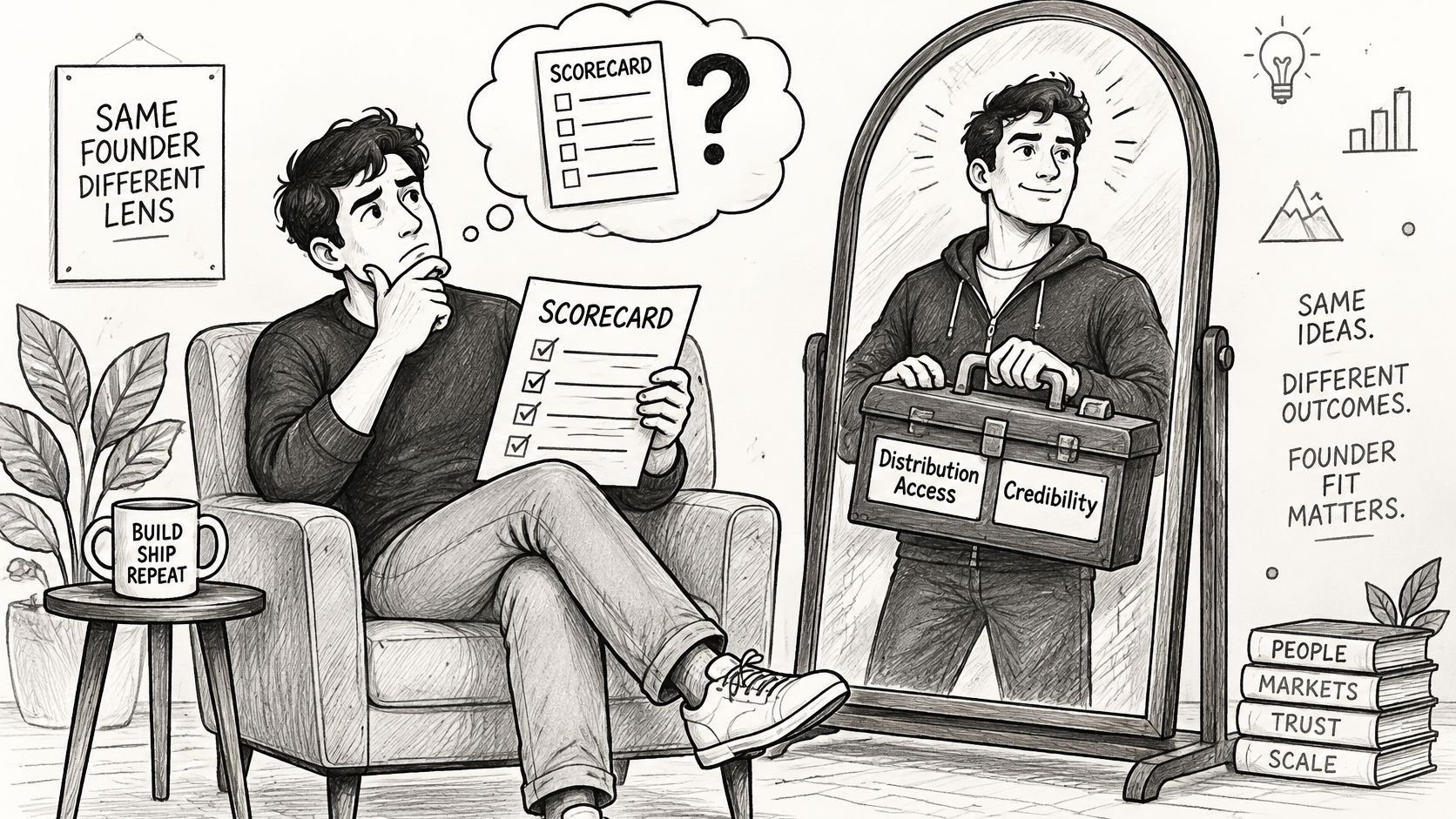
Capabilities and social context shape which opportunities a founder even notices. A 2025 study of 6,672 young firms found that founders' prior technical experience kept influencing recognition of digital opportunities after the firms' initial market-entry decision, while joining executives contributed more narrowly through specialized experience, as the 2025 Small Business Economics study of founder experience reports. The same body of work finds social intelligence and social capital moderating opportunity outcomes in resource-constrained and volatile economies, where access, trust and local relationships carry as much weight as market attractiveness.
That argues for a founder-market fit layer beside the five criteria:
- Domain knowledge: can you name the five people who'd take your call today?
- Customer access: do you already stand inside the channel, or must you buy your way in?
- Technical execution: can you ship the first version, or does it need someone you haven't met?
- Regulatory familiarity: do you know which licence gates the sale?
- Language and cultural proximity: do you speak the buyer's shorthand?
- Partnership reach: who introduces you to the economic buyer?
Then separate portable advantages from founder-dependent ones. A distribution channel you could hire a head of sales to build is portable. A personal network of clinic managers, or an insight only you can deliver credibly, is not.
Say a non-technical founder has direct access to dental clinics through her family's distribution business. She scores high on customer access and language proximity, low on technical execution. The decision isn't to drop the idea. It's to recruit an engineer before any code is written, with a date on the conversation. Every gap becomes a hire, a partner or a sequencing decision on the calendar, not a wistful note in a document.
Stop, Pivot or Build Decision Rules
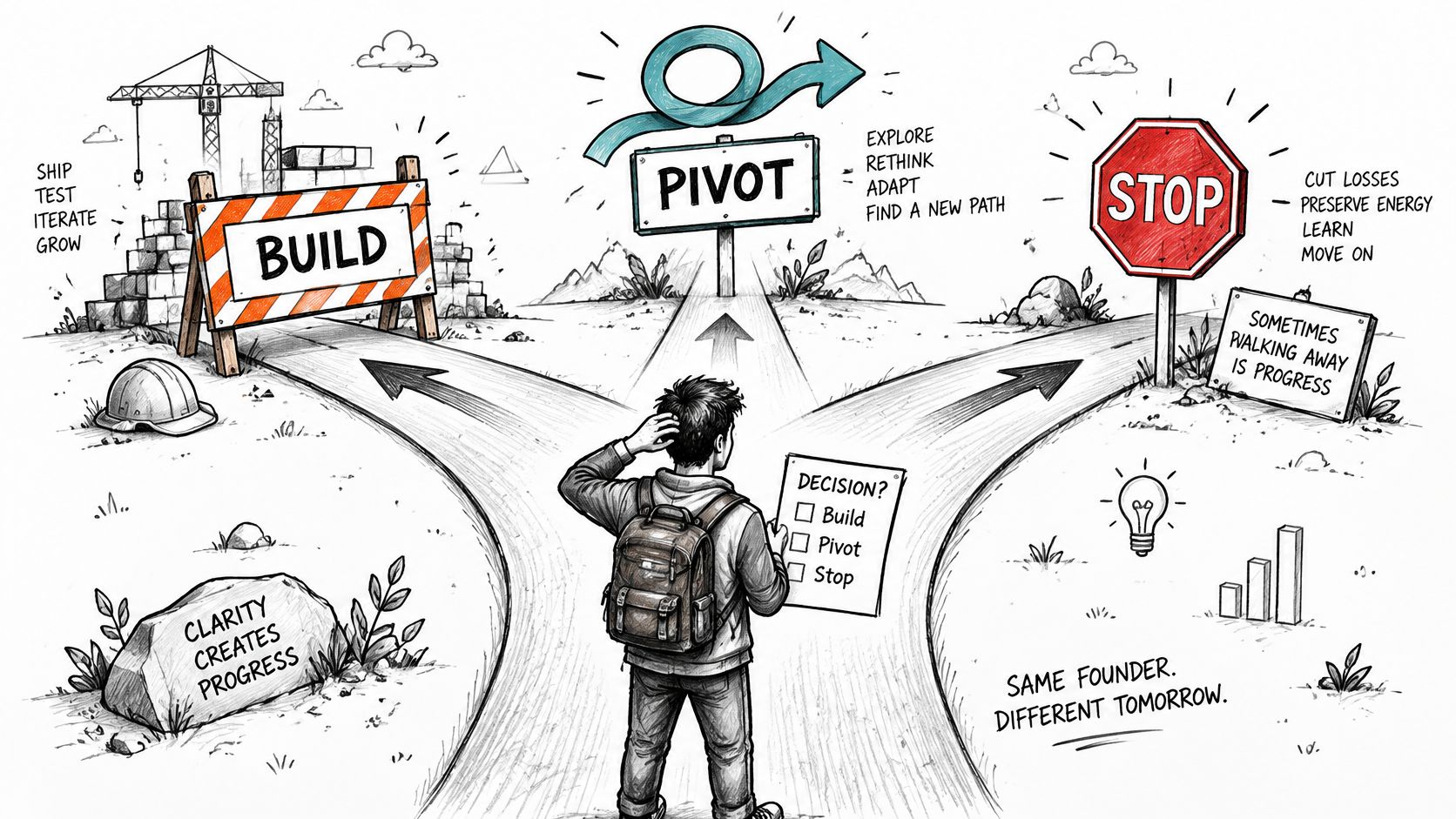
Founders rarely fail because they tested too much. They fail because they never wrote down what result would make them stop, so every result becomes a reason to keep going.
Decide on a deadline. Within 14 days you take one of three paths: build, iterate on one variable, or move on.
| Evidence after testing | Decision | Next action |
|---|---|---|
| Buyers pay or preorder within the test window | Build | Build the smallest version and keep charging for it |
| Pain confirmed, one variable looks weak | Iterate | Change one variable (price, segment, channel or delivery) and retest |
| Pain real, but the buyer differs from the assumption | Pivot | Re-scope the segment or the job to be done |
| No named buyers and no commitments after two tests | Stop | Record the failed assumption and move on |
| Traffic is bought but the model does not repeat | Return to discovery | Stop acquisition spend and rerun interviews |
The decision record is what makes this work, and it's four lines long: the evidence you collected, the confidence level, the assumptions that failed, and the criterion you applied. A stop recorded that way is a cost avoided with a receipt attached. It isn't a defeat.
Some calls can't be reduced to a probability. Recent entrepreneurship research frames opportunity development as three linked phases, recognition, evaluation and exploitation, with ideas legitimately abandoned after evaluation, as a study of entrepreneurial opportunity development describes. The same work argues that conventional decision models struggle with radical uncertainty, where the relevant outcomes and probabilities can't be specified in advance, and points to parallel experiments and what-if scenarios instead of one confident forecast.
The question that beats "is this attractive": what's the cheapest, fastest experiment that could materially change this decision?
Buying traffic before the model repeats is the most common way to turn a clean stop into a slow bleed. If customers buy but don't stay, the answer is discovery, not ad spend. And if your next test runs through outbound email, model the economics first, since a cold email ROI calculator turns reply rates and deal size into a number you can put straight into the decision record.
Keep one counterintuitive ranking in mind throughout. An idea with low confidence but cheap, fast, informative tests can beat a stronger-looking idea whose key assumption costs six figures to check.
Your First 14-Day Test
Do this today: write the problem in one sentence that names a real buyer, then book five conversations with people who match it. The schedule below is only the container around that action.
Day 1. One idea, one sentence. Pick a single idea and finish the sentence. Reaching for a second idea to feel safe is postponement wearing a disguise.
Days 2 and 3. Write the tests before anyone hears from you. Hypotheses, evidence thresholds and next actions go in one document. Drafting them after the first call guarantees they'll match what you heard.
Days 4 to 7. Five strangers. Run the interviews or the cheapest experiment, and log every response against its threshold as it happens, not from memory on Sunday night.
Days 8 to 12. A second test, only if the riskiest assumption is still open. Stay inside the budget you set on day one. A second test that repeats the first teaches nothing and costs the same.
Day 14. Write the decision record. Evidence, confidence, failed assumptions, criterion applied. Then choose build, iterate, pivot or stop using the table above.
It's the shape of our own validation playbook, a six-step, 14-day process built from real r/SaaS founders' threads and designed to work for a SaaS product, a physical item, a marketplace, a consumer app or a course. Most of the value sits in the part founders skip when they're in a hurry: writing the thresholds down before the calls.
Find Startup Idea was built for the moment after the decision record, when you need the next problem instead of a post-mortem. The library holds 1000+ ideas pulled from real Hacker News and Reddit pain points, organized across AI, SaaS, dev tools, consumer and crypto, so the problem statement is already written for you. Browse the ideas at Find Startup Idea and bring your scorecard.