Jobs to Be Done Framework: How Customers Hire Products
The Jobs to Be Done framework explained: core concepts, real examples and how teams use it to guide product decisions and find customer needs.
You've collected feature requests, sketched a product, and found people who say they like it. Yet you still can't explain what would make someone abandon their current workaround and choose yours. That's a better starting point than another brainstorming session: investigate the moment when someone needs things to change.
The jobs to be done framework helps you investigate that moment. Used well, it becomes a repeatable research habit: identify a circumstance, understand the progress someone wants, and test whether they'll act before you build.
What Customers Really Hire Products to Do
Why would someone buy a milkshake first thing in the morning?
The JTBD answer starts with the situation, not the drink. A customer brings a problem from their life and selects something to help them make progress. The product is a means, not the destination.
A purchase is a hire. Someone might hire a spreadsheet to prepare for a difficult budget conversation, rather than because they enjoy organizing cells. A competitor could be budgeting software, an accountant, or postponing the conversation. Product categories alone won't reveal that competitive set.
Start with the circumstance
The framework entered mainstream business thinking through Clayton Christensen and Michael Raynor's The Innovator's Solution in 2003, followed by Christensen, Scott Cook, and Taddy Hall's 2005 Harvard Business Review article Marketing Malpractice, as described in Kalam's history of the JTBD framework.
Its central shift is from describing customers to explaining choices. Demographics can help you locate potential buyers, but they don't necessarily explain why a particular person needs a solution today.
Compare these starting points:
- Segment first: Design something for independent professionals.
- Persona first: Design something for a busy, technology-confident freelancer.
- Job first: Help someone collect overdue payment without damaging a client relationship.
The job-first description gives a product team something concrete to investigate. What happened? What does the person do now? What would a satisfactory result look like?
Practical rule: Treat a job as an explanation to test, not a clever sentence to put in a presentation.
JTBD doesn't require you to discard personas or feature lists. It changes their role. Describe the relevant customer after understanding the circumstance, and prioritize features according to the progress they support. A job can remain useful even as the tools people hire to accomplish it change.
Core Concepts Behind Every Job
Parts of a Job and How They Show Up
The commuter example makes the vocabulary concrete. Treat the detailed outcomes and social interpretation below as interview hypotheses, not established findings about every milkshake buyer.
| Concept | What It Means | Milkshake Example |
|---|---|---|
| Job | The progress a person wants in a situation | Make a long morning commute more bearable |
| Circumstance | The context that triggers the need | Driving alone on a long, monotonous route |
| Functional progress | The practical task to complete | Stay full until lunch |
| Emotional progress | How the person wants to feel | Feel less bored and less rushed |
| Social progress | How the person wants to be seen | Look like a sensible, organised commuter |
| Desired outcome | The measurable result used to judge success | Drink lasts the whole drive without becoming watery |
A job uses plain verbs: collect payment, prepare dinner, arrive feeling ready. Buying a milkshake describes a transaction, not the underlying progress. Make the commute more bearable gives you room to consider different solutions.
The circumstance tells you when the job becomes relevant. Driving alone on a monotonous route is more useful than a broad label such as commuter because it identifies the conditions you need to investigate.
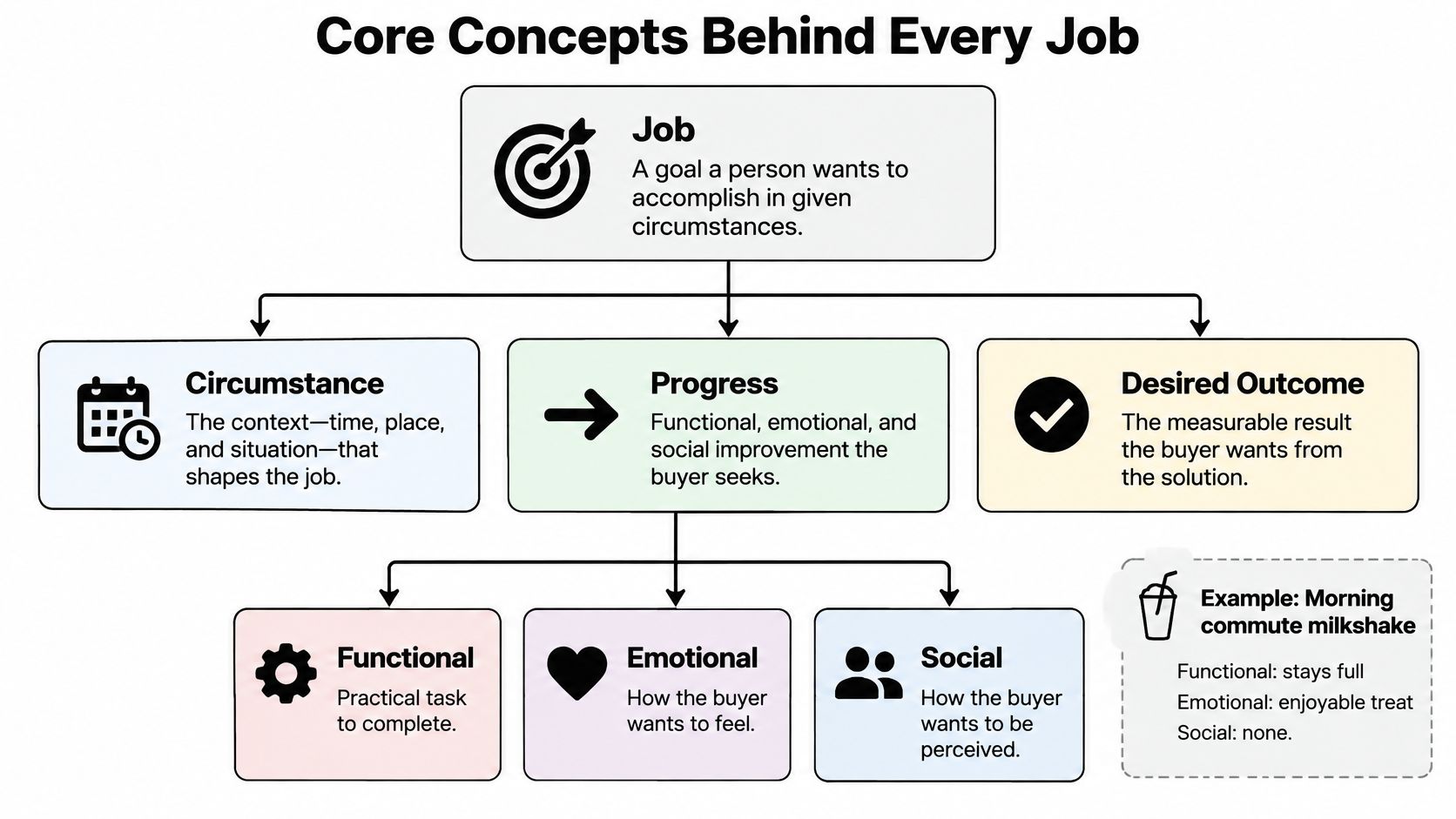
This diagram separates the concepts while showing how they connect.
Separate progress from proof
Functional progress concerns what someone needs to accomplish. Emotional progress concerns how they want to feel. Social progress concerns how they want others to perceive them.
Don't force every dimension into every interview. The sensible-commuter interpretation in the table needs evidence; someone driving alone might attach no social meaning to their breakfast. Likewise, feeling less rushed is something to ask about, not assume.
Emotional and social considerations can help distinguish otherwise similar options. Say a freelancer can collect payment through either a blunt automated reminder or a tactful personal message. Both address the practical task, but the freelancer may prefer the option that preserves their professional identity.
Check a proposed job by asking:
- Progress: Does it describe an improvement the customer wants?
- Context: Can you identify the circumstance that makes it relevant?
- Alternatives: Could a different kind of product satisfy it?
The desired outcome is the yardstick. Replace vague goals such as better mornings with something observable, such as whether breakfast lasts through the journey without creating another inconvenience.
A Job Hidden in Plain Sight
The familiar milkshake case began with a conventional business problem: a fast-food chain wanted to improve sales. The initial approach focused on customer segments and product attributes. Researchers then changed the question from what kind of milkshake people preferred to what was happening when they bought one.
The morning purchase is easier to understand when you place it in the customer's journey.
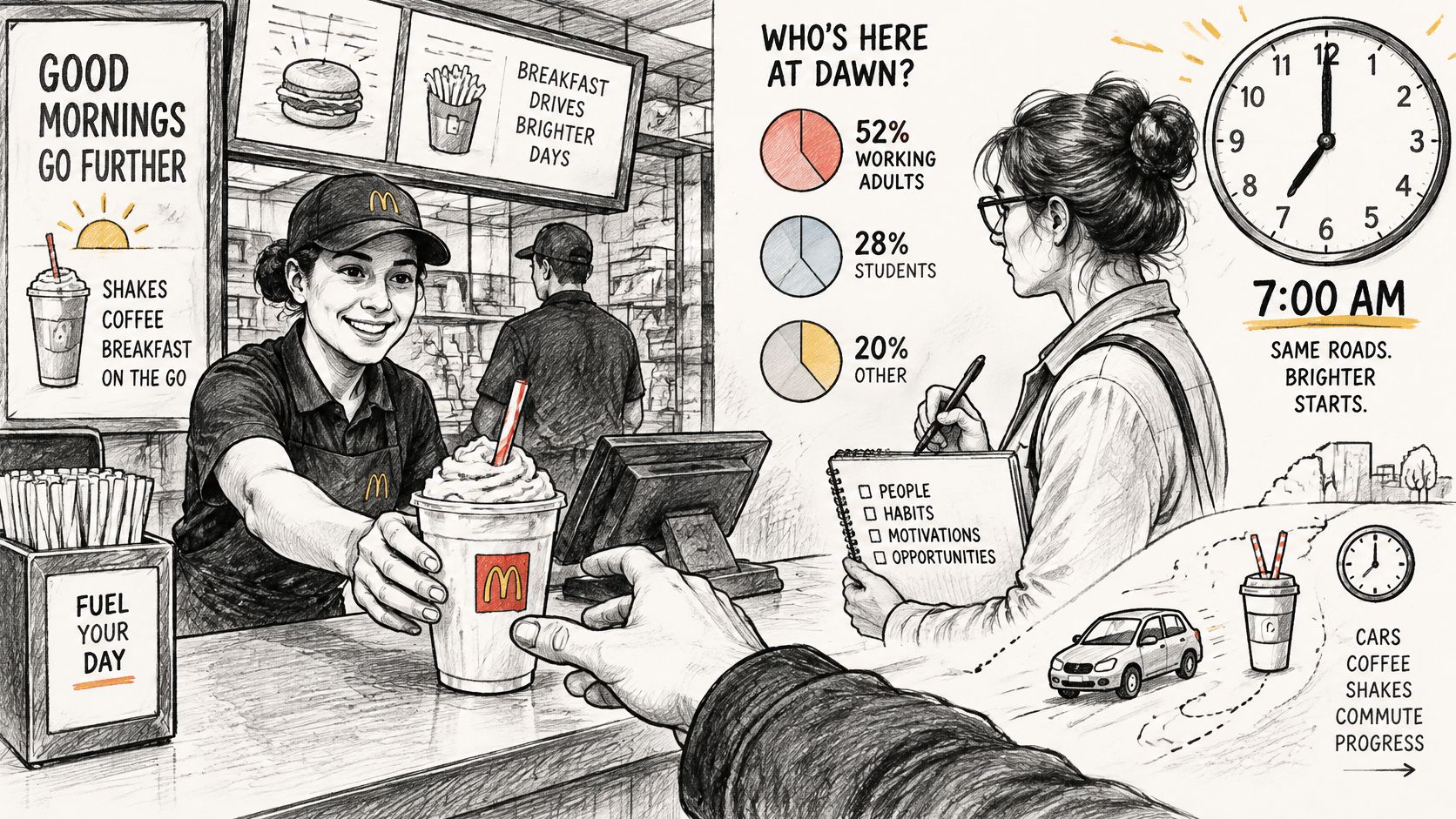
According to Launchrock's account of the milkshake case, a meaningful share of purchases occurred in the morning, often among commuters facing a long, monotonous drive; they hired the milkshake to provide a filling breakfast, last through the commute, work with one hand, and make the journey less boring.
That reframing changed the relevant competition. The chain wasn't only competing with other beverages. It also needed to understand alternative breakfasts and ways people managed their commute.
Let the job guide the intervention
The recommendations followed the situation: make the product thicker so it lasts longer, make purchasing convenient through self-service, and introduce additions that create variety. These weren't arbitrary improvements to taste or packaging. They addressed particular reasons someone might choose the product.
Notice the difference between a complaint and an explanation. A customer asking for faster service might be expressing a preference, but reconstructing their morning reveals why delay matters. They need the purchase to fit into an existing journey.
If you're collecting similar observations, a guide to identifying customer pain points can help you distinguish a surface complaint from the circumstance behind it.
The case also offers a useful introduction to the hiring metaphor in video form.
Use the milkshake story to improve your questions, not to forecast your sales.
The underlying study's full dataset hasn't been publicly published. It's an illustrative case, not a reproducible statistical benchmark or proof that every context-based intervention succeeds. The defensible lesson is narrower: investigate when and why people choose before deciding what to improve.
How to Write and Test a Job Statement
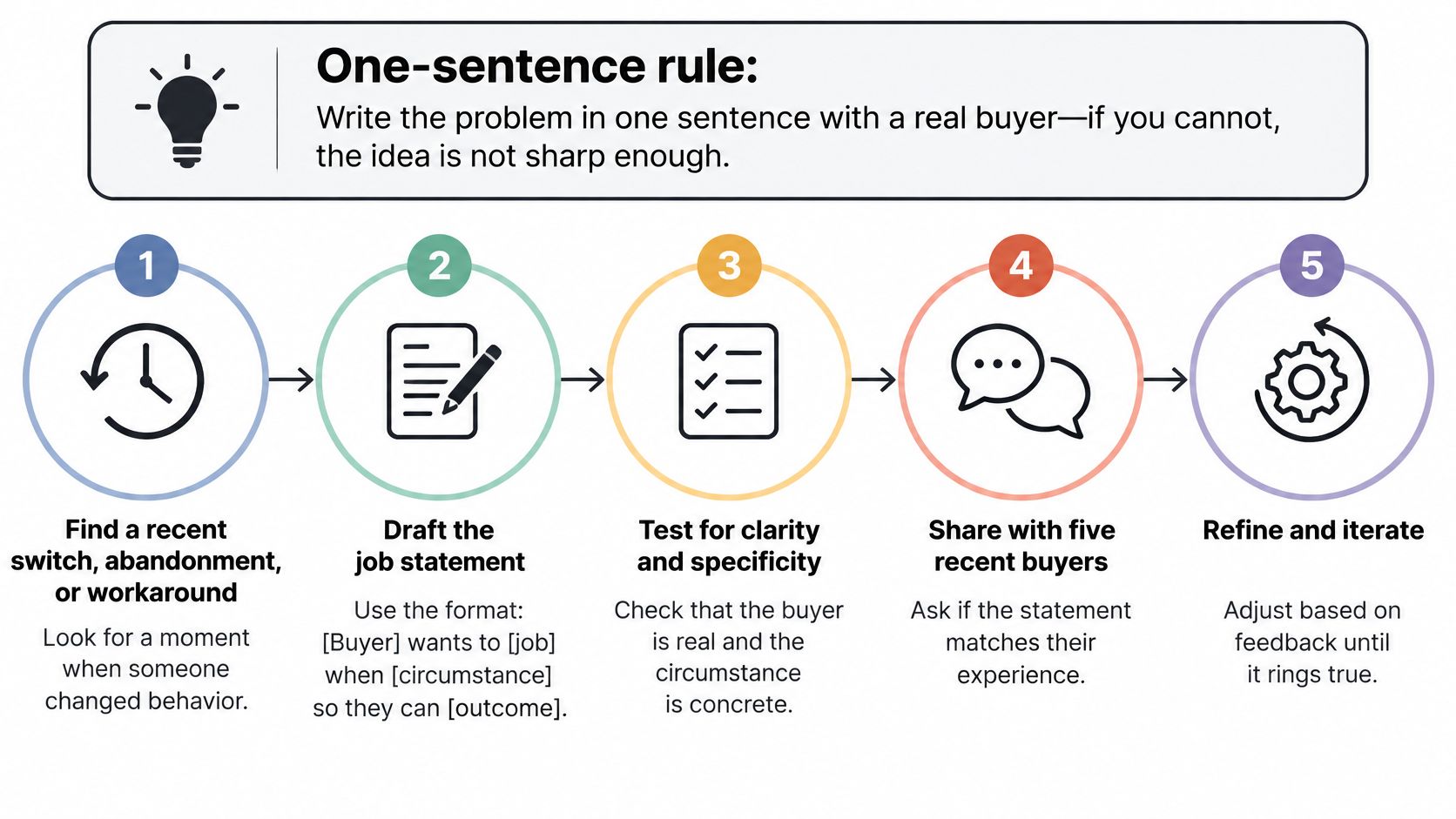
Write the problem in a sentence with a real buyer. If you can't, the idea isn't sharp enough. A sentence about helping businesses become more productive doesn't yet tell you whom to interview or what behavior to observe.
The JTBD guide by Saif Ali treats the framework as a situational choice model, linking circumstances and desired progress to observable switching, adoption, or willingness to pay.
Reconstruct a decision before drafting
Find someone who acted recently. Recruit a person who switched solutions, abandoned one, or actively evaluated alternatives. Their decision gives you a concrete event to examine instead of a hypothetical wish.
Locate the trigger. Ask what happened immediately before they started looking. For a freelancer, the trigger might be an overdue invoice arriving just as another bill becomes payable.
Document the previous workaround. Ask them to walk through what they did, including tools, messages, and manual checks. Record what the workaround failed to deliver, rather than treating its inconvenience as self-evident.
Reconstruct alternatives and barriers. Find out what else they considered and why they hesitated. A freelancer might avoid automated reminders because they fear sounding aggressive, even when the manual process consumes time.
Use customer discovery interviews to uncover that decision sequence. Ask for concrete episodes and, where appropriate, artifacts such as reminder drafts or payment-tracking spreadsheets.
The visual below summarizes the drafting and refinement loop.
Turn the account into a test
Draft the statement. Use the structure: “When [circumstance], I want to [make progress], so I can [desired outcome].” For the hypothetical freelancer: When a client invoice becomes overdue and I need the income, I want to follow up confidently so I can collect payment without damaging the relationship.
Remove the proposed solution. Check that the statement doesn't depend on a feature, product, or invented persona. An assistant, a payment service, and a manual process should all remain plausible ways to address the freelancer's job.
Specify confirming behavior. Decide what you'd expect to observe if the explanation is useful: sharing an invoice for a manual follow-up service, starting a paid trial, or replacing an established workaround. Also record what would weaken the hypothesis, such as satisfied customers refusing to change because the problem has little consequence.
Evidence check: Recognition confirms that your wording sounds familiar. Commitment tells you more about whether the opportunity deserves investment.
A useful statement should be recognizable to people in the relevant circumstance, but agreement isn't the finish line. Compare people who act with those who don't. If circumstance and desired progress fail to explain that difference, revise the hypothesis rather than polishing the wording.
Judging Which Jobs Are Worth Pursuing
A recurring complaint isn't automatically a market opportunity. People can dislike a task while preferring their current workaround to the cost, risk, or effort of changing it.
An underserved outcome matters to the customer and isn't adequately satisfied today. SurveyMonkey's JTBD guidance describes measuring outcome importance alongside satisfaction to identify such gaps. That's a stronger basis for prioritization than counting complaints, though a representative survey may be premature for a small team.
Use practical gates, not universal cutoffs
Go or No-Go Signals for a Candidate Job
| Criterion | Supports Pursuing | Warning Sign |
|---|---|---|
| Frequency | The job recurs in a predictable circumstance | It surfaces occasionally and fades |
| Pain | People pay a real cost in time, money or risk | Mild annoyance with no costly workaround |
| Reachability | You can find and contact people in this circumstance | No practical channel reaches them |
| Switching or payment | People switch, pay, or give a clear yes to a concrete next step | Only praise with no action |
| Underserved outcome | Existing solutions leave a stated outcome unmet | Current options fully satisfy the outcome |
Frequency isn't an absolute veto. An infrequent job can still warrant investigation when failure is expensive. Assess recurrence alongside consequence, rather than inventing a universal weekly cutoff.
Reachability deserves equal attention. You need access to people experiencing the problem, not merely people sharing a demographic trait. DMpro's guide to how to segment your outreach market can help organize recruitment; add the triggering circumstance to your targeting.
Move from interviews to commitment
Use public pain points to generate hypotheses, interview people to understand decisions, and then run a small behavioral test. A practical stopping rule is to move toward testing when new conversations stop adding meaningful triggers, workarounds, or barriers. That's a workflow decision, not proof that your sample represents the market.
Our validation standard is that real strangers, not friends or coworkers, give money, time, or a clear yes before the product is built. A yes should attach to a specific next step, such as a scheduled pilot with responsibilities, not a compliment.
Record the job, uncertainty, test, and decision in an idea validation framework. This keeps an appealing explanation from becoming an indefinite excuse to keep interviewing.
Decide Whether a Job Is Worth Building Around
Give the investigation a decision deadline. Our process ends within 14 days with a choice: build, iterate on one variable, or move on. The deadline limits speculative work; it does not turn a small test into proof of a scalable business.
Start with the buyer and job statement, then review frequency, pain, reachability, and commitment. Identify the weakest assumption. If people describe an expensive problem but will not let you contact the budget owner, buying access may deserve testing before product usability.
Check whether the local system permits adoption
A customer can want an outcome without having the authority or infrastructure to obtain it. Separate the core job from the conditions required to buy and use your solution. In regulated or institution-heavy markets, the user, approver, budget holder, and data owner can be different people, so strong desire in one seat can still stall in another.
Ask these questions before treating interest as demand:
- Buying authority: Who uses the solution, who approves it, and who controls the budget?
- Data readiness: Can customers obtain and share the information the service needs?
- Measurement: Can everyone agree on what a successful outcome means?
- Financing and procurement: Can the customer fund adoption and complete the approval process?
Say you're investigating sustainability verification. A farm operator may want simpler reporting, while an auditor needs traceable evidence and a lender needs acceptable documentation. Test those requirements separately. Enthusiasm from the user does not guarantee approval from the institution.
Choose a test that matches the uncertainty
Write down the audience, offer, required commitment, and pass condition before launching. Set the required number of commitments from your delivery capacity and economics, not from an invented industry benchmark.
A landing page collecting waitlist sign-ups can test whether an offer attracts interest. It can't, by itself, establish willingness to pay. If payment is the uncertainty, offer a paid pilot; if implementation is the uncertainty, ask a prospect to supply the information needed to deliver a manual version.
Keep a decision record containing the original expectation, actual behavior, objections, and local constraints. If the result is close, identify what you'll change and what you'll hold constant. Changing the buyer, offer, channel, and price together makes the next result difficult to interpret.
Build when the predefined commitment threshold is met and delivery is feasible. Iterate on one variable when the evidence identifies a specific, fixable barrier. Move on when a fair test fails and you have no supported explanation worth testing. This week, rewrite your strongest candidate as a job statement and put a concrete offer in front of people experiencing that circumstance.
Find Startup Idea offers startup ideas sourced from real HN and Reddit pain points, giving you candidate problems to investigate rather than feature lists to copy. Visit Find Startup Idea, choose a problem with a recognizable trigger and workaround, and turn it into a job statement you can test with real buyers.