The Mom Test Questions: 8 Ways to Validate Ideas in 2026
The Mom Test Questions: 8 proven prompts with exact phrasing, why each works, sample follow-ups, and tips to validate your startup idea.

Your calendar is full and every call ends the same way. The person says the problem sounds real, that they'd probably use something like it, and that you should send a link when it launches. Three weeks later you have a folder of encouragement and no evidence that anyone will pay for anything.
The questions were the problem, not the product.
Rob Fitzpatrick published The Mom Test in 2013 around three rules. Talk about their life instead of your idea. Ask about specifics in the past instead of opinions about the future. Talk less than they do. A question about next year returns a polite guess. A question about last Tuesday returns a date, a workaround, and occasionally a receipt. If you want the wider toolbox around these conversations, this guide to user research techniques covers the methods that sit either side of the interview.
The Mom Test questions below are the eight I run in calls, each with exact wording, the signal it produces, the version that ruins it, and the follow-up sequence that turns a vague answer into evidence you can act on.
1. Tell me about the last time you [experienced the problem]
Open every interview with this and nothing else. The wording I use is "Walk me through the last time [problem] happened, starting from when you first noticed it." "Walk me through" carries more than "tell me about" because it asks for a sequence, and sequences hold the details: who was involved, what they opened, how long it took.

The signal is recency and specificity. A real memory arrives with a day of the week, a name, a tool, a number of minutes. "It happens all the time" is a summary, not a memory, and summaries are where founders fool themselves. When you hear one, ask "What's the most recent time that happened?" and then stop talking.
The bad version is "Do you ever run into [problem]?" It's a yes-or-no question with a socially correct answer, and it hands the person a category instead of a moment. "Do you find scheduling clients frustrating?" is worse, because you've told them how to feel before they answer.
Why a dated story carries the weight
The failure data explains the fuss. CB Insights identified poor product-market fit as a cited reason in 43% of 385 startup failures, with bad timing at 29% and unsustainable unit economics at 19%, overlapping categories that don't sum to 100, per Getupsight's summary of customer discovery statistics. Nearly half of those analyzed failures involved building something the market didn't want. A dated story about a real problem is the cheapest defence available against joining that group.
The follow-up sequence: "What did you do next?" then "Who else was involved?" then "How long did that take, start to finish?" Let the silence sit after each one. The third follow-up is usually where the useful detail lives.
Here's how the rhythm should feel in practice.
Practical rule: if you can guess the answer before you ask the question, don't ask it.
2. How are you dealing with this problem today?
Every interview has one question that reveals the true competitor, and it's rarely the one you found on G2. It's the spreadsheet with 14 tabs, the freelancer on retainer, or the sticky note taped to the monitor.
Ask "How are you handling this today?" and then "Can you show me?" The second half does the work. People describe their workaround generously and demonstrate it.
The signal is an existing solution with a cost attached. A current solution means the problem already survived the test of someone bothering with it. It tells you what you have to beat, and it tells you what switching away will cost your buyer, which is a number most founders never calculate.
The bad version is "Is your current setup a pain?" You've led the witness and you'll get agreement plus nothing usable. Equally dead is "Would you switch to a better tool?" Nobody has ever said no to that one.
What doing nothing tells you
"We don't really do anything about it" is a finding, not a dead end. It can mean the problem is rare, cheap to absorb, or owned by someone else in the building. Any of those three is a reason to change segment or drop the idea. Don't rescue the moment by pitching.
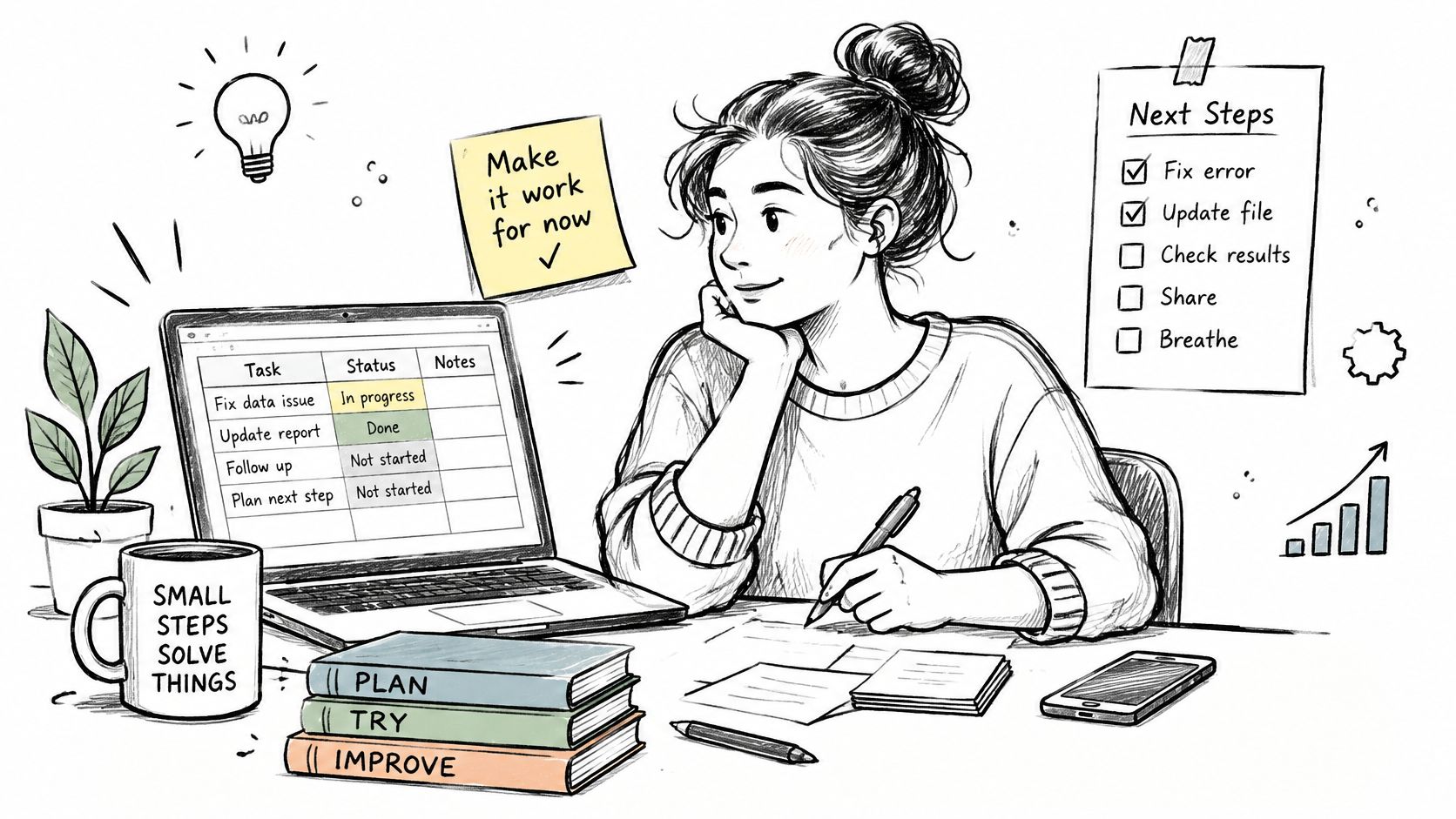
The follow-up sequence: "What else have you tried?" then "How many hours a week does that take?" then "Who set that up and who maintains it?" That last question often uncovers a second person with budget, and the buyer you assumed is the buyer stops being the buyer.
3. What else have you tried?
Say a prospect tells you they use a spreadsheet for scheduling. That's the first answer. The informative one is the third.
Ask "What else have you tried before this?" and then, after each answer, "Why did you stop?" People churn for reasons, and the reasons are a list of what your product has to get right on day one. A tool they dropped because it was slow tells you speed matters more than features. A tool they dropped because the team refused to log in tells you adoption is the actual product.
The signal is volume and recency of attempts. Someone who has tried four things in two years cares. Someone who has tried nothing and isn't looking is telling you the problem is theoretical for them, however agreeable they sound.
The bad version is "Have you tried other tools?" It's a yes or no question, and it invites a short answer that ends the thread. You want the list.
Do the public homework before the call. Read up on competitor research and who already sells to this buyer so interview time goes on what only the buyer can tell you, not on questions a pricing page already answers.
- Cost of each attempt: "What did that cost you?" in money or hours, whichever they volunteer first.
- Their exact words: write down how they describe what broke. Those phrases become your landing page copy.
- The pattern: three people dropping the same tool for the same reason is a positioning opportunity, not a coincidence.
4. How much time or money does this problem cost you?
This is the question that turns a sympathetic conversation into a business case, and it's the one founders flinch from.
Ask "How many hours a week does this take you, roughly?" and then "What does it cost when it goes wrong?" Rough numbers are fine. You're not building a financial model, you're checking whether the pain has a price.
The signal is a number with a person attached to it. Six hours a week of an office manager's time is a cost. Six hours a week of the founder's time is a bigger one. Multiply hours by a loaded hourly rate and you have the annual budget your product is competing for.

The bad version is "How much would you pay for this?" It's a hypothetical about a product that doesn't exist, and it costs the speaker nothing to answer generously. Ask what they pay today for anything that handles part of the problem, contractors and staff hours included.
The test I use: if the problem costs less to tolerate than to solve, you've found a nice-to-have.
The follow-up sequence: "And what does that work out to over a year?" then "Who pays for it now?" then "What would have to happen for this to become urgent?" That last question surfaces the trigger events that make people buy, which is more actionable than any price point. Only once the cost is on the table is it fair to ask what a fix would be worth. Asked earlier, it's just fluff with a number attached.
5. Why is that important to you?
Ask this carefully. Said flatly, it sounds like a challenge, and people get defensive. Said with real curiosity, it's the question that separates a business problem from a preference.
Wording: "Can you tell me more about why that matters to you?" Ask it once, maybe twice, then move to specifics. A third "why" turns the call into therapy and the person starts editing themselves.
The signal is emotional language. Words like "embarrassing", "stressful", "we're losing money", "the client nearly walked" tell you the problem has weight. Motivation is often career-based rather than operational: someone wants to stop working weekends, or wants to look competent in front of a manager. That matters because it changes how you frame everything. Sell the outcome they already want, not the feature you find elegant.
The bad version is "Wouldn't it be better if...?" You've supplied the motivation and they'll agree with your framing. The other failure is arguing. If someone says their current process is fine, don't correct them. Note it and move on.
The judgement I make in the moment
If the person can't articulate why the problem matters beyond "it's a bit annoying", I downgrade everything else they say for the rest of the call. Motivation is the difference between a user and a buyer, and no amount of feature enthusiasm replaces it. That's a hard call to make mid-conversation, which is exactly why it's worth making.
6. What is the worst part about this?
This is the prioritization question. It saves you from building the wrong slice of a large, real problem.
Ask "What's the worst part of dealing with this?" and then "Can you give me an example of the last time that happened?" The second question is what keeps the answer honest.
The signal is a specific, repeatable pain point. If three people in the same segment name the same worst part, you have a wedge. If everyone names something different, your segment is too broad, and that's a targeting problem rather than a product one.
The bad version is any question that supplies the answer: "Is it the invoicing that's worst?" You've just told them what to say. A field experiment involving 450 interviews in Bangalore found respondents were about 2.5 times more likely to prefer an option they believed the interviewer had created, even when the alternatives were identical, and they kept preferring it after it was made objectively worse. That's courtesy bias under controlled conditions. Your interview has the same pressure and none of the controls.

Keeping your thumb off the scale
Write the answer down in their words before you respond. Nodding along while you mentally rephrase it into your roadmap is how founders lose the detail that matters most. If you're clustering pain across a segment, this guide to identifying customer pain points shows how to group what you hear without flattening it.
The follow-up sequence: "What have you done about that so far?" then "What made you stop?" then "What would fix it, in an ideal world?" That last one is the only place in the interview where a wish list is allowed, and you label it as a wish list rather than a requirement.
7. Who else should I talk to about this?
End most calls with this one, and end it before you describe your idea.
Ask "Who else deals with this? Could you introduce me?" Specific beats general. "Who on your team touches this?" gets a name and a job title. "Do you know anyone?" gets a shrug.
The signal is an introduction, not a name. A forwarded email costs the referrer a little reputation, which is why it counts as evidence. A name on a Post-it costs nothing.
The bad version is "Would you recommend this to others?" That's a question about your idea, answered generously, and it predicts nothing about anything.
How many interviews before you stop
Volume is the most over-asked question in customer discovery and the least useful target. A qualitative study of 60 interviews reported that 34 of 36 common themes had appeared after six interviews and 35 after twelve, according to this analysis of customer discovery interview questions. That's one relatively homogeneous group, so it doesn't license stopping at five on every project.
The working rule I use is to start with 6 to 12 interviews inside one narrow segment and keep going until two consecutive calls produce no new high-impact problem, workaround, or purchasing constraint. Mixed buyer roles, geographies, and company sizes each need their own sample. Referrals from this question are the fastest way to fill those cells.
The follow-up sequence: "Is there anyone on the buying side I should hear from?" then "Would you mind sending an intro today?" then, if they say yes, ask what to mention so the next call starts warm instead of cold.
8. Can I follow up with you next week to show you what I'm building?
Now the idea can enter the room, at the end, as a request rather than a pitch.
Ask "Can we book 20 minutes next week so I can show you a rough version?" A date on the calendar is time, and time is a commitment. A refundable deposit is money. An introduction is reputation. Compliments and "send me a link" are none of the three.
The signal is a specific yes with logistics attached. A day, a time, a card, a colleague copied in. Vague enthusiasm is data too, but it's data about politeness.
The bad version is "Can I follow up with you sometime?" Everyone says yes to sometime. Nobody has ever blocked a calendar for it.
What counts as a real commitment
Rank the answers you get. Money is strongest, then a scheduled call, then an introduction, then a filled-in calendar invite. Anything below that is a compliment wearing a costume.
The hard part isn't asking, it's interpreting. Most question lists stop at how to ask and skip the step where you decide what you've heard. A course reading on the Mom Test framework makes the gap plain: interviewers get warned about confirmation bias but rarely get a rule for recording disconfirming answers or comparing one interviewee against another. Set the rule before the calls, tagging each response by recency, frequency, severity, existing spend, and whether the person went looking for a fix on their own.
The follow-up sequence: "What would you need to see to make this worth paying for?" then "Who else would need to approve it?" then "Can I hold a spot with a refundable deposit?" If you want the full arc of the conversation in order, this walkthrough of customer discovery interviews covers the sequence end to end.
How the Mom Test Questions Compare at a Glance
| Item | Best For | Signal Type | Main Risk |
|---|---|---|---|
| Tell me about the last time you [experienced the problem] | Finding recent, concrete examples of the problem | Past behavior | The event may be hard to recall or too old |
| How are you dealing with this problem today? | Identifying current workarounds and alternatives | Existing solutions | Customers may describe an ideal process |
| What else have you tried? | Understanding previous attempts and unmet needs | Solution history | Answers may be incomplete or feel like an interrogation |
| How much time or money does this problem cost you? | Estimating the problem's impact and potential value | Quantified cost | Estimates may be inaccurate or sensitive |
| Why is that important to you? | Uncovering motivation and underlying stakes | Motivation | Can feel confrontational or lead off topic |
| What is the worst part about this? | Prioritizing the most painful aspect of a problem | Pain severity | May prompt venting without concrete evidence |
| Who else should I talk to about this? | Expanding research through relevant referrals | Referral and engagement | Referrals may be biased or not follow through |
| Can I follow up with you next week to show you what I'm building? | Testing interest through a concrete next step | Commitment | Agreement may be polite rather than genuine |
Turn Customer Answers Into a Build, Iterate, or Walk-Away Decision
An interview that doesn't change a decision is entertainment.
Score each conversation on three things: a past event with a real cost, an existing workaround someone already pays for, and a concrete commitment at the end. Two out of three across a narrow segment is a signal to build. One out of three is a signal to change a single variable, usually the segment or the problem you're framing. Zero across eight calls is a walk-away, and taking it early is the cheapest win available to you.
Strangers who give money or a work email are the strongest evidence you can collect. Friends, former colleagues, and anyone who opens with "I love this idea" are the weakest, not because they're dishonest but because agreeing is free. The discipline most founders skip is applying the six steps of decision making: define the criteria, gather evidence against them, and commit to a choice before the evidence arrives.
Then put a clock on it. A 14-day window is long enough to run the interviews and short enough that you don't keep researching as a way of avoiding the decision. Book the calls at the start of the window, score them at the end, and write the decision down where you'll see it.
One more discipline: stop interviewing the same profile once the answers repeat. Five conversations with the same job title, company size, and context beat fifty across a vague category, and the referrals from question seven are how you keep the sample tight.
Find Startup Idea builds its validation playbook from real top-voted Reddit threads and Hacker News complaints, so the problems you're testing already have a public trail of people describing them in their own words. If you need a shortlist of pain points to take into your next eight calls, that's where to start.
Find Startup Idea gives you a shortlist of problems people have already described publicly on Hacker News and Reddit, then hands you a 14-day test to run against the one you pick. Take the eight questions above into those calls, score the answers against the three signals, and decide within two weeks whether to build, change one variable, or move on. Visit Find Startup Idea to pull your first set of real complaints and start booking interviews.