Idea Validation Framework: Steps, Tests and Decision Rules
An idea validation framework in five stages: define the problem, test hypotheses, rank evidence and set decision rules before you build anything.
Would you rather have 500 people on a waitlist or three strangers who've paid you $50? Most founders pick the waitlist, then spend six months building for an audience that never converts. That isn't optimism. It's a sorting problem, because a compliment, an email signup and a purchase all feel like versions of the same yes.
They aren't. Every piece of validation evidence costs the person giving it something: a minute, a work email, an hour of their week, or their own money. Sort what you've collected by that cost and the picture sharpens fast.
What follows is an idea validation framework built on that one principle. Five stages, each with a single question, one cheap test and one pass signal, then a ranking of evidence that keeps a signup from ever masquerading as a sale.
Idea Validation Framework at a Glance
Every founder asks a version of the same question in week one: how do I know this is worth building? You can't know. You can buy information, though, and you can decide to buy the cheapest information first.
Five validation stages and the evidence each one needs
| Stage | Question to answer | Experiment | Pass signal |
|---|---|---|---|
| 1. Problem | Does a narrow group feel this pain often? | 10 or more interviews with people who have the problem | Most name the same pain without prompting |
| 2. Solution | Does a clear promise attract the right people? | Landing page or manual concierge workflow | Qualified visitors take the next action |
| 3. Commitment | Will strangers pay or give a work email? | Pre-order, deposit or paid pilot | Money or a work email from people outside your network |
| 4. Economics | Do the unit economics hold? | Price test with conservative acquisition cost | Margin stays positive under pessimistic assumptions |
| 5. Decision | Build, iterate on one variable or stop? | Review results against thresholds set in advance | Decision recorded within 14 days |
Why the order matters
Each stage is expensive to skip. A landing page with a healthy signup rate tells you nothing if the visitors arrived from a broad-interest audience and none of them carried the problem. The commitment stage tells you even less when you skipped the problem stage, because you end up testing a price against people who were never going to buy. Founders who jump straight to stage two or three collect numbers that feel encouraging and mean very little.
Economics sits fourth for the same reason. Margin only makes sense once you know who buys and roughly what it costs to reach them. Run the arithmetic before you've met the buyer and you're calculating on guesses.
How to use the table without fooling yourself
Start at stage one and stay there until its pass signal appears. Write that signal down before you run the experiment, in a sentence with a number in it. "At least six of ten operations managers describe the reconciliation problem unprompted" is a pass signal. "Good conversations" is a mood.
The early stages are fast and cheap by design. Most founders clear stages one and two in days to a few weeks on a small budget, so the full sequence fits inside a short sprint rather than a quarter.
Run this check before reading on: name the person who pays, the pain they'd pay to remove, and how often it hits them. If any of the three is fuzzy, that's the stage you're on, whatever you've already built.
A useful discipline: put your own idea against the table and find the first row you haven't genuinely passed. That row is next week's work.
Founders validating outside the US should also read product market fit signals for MENA from Founder Connects before setting the economics stage, because buyer expectations, payment habits and channel costs shift by market.
Why Most Startups Need Testing Before Building
Survival data makes the case better than any argument about discipline. U.S. Bureau of Labor Statistics figures for establishments born in 2015, cited in Startups.com's breakdown of why startups fail, show that 79.6% survived one year, 69.1% survived two years, 50.2% survived five years and 34.7% survived ten. Those figures describe new businesses broadly rather than venture-backed startups, which doesn't soften the slope: roughly two out of three new establishments are gone inside a decade.
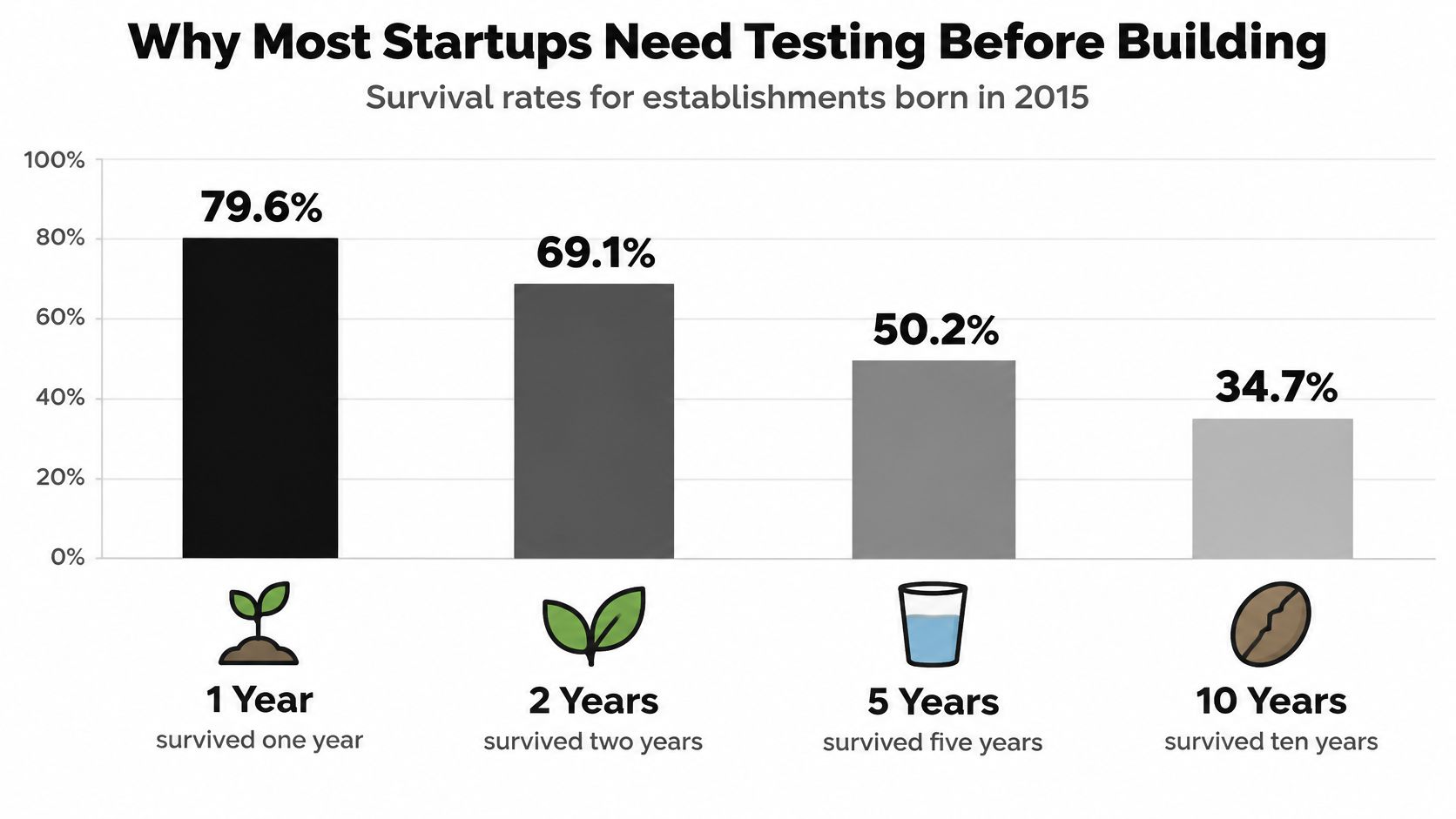
The failure pattern behind that attrition is stubbornly consistent. The post-mortem data in that same analysis identifies inadequate market demand as the leading cause, with "no market need" appearing in approximately 35% to 42% of analyzed failures, while running out of cash is commonly reported at roughly 29%. Newer numbers point the same way: in 2024, 43% of 431 failed venture-backed companies were attributed to poor product-market fit, according to Preuve's analysis of startup failure data.
Cash doesn't vanish on its own. It disappears into months of building, hiring and ad spend that happen before anyone confirmed a large enough group would pay. That's why a few weeks of interviews and a small page test is the cheaper purchase, every time.
If you intend to build something anyway while you test, keep it disposable. A primer on launching a lean web MVP in 2026 from Arch is a sensible way to scope something you can throw away without regret.
Market-demand assumptions deserve their own test, with a number attached, before the first serious invoice.
The Customer Development Logic Behind Validation
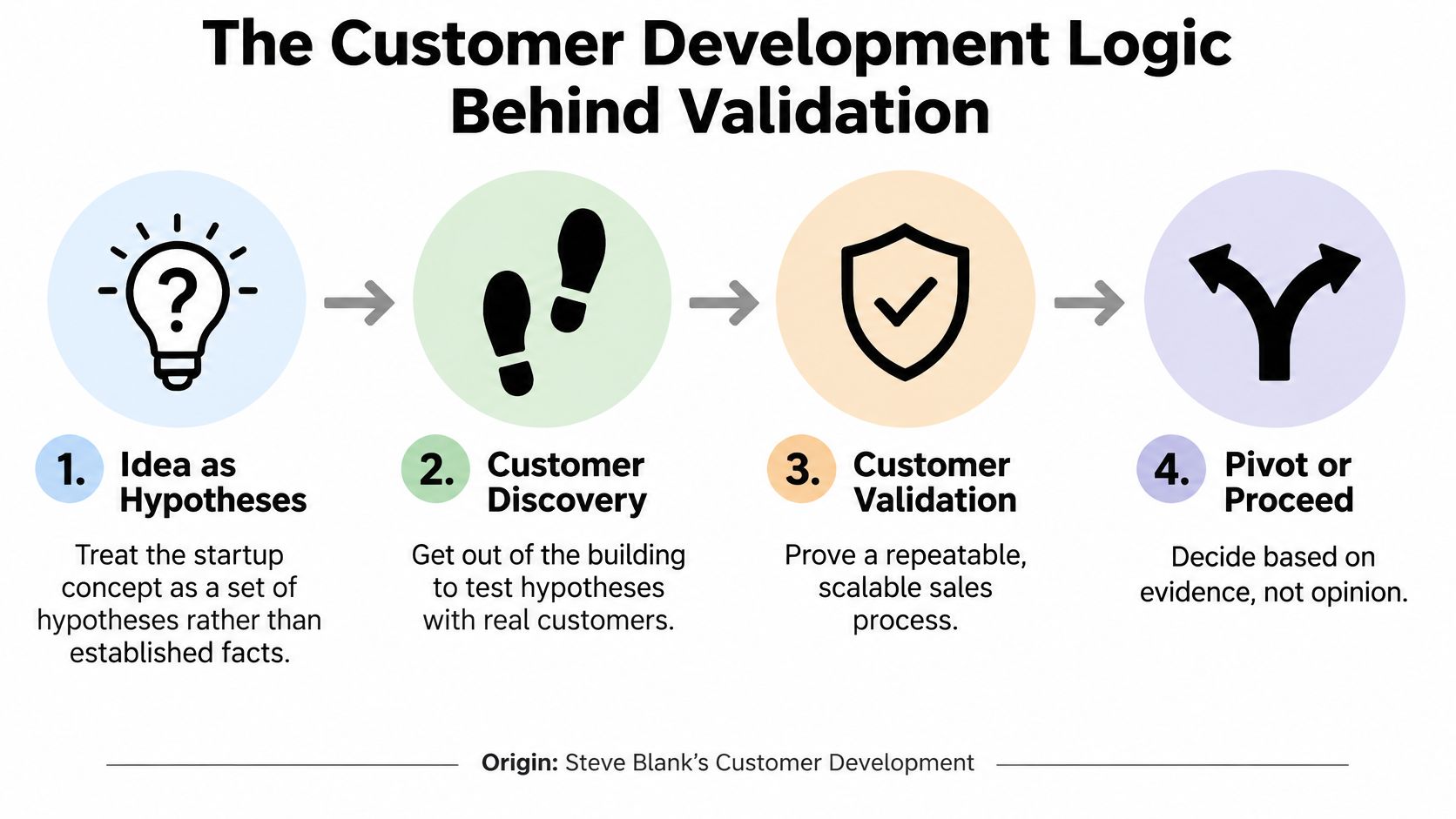
An engineer doesn't open a new bridge to traffic and hope. Someone loads it with weights first, in steps, and watches what bends. Idea validation applies the same logic to a business model, and it became a formal discipline through Steve Blank's Customer Development framework, articulated in the late 2000s and widely associated with his 2005 book The Four Steps to the Epiphany, as Blank's own writing on customer development sets out.
The framework's first move is a reframe. A startup's business model is a set of hypotheses, not a set of facts you're defending.
Two phases, one job each
Customer discovery means picking a target customer, studying how they work today and where it hurts, then checking whether the problem is big enough to make them change anything. Notice the standard: not whether they dislike the problem, but whether it's severe enough to move them.
Customer validation follows, and it tests something different. Does the proposed solution attract real commitments, meaning purchases, pilot agreements, active use or another measurable behavior? Discovery asks what's broken. Validation asks whether anyone will pay to fix it.
Blank's argument for founders running these conversations themselves, rather than delegating to sales staff or a research firm, is practical. Direct conversations reveal whether a customer recognizes the problem, wants it solved and will pay. A summary of those conversations rarely carries that much.
If you're starting discovery this week, a structured guide to running customer discovery interviews will keep you from turning the call into a pitch.
Why it's a money decision, not a brainstorming exercise
The economic logic is the part founders skip. The framework says to validate a repeatable, scalable revenue model before you increase hiring and burn. Run that in reverse and you see the assumption founders are making: that growth spend fixes an unproven model. It doesn't. It accelerates whatever the model already does.
Validation, framed this way, is capital allocation. The milestone that matters is behavioral: customer orders, active use, or another success metric you defined in advance. Favorable opinions don't clear the bar, no matter how many of them you collect.
The only test that counts early: real strangers, not friends or coworkers, give money, time or a clear yes before the product exists.
The first move takes one sentence
Write the problem as one sentence with a real buyer in it. "Independent bookkeepers spend three or more hours a month reconciling marketplace payouts by hand" is a sentence you can test. If you can't produce one, the idea isn't sharp enough yet, and no amount of building will fix that.
Read your sentence back and ask whether a specific person would nod at it. If the buyer is "small businesses" or the problem is "inefficiency", you've written a category, not a hypothesis.
Turning Assumptions Into Testable Hypotheses
A hunch can't be tested. A sentence with a number in it can, and that's the whole conversion job.
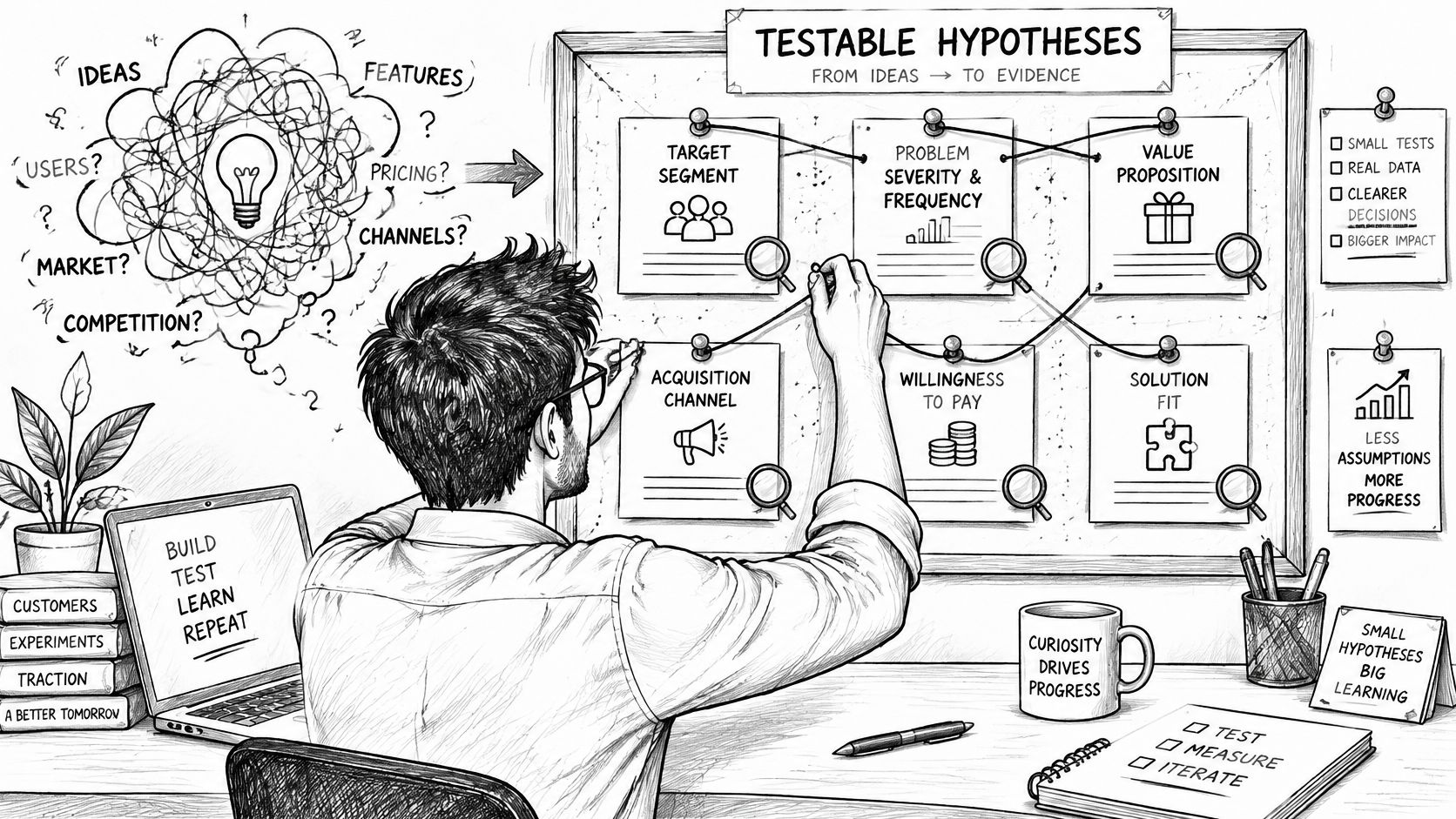
Break your idea into at least six hypotheses: the target segment, the severity of the problem, how often it occurs, the value proposition, the acquisition channel, willingness to pay and the size of the market you can realistically reach. A synthesis of Lean Startup research published in Entrepreneurship Theory and Practice describes validated learning this way, as forming hypotheses, testing them through experiments and using the results to generate better hypotheses, with customer development, minimum viable products and market-opportunity analysis working together rather than separately. A working guide to market research for startups is worth reading before you fix the market-size number, since that's the assumption founders most often leave untested.
Four parts every hypothesis needs
A prediction you can measure. An experiment that produces the measurement. A threshold that decides pass or fail. A next action if it fails.
Here's the template, worth copying for each assumption:
We believe [segment] has [problem] at least [frequency]; we will test this with [experiment]; we pass if [threshold] is met within [window]; if it fails, we will [next action].
Written out, it looks like this. We believe independent bookkeepers reconcile marketplace payouts manually at least four times a month; we will test this with twelve interviews and a paid concierge pilot; we pass if four of twelve put down a deposit within three weeks; if it fails, we move the same test to ecommerce bookkeepers.
Set the threshold before you look at the data
This is the quality-control rule the whole method rests on: define pass or fail before collecting results, so the standard can't drift once the numbers look friendly. The most common failure isn't a bad experiment. It's a good experiment with a threshold invented afterwards.
Comparisons beat single readings whenever you can afford one. Test two value propositions, two price points or two onboarding flows with comparable groups and the same traffic source, then compare activation, retention at a fixed interval, conversion to paid use and acquisition cost. Controlled designs are standard in this field: a review in Organizational Research Methods identified 46 randomized or quasi-experimental studies and 44 conjoint-experiment studies of opportunity evaluation published from 2000 through 2015.
That review also flags the trap waiting for every founder: respondents recruited from your own network overstate demand, because they want you to succeed. Strangers who complete a costly action are the ones telling you the truth.
The threshold itself changes with the product model. Use these as starting numbers, then write your own.
| Product model | Validation signal | Window |
|---|---|---|
| SaaS or digital product | 10 strangers paying anything | Within 14 days |
| Course or info product | 10 to 20 paid signups | Before the first lesson exists |
| Marketplace | 5 paid matched transactions brokered by hand | Before any code is written |
Notice what the marketplace row implies. You're matching buyers and sellers personally, by email and spreadsheet, because the question isn't whether software could do it. It's whether the match has value at all.
Write three hypotheses tonight, with thresholds, before you run a single experiment.
Ranking Evidence From Interest to Paid Commitment
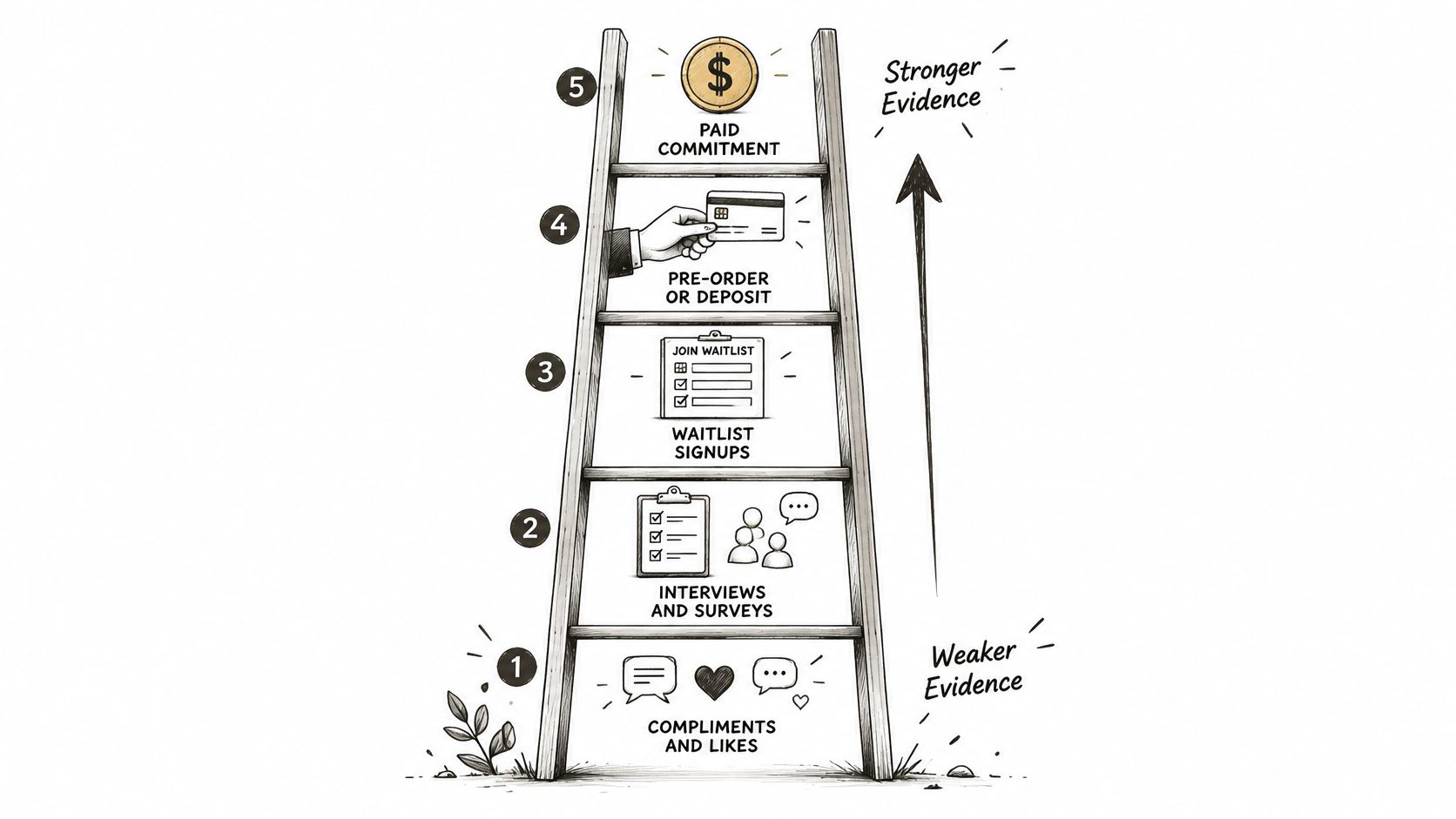
The most expensive mistake in validation is treating all positive feedback as one substance. Interviews, surveys, waitlist signups and enthusiastic replies get stacked into the same pile, and the pile gets read as proof.
It isn't proof. Sort it by cost instead.
| Evidence | Strength | Why it counts |
|---|---|---|
| Compliments, likes and retweets | Weak | Costs the giver nothing |
| Waitlist signup | Weak to moderate | Cheap to give, but no money or time changes hands |
| Stated interest in interviews | Moderate | Useful for discovery, not for a build decision |
| Pre-order or deposit | Strong | Real money at risk |
| Paid pilot or signed letter of intent | Strong | Budget is committed |
| Repeated use of a manual workaround | Strong | Shows the problem already costs time today |
Why cost is the sorting rule
A like costs a tap. A deposit costs money the person could spend elsewhere. When someone hands over both a work email and a hundred dollars, they've paid twice, and the second payment is the one that predicts a purchase.
That distinction is usually lost. As SBE Council's 2025 small business technology survey illustrates, nearly 30% of small firms wanted AI tools better suited to unmet business needs. That's a real, unmet need, and it still isn't validation. Wanting a better tool and paying for one are separate events, and you have to test the second.
Likes, retweets and "this is genius" comments are encouragement. Encouragement is pleasant and it costs nothing to give.
The contrarian read on crowded markets
A market where people already spend money and complain about their tools is more promising than a gap nobody has budgeted for. Active spending proves the pain is real and funded. Incumbent dissatisfaction tells you where to position. The bad setup is a "unique" idea with no existing budget line, because you'll spend your first year teaching the market that it has a problem.
So when you find three competitors and a stream of complaints about them, don't treat that as a red flag. Treat it as a starting price.
Turning the ranking into a decision
Set a threshold for each evidence type before you collect it. How many independent prospects must describe the same urgent problem in the same words? What price gets tested, and at what conversion does it count as a pass? The default assumption should be that anything without money or a work email from outside your network is still inventory, not verdict.
Apply the ladder to what you already have. If the top of your stack is a waitlist and a folder of kind emails, you're at stage two, not stage three.
Checking AI-Assisted Ideas Without False Confidence
Generative AI can produce customer segments, competitor gaps, feature lists and a full experiment plan before lunch. That speed creates a specific failure mode worth naming: synthetic consensus, where a model's summary of generic online opinion starts to feel like market evidence.
Treat all of it as hypothesis material until independent primary evidence arrives. That means interviews you ran, workflows you observed, payment tests you launched, usage data you collected and, most usefully, disconfirming interviews with people who should dislike your idea. If nobody in your sample pushes back, you've been sampling courtesy.
The stakes are rising because building is getting cheaper. AI adoption among startups went from about 21% in 2023 to 44% in 2025, according to reporting on Gen Z founders using AI to launch faster, which means speed and low development cost are weaker advantages than they were two years ago. When everyone can prototype, the only scarce asset is a verified, paying customer.
Synthetic testing tools have a legitimate place, just not as a substitute for buyers. Approaches like validating design ideas with AI participants from Uxia help you pressure-test a flow or a message before you spend money on it. They shorten the path to a test. They don't replace the test.
Four questions AI output can't answer
Can this be built and operated reliably? Will customers trust a machine-assisted version of it? Does it clear the compliance bar in the market you're selling into? Will it stay differentiated once your competitors have the same models? Answering those requires your own evidence, not a summary of other people's.
Localization is the quiet gap. Conclusions drawn from U.S. small businesses may not transfer to another region, sector, language or regulatory environment, and a model trained mostly on English-language sources will rarely flag that mismatch for you.
Three checks to run this week. Label every claim as AI-sourced or people-sourced, and don't let the first column into your decision. Find one interview that contradicts the idea and write down exactly what the person said. Repeat the willingness-to-pay test in the market you plan to serve, at the price you plan to charge.
Run a Two-Week Validation Sprint on Your Idea
The framework fits into fourteen days, and the target spend is under $200. That's the same shape as our 6-step, 14-day validation playbook, and it's deliberately unfancy.
Day 1. Write the problem in one sentence with a real buyer. Confirm you can reach that buyer without paying for a list. If you can't reach them, you don't have a testable idea yet.
Days 2 to 4. Recruit strangers, not friends or coworkers, and run ten or more problem interviews. Record the pain in their own words, then count how many describe the same pain unprompted. That count is your stage one result.
Days 5 to 9. Build the cheapest test your product model allows. For SaaS, a landing page with Stripe checkout for a paid waitlist plus $50 to $150 of ads does the job, and there are plenty of working waitlist landing page examples to borrow structure from. For a physical product, a Shopify or Kickstarter page with the actual price and $100 to $300 of traffic is enough, using a sample or a 3D render rather than production. Write your pass and fail thresholds down before the first visitor arrives.
Days 10 to 12. Run the experiment and score it against those thresholds, not against how it felt. Give it enough traffic to mean something, since a few dozen cold visits from strangers tell you very little and 200 to 500 is a fairer read.
Days 13 to 14. Decide. Build if the signal cleared the bar. Iterate on one variable if it nearly did. Move on if it failed, and don't relabel a miss as a lesson. The decision lands within 14 days either way.
If you don't have an idea to test yet, ours collects pain points people discuss on Reddit and Hacker News, which beats staring at a blank page.
One budget note that saves months: spending more than about $500 on validation usually means you're avoiding the harder work, which is talking to people who might say no.
So write the sentence now. Who pays, for what, and how often.
A waitlist is a list of people who gave you an email. Find Startup Idea is built for what comes next: it collects the pain points founders and operators post on Reddit and Hacker News, so you can start from a real problem instead of a blank page, and it hands you a saved idea plus a launch prompt when one fits what you'd put your name on. Pair that with the 6-step, 14-day validation playbook on Find Startup Idea and you can move from raw complaint to a paying stranger in about two weeks.