Market Research for Startups: A Step-by-Step Guide
Learn market research for startups step by step: frame questions, run interviews, size TAM, SAM and SOM, and pick the right tools.
Most advice on market research for startups tells you to start with a big survey, a polished persona, and a headline market size. That's backwards. A survey can't discover a problem you haven't defined, and a persona built from opinions won't tell you who pays. I would start by trying to kill the idea. Look for recent behavior, current spending, and a costly commitment from strangers, and treat praise as noise until someone gives up time, data, or money.
Six Research Stages and What Each One Proves
| Stage | Question it answers | Main method | Typical time |
|---|---|---|---|
| Frame the problem | Who has the problem and how sharp it is | One-sentence problem statement and segment definition | 1-2 days |
| Interview problem holders | Is the pain recent, costly and currently paid for | 15-20 interviews about recent behavior, alternatives and spending | 1-2 weeks |
| Scan competitors | Who already solves it and where they fail | Review mining, pricing pages, switching interviews | 3-5 days |
| Survey | How common the pattern is across the segment | 150-400 qualified responses | 1-2 weeks |
| Size the market | How many buyers are reachable | Bottom-up TAM, SAM and SOM | 2-3 days |
| Test demand | Will strangers pay or commit | Landing page, waitlist, pre-order or paid pilot | 2 weeks |
The stakes aren't academic. The MNB Research summary of CB Insights post-mortem analysis reports that CB Insights' original analysis reviewed more than 110 startup failure post-mortems and found 42% cited "no market need" as the primary reason, while a later update of 431 venture-backed companies that had shut down since 2023 found poor product-market fit in 43% of cases. Running out of cash ends companies, but weak demand is often why cash can't be raised or turned into revenue.
Why the order matters
Framing forces you to name one segment and one frequent, expensive, urgent problem. Interviews test whether people lived that problem recently and already pay to reduce it. Competitor scanning shows whether existing alternatives are good enough, including doing nothing.
Surveying then measures how common a validated pattern is. It doesn't invent the pattern. Sizing counts reachable buyers from the bottom up, and the demand test asks strangers for money or a firm commitment before you build.
Research exists to find out whether the problem is real before the build, not to produce a report after launch.
The sequence loops. If interviews collapse, you go back and reframe the problem. You don't push forward to a survey to get a nicer chart. If only one sub-segment shows pain, you narrow and test that group again.
End this stage with a dated plan, not a folder of notes. Give each stage one owner, one deadline, and a spending cap set before the first call. Without those limits, teams keep researching because stopping feels like failure. With them, a negative result is a cheap answer, and that's the point.
How to Frame Research Questions Before Any Interview
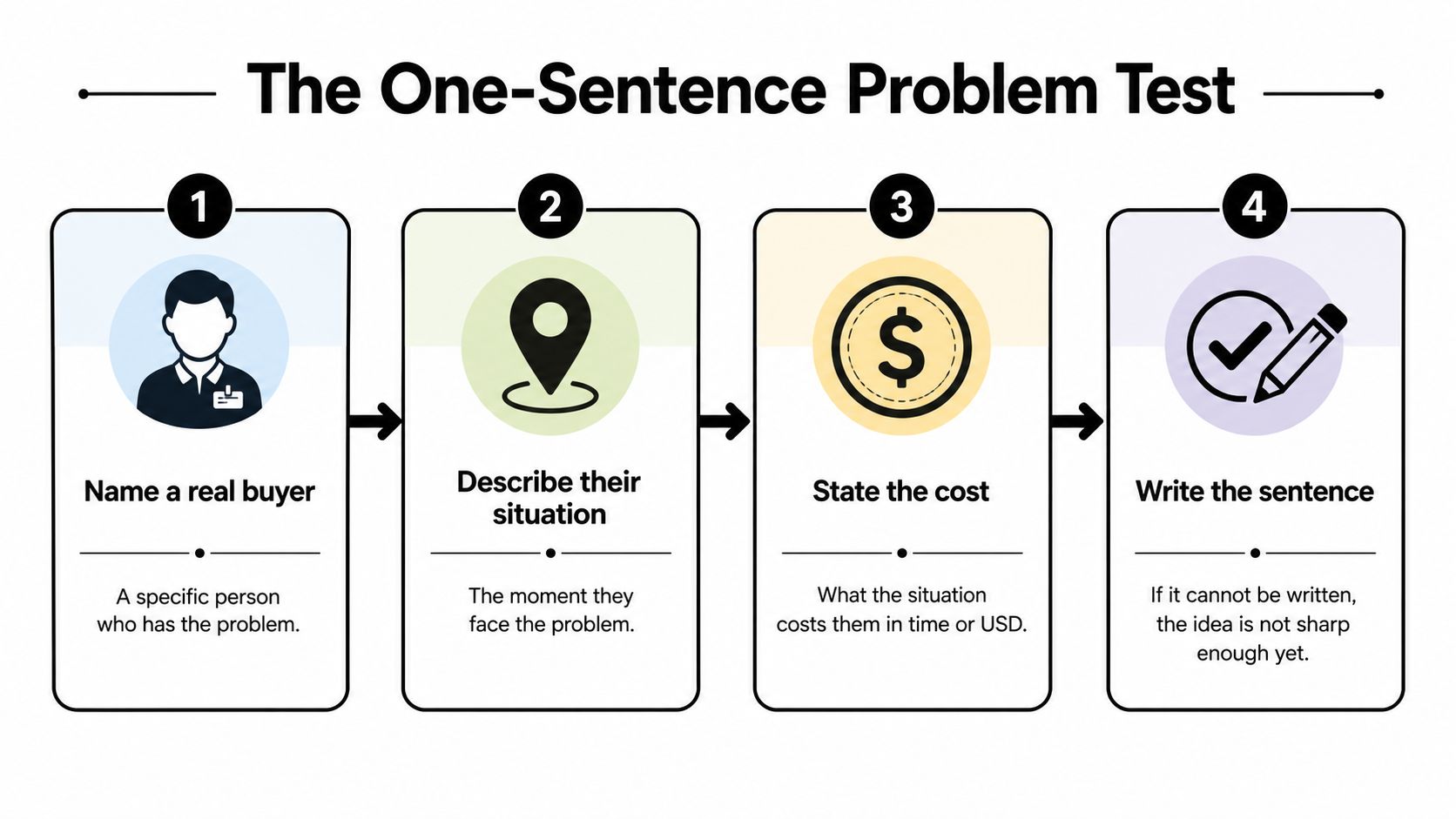
The first validation step is to write the problem in one sentence with a real buyer. If that can't be done, the idea isn't sharp enough. No interview script fixes a vague buyer.
Use the test below before you recruit anyone.
Steve Blank's Customer Development treated a startup as a search for a repeatable business model, not a small version of a large company. You test assumptions outside the building and revise when customers contradict them.
Five steps before the first call
- Write the one-sentence problem with the buyer named. This forces a decision about who owns the pain. Say a sentence reads, "Owners of small clinics lose bookings when staff confirm appointments by phone." That names a buyer, a situation, and a cost.
- Narrow the segment by role, company size, country, and trigger event. Narrowing makes recruiting and comparison possible. Owners of 5-20 person agencies who just lost a client will answer differently from agency owners in general.
- List the job to be done and every current alternative. Include spreadsheets, a freelancer, manual work, and doing nothing. If you only list software rivals, you'll miss the option most buyers end up choosing.
- Write three hypotheses, each with a result that would kill it. A kill rule stops you from rescuing weak evidence later. For example, if nobody can name a recent instance in the last 30 days, we stop.
- Record the disconfirming evidence in a research log before the first call. Writing it early prevents goalpost moving. You decide in advance what counts as a no.
Practical rule: If you can't state what evidence would make you quit, you're collecting encouragement, not doing research.
Keep the log simple and use the same columns for every conversation: source, problem frequency, severity, current workaround, buyer, and economic cost. That structure lets you compare a community post, an interview, and a pilot request on equal terms. It also helps when you use online communities for early market research to find where problem holders already describe workarounds in their own words.
Don't add a second segment because the first is hard to reach. Reachability is part of the test. A sharp problem in a group you can't contact within your runway is not yet a business opportunity, however real the pain sounds.
How to Run Problem Interviews That Show Real Demand
More interviews aren't automatically better. Fifty polite chats with the wrong people teach you less than fifteen sharp conversations with buyers who faced the problem this month. Validating a product idea means proving that real strangers, not friends or coworkers, will give money, time or a clear yes before the product is built.
Recruit strangers who match the segment and trigger event. Aim for 15-20 interviews of about 30 minutes, booked through communities, referrals from non-friends, association lists, or direct outreach. Skip followers who like you but don't own a budget.
The discussion below shows the kind of setting that works, a focused conversation about a real workflow rather than a pitch.

Five questions that expose behavior
- Ask about the last time it happened. "Walk me through the last time this broke. What did you do next?" Recent stories beat opinions about a hypothetical future.
- Ask what it cost. Push for hours lost, money spent, deals missed, or staff pulled off other work. Vague frustration without cost rarely supports a paid product.
- Ask what they tried and why it failed. A paid workaround that disappoints is stronger evidence than a wish list. Ask what they still use despite hating it.
- Ask who approves spending. Find out whether they've already bought a tool for this job and who signed it off. A user who loves the idea but can't buy is not your buyer.
- Ask what would make them switch this month. This reveals switching cost, timing, and the trigger that turns pain into action.
Don't ask "Would you use this?" and don't pitch in the first ten minutes. Both invite politeness. If you need a deeper guide to structure and follow-ups, use a customer discovery interview framework and keep your questions anchored to past behavior.
This video walkthrough is useful for hearing how a discovery conversation should sound when you're listening instead of selling.
Read signals by cost, not enthusiasm
- Weak signals: Praise, "sounds great," asking to be told at launch, or joining a free list. These cost nothing.
- Medium signals: Sharing their actual workflow, introducing a budget owner, showing data, or describing a paid workaround they maintain.
- Strong signals: A deposit, a signed letter of intent, or a paid pilot using their own data and staff time.
Enthusiasm is free. Demand shows up when the other person pays with money, access, reputation, or time.
Stop the round when the same problem, cost, and workaround repeat across six to eight interviews. That rule only applies when the pattern is already clear inside a full round. Don't call six friendly chats saturation. If stories keep changing, your segment is too broad or the problem isn't shared.
Write notes the same day using your log columns. Tag each claim as observed behavior, stated opinion, or your interpretation. Founders who skip that distinction end up quoting their own hopes back to themselves as evidence.
Competitive Analysis and the Tools to Run It
Your hardest competitor is often the status quo. Buyers already cope by doing nothing, delegating the task, or stitching together tools they own. If you can't beat that inertia, a feature gap against a named rival doesn't matter.
Map competition in three layers. Direct products solve the same job for the same buyer. Indirect substitutes include spreadsheets, agencies, freelancers, and internal staff. Doing nothing wins when pain is tolerable, switching looks risky, or procurement takes too long.
Where the useful evidence hides
Mine one- and two-star reviews for repeated complaints about onboarding, price, reliability, or missing integrations. Read pricing pages to see what unit rivals charge by, such as seats, locations, orders, or usage. Interview people who switched away and ask what broke, who decided, and how long migration took.
For price changes you need to track over time rather than check once, Competitor price monitoring software can help you spot patterns without manual screenshots. Use it as an input, then confirm with buyers whether price actually drove switching.
Add timing and geography checks before you pick an entry point. A real problem can still be wrong right now if buying cycles are annual, procurement is slow, local regulation blocks the workflow, or language and support expectations raise delivery cost. Ask about trigger events, budget timing, approvals, and contract renewal dates in every switching interview.
| Tool | Best for | Cost tier |
|---|---|---|
| Google Trends | Demand trends, seasonality and country comparisons | Free |
| Google Keyword Planner | Search volume for problem phrases | Free with an ads account |
| Similarweb | Rough traffic estimates for competitor sites | Free tier, paid plans |
| Crunchbase | Funding rounds, founding dates and investors | Free tier, paid plans |
| G2 | Reviews and complaint patterns within a category | Free to read |
| Reddit and Hacker News search | Unfiltered complaints and workaround talk | Free |
| Otter.ai | Transcribing interviews | Free tier, paid plans |
| Calendly | Booking interview slots | Free tier, paid plans |
Use Google Trends to compare problem phrases by country and season, not to prove willingness to pay. Use Similarweb for rough traffic direction and Crunchbase for who raised, when, and from whom. Use G2 to group complaints by buyer size, because a complaint from an enterprise admin may not apply to a ten-person firm.
Reddit and Hacker News search are better for unfiltered workaround talk than polished case studies. Otter.ai saves transcription time, but you still need to code the log yourself. Calendly removes scheduling friction, which matters when busy buyers give you one chance to book.
Traffic and funding estimates are directional. Cross-check them against interviews, pricing pages, and review volume before they reach a pitch deck. A rival with modest traffic and strong renewals can be harder to displace than a loud rival that churns.
When a Survey Adds Value and How to Keep It Honest
A survey confirms and quantifies what interviews found. It doesn't discover the right questions. Interviews give you the answer options, the buyer's language, and the wording that confuses people.
Define the population and eligibility rule first. Then stratify by customer type and invite randomly where you can. Pilot the wording with three to five people from the segment and watch where they hesitate.
Ask about behavior, not intention. "How many times in the last month did you do this task?" beats "Would you use a tool for this?" Keep choices mutually exclusive so one answer doesn't overlap another.
Keep the error visible
The Pew Research Center methodology notes state that nonresponse, respondent selection, question wording, and reporting inaccuracy can all introduce error, and a probability sample of 5,166 respondents had a reported margin of sampling error of ±1.6 percentage points, which still didn't eliminate coverage or nonresponse bias. Your small convenience sample won't prove market size or willingness to pay.
- Analyze each segment separately: Report users and purchasers apart before you show any aggregate.
- Report response rate and exclusions: Say who was invited, who qualified, and who you removed.
- Weight when the sample differs: Adjust when your respondents don't match the target population.
- Compare weighted and unweighted results: If the decision flips, you don't have a stable finding.
Decision check: If the survey can't change a build, narrow, or stop choice, don't run it.
Common pitfalls are surveying followers instead of buyers, mixing users with purchasers, and treating high stated intent as a forecast. Tie the final question to an action such as a demo request, deposit, or paid pilot. That's the metric you'll trust.
Sizing TAM, SAM and SOM From Bottom-Up Counts
Start from counts, not a report's headline. A headline tells you a category exists. It doesn't tell you how many buyers you can reach, serve, and win before money runs out.
The funnel below shows the logic from every possible buyer down to the share you can realistically capture.
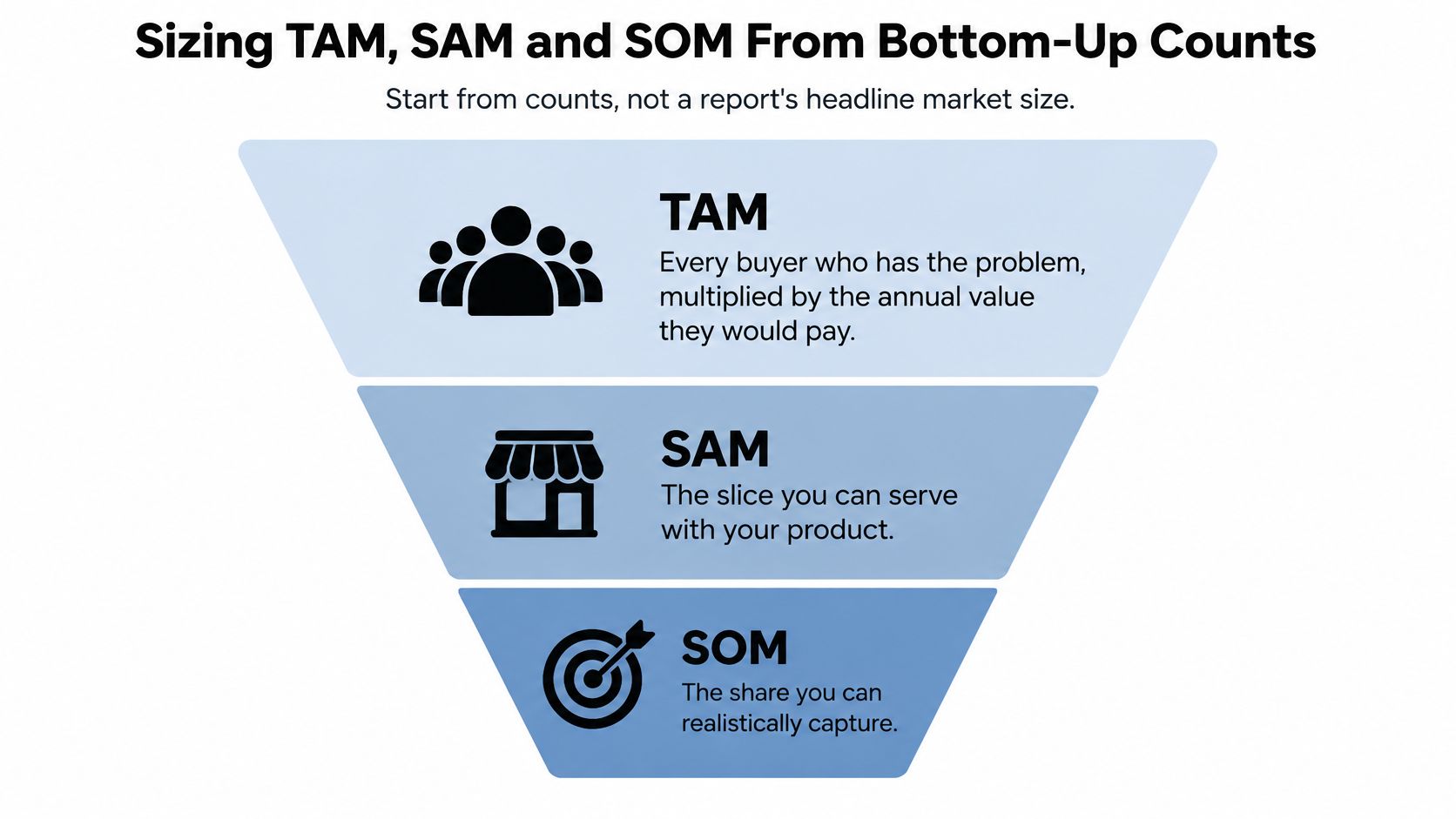
TAM is every buyer who has the problem, multiplied by the annual value each would pay. SAM is the slice you can serve with your product, geography, language, and sales channel. SOM is the share you can realistically win in two to three years given your reach and capacity.
Worked example using illustrative clinic counts
Say you're selling booking software to clinics at €1,200 a year. These figures are illustrative. Copy the method, not the numbers.
| Layer | Clinics | Annual revenue at €1,200 each |
|---|---|---|
| TAM | 12,000 | €14.4M |
| SAM | 7,200 | €8.6M |
| SOM | 144 | €172,800 |
Start with 12,000 clinics. At €1,200 each, TAM is €14.4M a year. If 40% already book online and you can't serve them yet, 60% remain. That's 7,200 clinics, or about €8.6M, for SAM.
Winning 2% of SAM gives 144 clinics and about €173k a year for SOM. That final line is the one to interrogate. It tells you whether early revenue can support the team you're planning.
Source each count where a reader can check it. Use government registries, association membership lists, Crunchbase company counts, licensing lists, or your own interview sample scaled up with a stated assumption. Write the assumption beside the number. If you can't name the source, label it a guess and test it.
Avoid the top-down trap of claiming one percent of a $50 billion market. That sentence assumes the hard part. It doesn't show which buyers, which channel, which price, or why they'd switch to you.
Finish with a capacity check. Count how many sales conversations your SOM requires each month, allowing for replies, calls, pilots, and closed deals. Then ask whether the founder can run those conversations while building. If the math needs a sales team you can't fund, narrow the geography, raise the price hypothesis, or pick a segment with a shorter path to the buyer.
Test Demand With a Minimum Viable Offer
Run the demand test before any build, with one offer for the segment you chose. You're testing commitment, not collecting compliments.
- Build one landing page. State the problem, outcome, price, and one action: pre-order, paid waitlist, or paid pilot. If you're unsure what counts as the smallest testable version, review what an MVP should include and cut everything that doesn't affect the decision.
- Send only segment traffic. Use the communities, newsletters, partner lists, and referrals where interviewees already gather. Broad ads bring curious bystanders who inflate sign-ups.
- Set the threshold before launch. For SaaS or a digital product, the bar is ten strangers paying anything within 14 days. Waitlist emails don't count toward it.
- Record every step. Track visitors, sign-ups, prepayments, and refund requests by source. A channel that sends clicks but no payments is a finding.
- Cap spend and stop on time. End when the fixed cap or window ends, even if results feel close.
Prepayment and a signed letter of intent outrank email sign-ups because signing up costs nothing. If you sell a physical or commerce product, the discipline is the same, and it's worth learning how to research product ideas before selling so you test the offer rather than your ability to make a pretty page.
Compare the result with the threshold you wrote down. Pass, miss, or unclear segment performance all go to the final decision without rewriting the bar.
Confirm the Build, Narrow or Stop Decision
Use the decision rule you wrote before research started. The final decision is made within 14 days: build, iterate on one variable, or move on.
- Build: Interviews show repeated recent pain and the demand test hits its threshold, such as 10 strangers paying anything inside 14 days for SaaS or a digital product.
- Narrow: One sub-segment shows medium or strong signals and the rest don't. Rerun sizing and the demand test on that sub-segment alone.
- Stop: Nobody can name a recent, costly instance across the segment after you meet the interview target, or buyers won't commit when asked.
Iterate on one variable only, such as price, onboarding, buyer, or trigger event. Changing three things at once leaves you unable to explain the result. If you'll need outside capital after a build decision, you can explore funding options for South Florida startups while keeping the evidence log ready for investor questions.
Spending more than $500 on validation usually means avoiding the harder part, which is talking to people. Ads, tools, and design feel productive. Asking a stranger for a deposit is uncomfortable, and that's why it works.
- Problem named: One sentence with a real buyer and a cost.
- Evidence logged: 15 or more interviews focused on recent behavior.
- Segment chosen: One group, not a blend of everyone who responded.
- Commitment tested: Payment, pilot, deposit, or signed intent.
- Decision dated: Build, narrow, iterate once, or stop.
If you need candidate problems to test, shortlist them and run each one through this same sequence. Don't promote an idea because it sounds popular. Promote it because buyers paid to make the problem go away.
Find Startup Idea surfaces startup ideas sourced from real Hacker News and Reddit pain points, so you can start with problems people already describe instead of inventing demand from a blank page. Shortlist a few candidates, run each through the framing, interview, and paid-commitment tests above, and build only where strangers prove the pain is worth paying for. Start your shortlist at Find Startup Idea.