8 Minimum Viable Product Examples and What Each Tested
Explore minimum viable product examples from Dropbox, Airbnb, Stripe and more, with what each tested and how to validate your own idea.
“Build a smaller product” is popular MVP advice, but it can still send you in the wrong direction. Founders can spend heavily on a polished, limited application while avoiding the uncomfortable work of asking real buyers to commit. A cheaper test often produces a clearer answer because there's less room to hide behind development progress.
The useful definition is the smallest testable version of a product, with emphasis on testable. Before choosing features, name the uncertainty: whether people understand the benefit, trust the transaction, accept the price, return to the workflow, or complete the integration.
These minimum viable product examples are useful as experiments, not success stories. Each isolated a question before the founders built the broader business. Some tested interest before a complete product existed; others used a working service or focused application to observe behavior that a landing page couldn't reveal.
Practical rule: Choose the cheapest test that produces the evidence your next decision requires, not the cheapest thing you can publish.
A registration isn't a purchase. A purchase isn't retention. A successful manual delivery isn't proof that you can serve customers profitably at scale. Copy the experiment that matches your uncertainty, accept its limitations, and decide in advance what you'll do with the result.
1. Dropbox Explainer Video MVP
Dropbox tested whether people could understand and want an unfamiliar workflow before the consumer-ready service was complete. In 2007, Drew Houston recorded a roughly three-minute demonstration, according to StartDesigns' account of the Dropbox MVP, which describes approximately 70,000 interested sign-ups from the early demonstration.
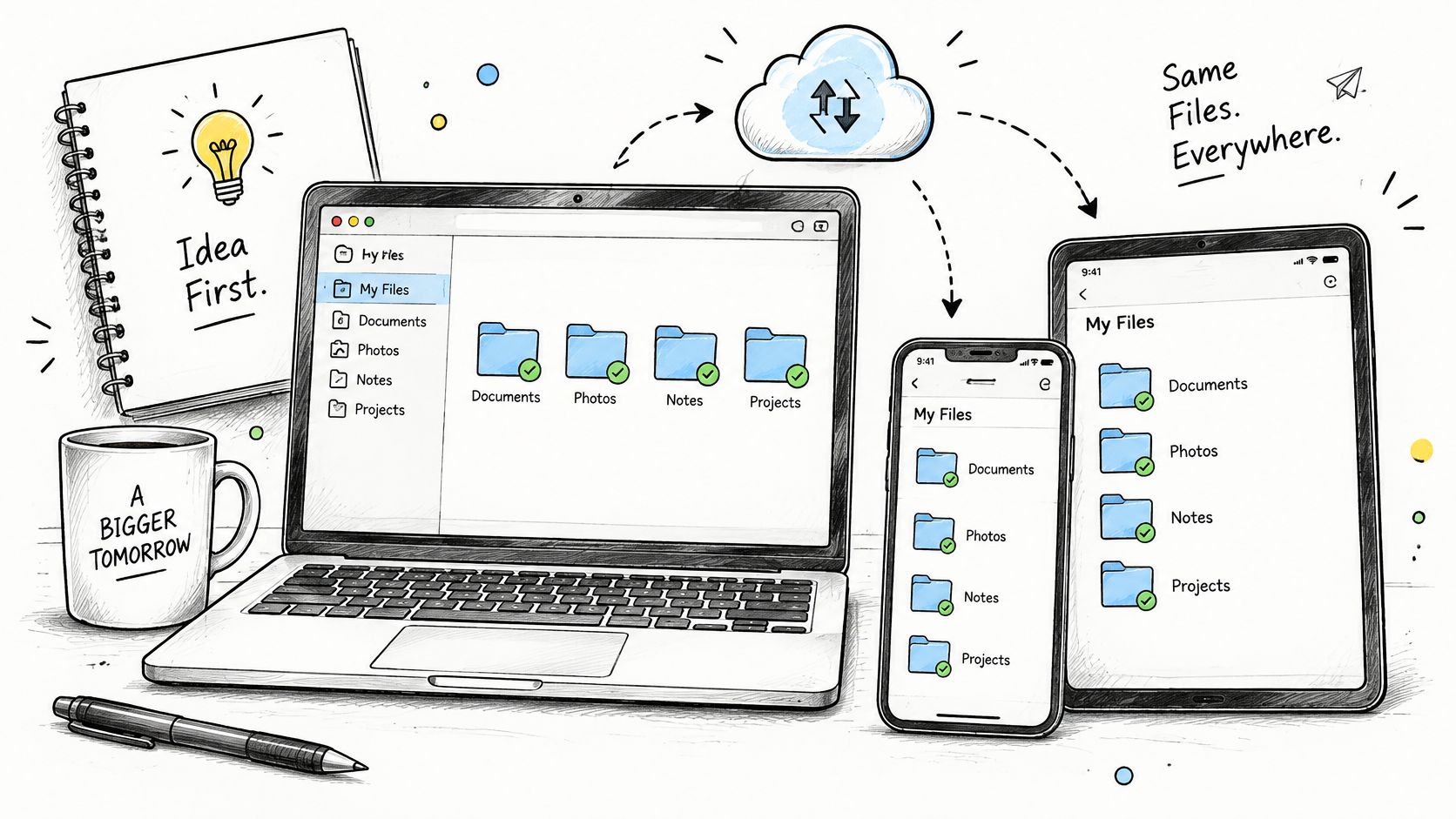
The underlying benefit was easier to show than describe. A file changed on a computer, then appeared where the user needed it elsewhere, without an awkward transfer process.
This illustration captures the outcome the demonstration needed to communicate.
Copy the workflow, not the production quality
For a document-approval tool, record a prototype showing a buyer receiving a draft, requesting changes, and approving the revision. Explain the starting frustration and the finished outcome, then offer a clearly labeled early-access registration. This explanation of an MVP helps distinguish a bounded learning experiment from an undersized feature roadmap.
Track qualified visitors, registrations, and acquisition source. Follow up with registrants to learn what they currently use and whether they'll participate in a hands-on pilot.
Watch how the demonstration makes the workflow concrete.
The trade-off: You postpone infrastructure work, but you also postpone learning about reliability and ongoing usage. A persuasive demonstration validates comprehension and initial interest, not willingness to pay.
The copying trap: Treating a large waitlist as permission to build everything. Your next experiment should ask for a stronger commitment, such as a pilot appointment or a transparent paid reservation, rather than collecting more passive interest.
2. Zappos Retail Store Validation MVP
The Zappos test worked because it was almost embarrassingly unscalable. The question was narrow: would shoppers order shoes online without trying them on? The early pre-inventory ordering experiment separated that demand question from the cost of owning stock.
The method was manual on purpose. Show shoes online, take an order, then buy the pair from an existing retail store and ship it. The customer saw a real online offer; the founder absorbed the fulfillment mess behind the scenes.
That split is the lesson. Manual delivery can test willingness to buy while telling you very little about margin, returns, or whether the operation can survive growth.
Run a narrow catalog experiment
For a copyable version, pick a constrained category such as specialist gardening tools. A two-week version needs supplier permission, product details and images, confirmed availability, and a small catalog with actual prices and honest delivery times. Do not list stock you cannot reliably source.
Track each order in a spreadsheet:
- Purchase behavior: which items produce paid orders rather than casual browsing.
- Delivery effort: sourcing time, buyer communication, packing, and exceptions per order.
- Contribution: what remains after acquisition, sourcing, delivery, and refunds.
- Repeat intent: whether the buyer returns when a related need appears.
Test the assumption that could kill the business before polishing the storefront. A riskiest-assumption test beats a general request for feedback.
The signal: a stranger pays the advertised price and accepts the stated delivery terms.
The copying trap: counting revenue while ignoring founder labor and fulfillment losses. Keep a separate experimental subsidy column so the cost of learning stays visible beside the economics the business will eventually need.
3. Airbnb Air Bed and Breakfast MVP
Airbnb's early experiment answered a specific question: would travelers pay to stay in a stranger's home when conventional accommodation was scarce? During a sold-out San Francisco design conference in 2007, Brian Chesky and Joe Gebbia offered space in their apartment and hosted three paying guests, according to InfoStride's account of the Airbnb MVP.
The founders didn't need a global marketplace to observe a real transaction. They needed available space, a basic listing, a high-intent traveler, and enough trust to complete the stay.
The arrival experience was part of the product, not an operational detail to postpone.

Use urgency to narrow the marketplace
For a copyable experiment, consider matching exhibitors with local equipment rental providers around a trade show. Recruit suppliers directly, publish available equipment, and broker requests through email or a form. Confirm the price, availability, collection arrangements, and cancellation terms before accepting payment.
Measure completed paid matches, failed requests, cancellations, and the time required to coordinate delivery. Ask both parties what nearly prevented the transaction.
The trade-off: An event creates concentrated demand, but that urgency may disappear afterward. Successful bookings during a shortage don't establish normal-season demand, repeat usage, or attractive delivery economics.
Start with a constrained occasion, but test again outside that occasion before treating urgency as a permanent customer need.
The copying trap: Building listings while neglecting supply quality. A marketplace isn't validated because people browse inventory. You need buyers receiving the promised outcome and suppliers willing to participate again without constant persuasion.
4. Buffer Pricing Page MVP
A pricing page asks a harder question than a feature page. Instead of merely asking whether a scheduling tool sounds useful, Buffer's early landing-page approach put prospective customers in front of paid plans before the full service was available.
The important behavior was plan selection followed by contact submission. That's stronger than a page view because the visitor has considered a commercial offer, but it still falls short of payment.
For your own test, keep the offer specific. A social scheduling tool for independent consultants should describe the workflow it replaces, show the proposed billing basis, and explain who the service is designed for.
Make the commitment honest
Build a landing page with a clear outcome, a sample workflow, and meaningful plan differences. When someone selects a plan, explain that the product is in development and invite them to join a pilot. Don't imply that an unavailable service is ready to use.
Record the path from visitor to plan selection to pilot conversation. This guide to willingness to pay helps separate price curiosity from an actual purchasing commitment.
- Useful evidence: Qualified buyers choose a plan and agree to discuss a concrete start date.
- Stronger evidence: Buyers accept a clearly disclosed paid pilot or reservation.
- Weak evidence: Visitors select the cheapest option but won't explain their need or continue the conversation.
The trade-off: You can test positioning and pricing presentation cheaply, but visitors haven't experienced the product's value.
The copying trap: Choosing permanent pricing from click behavior alone. Buyers may click to inspect the offer, not because they accept the price. Ask who controls the budget, what they'd replace, and whether they want recurring software rather than a service or one-time tool.
5. Groupon Single-City Daily Deal MVP
Groupon's daily-deal model is useful to reverse-engineer because it involves two customers with different definitions of success. Consumers want an attractive offer. Merchants need business that justifies the discount and the delivery burden.
A narrowly scoped local deal tests whether you can recruit a merchant, reach relevant buyers, collect commitments, and deliver the offer without disappointing either side. None of that requires a broad marketplace or a complicated merchant dashboard.
Consider a neighborhood pottery studio with unused weekday capacity. Agree on an introductory workshop offer, publish the exact terms, and promote it to people who can realistically attend.
Test the merchant's outcome too
Use an email list and a simple purchase page rather than building a discovery app. If the offer depends on minimum participation, state the condition clearly and explain what happens if it isn't met.
Track the complete transaction:
- Acquisition: Where did paying customers come from?
- Redemption: Did purchasers attend or use the service?
- Delivery: Could the merchant accommodate demand without disrupting regular customers?
- Merchant value: Would the business repeat the offer on comparable terms?
The signal: Consumers buy and redeem the offer, while the merchant considers the resulting business worthwhile. A busy checkout page proves little if the merchant refuses to participate again.
Watch the subsidy: If the deal works only because the merchant absorbs an unacceptable loss, you haven't validated a repeatable proposition.
The copying trap: Assuming discounted demand represents full-price demand. Separate customers attracted solely by the bargain from those who return for the underlying service. The practical trade-off is speed versus representativeness: a compelling promotion can recruit buyers quickly, but it can also attract customers your eventual business won't profitably retain.
6. Instagram Focused Photo App MVP
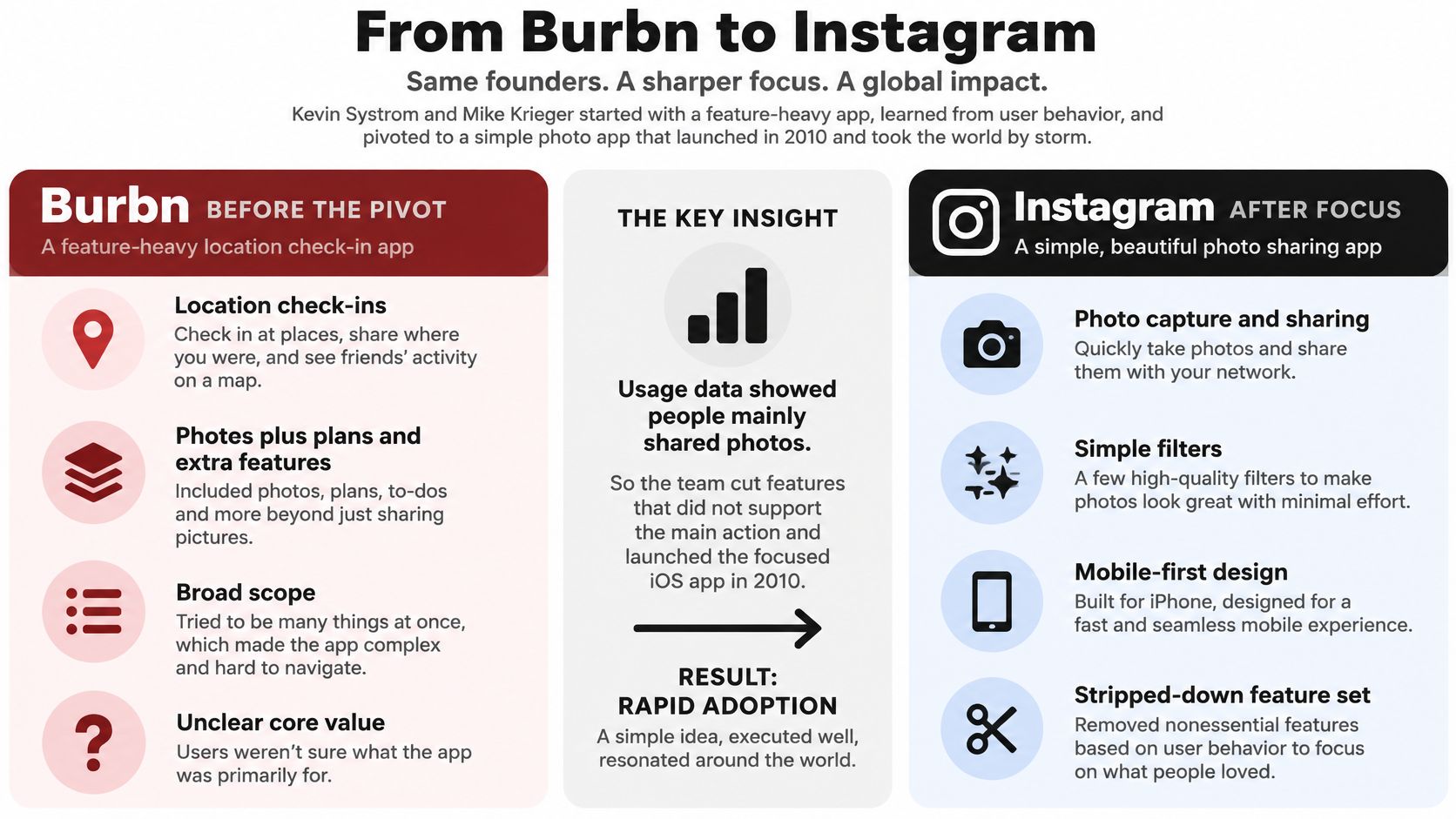
Instagram's evolution from Burbn illustrates a different kind of MVP decision: reduce an existing experience around the behavior users choose to repeat. Rather than asking customers to evaluate a larger collection of features, the focused photo app put sharing at the center.
This isn't the same experiment as a landing page. Users need something functional enough to complete the activity, return, and demonstrate whether the narrower experience remains useful.
The contrast is between a broad feature set and a clearer core action.
Observe completion and return behavior
Say you have a creator app with planning, chat, editing, and publishing. Instrument each action, then examine which completed workflows lead people to return voluntarily. Don't confuse prominent placement with genuine preference.
Build a focused version around the strongest behavior and invite relevant users to complete their normal work. Compare task completion, abandonment, and repeat usage, then ask what they still need outside the app.
An education-software experience report published by Agile Alliance describes a learning-chart MVP that helped students and educators view progress, with educators expressing interest in trying it with their own students. The practical lesson is to isolate a useful outcome and distinguish stated enthusiasm from observed reuse.
The trade-off: Removing features improves focus but may remove supporting steps users need to finish the job.
The copying trap: Cutting everything except the most frequently clicked feature. A less-used export or permission control may be essential to completing the workflow. Optimize for repeatable customer outcomes, not a popularity contest among interface elements.
7. Facebook Harvard-Only Launch MVP
A social product with scattered users can look empty even when the underlying idea is attractive. Facebook's Harvard-only launch illustrates why a bounded community can be a more useful starting point than unrestricted registration.
The experiment is best understood as a test of relevant network density. Can people find others they recognize, receive useful responses, and develop reasons to return within an existing community?
For a copyable version, take a professional network for independent restaurant owners. Start with an established local association rather than inviting unrelated owners everywhere. Give members a clear activity, such as exchanging supplier recommendations, and make it easy to respond.
Restrict the audience, not the evidence
Track whether members initiate useful interactions without founder prompting. Separate account creation from meaningful participation, and distinguish community-driven replies from conversations your team manufactures.
Ask practical questions before expansion:
- Connection: Can a new member find someone relevant?
- Response: Do requests receive useful answers?
- Return: Do people come back without repeated reminders?
- Dependence: How much activity disappears when the founder stops intervening?
The signal: Members create value for one another and return because of those interactions. A full directory is weaker evidence than a working exchange between people who didn't need you to broker every step.
The trade-off: A tight community makes recruitment and feedback easier, but it can conceal dependence on shared identity, personal relationships, or unusual enthusiasm.
The copying trap: Treating exclusivity as the product. Restricted access helps only when it creates a better experience. Before opening broadly, recruit an adjacent community and check whether the same behavior appears without importing all the social conditions that supported the original launch.
8. Stripe Seven-Line Payments MVP
The useful idea behind Stripe's seven-line integration shorthand is a shorter path from developer intent to a working payment flow. Don't treat the code count as the experiment. The practical question is whether a developer can complete the target integration without fighting setup, documentation, and unfamiliar payment concepts.
This type of MVP requires a functioning technical path. A persuasive screenshot can attract interest, but it can't establish that developers can successfully integrate an API.
For a copyable test, consider an invoice-generation API. Support a narrow request format, provide a runnable example, and return a usable invoice rather than building a complete accounting platform.
Narrow capability without weakening safeguards
Invite developers to integrate it into a small project. Observe where they pause, which errors they encounter, and whether they can recover using the documentation.
Measure successful completion, support required, and willingness to use the integration again. Keep founder-assisted and self-serve results separate, because a working integration achieved through constant intervention doesn't prove easy onboarding.
Operational evidence matters alongside demand. A healthcare-booking pilot described in WithRemote's MVP case study processed 240 patient bookings and completed 218 visits over 90 days. That distinction between starting a workflow and completing its intended outcome is useful for technical products too.
The trade-off: A narrow API can make one integration simple while leaving broader compatibility unresolved. Document unsupported cases rather than handling them through custom work.
The copying trap: Reducing visible complexity by hiding risky manual processes. Payments and other sensitive workflows still require appropriate security, access controls, error handling, and specialist review. Small scope isn't permission for weak safeguards. Simplify the customer's task without pretending the underlying obligations have disappeared.
What each MVP tested, the signal it measured, and what it cost
| Item | Core Test | Signal Measured | Cost Level | Best For |
|---|---|---|---|---|
| Dropbox Explainer Video MVP | Demo the core value before building the product | Waitlist signups | Very low | Testing demand for a product concept |
| Zappos Retail Store Validation MVP | Sell online using store inventory and manual fulfillment | Orders and purchasing behavior | Low | Testing demand without holding inventory |
| Airbnb Air Bed and Breakfast MVP | Offer home stays to guests through a basic listing site | Bookings and willingness to pay | Very low | Testing a local marketplace with real transactions |
| Buffer Pricing Page MVP | Present pricing plans before building the product | Plan clicks and email signups | Very low | Testing pricing and purchase intent |
| Groupon Single-City Daily Deal MVP | Offer one deal in one city with a minimum-buyer threshold | Deal purchases and merchant response | Low | Testing a local offer model before expanding |
| Instagram Focused Photo App MVP | Focus the product on photo sharing and filters | Feature usage and repeat photo sharing | Moderate | Finding the most valued behavior in an existing product |
| Facebook Harvard-Only Launch MVP | Launch to one campus before expanding | Engagement and community feedback | Low | Testing a social product in a focused community |
| Stripe Seven-Line Payments MVP | Simplify payment integration for developers | Adoption and developer feedback | Moderate | Validating a focused technical solution |
Turn These Eight Tests Into Your Two-Week Plan
Start with a sentence naming the buyer, the problem, and the consequence. For example: independent bookkeepers lose billable time chasing missing client documents before closing the books. If you can't identify the buyer without saying everyone, narrow the idea before choosing a test.
Then name the uncertainty that could make further development wasteful. You might need to establish that buyers understand the outcome, can be reached economically, accept the proposed price, complete the workflow, or return after their initial curiosity fades.
Match the evidence to the decision
Choose a demonstration when the workflow is difficult to explain. Choose a pricing page when the commercial offer is uncertain. Choose manual fulfillment when you need to observe a real transaction, and choose a functional slice when completion or repeat usage is the unresolved question.
Write the decision rule before launching:
- Build: The intended buyer makes the commitment you requested, and you can deliver the promised outcome within acceptable constraints.
- Iterate: You identify a specific obstacle worth testing, such as unclear positioning, the wrong acquisition channel, or a difficult onboarding step.
- Move on: Qualified buyers understand the proposition but won't commit, or delivery depends on economics you can't plausibly improve.
Keep a simple experiment log with the acquisition source, customer type, requested commitment, observed behavior, delivery effort, and next decision. Record refusals as carefully as conversions. A buyer who explains why they won't switch may provide more useful direction than an enthusiastic subscriber.
Keep the deadline real
Our validation process calls for a decision within 14 days: build, iterate on one variable, or move on. For a SaaS or digital product, our proposed signal is 10 strangers paying anything inside that period, alongside confirmation that they want software and will tolerate recurring billing. That's a practical decision rule for our process, not a universal benchmark for every business.
Don't force a long procurement cycle into a consumer-style checkout test. Identify the user, budget owner, and gatekeeper, then request the strongest feasible commitment from each. An internal champion's enthusiasm isn't the same as purchasing approval.
Find Startup Idea's product validation playbook provides a structured way to run these tests and is drawn from real top-voted Reddit threads. Use the examples as experiment designs, not templates for copying famous companies. The objective is a defensible next decision, not an impressive-looking launch.
Find Startup Idea offers startup ideas sourced from real HN and Reddit pain points, plus a validation playbook for testing an idea before committing to the full build. Visit Find Startup Idea, choose a problem with a recognizable buyer, and turn it into a bounded experiment with a clear commitment and decision date.