Riskiest Assumption Test: How to Find, Run and Read One
Learn how to run a riskiest assumption test on your startup idea: pick the belief that could kill it, design a cheap experiment, and read the results.
Your laptop has fourteen tabs open. One is a competitor's pricing page, one is a Reddit thread where a stranger described your idea's problem better than you ever have, one is a Stripe setup you keep meaning to finish, and one is the Figma file with three months of work in it. Two friends have told you the idea sounds useful. Neither has offered you a dollar.
That's the state most founders are in when they go looking for a way to test an idea properly. The method that answers it is the riskiest assumption test, and the part most guides skip is the least exciting one: deciding before you start what result would make you stop. A test with no pass line isn't a test. It's a mood with a deadline.
The founders who learn cheaply aren't smarter than the ones who learn expensively. They write the decision rule down before the evidence arrives, and then they obey it.
Why One Assumption Can Sink Your Startup
Say a founder spends three months building a scheduling app. Calendar sync works. Timezone handling works. Onboarding is clean. Launch day brings a dozen signups and no buyers, because the people she imagined as customers already solve the problem with a shared calendar and never considered it urgent enough to pay for.
The build wasn't the mistake. The mistake was treating "buyers feel this scheduling pain every week" as a fact instead of the one belief the whole business rested on.
A riskiest assumption test targets that belief, not the full inventory of things that could go wrong. You identify the single assumption most likely to invalidate the business, then run the cheapest credible experiment against it before committing money to development. The post-mortem record explains why demand usually deserves to go first: CB Insights' study of 101 failed startups found that "no market need" was the leading failure reason, appearing in 42% of cases (CB Insights startup failure report).
That figure should reorganize your next four weeks. It means your idea's most likely killer is a belief about buyers, not about your ability to build.
| Assumption type | Example belief | What it kills if false | Cheapest first check |
|---|---|---|---|
| Desirability | Buyers feel this pain every week | No demand for the product | Interviews about the last real incident |
| Viability | Buyers will pay the proposed price | Unit economics fail | Pre-order or paid pilot at the real price |
| Feasibility | We can deliver the result without building the full product | Product cannot work at a sustainable cost | Manual delivery for the first 10 customers |
| Usability | Users finish the core task without help | Users abandon the product | Watch 5 people attempt a clickable prototype |
| Timing | The buyer has budget this quarter | Good idea, wrong moment | Ask for a named budget line and a decision date |
Pick the row that would hurt most if the belief turned out false, and where you currently have the least evidence. Founders instinctively pick the row they know how to investigate, which is why engineers test feasibility and designers test usability. Neither kills companies at the rate demand does.
Two inputs sharpen the desirability row before you write anything: a specific, repeated pain, which how to identify customer pain points covers at source level, and a scoped first build. When you get to that build, a proof of concept guide for growth marketers shows how to keep it a test rather than a product in disguise.
How to Run a Riskiest Assumption Test Step by Step
The sequence below is what I'd run, and the order matters more than the sophistication of any single step.
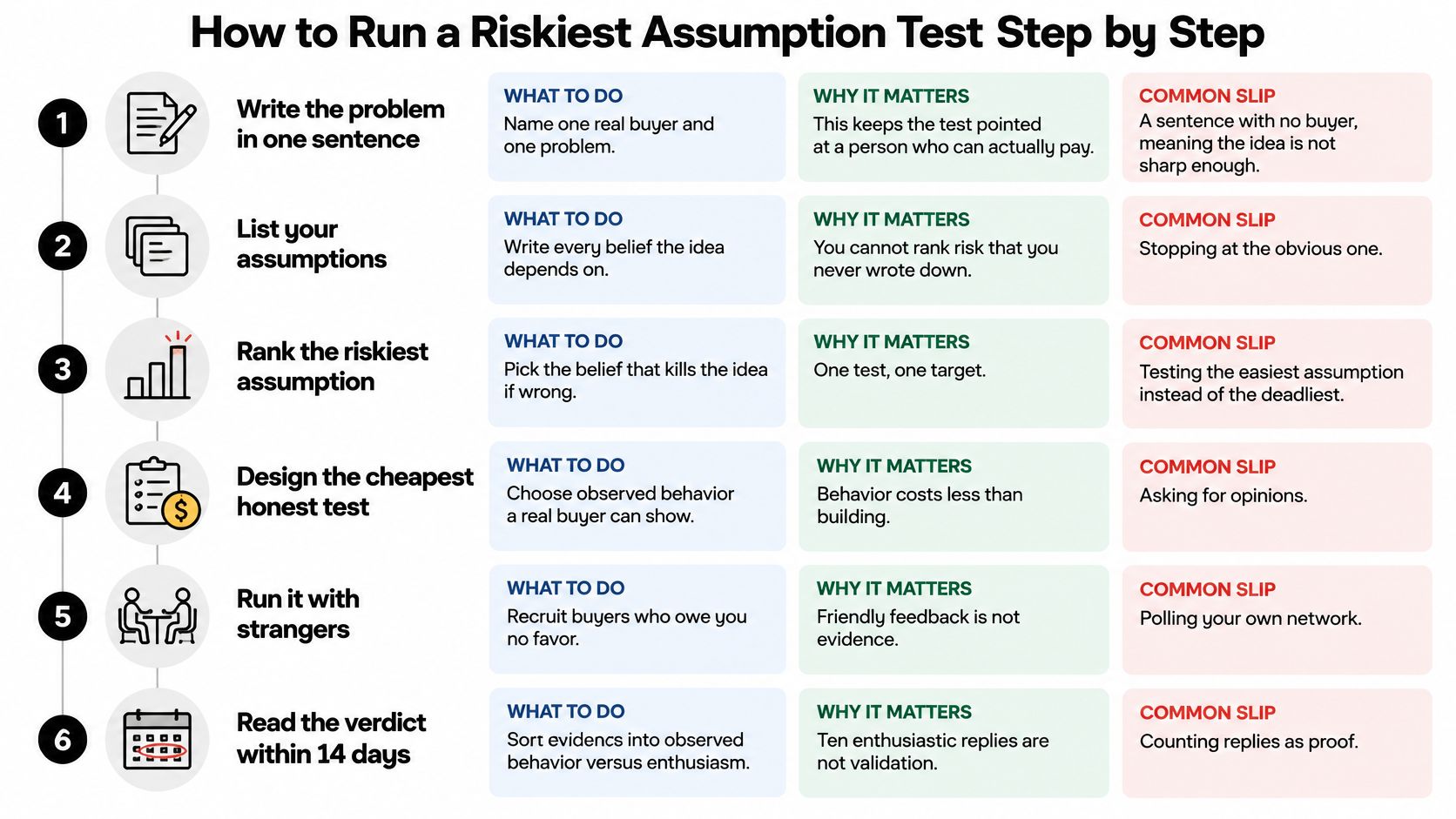
The eight steps
- Write the problem in one sentence with a real buyer. Not "small teams struggle with scheduling" but "office managers at dental practices rebuild the same roster by hand every Friday." If you can't name the buyer and the moment, the idea isn't sharp enough to test yet.
- List every belief the idea depends on, including who the buyer is, how often the problem occurs, who signs the payment, and whether buyers will hand over the data the product needs to function. A rigorous pass covers desirability, usability, feasibility, viability and ethics (Mentornity customer discovery guide). The common slip is stopping at the obvious demand assumption and never writing down the data-access or payment-approval one.
- Score each belief twice: how badly the business fails if it's false, and how little evidence currently supports it. High damage plus low evidence is your target.
- Write the single question the test must answer. "Will a practice manager pay $40 a month for this?" is answerable. "Is there demand?" isn't.
- Set the pass and stop lines before you collect anything. A threshold chosen after the data lands is a negotiation with yourself, and you'll win it in whichever direction protects the work you've already done.
- Choose the cheapest test that produces behavior, not opinion. A signed letter of intent costs less than a build and tells you more than twenty compliments.
- Run it in small batches and record actions separately from words. Payments, sign-ups, tool switches, data access and warm introductions count. "They loved it" goes in a different column.
- Issue one verdict per batch: supported, weakened, unclear or replaced. If the batch is unclear, narrow the segment or rewrite the question. Averaging ambiguous answers into a maybe is how a quarter disappears.
The slip that costs the most: skipping step five. A warm conversation feels like a result, so the threshold quietly becomes "people seemed interested", and the next three months go into a product the evidence never supported.
If you'd rather watch the logic once before writing your own test, this walkthrough shows how a single assumption gets isolated and stressed.
The interview mechanics matter as much as the plan. How to run customer discovery interviews covers question wording that keeps people in the last real incident instead of the hypothetical future. Before you start, write this where you can see it: what would I have to see to abandon this?
Cheapest Tests That Still Produce Real Evidence
Validation is a ladder, not a single test. You climb in order: prove the pain exists, prove a rough solution addresses it, then prove people will exchange money or access for it. Skipping a rung is the usual reason a test produces a confident answer to the wrong question.
| Test | Best for testing | Evidence strength | Typical cost |
|---|---|---|---|
| Problem interviews | Desirability and pain frequency | Low to medium: recall and small samples limit it | Founder time only |
| Landing page with paid waitlist | Demand at a stated price | Medium: shows intent, not usage | $50-$150 of paid ads |
| Manual concierge service | Feasibility and workflow | High: real delivery to real buyers | Founder hours, no code |
| Paid pilot or pre-order | Viability and willingness to pay | Highest: money changes hands | Pilot price, with no build cost |
The limits of the cheap rungs are well documented. A customer discovery field guide from Unusual Ventures points out that interviews rest on small, non-random samples and imperfect recall, while prototype reactions measure stated interest rather than real usage, and landing-page clicks signal interest rather than retention or willingness to pay. That's not an argument against interviews. It's an argument for climbing past them before you write code.
Two setups that work
For a SaaS or digital product, the workable setup is a landing page with Stripe checkout for a paid waitlist, backed by a short paid-ad run. Visitors see the actual price and a payment form, and what you count is completed payments. Screening interviewees and collecting waitlist signups both need a form before a product exists, and Kiwiform as a Google Forms replacement gets that page live in an afternoon instead of a sprint.
For a marketplace, don't build matching logic. Broker the first deals by hand through a spreadsheet and an invoice, and watch whether either side comes back for a second transaction.
From cold ad traffic, 4%+ to email capture is the number that says your offer is legible to strangers. Well below that, the problem is the offer or the audience, not the page design.
A test that produces sign-ups but no payment, no data access and no follow-up commitment has produced interest, not evidence.
The rule I'd hold to: if the behavior you asked for didn't happen, mark the assumption unresolved, not validated, and design the next test against the specific risk that remains.
Pass and Fail Thresholds to Set Before You Test
Ranking assumptions is the easy half. The half that decides whether you learn anything is the decision rule, and it's usually missing. Guidance on validation tends to say rank by impact and uncertainty, then run interviews, a landing page or an MVP, without specifying how much evidence is enough or when to reject the idea outright (startup validation checklist). Leave that blank and optimism fills it.
A test is only a test if four things are written down first: the observable behavior, the minimum sample, the success threshold and the stop rule. Here are the numbers I'd use.
| Idea type | Minimum sample or action | Pass signal | Stop signal |
|---|---|---|---|
| SaaS or digital product | 10 strangers within 14 days | 10 strangers paying anything | Fewer than 10 paying after 14 days |
| Marketplace | First 10-20 buyers and sellers matched by hand | 5 paid matched transactions | Fewer than 5 paid after manual matching |
| Cold traffic to a landing page | 200-500 visits from strangers | 1%+ paid waitlist at the real price | Under 1% paid waitlist after 200-500 visits |
| Physical product | Shopify or Kickstarter page at the real price plus $100-$300 of paid traffic | Pre-orders at the real price from strangers | No pre-orders from anyone outside your network |
When the sample is too small to read
The physical product row is the one where I'd argue for setting your own number before you spend the traffic budget, because the honest pre-order threshold depends on your unit margin. Write the number down anyway. A row left blank becomes a feeling.
The general warning is the one that saves quarters: a low-cost test with ambiguous results can delay a necessary pivot. Cheapest isn't automatically best, and a shrug in week three is more expensive than a clear no.
Write the stop line first. It's the only line you'll be tempted to renegotiate while staring at results.
Two hundred visits and a paid conversion rate just under 1% is not a pass with "promising early signals" attached. Under the threshold is under the threshold.
Test Next When the Pain Is Real but Nobody Commits
The result that stalls teams isn't a flat no. It's a warm yes with no movement: the buyer describes the problem in vivid detail, agrees it costs hours every week, and then doesn't answer your email about a pilot.
At that point more features tell you nothing. You need to work out which of four things is failing.
- Do they experience the problem at all, or are they repeating a complaint they heard from someone else in the industry?
- Is it frequent and expensive enough to prioritize, against the twenty other items on their list this quarter?
- Can the person you're speaking to approve payment, or are you testing with an enthusiast who has no budget authority?
- Is their current workaround good enough, which is a much higher bar than "bad"?
The shutdown record supports taking timing and economics as seriously as demand. CB Insights examined 431 venture-backed companies that shut down since 2023 and found bad timing in 29% of cases and unsustainable unit economics in 19% (CB Insights startup failure research). Those categories overlap, so don't add them up. The point is that demand alone doesn't explain why companies stop.
What to test next
The next test should be a transaction, not another opinion survey. Ask a named buyer to pay a deposit for a manually delivered version, or to replace one step of their current process with yours for two weeks and tell you what breaks.
Say a team confirms that dispatchers lose twenty minutes every shift rebuilding a route sheet, and then discovers the decision sits with a procurement office that won't approve a pilot until next fiscal year. The next test is a timing check: find a buyer with an approved budget line this quarter, or get a named decision date in writing. Shipping the feature faster changes nothing about that.
Price deserves its own separate test rather than a piggyback question inside a demand interview. What willingness to pay actually looks like in evidence covers how to ask for a number instead of a reaction.
Read the Verdict and Decide Within 14 Days
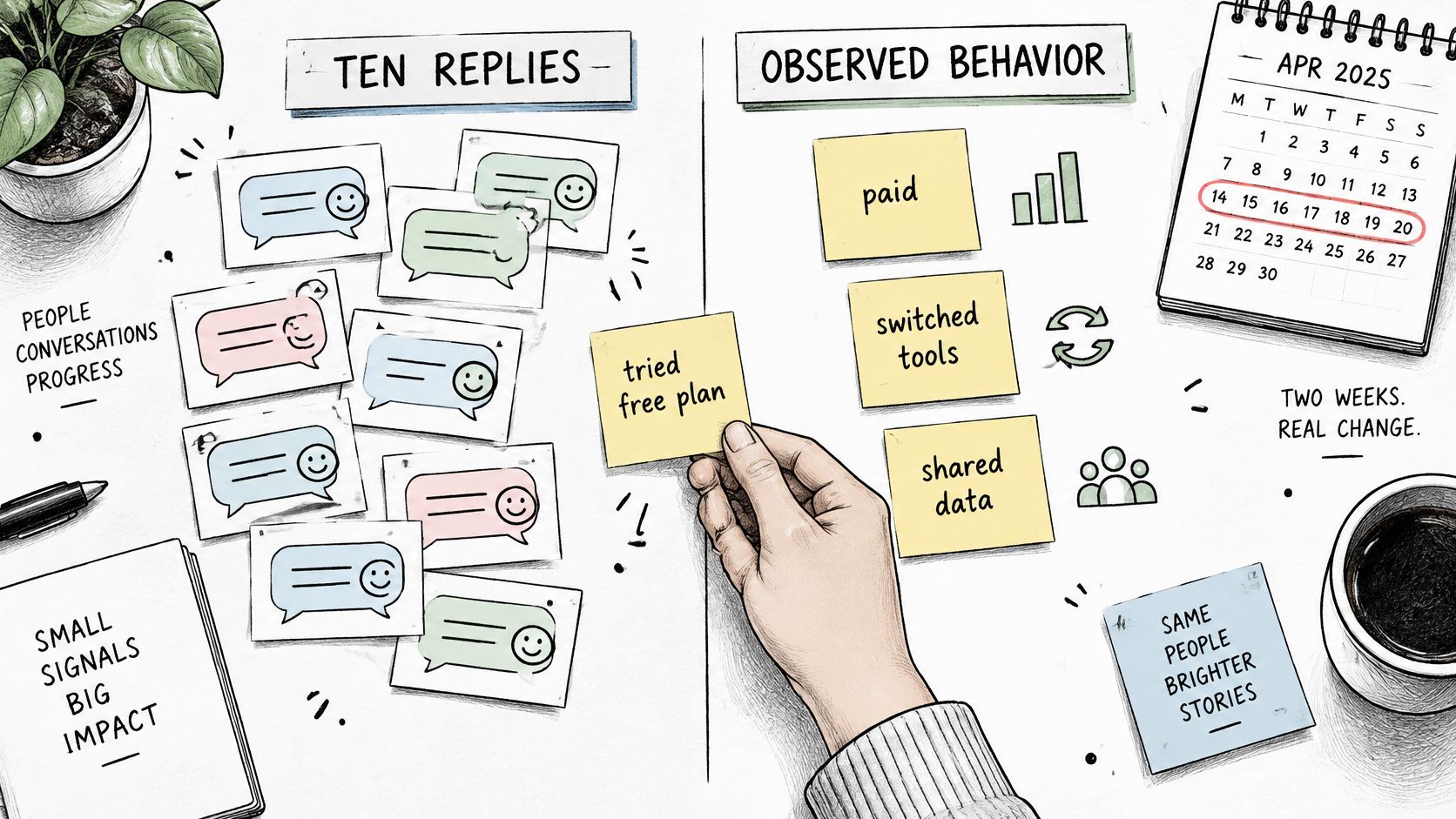
Ten enthusiastic replies are not validation. Neither are forty. The evidence that counts is behavior a stranger chose to perform with you out of the room: paying, switching tools, granting access to real data, finishing a task, or introducing you to whoever controls the budget.
Sort every batch into two columns, observed behavior and enthusiasm, and read only the left one. A strong signal is a stranger handing over money or a work email. Likes don't count.
What each verdict commits you to
| Verdict | What it means | Next move |
|---|---|---|
| Supported | Behavior crossed the pass line | Build, with the buyer named |
| Weakened | Fell short, but the segment still responded | Iterate on one variable: price, segment or channel |
| Unclear | Sample too small or answers conflict | Narrow the segment or rewrite the question |
| Replaced | A different assumption now carries the risk | Test it next, or move on if it has repeatedly stopped |
A batch that doesn't produce one of those four verdicts isn't a result. It's a delay. The failure mode you're trying to avoid is documented: post-mortem evidence indicates poor product-market fit accounted for about 43% of recent VC-backed shutdowns, with many of those companies failing before they found a market at all (how to tell a real market from an interesting problem). That ending rarely arrives as one dramatic moment.
The note on the desk below is the shape of a useful verdict. Something was built, something was observed, and the next move is already written.
Put a clock on it. Make the call within 14 days: build, iterate on one variable, or move on. One variable, because changing price, segment and channel in the same batch teaches you nothing about which one mattered.
The budget discipline matters too. Validating a SaaS, physical, marketplace, consumer or course idea should take under two weeks and less than $200, and spending more than $500 on validation usually means you're avoiding the harder part, which is talking to people. If you need fresh problems to test, Find Startup Idea collects pain points from Hacker News and Reddit as raw starting material.
Before the week ends, write one sentence that names the buyer and the next riskiest assumption, and put it where you'll see it tomorrow.
A verdict is only as good as the behavior behind it.
Find Startup Idea starts where validation starts, with real problems people are already describing on Hacker News and Reddit, so you're not inventing a buyer to test at midnight. Each idea gives you the framing to write your first assumption in one sentence, set a pass line and a stop line, and run a two-week test with strangers before you build anything. Go to Find Startup Idea and pick a problem worth testing this week.